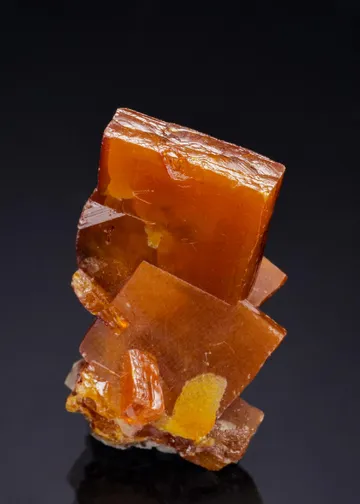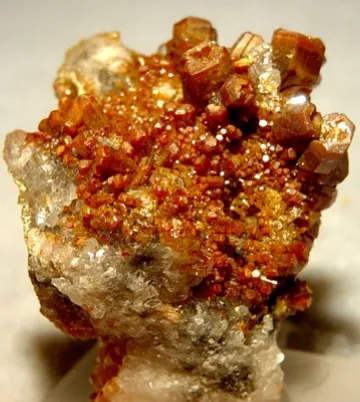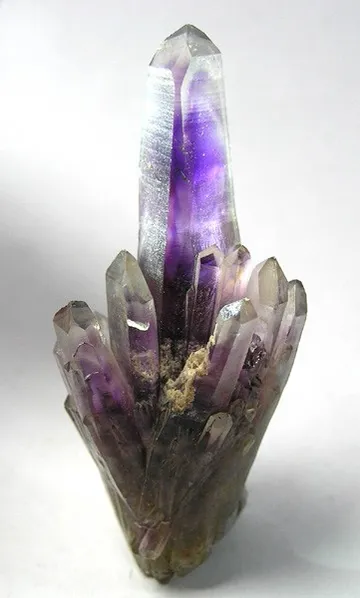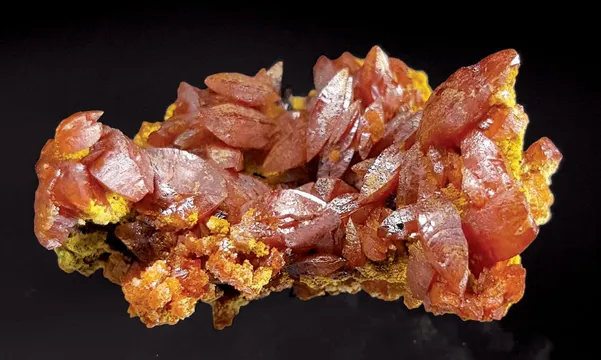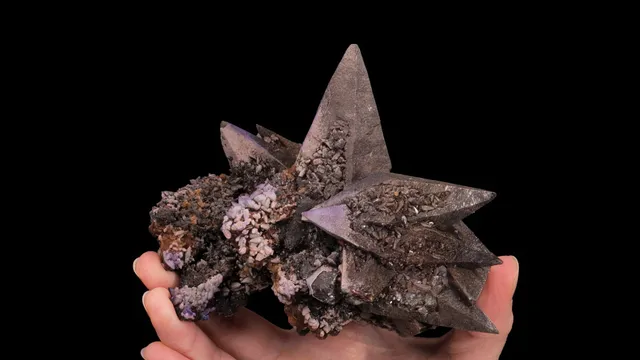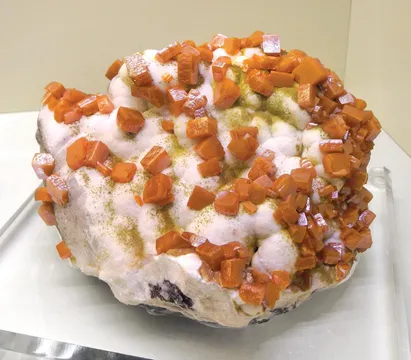
Erupción Mine, Mexico — famous for orange wulfenite crystals on calcite in a historic carbonate-hosted oxidized deposit, prized by collectors for its diverse m…
Key facts
Erupción Mine is the collector’s name attached to one of Mexico’s great oxidized lead-zinc-silver systems: the Erupción-Ahumada mine complex in the Sierra de Los Lamentos, Ahumada Municipality, Chihuahua. Its fame rests above all on wulfenite—thick, lustrous orange to caramel Pb(MoO4) crystals in sculptural groups—but the deposit is not a one-mineral curiosity. It is a carbonate-hosted manto in Cretaceous limestone whose original galena-sphalerite ore was profoundly oxidized, producing a distinctive suite of anglesite, cerussite, calcite, gypsum, sulphur, hydrozincite, willemite, vanadinite, descloizite, and wulfenite. The best specimens have a look that is instantly recognizable: chunky square orange plates or pseudo-cubic crystals, sometimes layered in “sandwich” color zones, perched on white calcite or muted brown-green vanadate-rich matrix.
Regional View
Country View
The locality’s importance is both geological and historical. Geologically, it is a classic northern Mexican carbonate-replacement deposit: ore followed a shallowly dipping reefal limestone bed, and later supergene oxidation reorganized lead, zinc, molybdenum, vanadium, arsenic, sulfate, carbonate, and silica into the specimen assemblage collectors now prize. Historically, Los Lamentos was a major oxidized lead producer in the early twentieth century, and specimen mining continued intermittently long after ore mining ceased. The deepest and most coveted wulfenite-bearing zones were around the lower Ahumada workings near the 700-foot level, where the orange crystals improved in size, luster, and color as vanadinite and descloizite became less smothering.

Photo: Wikimedia Commons
The name “Los Lamentos” gives the locality a romance beyond its mineralogy. The Sierra de Los Lamentos—“the lamentations”—was named for the eerie moaning and shrieking produced when wind moves through cracks and cavities in the limestone crest above the mine. That same cavernous limestone architecture matters to collectors: openings, replacement textures, friable oxidized ore, and calcite webs helped create pockets where wulfenite crystals grew free enough to become display specimens rather than just ore minerals.
Search for specimens: View all specimens from Erupción Mine, Mexico
The Erupción Mine lies in the Los Lamentos Mountains of northern Chihuahua, east of Villa Ahumada and south-southeast of El Paso. In specimen labels the locality appears under several overlapping names: Erupción Mine, Ahumada Mine, Erupción-Ahumada Mine, Los Lamentos, or simply “Los Lamentos, Chihuahua.” For collectors, the distinction is not pedantry. The upper workings historically associated with Erupción are best known for anglesite, cerussite, gypsum, and sulphur; the lower Ahumada ground produced the celebrated wulfenite. Many old labels collapse the whole connected mine system into “Erupción,” but the finest wulfenites are more precisely from the Ahumada portion of the Erupción-Ahumada system.
The deposit is a single manto hosted by a shallowly dipping reefal limestone bed correlated with the Lower Cretaceous Finlay Formation. The manto averaged about 15 meters high, 20 to 30 meters wide, and roughly 1,500 meters long down dip. Primary mineralization was chiefly massive galena and sphalerite, with silver values in the lead ore. Oxidation converted much of that sulfide body into anglesite, cerussite, hydrozincite, willemite, iron oxides, sulphur, gypsum, vanadinite, descloizite, and wulfenite. The zinc-rich secondary minerals tend to occur as vein fillings and replacement masses in limestone beneath the main manto, reflecting leaching and redeposition downward from the oxidized orebody.
The mine was developed on a steep, tiered underground system: levels on roughly 100-foot intervals from the adit level down to the 800-foot level, an internal decline, and a deep shaft. The manto was mined from the surface to the 700-foot level; high-grade oxide ore was known below that, but water inflow defeated the pumping technology of the period. The 800-foot drift did not successfully reach the orebody, leaving the deepest oxidized zones incompletely exploited. For specimen collectors, that matters because wulfenite quality improved with depth: the best zones were reported just above and on the 700-foot level, and some of the finest material came from partially flooded workings at Los Baños, “The Baths.”
Mining began as a modern desert mining venture rather than as a colonial Spanish working. The Erupción claim was located in the early twentieth century, and David Bruce Smith became central to its development after examining the ground and later optioning claims. Early ore shipments were made by wagon to Villa Ahumada, and by the 1920s the Ahumada mine had become a notable producer of oxidized lead ore. Water was both a resource and an enemy: scarce at the surface, then overwhelming underground once the mine reached the lower levels. Large-scale ore production ended after water inflow and pumping costs made continued operation impractical.
Specimen production followed a different rhythm. During ore mining, much good wulfenite must have gone to the smelter or been broken underground. Collectors and dealers increasingly recognized the specimens through the mid-twentieth century. Production was strongest from older workings and dumps from the 1920s into the early 1960s, with later recoveries in 1968, 1976, and the early 1980s during exploration and mine rehabilitation. In the 1950s and 1960s, wulfenite was abundant enough in some stopes that a full-time collector reportedly worked alongside miners to save crystals from friable oxidized ore.
The key mineralogical boundary is around the 500-foot level. Above it, the specimen suite is dominated by anglesite and related lead oxidation products in sulphur and gypsum-rich matrix. Below it, wulfenite and vanadinite appear in quantity. Between about the 500- and 650-foot levels, vanadinite and descloizite commonly coat, overgrow, or replace wulfenite, making attractive but often darker and busier combination specimens. Approaching the 700-foot level, these vanadate coatings separate more cleanly from the wulfenite, and the wulfenite improves: larger crystals, better orange to red-orange color, stronger luster, and more open display.
Collecting access today should be treated as private, hazardous, and not a casual field opportunity. The underground workings are old, extensive, water-affected, and partly collapsed; historic specimen recovery required permission and often local assistance. For most collectors now, Erupción is a marketplace locality rather than a destination to visit. The real work is connoisseurship: reading labels carefully, understanding whether a piece is an upper-level anglesite/sulphur specimen or lower-level wulfenite-zone specimen, and recognizing the difference between common broken orange plates and a sharp, lustrous, well-composed Los Lamentos classic.
Wulfenite from Erupción is the locality’s signature mineral and one of the defining Mexican wulfenite styles: thick tabular to blocky orange, caramel, butterscotch, red-orange, or yellow-orange crystals, often much stouter than the wafer-thin “windowpane” habit of many other localities. Crystals commonly range from several millimeters to around 1 or 2 cm, with exceptional display crystals larger; the best groups sit upright in sculptural clusters rather than lying flat against the matrix. Associations are usually white to cream calcite, oxidized limestone, vanadinite, arsenic-bearing vanadinite, descloizite, dolomite, quartz, limonite, and locally willemite. The finest material is tied to the lower Ahumada wulfenite zone near the 700-foot level and Los Baños, where size, luster, and saturated orange color improved as vanadinite and descloizite became less smothering. Superior pieces show sharp square outlines, bright vitreous to resinous luster, minimal edge bruising, strong color zoning or “sandwich” character, and a balanced matrix contrast; ordinary pieces are more crowded, iron-stained, heavily coated, chipped, or visually flat.
Calcite at Erupción is usually valued as the stage on which the wulfenite performs: white to cream granular, drusy, rhombohedral, or massive calcite matrix that sets off orange wulfenite with the classic Los Lamentos color contrast. In the orebody, calcite occurred as webs, fins, veinlets, and pocket linings within the friable cerussite-rich manto, and miners sometimes had to blast calcite ribs that held the oxidized ore together. Collector-grade calcite specimens from the locality are most desirable when the calcite is clean, bright, and architecturally supportive, especially when it carries sharp wulfenite or vanadinite without overwhelming them. Some calcite-bearing pieces fluoresce under ultraviolet light, and specimens with strong white calcite, undamaged orange wulfenite, and minor vanadinite or descloizite are far more appealing than dull, stained, friable matrix with broken plates.
Vanadinite from Erupción is an essential part of the wulfenite-zone story rather than merely a secondary accessory. It occurs as red-brown, brown, tan, orange-brown, or arsenic-bearing vanadinite—traditionally called endlichite—on calcite, quartz, dolomite, descloizite, and especially wulfenite. In the upper part of the wulfenite zone, roughly between the 500- and 650-foot levels, vanadinite is abundant and can coat wulfenite crystals, form crusts over them, or replace them as pseudomorphs and epimorphs, sometimes leaving vanadinite shells around wulfenite-shaped voids. The most desirable vanadinite-associated pieces keep a readable wulfenite form beneath or beside the vanadinite, with sparkle, color contrast, and visible crystal texture; less attractive examples are muddy, opaque, overly encrusted masses in which the original crystal geometry is obscured.
Descloizite at Erupción is most familiar as dark brown, olive-brown, golden-brown, or nearly black microcrystalline crusts and sparkling coatings in the vanadate-rich portion of the wulfenite zone. It is closely associated with wulfenite, vanadinite, arsenic-bearing vanadinite, calcite, quartz, dolomite, limonite, and, more rarely, willemite. Between the 500- and 650-foot levels, descloizite and vanadinite can be very abundant on wulfenite, producing the darker, more textured Los Lamentos combinations that some collectors prize for paragenesis rather than pure color. Good descloizite pieces from this locality show lively microcrystal sparkle, clear contrast with orange wulfenite or pale calcite, and recognizable crystal architecture; ordinary ones are visually muddy, heavily oxidized, or present merely as brown crust with little definition.
Anglesite belongs chiefly to the upper Erupción portion of the mine, above the main wulfenite zone, where oxidized lead ore occurred with gypsum, sulphur, cerussite, and plumbojarosite. Much of the anglesite was mined as ore rather than preserved as specimens, so good examples are far scarcer in collections than wulfenite despite the mineral’s importance in the deposit. Typical anglesite is tan, translucent, etched, granular, crusty, or rough-crystalline, commonly around the centimeter scale, but large tabular crystals exceeding 5 or 6 cm have been documented, sometimes embedded in gypsum or sulphur. The best Erupción anglesites are historic upper-level pieces with clear crystal form, translucent luster, and convincing sulphur or gypsum matrix; ordinary material is dull, abraded, or too ore-like to carry much display value.
Willemite from Erupción is a much rarer collector association than wulfenite, calcite, or vanadinite, occurring as secondary Zn2SiO4 in the oxidized zinc-bearing parts of the system, commonly beneath or marginal to the main lead manto where zinc was leached and redeposited. It appears on specimens as pale, white, grayish, or botryoidal to microcrystalline aggregates associated with wulfenite, calcite, vanadinite, descloizite, and oxidized matrix; the appeal is as much paragenetic as aesthetic. Good examples are those in which willemite is visible, clean, and identified with confidence, ideally carrying sharp orange wulfenite or showing ultraviolet response; lesser pieces can be difficult to distinguish visually from pale calcite, hydrozincite, or other white secondary coatings without context or testing. Because willemite is documented but not abundant from Los Lamentos, well-labeled wulfenite-with-willemite specimens have a rarity premium over similar calcite-only pieces.
Other documented minerals from Erupción include baryte, brochantite, cerussite, chalcopyrite, chlorargyrite, dolomite, galena, goethite, gypsum, hematite, hemimorphite, hydrozincite, limonite, plumbojarosite, pyrite, pyromorphite, quartz, sphalerite, sulphur, and arsenic-bearing vanadinite. No valid mineral species appears to have Erupción Mine as its type locality, but the locality is mineralogically rich in rarities of association: vanadinite shells and replacements after wulfenite, hemimorphite after wulfenite with vanadinite overgrowths, sulphur-gypsum-anglesite upper-zone pieces, and occasional willemite-bearing wulfenite combinations. These are not always the most colorful specimens, but they are the pieces that reward close label reading and paragenetic curiosity.
The first collecting concern is condition. Wulfenite is soft, brittle, and relatively dense, and even the thick Los Lamentos crystals chip at corners and edges. Minor peripheral bruising is common on older pieces, especially those collected from friable oxidized ore or transported long before modern specimen preparation standards. The crucial inspection points are the main display crystals: look for nicks on the leading edge, rehealed-looking but actually broken corners, missing plates at the front, and cracks through thick blocky crystals. Bright luster and clean terminations matter more than sheer number of crystals.
Mislabelling is more common than outright fakery. “Los Lamentos,” “Erupción,” “Ahumada,” and “Erupción-Ahumada” have all been used, sometimes interchangeably. For wulfenite, a lower Ahumada attribution is usually more precise, while upper-level anglesite specimens are more properly tied to the Erupción workings. A label reading “Los Lamentos Mine” can be ambiguous because Los Lamentos is also the district and mountain range name, not just a single mine identity. Old labels from well-known dealers or collections are worth preserving even when the geographic wording is imprecise, because they often establish pre-market history.
No widely recognized, locality-specific fake style is documented for Erupción in the standard collector literature. Still, wulfenite in general invites caution: orange glass, dyed or altered carbonate, glued assemblies, and crystals added to unrelated matrix are all possibilities in the broader market. A convincing Erupción specimen should have a plausible matrix and association—calcite, oxidized limestone, vanadinite, descloizite, dolomite, quartz, willemite, hydrozincite, or iron oxides—with natural contact relationships. Suspicious signs include crystals sitting on glue-like pads, no penetration into the matrix, implausibly uniform color and thickness, and a matrix texture unlike carbonate-replacement ore.
Cleaning should be conservative. Avoid acids: calcite and carbonate matrix will react, and delicate vanadate or oxide coatings can be damaged. Avoid ultrasonic cleaners and stiff brushes; even thick wulfenite plates can chip or detach. Dust with air or a very soft brush, handle specimens by the matrix, and pack them so individual crystals cannot vibrate against foam or harder minerals. Wulfenite itself is not a special toxic-handling problem under normal collection use, but it contains lead; wash hands after handling, do not grind or generate dust, and keep small loose fragments away from children and pets.
Fluorescence is worth checking but not the main basis for value. Calcite on some Los Lamentos specimens fluoresces under longwave and/or shortwave ultraviolet light, and willemite-bearing pieces may show useful shortwave response. Wulfenite is not usually bought for fluorescence, and any glow seen on mixed specimens may be from calcite or willemite illuminating the orange crystals. If a specimen is sold as willemite-bearing, ultraviolet response and clear documentation are valuable, because pale willemite coatings can resemble other white secondary minerals.
Market availability is healthy at the small and medium end because the mine produced many specimens over decades. Modest miniatures and small cabinet pieces appear regularly, often as orange wulfenite on calcite or darker wulfenite with vanadinite/descloizite coatings. The supply of truly fine pieces is much thinner: sharp, lustrous, saturated orange to red-orange wulfenite groups with minimal damage, strong three-dimensional composition, good old provenance, or rare associations command a substantial premium. Large cabinet specimens with clean, thick crystals from old collections are classic Mexican display pieces and should be evaluated with the same seriousness as better Mapimí, San Francisco, or Tsumeb wulfenites.
Los Lamentos has a hard desert origin story rather than the familiar tale of a Spanish colonial “antigua.” David Bruce Smith came to the limestone hills after years in Chihuahua mining, examining what looked from the plain like islands in a desert sea. The early Erupción working showed high-grade lead carbonate in a shallow hole, but the prospect was remote, dry, and politically dangerous. In 1916 Smith optioned the Erupción claim for $50,000 and the adjacent Labrador claim for $100,000. The figures alone would have been bold; the setting made them audacious. For two years, camp water had to be hauled from a spring 16 miles away, and the district was troubled by revolutionary banditry.
Smith’s solution to danger was part geology, part frontier reconnaissance. From high ground he watched the surrounding dusty plain through a telescope, looking for riders before they reached the mine. More than once he escaped by making what he called a “quick get-away.” In October 1918, Pancho Villa’s men finally caught Smith and E. F. Knotts, president of the Erupción company. The captives were held for twelve days while ransom was negotiated. Villa ultimately demanded $20,000 in gold, and C. L. Baker of the American Smelting & Refining Company advanced the money against ore receipts. After payment, Villa reportedly gave his word to protect the operation, and the bandit trouble ended.
The desert denied water at the surface and then delivered too much underground. Early camp water came from miles away; later, the deep workings met the regional water table. The best oxidized ore and the best wulfenite continued downward, but water inflow made the lower mine expensive and difficult to keep open. This is the great unresolved fact behind Los Lamentos collecting: the classic orange crystals were not exhausted in a tidy geological sense. The best zone simply ran into water, and below the old workings the manto may still preserve pockets that were never seen by collectors.
The collector stories from the 1940s have the flavor of another era. Louis Vance and Earl Calvert reached the mine in 1949 with a guide named Gómez after crossing 50 miles of desert road from Villa Ahumada. Their supplies included 10 gallons of water and “a couple of sticks of dynamite, just in case.” At the abandoned camp they slept in an adobe office furnished with a desk, three chairs, an iron safe, and old mine paperwork still hanging on wall spindles. The settlement had once been greened by mine water—cornfields and gardens in the desert—but by then the roof timbers had been stripped away because wood was too valuable to leave in empty buildings.
Underground, the distances were memorable: a 1,500-foot horizontal tunnel, then thousands of feet down an incline toward the lower levels. Vance found wulfenite widely present but not automatically good—too small, too stained, too ordinary—until better pockets appeared. Some specimens could be lifted from the friable ore; others had to be pried from intergrown masses where wulfenite, calcite, and oxidized matrix locked together. The ascent was the punishment. The incline was steep enough that Vance compared it to “walking up stairs without any stairs,” and the Mexican miners eventually had to come back down to help the exhausted collectors haul their sacks.
J. David Lowell, later one of the most successful exploration geologists of the twentieth century, also remembered Los Lamentos from his youth. In 1946, he and Dan Mayers went underground looking for cubical wulfenite and red vanadinite. They boarded with an old couple in an adobe house with a dirt floor, two pigs in residence, and two well-used homemade canvas cots. A cheerful twenty-year-old guide named José appeared after word spread that they needed help. Lowell recalled looking for escape routes and dangerous “heavy ground,” watching for trickles of sand, pebble-sized rock, and old timbers groaning under strain. “Some old mines are deathly quiet,” he wrote, but Los Lamentos was noisy and spooky.
One of the most striking mid-century accounts is not of a pocket underground but of specimens surfacing through local hands. Gerry Blair’s 1970 story in Villa Ahumada led him to a butcher named García, who reached under the counter and produced excellent wulfenites: one on white limestone with yellow crystals and another a hollow dome of deep orange intergrown crystals. Benny Fenn later recalled collecting about 2,000 pounds—roughly 400 flats—of good wulfenite around 1969–1970. For several months, the floor of his barn in Colonia Juárez was covered with what he remembered as “the most fantastic wulfenite you could imagine.”
The last great collecting chapter belongs to Los Baños, the partly flooded lower area near the 700-foot level. Early 1980s exploration and dewatering reopened access long enough for collectors to recover important specimens from the deepest wulfenite zone, but rising water again ended the opportunity. Drill logs reportedly showed cerussite carrying substantial wulfenite between the 700- and 800-foot levels and below. That is why Los Lamentos still feels unfinished: its most famous crystals are historic, but the geological system that made them probably continued past the practical limit of the old mine.
Wilson, Wendell E. “Famous Mineral Localities: The Erupción/Ahumada Mine, Los Lamentos District, Chihuahua, Mexico.” The Mineralogical Record, Vol. 34, No. 6, 2003, pp. 5–31. The essential modern collector article on the mine, with history, geology, levels, specimen production, and mineral descriptions.
Wilson, Wendell E. “Famous Mineral Localities: Los Lamentos, Chihuahua, Mexico.” The Mineralogical Record, Vol. 11, No. 5, 1980, pp. 277–286. The earlier foundational collector treatment, widely cited for Erupción/Ahumada species records.
Foshag, William F. “The Ore Deposits of Los Lamentos, Chihuahua, Mexico.” Economic Geology, Vol. 29, No. 4, 1934, pp. 330–345. Classic technical description of the ore deposit, including mapped and cross-sectioned geology.
Rickard, T. A. “The Ahumada Lead Mine and the Ore Deposits of the Los Lamentos Range, in Mexico.” Engineering and Mining Journal-Press, Vol. 118, No. 10, September 6, 1924, pp. 365–374. Period mining account with early development history, access, geography, ore shipment, and the Pancho Villa ransom episode.
Megaw, Peter K. M.; Ruiz, Joaquin; Titley, Spencer R. “High-temperature, carbonate-hosted Ag-Pb-Zn(Cu) deposits of northern Mexico.” Economic Geology, Vol. 83, No. 8, 1988, pp. 1856–1885. Regional framework for the northern Mexican carbonate-replacement province to which Los Lamentos belongs.
Alvarez, A.; Giles, D. A. “Los Lamentos lead-silver mine, Chihuahua,” in Lead-Zinc-Silver Carbonate-hosted Deposits of Northern Mexico, Society of Economic Geologists Guidebook, 1986. Field-guide reference cited in the Mindat locality bibliography for the deposit.
Moore, Thomas P. “Connoisseur’s Choice: Duftite after Wulfenite, Tsumeb Mine, Namibia.” Rocks & Minerals, Vol. 94, No. 1, 2019, pp. 40–59. Includes comparative discussion of Erupción wulfenite replacements and epimorphs, including vanadinite after wulfenite and hemimorphite after wulfenite with vanadinite.
Australian Museum specimen D.50729, Wulfenite, Sierra de Los Lamentos, Chihuahua, Mexico, Albert Chapman Collection. Museum record for a large Los Lamentos wulfenite specimen registered in 1996, with provenance through Al McGuiness and Cliff Krueger.
“Wulfenite with Vanadinite (variety endlichite) from Erupción Mine (Ahumada Mine), Los Lamentos Mountain Range, Mexico” — Fabre Minerals, Vimeo. Rotating specimen video of thick tabular wulfenite on matrix with arsenic-bearing vanadinite, from an important European collection.
“IRB1792 Wulfenite, Erupcion mine, Mexico” — Crystal Classics, Vimeo. Short dealer video showing the three-dimensional habit and luster of a Los Lamentos wulfenite specimen.
Wikimedia Commons category: Minerals of Los Lamentos Mts. Open image repository with wulfenite, calcite, vanadinite, dolomite, baryte, and associated Los Lamentos specimens.
Mindat: Erupción Mine, Los Lamentos Mountains, Ahumada Municipality, Chihuahua, Mexico — Essential locality page with coordinates, alternate names, geology, mine levels, mineral list, references, and photo gallery.
Mindat: Erupción Mine printable/locality data page — Text-rich version of the same locality record, especially useful for geology, mine workings, mineral list, and historical notes.
Mindat: Descloizite from Erupción Mine — Species-specific occurrence page showing associated minerals and photo-data relationships for descloizite at the locality.
Mindat: Wulfenite, Vanadinite, Descloizite specimen TW3-U46 — Example of candy-like wulfenite partly coated by arsenic-bearing vanadinite and descloizite.
The Mineralogical Record digital back issue, Mexico III, Vol. 34 No. 6 — Source for Wilson’s major 2003 Erupción/Ahumada locality article.
USGS National Geologic Map Database: Foshag 1934 bibliographic record — Independent bibliographic record for the classic Economic Geology paper on the ore deposits.
Engineering and Mining Journal-Press, September 6, 1924 — Digitized issue containing Rickard’s period article on Ahumada and Los Lamentos.
University of Arizona profile: Megaw, Ruiz, and Titley 1988 — Regional geological context for high-temperature carbonate-hosted Ag-Pb-Zn(Cu) deposits of northern Mexico.
Australian Museum: Wulfenite, Los Lamentos, Albert Chapman Collection — Museum specimen page with size, collection number, provenance, and photograph.
Wikimedia Commons: Wulfenite-24637.jpg — Rob Lavinsky photograph of thick orange Los Lamentos wulfenite crystals.
Wikimedia Commons: Wulfenite, Vanadinite, Calcite specimen — Classic wulfenite, arsenic-bearing vanadinite, and calcite combination from Erupción/Ahumada.
Wikimedia Commons: Wulfenite, Vanadinite, Dolomite specimen — High-resolution image of wulfenite with vanadinite and dolomite from the mine.