A collector's guide to Naica Mine, Mexico: its geology, mining history and notable minerals, illustrated with the 52 specimens documented from this locality on EarthWonders.
Key facts
Naica is one of the great paradoxes of mineral collecting: an industrial lead-zinc-silver mine whose most famous “specimens” are too large, too dangerous, and too protected to be collectible. In the Sierra de Naica of central Chihuahua, hydrothermal fluids used Cretaceous limestone, faults, fractures, dikes, sills, skarn fronts, mantos, and chimney-like replacement bodies as plumbing. The result was a vigorous carbonate-replacement and skarn-related ore system, mined for Pb-Zn-Ag, that also produced the Naica look collectors recognize instantly: pale green to colorless fluorite, lustrous calcite, pyrite, galena, sphalerite, quartz, chalcopyrite, and sculptural sprays of pale blue-white anhydrite.
The mine’s fame rests on two overlapping legacies. For ore geologists, Naica is a classic chimney-manto limestone-replacement system with high-temperature saline hydrothermal fluids and progressive zoning from copper-bearing skarn to zinc-lead-silver sulfide bodies. For the wider public, it is the home of the Cueva de las Espadas and Cueva de los Cristales, the celebrated gypsum caverns where selenite formed not as cabinet-size crystals, but as beams measured in meters. For collectors, Naica sits between those worlds: the same ore system that fed the great caves also opened vugs and breccia cavities where collectible sulfides and gangue minerals grew freely, often with a clarity and geometry that feel unusually refined for a base-metal mine.
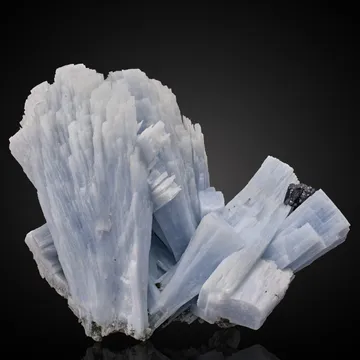
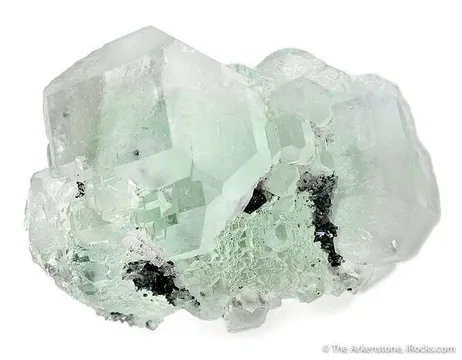
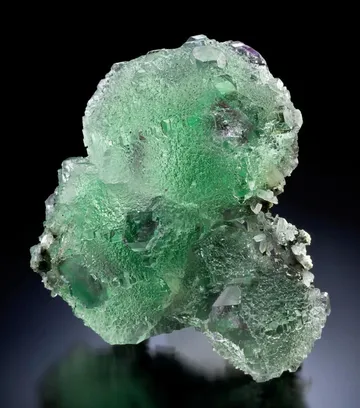
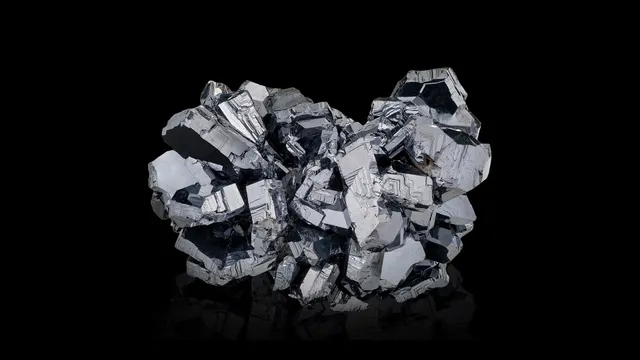
The best Naica cabinet pieces have a cool, understated elegance. Fluorite is commonly very pale green or nearly colorless, with modified cubes, octahedral tendencies, beveled edges, and glassy interiors, often perched against white to yellowish calcite, brassy pyrite, black sphalerite, or bright galena. Anhydrite is the locality’s other collector signature: pale blue to white, bladed to prismatic, often in sprays or sheaves, at its best dramatically set on calcite rather than removed as cleaved, loose fragments. Sulfide specimens are admired less for garish color than for balance—clean metallic galena, sharp sphalerite, and well-spaced fluorite or calcite in a coherent hydrothermal association.
Regional View
Country View

Photo: Wikimedia Commons
Naica’s giant gypsum caves are not specimen localities in the ordinary collecting sense. They are subterranean geological monuments, discovered through mining and made accessible only while pumps held back hot groundwater. The more realistic collecting story lies in older mine finds and ore-zone pockets: fluorite-calcite-sulfide combinations, matrix anhydrite, and classic gypsum from mine cavities such as the Cave of Swords and related voids, preserved in collections before modern restrictions and mine closure changed access.

Photo: Wikimedia Commons
Search for specimens: View all specimens from Naica Mine, Mexico
Naica is at Naica, Saucillo Municipality, Chihuahua, on the northern part of the Sierra de Naica, southeast of Chihuahua City. The district is developed in a northwest-southeast structural dome of Cretaceous carbonate rocks. Modern descriptions place the productive system in thick limestone of the Aurora Group, with the ore localized by major faults and fracture sets, by felsite dikes and sills, and by skarn and carbonate-replacement zones around the intrusive plumbing. A deeper igneous heat source and the Tertiary felsitic intrusions are central to the district’s history: they drove hot saline fluids through the carbonate pile and produced the Pb-Zn-Ag mineralization for which the mine was operated.
The ore bodies are chiefly mantos and chimneys rather than simple veins. This matters to collectors because vertical chimney systems can repeatedly collapse, reopen, and create breccia cavities. Those voids are where Naica’s better primary specimens grew: fluorite and calcite on sulfide matrix, galena with sphalerite and pyrite, quartz with sphalerite, and anhydrite in sharply bladed groups. The sulfide assemblage is dominated by pyrite, pyrrhotite, sphalerite, galena, and chalcopyrite, with subordinate arsenopyrite, molybdenite, bismuth sulfosalts, and other rarities. Gangue and skarn minerals include calcite, fluorite, quartz, adularia, anhydrite, gypsum, and a suite of calcium-silicate minerals such as garnet, pyroxene, amphibole, vesuvianite, and related skarn species.
The great gypsum caves are a later, chemically linked chapter in the same mountain. During late hydrothermal evolution, sulfuric acid generated by oxidation of earlier sulfides reacted with carbonate host rocks to produce calcium-sulfate-rich waters and abundant anhydrite. Where the system later stabilized just below the gypsum-anhydrite equilibrium temperature, anhydrite dissolved and gypsum precipitated very slowly. That slow, self-feeding calcium sulfate system produced the meter-scale selenite crystals of the Cave of Swords and, at greater depth, the giant beams of the Cave of Crystals.
Mining in the Naica district began as early as 1794, and formal exploitation by the Naica mining company began in 1900. Peñoles has controlled the mine since the mid-20th century, with its own current locality information listing control since 1964. Under Peñoles the mine became one of Mexico’s important lead producers, with zinc and lead concentrates and significant silver output. The operating infrastructure included an underground mine and refinery, with an installed milling capacity listed at 954,000 tonnes of ore per year before suspension. In 2014, the last full year before the flood shutdown, reported output included 711,000 tonnes milled, 1.855 million ounces of silver, 19,694 tonnes of lead, and 15,399 tonnes of zinc.
In January 2015, natural flooding affected a significant portion of the mine. After months of unsuccessful efforts to lower water levels enough for exploitation, Peñoles announced the indefinite suspension of Naica on October 13, 2015. Peñoles still lists Naica as a suspended operation, although local reporting in 2025 and 2026 described exploration and technical work aimed at evaluating a possible restart. For collectors, the practical point is unchanged: Naica is not a public collecting site. Any legitimate specimens in the market come from past mine production, older collections, authorized mine recoveries, or long-circulated dealer stock—not from casual field collecting.
Naica labels require care. The district includes older named workings such as Gibraltar, Maravillas, and Siglo XX, and historical labels may cite those names. For most post-oxide-zone primary sulfide and gangue specimens, however, “Naica Mine” is the safest and most accurate locality when no reliable, pocket-specific documentation accompanies the piece. Oxide-mineral labels are especially vulnerable to over-specific naming, because much of the collectible modern material represents sulfide-zone production consolidated under the Naica operation rather than isolated older district mines.

Photo: Wikimedia Commons
Naica fluorite is the collector’s classic from the sulfide-gangue pockets: typically very pale green to nearly colorless, but also known in bluish-purple to lavender pieces, with modified cubic and octahedral forms, beveled edges, stepped growth, phantoms, and occasionally water-clear interiors. Fine crystals range from small, sharply isolated miniatures to crystals of several centimeters, with old dealer descriptions recording highly modified transparent crystals to roughly 2.5 inches; the best pieces are not merely large, but transparent, lustrous, undamaged, and well-composed on contrasting calcite, pyrite, galena, sphalerite, or quartz. Ordinary Naica fluorite can look pale and sleepy without strong form or contrast; the desirable specimens show crisp geometry, visible internal architecture, and the unmistakable Pb-Zn-Ag mine association rather than a detached, anonymous fluorite cube.
Naica calcite is both a display species and the stage on which other Naica classics perform: white, cream, colorless, or pale yellow rhombs and scalenohedral-looking aggregates associated with fluorite, galena, sphalerite, pyrite, quartz, chalcopyrite, and anhydrite. In the caves, calcite also appears as crusts on limestone walls, locally with celestine and iron oxides, marking the evolving sulfate-carbonate chemistry of the system; in ore-zone specimens it more often provides the bright, clean contrast that makes pale fluorite or powder-blue anhydrite visible. Good Naica calcite has sharp faces, luster, and a useful architectural role in the specimen, especially when it frames fluorite or carries anhydrite blades; ordinary pieces are commoner massive or bruised gangue fragments without balance or edge preservation.
Naica anhydrite is one of the locality’s most distinctive collector minerals, occurring as pale blue, powder-blue, white, or faintly translucent prismatic blades and sheaves, commonly striated and strongly sculptural, and best when preserved on calcite or sulfide-bearing matrix. Geologically it belongs to the late hydrothermal calcium-sulfate stage and is reported from deeper mine levels below about -240 m, where it was abundant enough to feed the later gypsum-forming system by dissolution. The finest cabinet pieces show terminated, undistorted blades in radiating sprays or tight architectural groups with contrasting calcite; lesser examples are cleaved, chalky, massive, or detached blades whose softness of luster and easy cleavage make condition an immediate concern.
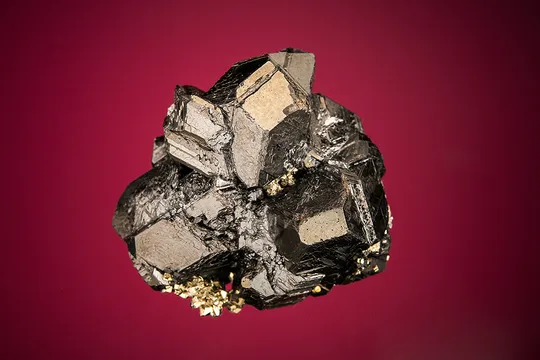
Naica galena is a primary ore mineral and a frequent component of the mine’s most satisfying fluorite-sulfide combinations, occurring as bright silvery cubes, modified octahedral forms, complex twinned crystals, and massive metallic matrix with sphalerite, pyrite, chalcopyrite, calcite, quartz, and pale fluorite. Older collector descriptions record sharp modified crystals in the centimeter range and exceptional complex groups several inches across, but most attractive modern cabinet pieces are valued less for sheer galena size than for clean metallic luster, lack of bruising, and the way galena anchors translucent fluorite or pale calcite. Good Naica galena should look like part of a high-temperature carbonate-replacement assemblage—crisp, heavy, and naturally associated—rather than a generic PbS lump with a vague Chihuahua label.
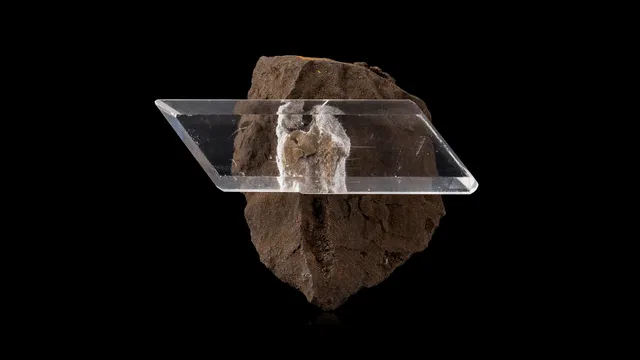
Naica gypsum is inseparable from the mine’s legend: transparent to translucent selenite from the Cave of Swords, the Cave of Crystals, Ojo de la Reina, Cueva de las Velas, and related cavities, with habits ranging from swordlike meter-scale crystals to blocky crystals and immense beamlike forms in the deepest, most famous chambers. Collectible gypsum from Naica should be understood cautiously: authentic older mine-cavity specimens and museum-preserved crystals exist, but the giant crystals of the Cave of Crystals are not a normal collecting source, and claims of freshly removed “Cave of Crystals” pieces deserve skepticism. The best legitimate pieces show clear provenance, clean selenite transparency, intact terminations, and minimal bruising; gypsum’s softness, perfect cleavage, and sensitivity to abrasion make preservation just as important as size.
Naica sphalerite is one of the principal zinc ore minerals and commonly appears as dark brown to black, lustrous crystals with fluorite, galena, calcite, quartz, pyrite, chalcopyrite, and skarn gangue. Well-formed crystals can reach cabinet significance—reports and specimen records describe sharp black crystals to several centimeters—and the best examples are bright, undamaged, well isolated, and naturally composed with pale fluorite or white calcite, where the dark zinc sulfide gives the specimen depth and contrast. Ordinary sphalerite from Naica can be massive, dull, or lost in sulfide matrix; collector-grade pieces show clean form, reflective faces, and the balanced Pb-Zn-Ag association that marks the mine’s better pockets.
Beyond the headline species, Naica has a broad documented mineral list reflecting skarn, sulfide, carbonate-replacement, cave, and post-dewatering environments. Notable ore and accessory minerals include pyrite, pyrrhotite, chalcopyrite, arsenopyrite, molybdenite, acanthite, cosalite, matildite, and kobellite-tintinaite-series material; skarn and gangue minerals include quartz, adularia, barite, celestine, actinolite, grossular-andradite garnet, hedenbergite, vesuvianite, magnetite, wollastonite, and related calcium-silicate phases. The caves have also yielded an unusually rich suite of delicate secondary and cave-environment minerals, including aragonite, celestine, clays, iron-manganese oxides, epsomite, halite, hexahydrite, kieserite, starkeyite, szmikite, szmolnokite, orientite, and woodruffite. Naica is therefore not just a fluorite-and-gypsum locality; it is a complex mineral system where ore formation, late sulfate chemistry, groundwater, heat, and dewatering each left a mineralogical overprint.
Naica specimens are common enough in old collections and dealer inventories that collectors can be selective, but the finest pieces are not abundant. Fluorite-calcite-sulfide combinations, matrix anhydrite, and aesthetic sulfide specimens remain available, while truly fine anhydrite on matrix and strongly composed fluorite with galena or sphalerite command a premium. The mine’s 2015 suspension reduced the prospect of fresh, legitimate production, although possible restart evaluation has kept the locality in the news.
The biggest authenticity issue is not synthetic material; it is locality overclaiming. “Naica” is sometimes applied loosely to district material, old named workings, generic Mexican gypsum, or pale fluorite from other localities. Labels naming Gibraltar, Maravillas, Siglo XX, Cave of Swords, or Cave of Crystals should be judged by documentation and specimen style. For most primary sulfide-zone fluorite, calcite, galena, sphalerite, and anhydrite, “Naica Mine, Naica, Saucillo Municipality, Chihuahua, Mexico” is usually the safest locality unless a credible historic label or collection record supports a more specific source.
Be especially skeptical of gypsum sold as newly collected from the Cave of Crystals. The giant crystal chamber is not a commercial collecting pocket, and the famous beams are environmental and scientific treasures rather than specimen stock. Authentic Naica selenite can come from older mine-cavity material, from historical recoveries, or from collections, but dramatic cave names are easy to abuse. A modest, well-documented Cave of Swords or Naica mine-cavity gypsum is preferable to an extravagant, unsupported “Crystal Cave” claim.
Condition matters greatly. Fluorite is vulnerable to corner bruising, cleaved edges, and hidden repairs; pale green Naica material can look deceptively clean in photographs, so examine high points and modified corners carefully. Calcite bruises and cleaves readily, and white calcite framing fluorite often carries small chips along rhomb edges. Anhydrite is more treacherous: its perfect cleavages, fibrous to bladed structure, and pale color make breaks easy to miss unless the specimen is examined under raking light. Galena may show edge dings, oxidation dulling, or contact marks; sphalerite may have chipped points and dull cleavages.
Fluorescence is not the main reason to buy Naica specimens, though fluorite may respond under ultraviolet light and calcite may fluoresce variably depending on composition. Handling is straightforward for fluorite and sulfides, but gypsum and anhydrite should be kept dry, dust-free, and away from abrasion. Avoid washing delicate anhydrite or gypsum with water; use air, a soft brush, or professional conservation methods. Store galena and other sulfides in stable humidity, and keep labels with the specimen—Naica provenance is part of the value.
In 1910, long before Naica became a global news photograph, miners broke into the Cueva de las Espadas, the Cave of Swords. It was the first great hint that the mountain did not merely contain ore, but open spaces armored with selenite. The crystals there were already startling by any normal mineralogical standard: meter-scale, transparent to translucent gypsum blades lining the chamber like weapons on a wall. For decades, those were the Naica crystals that museums and mineralogists talked about. Several examples from that cave eventually reached the Smithsonian, where the public could stand comfortably in Washington, D.C., before a piece of a place that, underground in Chihuahua, was hot enough to punish any visitor.
Then came April 2000. Miners Juan and Pedro Sánchez were driving new workings for Peñoles near the Naica fault, an area that mine officials had treated cautiously because of the ever-present risk of flooding. When the new opening broke into the chamber now famous as the Cueva de los Cristales, the scale changed from mineral specimen to architecture. The room lay about 300 m underground and held selenite beams up to roughly 11 m long and about a meter thick, some crossing the chamber like structural timbers. The miners’ own language shifted with the size: these were not merely “swords” but “vigas,” beams.
The cave looked frozen, but it was the opposite of ice. Heat from the mountain’s deep hydrothermal system made the chamber brutal. Accounts from explorers describe temperatures around 48–58 °C with extreme humidity, a combination that turns the human body’s cooling system against itself. Richard Fisher, one of the early photographers, compared stepping inside to entering a blast furnace; he said that within seconds his clothes were saturated and that after a few photographs he had to concentrate on finding the exit only 30 to 40 ft away. Without cooling suits, entry was measured in minutes, not hours.
The scientific teams that followed had to treat mineralogy like a space mission. Later expeditions used custom ice-cooled suits weighing about 45 lb, with ice compartments and respirators connected to chilled backpacks so that explorers could breathe cooled air. Even then, the margin was thin. The photographs show people in protective gear standing among great translucent beams, and the mind wants to read the scene as cold. The reality was superheated air, eyes needing protection, and a cave that could kill an unprepared person in roughly half an hour.
Naica kept revealing rooms. The Cave of Crystals turned out not to be a single marvel in isolation but part of a larger underground system with evocative names: the Cave of Swords, Ojo de la Reina, Cueva de las Velas, and later the Ice Palace. In 2009, during work on a deep ventilation shaft called the Robin Hole, a camera attached to a drill bit saw signs of another crystal-lined cavity. When a team descended later that year, they confirmed a naturally dry cave about 150 m below the surface. It did not contain the great beams of the deep chamber; instead it glittered with smaller, stranger forms, described as cauliflower-like growths and fiber-optic filaments.
The Cueva de las Velas, intercepted by a mine gallery in 2005 at the -290 m level, added a different kind of wonder. It was not simply another big-gypsum room. Mineralogists found a complex history written over the walls: earlier deposits of iron-manganese-lead oxides and hydroxides, carbonates, sulfates, and silicates, followed by minerals that began forming after dewatering changed the cave environment. Seventeen minerals were reported in the study of that cave, and several—orientite, starkeyite, szmolnokite, szmikite, and woodruffite—were noted as new for the cavern environment. For a collector used to thinking of Naica as “fluorite, anhydrite, gypsum,” the cave science opened a much finer-grained view: the famous mountain was still making minerals after the pumps changed its atmosphere.
One of Naica’s strangest modern stories unfolded inside the crystals themselves. Astrobiologist Penelope Boston and colleagues sampled tiny fluid pockets trapped in the gypsum during 2008 and 2009 expeditions. At a scientific meeting in 2017, Boston reported that microbes from those inclusions had been revived in culture and might have been isolated for 10,000 to 50,000 years. The claim was exciting and controversial: other microbiologists warned that contamination during drilling and sampling is a serious risk, especially when the alleged life is so old. Boston’s team had used protective suits, sterilized drills, hydrogen peroxide, and in some cases fire to clean crystal surfaces, but the story remains a vivid example of what Naica does best—it pushes mineralogy into questions about deep time, water, heat, and life.
When the mine flooded in 2015, part of Naica’s public story seemed to close. The pumps that had made the great chambers accessible were tied to mining, not tourism, and once the economics changed, water reclaimed the lower system. To a collector, flooding sounds like loss: no access, no new photographs, no new research trips without extraordinary effort. To a crystal, it may be preservation. The great gypsum beams formed underwater, protected from dry air and fed by a solution held near the delicate boundary between anhydrite and gypsum. In the dark, hot water beneath Naica, the most famous crystals in the mineral world returned to the environment that made them.