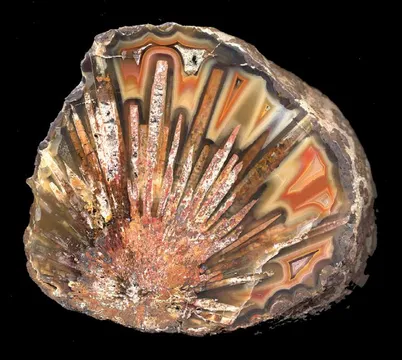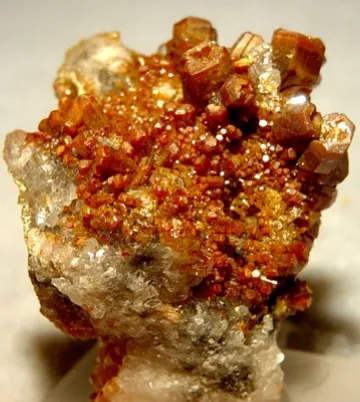
Aurora Mine, Mexico — a prized locality for orange wulfenite and vanadinite from oxidized Pb-Zn-V zones, prized for distinctive habit and collecting appeal.
Key facts
The Aurora Mine at Cuchillo Parado, in the Coyame del Sotol municipality of northeastern Chihuahua, is one of those Mexican localities whose reputation is far larger among seasoned wulfenite collectors than its physical output would suggest. It is not a prolific showpiece mine like Ojuela, nor a household name like the Erupción/Ahumada mine at Los Lamentos. Its importance lies in a compact, distinctive suite of secondary lead-vanadium-molybdenum minerals formed in oxidized Pb-Zn-V mineralization hosted by Cretaceous carbonate and carbonate-lutite units along the Cuchillo Parado structure. The classic specimens are old, uncommon, and immediately recognizable when right: orange to rust-red wulfenite, commonly bipyramidal to pseudo-cubic, rising from white calcite, dolomite, limonite-rich gossan, or vanadate-bearing matrix.
Historically, Aurora is doubly significant. To mining historians it was an early twentieth-century Pb-Zn-V property in the eastern Chihuahua desert, noted for wulfenite and vanadinite associated with low-silver galena and for vanadium concentrates. To stratigraphers it gave its name to the widely used Aurora Formation, the Lower Cretaceous limestone unit first tied to exposures near the mine. To collectors, however, Aurora is most compelling because it sits just outside the mainstream of Mexican classics: close enough in appearance to Los Lamentos wulfenite to confuse the unwary, but different enough in habit, matrix, and rarity to reward a trained eye.
Regional View
Country View
The best Aurora wulfenites are not usually large by international standards, but they have exceptional presence. Fine examples show saturated orange to reddish-orange color, greasy to nearly metallic luster, and isolated crystals or small sprays perched cleanly on pale carbonate. Good miniatures and small cabinets often succeed through contrast rather than abundance: a few sharp crystals on white calcite can be more desirable than a busy plate of damaged, brownish, or indistinct crystals. Larger Aurora pieces, especially cabinet specimens with numerous intact crystals over a broad calcite-rich matrix, are genuinely scarce.

Photo: Wikimedia Commons
Aurora’s secondary assemblage also includes vanadinite, arsenic-bearing vanadinite, mimetite, descloizite, dolomite, and calcite. The descloizite-vanadinite material gives the locality a second collecting identity beyond wulfenite: dark, sparkly, rust-red descloizite can pseudomorph elongated vanadinite prisms in open gossan vugs, producing jackstraw-like textures that are unmistakably oxidized-zone material from a small, arid carbonate-hosted system.

Photo: Wikimedia Commons
Search for specimens: View all specimens from Aurora Mine, Mexico
Aurora Mine is the Mina la Aurora of Cuchillo Parado, Coyame del Sotol Municipality, Chihuahua, plotted near 29°27' N, 104°53' W. The mine lies in the Cuchillo Parado mineralized zone of the Ojinaga region, within the arid eastern part of Chihuahua not far from the Big Bend border country of Texas. The broader mineralized zone occupies the Sierra Cuchillo Parado and adjacent ground, where Mesozoic sedimentary rocks are exposed in a long anticlinal structure. Mexican geological mapping describes the Cuchillo Parado anticline as an elongated sierra trending roughly northwest, about 38 km long and about 13 km wide, with mineralized structures developed chiefly as mantos and veins.
The regional host package is a Cretaceous sedimentary sequence that includes La Casita, Navarrete, Las Vigas, Cuchillo, Aurora, Benevides, Loma de Plata, Washita, Ojinaga, San Carlos, and younger units. From a mineral-deposit standpoint, the important units in the Cuchillo Parado zone are Las Vigas and Aurora, because the mapped Cu and Pb-Zn mineralization is emplaced in them. The Pb-Zn mineralization is interpreted in Mexican geological work as replacement, while copper mineralization in the same broader zone is described in more genetically complex terms, including stratigraphic control in permeable horizons and a debated mixture of processes. For collectors, the practical result is an oxidized carbonate-hosted Pb-Zn-V setting: enough lead, molybdenum, vanadium, arsenic, and carbonate gangue to build a compact but attractive suite of wulfenite, vanadinite, mimetite, descloizite, calcite, and dolomite.
Mining records for the Cuchillo Parado zone show small but serious early activity. A 1912 note in Engineering and Mining Journal reported that the Aurora mine in eastern Chihuahua was owned by the Madero family, and that wulfenite and vanadinite occurred there with galena carrying low silver values; the same note recorded vanadinite concentrates running 18% V2O5 being shipped to England. Later Mexican geological summaries report that mines in the region were exploited by Alicia Mining Co., S.A., whose work ceased in 1929; no production totals were preserved in those summaries, but recorded ore grades from the region included silver up to 96 g/t, copper to 10%, and lead to 10%. Modern SGM mapping lists La Aurora as one of the principal old mines of the Cuchillo Parado zone, specifically a Pb-Zn-V producer, and states that the zone is inactive.
The mineralized structures of the zone are described as mantos and veins with lengths from a few meters to about a kilometer and thicknesses commonly in the half-meter to several-meter range. In the mapped table for the zone, Aurora is marked as an inactive Pb-Zn mine occurrence. The ore and gangue minerals listed for the broader Cuchillo Parado Pb-Zn-Cu system include smithsonite, cerussite, zincite, malachite, azurite, chrysocolla, calcite, gypsum, iron oxides, quartz, and sparse vanadinite. The collector-specimen mineralogy preserved in mineral databases and specimen literature narrows that broad mine-geology picture to a secondary lead-vanadate-molybdate assemblage centered on wulfenite, calcite, vanadinite, arsenic-bearing vanadinite, descloizite, mimetite, and dolomite.
Access should be treated as closed or permission-only unless current ownership and land status are verified on the ground. SGM road descriptions for the district note access to the Cuchillo Parado zone from the Chihuahua-Ojinaga highway via Coyame, with dirt roads toward San Pedro and Cuchillo Parado, and another dirt road from the El Mangle-Cuchillo Parado side. That is infrastructure information, not collecting permission. The mine is an old, inactive underground and surface-working locality in remote desert country; serious collectors should assume unstable workings, private or concessionary mineral rights, and no casual collecting access.
Most collectible wulfenite appears to be old material, with many specimens attributed to 1960s collecting, although fine pieces have continued to surface irregularly from old collections and in small modern trickles. Dealer and auction records from the 2000s through the 2020s repeatedly characterize Aurora as seldom available, with specimens ranging from thumbnail clusters of elongated, doubly terminated orange crystals to small-cabinet and cabinet pieces carrying crystals around 1.0 to 1.4 cm; one published show report illustrated wulfenite crystals to 2.1 cm, and a Mindat specimen is described with a 2.2 cm standing crystal. The most desirable pieces are those with clear Aurora character: orange to rust-red wulfenite on white calcite or calcite-dolomite matrix, with sharp bipyramidal or pseudo-cubic forms and minimal bruising.
Aurora wulfenite is the locality’s calling card: orange, reddish-orange, rust-red, caramel, or deep orange crystals of Pb(MoO4), most often seen as small pseudo-cubic, thick tabular, prismatic, or tapering bipyramidal crystals on white calcite, dolomite, or limonitic gossan. Ordinary pieces tend to have scattered millimeter crystals with brownish color, edge wear, or visually confused matrix; superior specimens show saturated color, bright greasy to nearly metallic luster, and enough isolation on pale carbonate to let each crystal read clearly. Documented collector pieces commonly show crystals in the 3 to 6 mm range, with better examples around 1 cm, exceptional crystals around 1.3 to 1.4 cm, and rare published examples exceeding 2 cm. Associations with calcite are especially characteristic, while vanadinite, arsenic-bearing vanadinite, dolomite, and mimetite occur in the broader Aurora suite; the key distinction from Los Lamentos material is not a single diagnostic habit but the total context—rarity, old provenance, carbonate-gossan matrix, and the particular mix of pseudo-cubic to bipyramidal orange crystals from Cuchillo Parado.
Calcite from Aurora is valued less as a stand-alone species than as the pale stage on which the mine’s wulfenite and vanadate minerals perform. It occurs as white to colorless carbonate matrix, beds, and crystals beneath or around orange wulfenite, and is also documented over descloizite pseudomorphs after vanadinite; in fine wulfenite specimens the white calcite provides the contrast that separates a good Aurora piece from a merely rare one. Size depends on the specimen rather than on freestanding calcite crystals: thumbnails and miniatures may show only a small calcite base, while small-cabinet and cabinet wulfenites can carry broad calcite-rich matrices several centimeters across. The best calcite-bearing pieces are clean, bright, and structurally sound, with the calcite neither heavily iron-stained nor etched enough to distract from the wulfenite; however, a little limonite staining is not necessarily a flaw, because it is part of the oxidized-zone character of the locality.
Other documented Aurora minerals include vanadinite, arsenic-bearing vanadinite, mimetite, descloizite, and dolomite. There is no well-documented type-locality mineral species from Aurora in the standard locality listings; the mine’s “type” importance is stratigraphic, through the Aurora Formation, rather than mineralogical. The rarity of greatest collector interest after wulfenite is descloizite after vanadinite: sparkly rust-red descloizite pseudomorphs replacing elongated vanadinite prisms, sometimes in open gossan vugs with curved or jackstraw-like crystals. Arsenic-bearing vanadinite is also important because it ties the Aurora suite to the Pb-V-As chemistry that produced mimetite and related vanadate-arsenate combinations in the oxidized zone.
Aurora specimens deserve careful locality scrutiny. The most common confusion is with Los Lamentos/Erupción material, because some Aurora wulfenite can look close enough to Los Lamentos wulfenite that show reports and dealer descriptions have explicitly noted the resemblance. Aurora pieces should be judged by the whole specimen: matrix, associated calcite/dolomite, old labels, provenance, crystal habit, and the scarcity pattern of the locality. A specimen offered as “Aurora” solely because it is Mexican orange wulfenite is not enough.
There is also a specific published warning history: Mineral News in 1999 carried a caution regarding faked wulfenite matrix specimens attributed to Aurora. The readily available indexed record does not preserve enough detail to identify every fabrication method, so the practical collector response is conservative examination. Look for glued crystals, improbable point contacts, mismatched luster between crystal and matrix, adhesive in protected crevices, matrix that lacks the Aurora carbonate-gossan look, and wulfenite crystals sitting unnaturally on broken calcite surfaces. The best protection is old provenance from a known collection or reputable dealer, especially for cabinet specimens and for unusually rich pieces.
Condition is a major value factor. Wulfenite has perfect to good cleavage and brittle edges; Aurora’s isolated bipyramidal and pseudo-cubic crystals are easily nicked at corners, tips, and high points. Many crystals are small, so a single bruised face can dominate the visual read under magnification. Calcite matrix is soft and can be etched or dulled by acidic cleaning; avoid acid treatment, aggressive water jets, ultrasonic cleaning, and prolonged soaking. Limonitic matrix may shed fine dust, and white calcite can trap dirt in recesses.
Handling should be sensible rather than fearful. Wulfenite is a lead molybdate, vanadinite is a lead vanadate, mimetite is a lead arsenate, and descloizite contains lead, zinc, and vanadium. Keep specimens dry, do not abrade them, wash hands after handling, and never use Aurora material for lapidary, elixirs, aquaria, or children’s handling. No locality-specific fluorescence behavior is central to Aurora collecting; if calcite fluorescence is present on an individual specimen, treat it as a specimen attribute rather than a primary locality diagnostic.
Market availability is thin. Small thumbnails and miniatures appear occasionally, often from dispersed older collections, while attractive small-cabinet and cabinet specimens are much less common. Recent public records show everything from modest auction results for small-cabinet old collection pieces to high asking prices for unusually large, rich, clean cabinet specimens. The highest premiums attach to specimens with strong orange-red color, crisp undamaged crystals, white calcite contrast, and trustworthy old provenance.
Aurora’s first great story is not a pocket story but a naming story. In 1910 R. H. Burrows described a thick-bedded fossiliferous limestone sequence in northern Chihuahua, a carbonate package with nodules of iron and chert, and the mine at Cuchillo Parado became the geographic anchor for the name Aurora. Later workers clarified that the formal type locality had not been designated in the strict modern sense, but the association stuck: the Aurora Formation, used across large parts of northern Mexico stratigraphy, carries the name of this small desert mine. Few mineral localities can claim that their name moved so far beyond the specimen cabinet into regional geology.
The second story comes from the old ore trade. By 1912, Aurora was not merely a mineral collector’s curiosity. Engineering and Mining Journal reported the mine as an eastern Chihuahua property owned by the Madero family, with wulfenite and vanadinite occurring alongside low-silver galena. The same brief notice included the arresting commercial detail that vanadinite concentrates running 18% V2O5 had been shipped to England. That sentence captures Aurora at the hinge between mineralogy and industry: the same orange and red species now prized in cabinets were once evidence of a vanadium-bearing orebody remote enough that concentrate had to begin its journey by desert transport before entering international commerce.
A third thread runs through the collector market. For decades, Aurora wulfenite seems to have moved in small pulses rather than floods. Dealers have described pieces as old material, often attributed to the 1960s, and later show reports noted better and better specimens appearing around the turn of the millennium. One Mineralogical Record show report described Dan Belcher of Blue Sky Mining offering Aurora wulfenites in a variety of sizes, with crystals that could “easily be mistaken for Los Lamentos.” That is the kind of sentence collectors remember, because it names both the charm and the problem of the locality: Aurora is close enough in appearance to a famous Mexican wulfenite district to fool a casual eye, yet scarce enough that correct identification matters.
Rivières, Jean des (2016). “The Aurora mine, Cuchillo Parado, Coyame del Sotol, Chihuahua.” The Mineralogical Record, 47(5), 609–619. The principal modern locality article devoted specifically to Aurora, published in the September–October 2016 Mexico VII issue.
Mineralogical Record, Mexico VII, Vol. 47 No. 5, September–October 2016. Back-issue contents page confirming the Aurora article by Jean des Rivières and its page range.
Panczner, William D. (1987). Minerals of Mexico. Van Nostrand Reinhold, 459 pp. Standard reference cited for Aurora calcite, descloizite, vanadinite, arsenic-bearing vanadinite, and wulfenite in the Mindat locality record.
Cook, Robert B. (2001). “Connoisseur’s Choice: Mimetite, Tsumeb, Namibia.” Rocks & Minerals, 76(2), 114–117. Cited in the Aurora locality record for mimetite from the mine.
Engineering and Mining Journal, Vol. 93, No. 5, February 3, 1912. Historical note recording wulfenite and vanadinite at Aurora, low-silver galena, Madero-family ownership, and shipment of vanadinite concentrate assaying 18% V2O5 to England.
Servicio Geológico Mexicano / Consejo de Recursos Minerales. Carta Geológico-Minera Ojinaga H13-8, Chihuahua, scale 1:250,000. Regional geological-mining metadata summarizing the Cuchillo Parado mineralized zone, Pb-Zn-V production at La Aurora, inactivity of the zone, ore grades, and deposit setting.
Servicio Geológico Mexicano / Consejo de Recursos Minerales. Carta Geológico-Minera Ojinaga H13-8 technical report PDF. Full technical report with details on access, stratigraphy, Cuchillo Parado anticline geometry, mineralized structures, assays, and old mining history.
Burrows, R. H. (1910), as summarized in SGM stratigraphic reports on the Aurora Formation. Source trail for the original use of the Aurora Formation name from limestone near Mina Aurora in Sierra Cuchillo Parado.
Humphrey, W. E., and Díaz, T. (1956), as summarized in SGM stratigraphic reports. Later formal stratigraphic treatment locating the informal type area of the Aurora Formation near the Aurora Mine.
Mineral News, Vol. 15 No. 2, February 1999, as indexed in the Mindat wulfenite occurrence record. Important collector-warning reference noting faked wulfenite matrix specimens attributed to Aurora.
Mindat: Aurora Mine, Cuchillo Parado, Coyame del Sotol Municipality, Chihuahua, Mexico — Core locality page with coordinates, alternate name Mina la Aurora, species list, references, and gallery.
Mindat: Wulfenite from Aurora Mine — Species occurrence page with photo statistics and associated-mineral data for Aurora wulfenite.
Mindat: Arsenic-bearing Vanadinite from Aurora Mine — Occurrence page for the arsenic-bearing vanadinite component of the Aurora suite.
Wikimedia Commons: Wulfenite-41199.jpg — Open-license photograph of an old Aurora wulfenite specimen on calcite and limonite matrix.
Wikimedia Commons: Descloizite-Vanadinite-261817.jpg — Open-license photograph of descloizite pseudomorphs after vanadinite from Aurora.
Mineralogical Record Vol. 47 No. 5, 2016 — Back issue containing Jean des Rivières’ dedicated Aurora Mine article.
Mineralogical Record Mexico VII issue page — Contents page confirming the Aurora article and other Mexico-special-issue context.
SGM metadata: Carta Geológico-Minera Ojinaga H13-8 — Concise regional mining-geology summary for Ojinaga, including Cuchillo Parado and La Aurora.
SGM technical report: Carta Geológico-Minera Ojinaga H13-8 PDF — Detailed geological and mining report for the district, including access, structures, assays, and production notes.
Engineering and Mining Journal, February 3, 1912 PDF — Early historical notice of Aurora wulfenite, vanadinite, galena, ownership, and vanadium concentrate shipment.
MineralAuctions: Wulfenite, Aurora Mine, 2016 closed auction — Dealer-market record describing rust-red bipyramidal crystals to 1.3 cm on white calcite.
MineralAuctions: Wulfenite, ex Bob Reynolds Collection, 2021 closed auction — Market record for an old small-cabinet Aurora wulfenite with provenance and pricing history.
MineralAuctions: Wulfenite, ex John Arnaud Collection, 2013 closed auction — Useful comparison record for pseudo-cubic deep orange Aurora wulfenite on calcite-dolomite matrix.
Minfind: Wulfenite from La Aurora Mine — Archived dealer record for a sold Aurora wulfenite with calcite, documenting small-format market material.
Marin Mineral Company: Wulfenite from La Aurora Mine — Dealer archive noting elongated double-terminated orange wulfenite crystals from the Chuck Trantham collection.