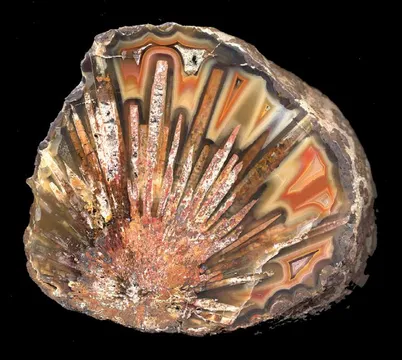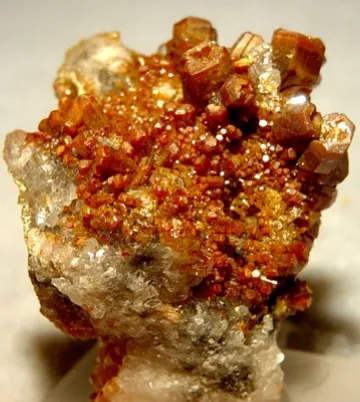
Santa Rosalia Mine, Mexico — famed for boleite, cumengeite, and pseudoboleite; blue halide crystals from oxidized deposits, a cornerstone for collectors.
Key facts
Santa Rosalia Mine, as the name is used in fine-mineral collecting, points to the Santa Rosalía–El Boleo copper district on the Gulf of California coast of Baja California Sur: a classic sediment-hosted Cu-Co-Zn-Mn system in which the glamour minerals are not the ore minerals themselves, but the strange, intensely blue lead-copper-silver chloride species that formed in the oxidized, chloride-rich parts of the deposit. For collectors, the locality’s standing rests above all on boleite, cumengeite, and pseudoboleite—species whose best crystals made El Boleo famous in 19th-century French mineralogy and still make the district a reference point for rare halides. The best specimens are miniature to thumbnail-scale, but they have a visual authority out of all proportion to size: indigo to Prussian-blue pseudo-cubes, sometimes with stepped pseudoboleite faces or pyramidal cumengeite epitaxy, set in pale clay, gypsum, anglesite, atacamite, paratacamite, or limonitic matrix.
Geologically, El Boleo is equally distinctive. The ore occurs in laterally persistent, clay-rich stratiform beds known as mantos within the Boleo Formation, a late Miocene fan-delta and shallow-basin sedimentary sequence tied to the early opening of the Gulf of California. These mantos lie above coarse clastics and beneath tuffaceous sandstones, in a faulted basin cut by arroyos that expose the mineralized horizons inland from Santa Rosalía. That combination of volcanic detritus, evaporitic components, seawater chloride, copper-lead chemistry, and near-surface oxidation made the district an ideal natural laboratory for oxychloride and hydroxychloride mineral formation.
Regional View
Country View
The locality also matters historically. Santa Rosalía was a purpose-built French mining town, raised in the desert because El Boleo was rich enough to justify furnaces, railways, a port, company buildings, housing, a hospital, and eventually a townscape now recognized for its industrial heritage. Compagnie du Boléo operated the mines from the 1880s into the mid-20th century; later Mexican and modern corporate operators worked or redeveloped the district for copper, cobalt, zinc, and manganese. The mineral collector sees the same story in miniature: an industrial copper camp that unexpectedly became one of the world’s great type-locality sources for rare blue halides.

Photo: Didier Descouens, Wikimedia Commons
Search for specimens: View all specimens from Santa Rosalia Mine, Mexico
Santa Rosalia Mine is best understood as the collector shorthand for the El Boleo or Boleo District, centered near Santa Rosalía in Mulegé Municipality, Baja California Sur. The historic copper mines lie in a northwest-trending belt roughly parallel to the Gulf of California coast, generally a few kilometers inland, where arroyos cut into the mesas and expose the mineralized succession. Classic sublocalities cited on specimen labels include Amelia Mine in Arroyo de la Soledad, the Cumenge shaft, Curuglu Mine in Arroyo del Boleo, Rancheria Mine in Arroyo de la Providencia, Carmen Mine, San Luciano Mine, Toro Mine, and other workings and cuts across the district.
The deposit is a sediment-hosted, manto-style Cu-Co-Zn-Mn system in the Boleo Formation of the Santa Rosalía basin. The host succession consists of volcanic-derived clastic sediments, altered tuffs, conglomerates, sandstones, claystones, limestones, gypsum-bearing intervals, and evaporitic components deposited in a transtensional basin during the early evolution of the Gulf of California. Published stratigraphic work describes the El Boleo Formation as a 200–300 m package above Comondú volcanic rocks, beginning with basal limestone and gypsum and passing upward into repeated coarsening-upward fan-delta and shallow-basin cycles. The mineralized beds occur in the fine-grained, clay-rich portions of these cycles.
The ore bodies are the famous mantos. Technical reports describe up to seven mineralized units—Mantos 0, 1, 2, 3AA, 3A, 3, and 4—dipping gently eastward and displaced by abundant faults into step-like positions. Historically, Manto 3 was the dominant producer, credited with the great majority of production before the 1980s closure. The mantos are soft, clay-rich beds formed largely from altered ash, with laminated basal zones commonly less than a meter thick and slump-breccia intervals that can reach many meters. The richest copper historically came from the basal laminated part of the manto, not from broad spectacular veins: this was an orebody measured in beds and sheets rather than in the open cavities familiar from many Mexican carbonate replacement deposits.
The ore mineralogy is fine-grained and complex. Primary and early ore species reported from the district include pyrite, chalcocite, chalcopyrite, bornite, covellite, carrollite, and sphalerite, with secondary copper, zinc, manganese, and lead minerals including chrysocolla, malachite, azurite, smithsonite, cryptomelane, pyrolusite, atacamite, paratacamite, anglesite, cerussite, gypsum, calcite, and the rare Boleo chloride suite. The collector minerals formed in the oxidized lead-copper portions of the system, especially where chloride-bearing solutions reacted with primary sulfides and lead-rich zones. That is why the finest boleite-group specimens are tied particularly to the Amelia Mine and the Cumenge shaft area rather than evenly distributed through every copper working.
Mining began after the discovery of copper nodules in the Santa Rosalía region in 1868, generally credited in historical sources to José Rosa or José Rosas Villavicencio. Before the French era, Mexican and German interests worked the deposits on a limited scale. Large-scale industrial mining began with the creation of Compagnie du Boléo in 1885. The company built the town, smelter, port infrastructure, railway, and support buildings that made Santa Rosalía a rare example of a French-influenced mining town in Mexico. French operation continued until 1954, after which Mexican government-backed mining under Compañía Minera Santa Rosalía kept the district alive with aging infrastructure. Historic production continued by underground and later sporadic open-pit and dump-treatment methods until final smelter closure in 1985.
Modern exploration and redevelopment changed the scale of the district again. Exploration in the 1990s and 2000s demonstrated large remaining resources of copper, cobalt, zinc, and manganese in the manto system. Minera y Metalúrgica del Boleo developed a hydrometallurgical operation designed to recover copper cathode, cobalt, and zinc products from ores whose cobalt and zinc had largely been unrecovered in the old smelting era. Production began in the 2010s, and current access is therefore an industrial, concession-controlled matter, not a casual collecting opportunity. Collectors should treat old mine workings, dumps, and arroyos as private or controlled mining ground unless explicit permission has been obtained from the land and mineral-rights holders.
Specimen production is episodic. Classic boleite, pseudoboleite, and cumengeite came from historical mining and later reworking of old claims, dumps, and pockets, especially around Amelia. Many matrix pieces are fragile because the crystals sit in soft clayey or sandy material; old material stabilized by time, careful trimming, or professional consolidation is highly valued when disclosed honestly. Loose blue cubes are commoner on the market than matrix pieces, but matrix specimens carry greater locality context and tend to be more desirable when the crystal is sharp, lustrous, undamaged, and visibly associated with gypsum, atacamite-group minerals, anglesite, or related Boleo halides.
Calcite at Santa Rosalía is part of the gangue and secondary carbonate story rather than the headline rarity, but it is well documented across Boleo District sublocalities including Curuglu, Amelia, Rancheria, and the broader manto system, where it occurs with gypsum, clay minerals, chalcedony, and oxidized copper-manganese assemblages. Collectors should expect Boleo calcite to be locality-significant rather than generally showy: the most interesting pieces are those that preserve the district’s chemistry, especially cobalt-bearing pink calcite or calcite directly associated with copper minerals and the rare chloride suite. Good specimens are separated from ordinary carbonate gangue by sharp crystal form, attractive contrast against limonitic or gypsum-rich matrix, unambiguous Baja California Sur provenance, and clean association with recognized Boleo sublocalities rather than vague “Mexico” labeling.
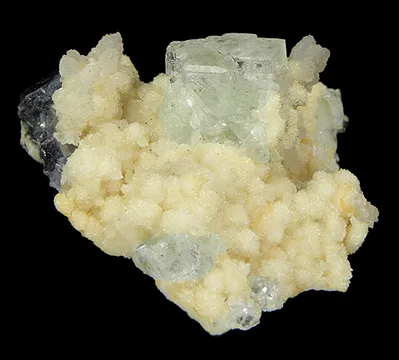
Fluorite requires particular caution under the Santa Rosalia Mine name because the verified Boleo literature and standard locality records do not make fluorite a defining species of the Baja California Sur district, while some marketplace records filed under “Santa Rosalia Mine” describe pale purple fluorite coatings on large scalenohedral calcite from the Tres Marias mine in the Santa Eulalia district of Chihuahua—a completely different Mexican collecting province. Where a specimen is offered as fluorite from Santa Rosalia Mine, the locality evidence matters more than the mineral itself: serious collectors should look for old labels, dealer provenance, and a consistent geological context, and should be wary of attractive calcite-fluorite plates whose habit, color, and association fit Santa Eulalia better than El Boleo. The best such pieces, if correctly attributed to their true source, are judged by sharp calcite, even fluorite coverage, pale violet color, and sculptural balance, but they should not be used as evidence for a classic Boleo fluorite occurrence without stronger documentation.
Boleite is the species that makes Santa Rosalía essential. From the Boleo District type locality, especially Amelia Mine and the Cumenge shaft area, it forms deep indigo to Prussian-blue pseudo-cubic crystals, commonly only a few millimeters but locally approaching about a centimeter on edge, either loose or perched in soft clay, gypsum, limonite, or copper-chloride-bearing matrix. The finest specimens show sharp cube outlines, bright vitreous to pearly faces, edge translucency under strong light, and undamaged corners; the truly exceptional pieces show epitaxial relationships with pseudoboleite as stepped plates on cube faces or cumengeite as pyramidal outgrowths that turn a simple blue cube into a crystallographic sculpture. Ordinary Boleo boleite is small, dark, and often loose; great Boleo boleite is sharp, lustrous, matrix-supported, visibly associated, and fully documented as Amelia or Boleo material.
Beyond those three species, the locality’s most important supporting cast is the Boleo rare-halide suite. Boleite, cumengeite, and pseudoboleite are all type-locality minerals of the district; cumengeite, named for Édouard Cumenge, forms indigo tetragonal pyramidal crystals and spectacular epitaxial overgrowths on boleite, while pseudoboleite forms closely related blue crystals and stepped overgrowths that can be easy to miss without magnification. Other documented and collector-relevant minerals include atacamite, paratacamite, clinoatacamite, anglesite, cerussite, phosgenite, gypsum, chrysocolla, malachite, azurite, smithsonite, pyromorphite, native copper, native silver, pyrite, chalcocite, chalcopyrite, bornite, sphalerite, pyrolusite, cryptomelane, hollandite, todorokite, romanèchite, quartz, chalcedony, and amethyst from district sublocalities.
The first authenticity issue is locality confusion. “Santa Rosalia” appears on labels in several forms: Santa Rosalía, Boleo, El Boleo, Boleo District, Amelia Mine, Cumenge shaft, and Baja California Sur. Those are consistent with the classic boleite locality. By contrast, “Santa Rosalia Mine, Chihuahua” is a red flag when attached to Boleo species, because the famous boleite locality is in Baja California Sur, not Chihuahua. Chihuahua labels involving fluorite and calcite often point instead to the Santa Eulalia district, particularly Tres Marias or related West Camp material. A specimen can be genuine and still be filed under the wrong Santa Rosalia; serious buyers should separate specimen authenticity from database or label accuracy.
Boleite itself is frequently misread. A dark blue cube may not be “just boleite”: pseudoboleite can form subtle stepped overgrowths on the faces, and cumengeite can appear as pyramidal blue outgrowths. Because the three species are visually similar and intimately intergrown, labels often simplify a mixed specimen. On higher-value pieces, especially matrix specimens with multiple rare species, magnification and, when necessary, analytical confirmation are appropriate. The distinction matters: boleite is silver-bearing, while cumengeite and pseudoboleite are related lead-copper hydroxychlorides without the same silver component.
Condition is a major part of value. Boleo matrix is commonly soft, friable, clayey, sandy, or limonitic, and many pieces are naturally fragile. Stabilization, trimming, or backing is not automatically disqualifying, but it should be disclosed. Matrix pieces from some modern finds have been reported in the trade with concerns about repairs, reattachments, or fabricated-looking assemblies, so examine contact points between blue crystals and matrix carefully. Look for natural seating, consistent sediment adhering around the crystal, and no suspicious glue meniscus or mismatched dust. Loose crystals should be inspected for bruised corners, chipped edges, and abrasion along the cube faces.
The market rewards a very specific hierarchy. Common Boleo thumbnails are small loose cubes, often dark and opaque unless strongly lit. Better specimens show sharp form, luster, edge translucency, and clean modification. Better still are crystals on natural matrix, especially with gypsum, atacamite-group minerals, anglesite, or visible pseudoboleite and cumengeite. The finest pieces are old-collection or well-provenanced matrix specimens from Amelia Mine with large, sharp, undamaged crystals and crystallographically obvious epitaxy. These remain scarce, and modern availability is irregular rather than steady.
Handling should be gentle. Boleite is a lead-, copper-, silver-, chloride-bearing mineral with low hardness and perfect cleavage; it is not a handling stone. Keep specimens dry, avoid washing, avoid acids and ultrasonic cleaning, and do not soak clay-rich matrix. Store small pieces in a Perky box or membrane box with minimal pressure on the crystal. Because associated copper chlorides and clay-rich matrices can be sensitive to moisture and salts, stable indoor humidity and careful dust protection are wiser than open display near kitchens, windows, or marine air. As with all lead-bearing minerals, wash hands after handling and keep loose fragments away from children and pets.
The story collectors remember begins not in a laboratory, but with blue-green balls on desert ground. In 1868, José Rosa Villavicencio was traveling through the Santa Rosalía region when he noticed unusual coppery nodules—“boleos”—in an arroyo. The name stuck because the ore literally announced itself as rounded lumps, not as a glittering vein. What Villavicencio had noticed eventually drew engineers, investors, and a French company town to a hard, dry stretch of coast that otherwise had no obvious reason to become one of Mexico’s famous industrial places.
The French arrival changed Santa Rosalía more completely than any mineral discovery usually changes a village. Compagnie du Boléo did not merely sink shafts; it built a working town. By the turn of the 20th century, the camp had railways, furnaces, a hospital, schools, hotels, a company store, worker housing, a port, and a social geography that reflected the mines themselves: Santa Rosalía, Providencia, Purgatorio, and Soledad. The red roofs, timber buildings, metal structures, and company architecture gave the place a visibly European cast in a Baja California desert landscape.
Even the harbor was made out of the mine. Contemporary engineering accounts described the smelter slag being cast into great blocks and used to form the breakwater and wharf. In one account, the blocks were described as enormous masses about 15 feet long and five feet square, a wonderfully blunt solution: the waste of copper smelting became the foundation of the port that moved copper out. The same industrial improvisation became part of the town’s identity, and old slag, furnaces, rail equipment, and company buildings remain among the most visible reminders of El Boleo’s scale.
Santa Rosalía’s most famous non-mineral artifact is the metal church of Santa Bárbara. Sources differ in the details of its design history, but the accepted local story is inseparable from the French mining company: a prefabricated iron church exhibited in Europe was acquired by an El Boleo administrator and shipped to Baja California, arriving in the 1890s and being installed in the company town. For collectors, it is a useful reminder that the Boleo story was not just geological. The same network that sent specimens of blue chloride minerals to French mineralogists also carried industrial architecture, machinery, capital, and European urban habits to a remote Gulf coast camp.
The district’s crises were equally vivid. A 1911 cyclone, reported in historical research on the company, damaged the coastal works badly: mines flooded, ships were damaged and piled against one another, railway line was broken in multiple places, and the sailing vessel Pablito was thrown onto land about 50 meters from the beach. For a mine built around arroyos, a port, and a narrow working strip between sea and desert, water was both a chemical ingredient in its minerals and a physical threat to its existence.
Then came the long decline. The rich oxidized ore that made the French operation so attractive could not last forever, and by the mid-20th century the cost of deeper, thinner, lower-grade material was catching the old system. When the French company shut down in 1954, Santa Rosalía might have become one more abandoned mining town. Instead, Mexican-backed operations kept the works alive for decades, even if with aging methods and persistent financial difficulty. For mineral collectors, that extended afterlife mattered: old workings, dumps, and later reworking helped keep Boleo specimens moving into collections long after the great French period had ended.
Ernest Mallard and Édouard Cumenge, “Sur une nouvelle espèce minérale, la Boléite,” Bulletin de la Société française de Minéralogie, 14, 1891, pp. 283–293. Original description of boleite from the Boleo copper deposit near Santa Rosalía.
Ernest Mallard, “Sur la Boléite, la Cumengéite et la Percylite,” Bulletin de Minéralogie, 16, 1893, pp. 184–195. Early crystallographic and species-level treatment of the Boleo blue chloride minerals, including cumengeite.
G. Friedel, “Contribution à l’étude de la boléite et de ses congénères,” Bulletin de Minéralogie, 29, 1906, pp. 14–55. Classic study of boleite and related Boleo species, using important French institutional material.
Ivan F. Wilson and Víctor S. Rocha, “Geology and Mineral Deposits of the Boleo Copper District, Baja California, Mexico,” U.S. Geological Survey Professional Paper 273, 1955. Foundational geological monograph on the district, including geology, ore beds, mining history, and mineralogy.
Lucas Ochoa-Landín, Joaquín Ruiz, Thierry Calmus, Efrén Pérez-Segura, and Francisco Escandón, “Sedimentology and stratigraphy of the upper Miocene El Boleo Formation, Santa Rosalía, Baja California, Mexico,” Revista Mexicana de Ciencias Geológicas, 17(2), 2000, pp. 83–96. Key sedimentological paper explaining the fan-delta and basin architecture that hosts the mantos.
Rafael Del Río-Salas and coauthors, “Genesis of manganese oxide mineralization in the Boleo region and Concepción peninsula, Baja California Sur: Constraints from Pb-Sr isotopes and REE geochemistry,” Revista Mexicana de Ciencias Geológicas, 30(3), 2013, pp. 482–499. Modern geochemical work on manganese oxide mineralization tied to the broader Boleo metallogenic system.
Charles L. Duval, Stephanie Elaine Suarez, and James B. Murowchick, “Mineralogical Evidence of an Epithermal Exhalative Origin of the Boleo Cu-Zn-Mn-Co Mantos, Santa Rosalia, Baja California Sur, Mexico,” Geological Society of America Abstracts with Programs, 2016. Concise modern discussion of competing genetic models for the Boleo mantos.
Mindat: Boleite mineral data. Useful for the type occurrence, formula KPb26Ag9Cu24(OH)48Cl62, associated minerals at Boleo, and the boleite–cumengeite–pseudoboleite epitaxial relationships.
Mindat: Cumengeite mineral data. Documents cumengeite as a Boleo type-locality species and gives the modern spelling, formula, and naming after Édouard Cumenge.
Mindat: Boleo District locality page. Practical mineral list and locality framework for the district, including type-locality status for boleite, cumengeite, and pseudoboleite.
Smithsonian / HyperPhysics: Boleite specimen from Santa Rosalia mine, Boleo, Baja California, Mexico. Shows a Smithsonian-displayed boleite specimen and provides a museum-linked example of the classic locality attribution.
Mindat: Boleo District, Santa Rosalía, Mulegé Municipality, Baja California Sur, Mexico — The most useful collector-facing locality index for species, sublocalities, photos, and references.
Mindat: Boleite from Boleo District — Focused occurrence page for the locality’s signature mineral, with associated minerals and photo references.
Mindat: Amelia Mine, Boleite occurrence — Essential for understanding Amelia Mine as the prime sublocality for boleite-group specimens.
U.S. Geological Survey Professional Paper 273: Geology and Mineral Deposits of the Boleo Copper District — The classic geological reference on ore beds, district layout, history, and mineralization.
University of Arizona profile: Sedimentology and stratigraphy of the Upper Miocene El Boleo Formation — Best compact source for the basin and host-rock setting.
University of Arizona profile: Genesis of manganese oxide mineralization in the Boleo region — Useful modern geochemical context for the manganese-rich side of the Cu-Co-Zn-Mn system.
GSA Abstract: Mineralogical evidence of an epithermal exhalative origin of the Boleo mantos — Short technical summary of modern genetic interpretations.
Persée: Mallard and Cumenge, 1891, original boleite description — Primary source for the naming and early description of boleite.
Persée: Mallard, 1893, Boléite, Cumengéite et Percylite — Early French paper central to the Boleo chloride-mineral group.
Persée: Friedel, 1906, Contribution à l’étude de la boléite et de ses congénères — Historic crystallographic study of boleite and its congeners.
INAH: Santa Rosalía Historical Monuments Zone — Cultural-history context for the French mining town, industrial buildings, and protected historic fabric.
Sistema de Información Cultural: Museo El Boleo — Museum information for the mining-history collection in Santa Rosalía.
Yonhap News Agency: 2026 sale of Korean interest in Boleo mine — Current-business context for the modern Boleo operation and its ownership changes.
Wikimedia Commons: Amelia Mine media category — Open image repository for Boleo and Amelia Mine specimen photographs.