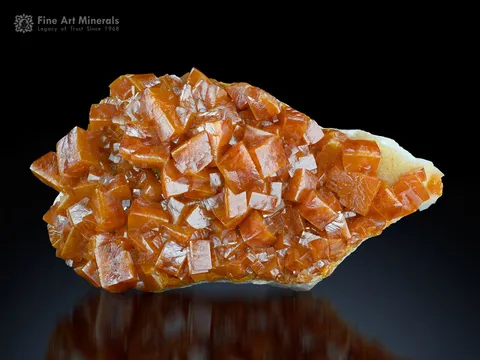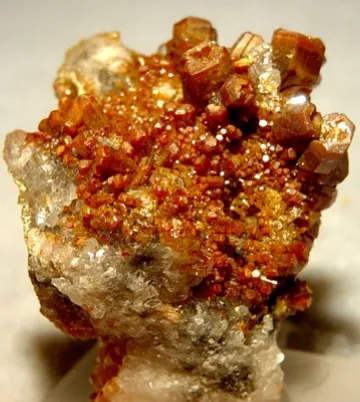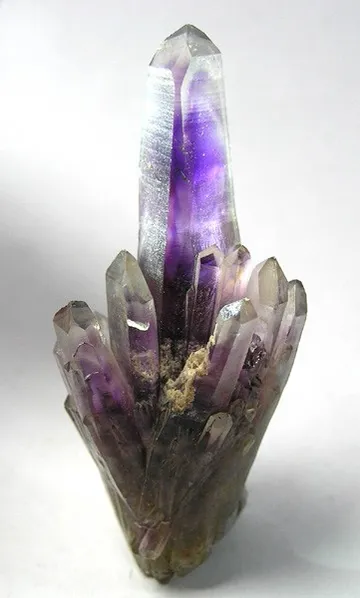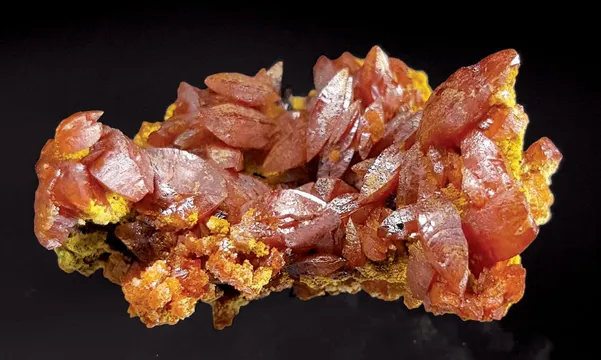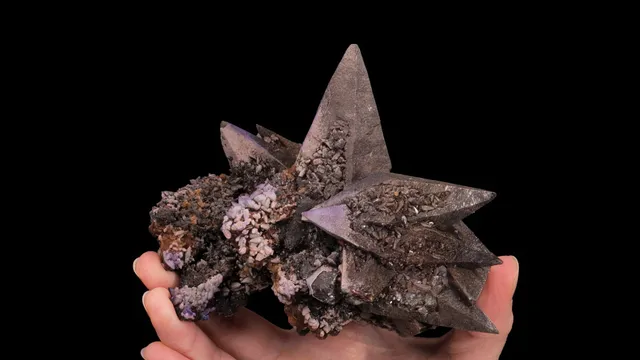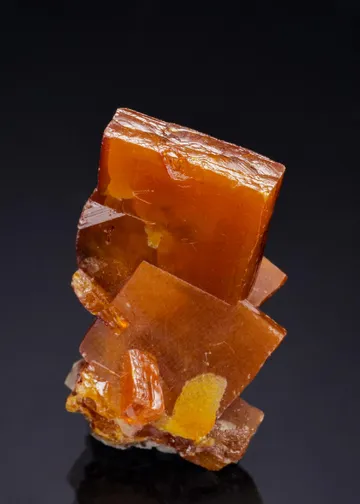
Los Lamentos, Mexico — famed wulfenite from the Erupción-Ahumada system; orange-to-caramel crystals on calcite, a district classic prized by collectors.
Key facts
Los Lamentos is one of the great names in Mexican mineral collecting, not because it produced an encyclopedic variety of species, but because it did one thing with memorable authority: wulfenite. The classic specimens are from the Erupción-Ahumada mine system in the Sierra de Los Lamentos, Ahumada Municipality, Chihuahua, where an oxidized carbonate-hosted lead-zinc-silver replacement body yielded thick orange to caramel PbMoO4 crystals unlike the wafer-thin “windowpanes” typical of many other wulfenite districts. On the best pieces, lustrous blocky or tabular crystals sit on white calcite, brown limonite, dolomite, vanadinite, descloizite, willemite, or mixed oxidized ore, making a color contrast that is unmistakably Los Lamentos.
Geologically, the deposit belongs to the family of limestone-replacement, manto-style lead deposits of northern Mexico. The ore followed favorable Cretaceous carbonate beds and was later deeply oxidized, transforming primary galena and sphalerite into a supergene suite of cerussite, anglesite, plumbojarosite, hydrozincite, willemite, vanadinite, descloizite, wulfenite, gypsum, sulfur, iron oxides, and calcite. For collectors, the important nuance is that “Los Lamentos” is often used as a district name, while most classic wulfenite is better understood as Ahumada mine material from the deeper portion of the same Erupción-Ahumada system.
Historically, Los Lamentos occupies an unusual place among Mexican classics. It was not one of the old colonial silver camps; its serious development came in the early twentieth century, after discovery and promotion during the turbulent years around the Mexican Revolution. The mine became famous first as a lead producer and then, in the specimen world, as a prolific source of wulfenite during the 1920s through early 1960s, with later small recoveries in 1968, 1976, and the early 1980s. The finest surviving pieces have the feel of old-time classics: heavy, saturated, sculptural crystals, sometimes as neat butterscotch-colored blocks, sometimes as glowing orange plates, and occasionally as wulfenite overgrown by vanadinite or accompanied by rare zinc silicates.
Regional View
Country View
The name itself is part of the locality’s appeal. The Sierra de Los Lamentos takes its name from the “lamentations” made by wind moving through cracks and cavities in the limestone crest above the workings. That cavernous plumbing mattered mineralogically as well as poetically: openings, breccias, and permeable horizons helped channel oxidizing waters through the lead-zinc ore and created the vugs and pockets that later furnished collector specimens.

Photo: Wikimedia Commons
Search for specimens: View all specimens from Los Lamentos Mts, Mexico
The classic collecting locality is the Erupción-Ahumada mine system in the Sierra de Los Lamentos of northeastern Chihuahua, east of Villa Ahumada. The Erupción Mine locality is recorded near 30°34'25" N, 105°49'05" W, and the district is reached from the Villa Ahumada area by desert roads across the broad plains of northern Chihuahua. Older accounts describe the range as a limestone island rising from creosote-covered flats, with the mine settlement and dumps tucked against the southern part of the ridge.
The orebody is a carbonate-hosted polymetallic replacement deposit, commonly described as a manto following bedding in Cretaceous limestone. In the older mining literature and later compilations, the Erupción-Ahumada manto is described as a continuous, pipe-like to ribbon-like replacement body in the lower part of the Los Lamentos Formation, dipping gently north to northeast roughly parallel with the limestone beds. Published descriptions give dimensions on the order of 9 to 12 meters thick, locally much wider, and extending for more than a kilometer along its course, though the body is irregular and accompanied by smaller pockets, breccia fillings, fissure replacements, and subsidiary mineralized zones.
The zoning of the ore is critical for labeling specimens. The upper Erupción portion, above about the 500-foot level, was richer in anglesite, cerussite, gypsum, sulfur, and lead-sulfate ore. The lower Ahumada portion, reached by deeper workings, is the source of the classic wulfenite and vanadinite specimens. Mindat’s locality notes preserve the practical collector distinction well: the change in mineralogy coincides closely enough with the claim and mine-name change that purist labels often assign wulfenite to the Ahumada Mine and anglesite to the Erupción Mine, even though collectors commonly use “Erupción,” “Erupción-Ahumada,” or simply “Los Lamentos.”
The mine workings were extensive for a remote desert lead operation. Descriptions record a main adit intersecting an internal decline around the 400-foot level and continuing to a deep internal shaft; haulage levels were driven at depth, and the lower workings reached the 700-foot level. The 800-foot level was driven but apparently never reached the orebody. Below the 500-foot level, access and mining moved into the manto itself, which is why deeper water became such a decisive factor in the history of both ore mining and specimen recovery.
The primary sulfide assemblage was simple: galena as residual nodules and masses, with sphalerite much less abundant and pyrite locally present. Oxidation did the rest. In the upper mine, massive and disseminated anglesite and cerussite formed high-grade lead ore with gypsum and sulfur. In the deeper Ahumada zone, the ore included hematite, cerussite, residual galena, vanadinite, descloizite, willemite, hydrozincite, plumbojarosite, calcite, dolomite, gypsum, and wulfenite. Some stopes were described as spongy masses of vanadinite needles in exceptionally rich lead-vanadium ore, and it is from this same oxidized lower environment that the best wulfenite pockets were obtained.
Mining history began comparatively late. José María de la Peña brought the district to the attention of David Bruce Smith in the first decade of the twentieth century, and the Erupción claim was located in 1907. By 1909, zinc carbonate ore had already been shipped from a nearby prospect, but the real development of the Ahumada lead operation came later, after Smith and his associates optioned and developed the property. Early work was hampered by lack of water, distance from rail transport, and the instability of revolutionary northern Mexico. By the early 1920s the Erupción Mining Company and Ahumada Lead Company were active, and the district was significant enough to merit a detailed 1924 article in Engineering and Mining Journal-Press.
Production was mainly lead-silver oxide ore, with vanadium, zinc, molybdenum, iron, and copper present as secondary or accessory commodities. Government and geologic compilations list the Los Lamentos site under lead and silver, with vanadium as a minor commodity and zinc/iron potential, and describe ore minerals including anglesite, cerussite, plumbojarosite, galena, vanadinite, descloizite, willemite, hydrozincite, sphalerite, hematite, goethite, limonite, pyrite, wulfenite, and minor brochantite. Annual production figures are recorded for 1929 and 1930, but the fame of the locality in mineral collections rests far more on the specimen output preserved from underground pockets than on tonnage.
Specimen mining appears to have been strongest from the 1920s into the early 1960s, with later recoveries in 1968, 1976, and the early 1980s during rehabilitation and exploration work. The lower levels are the key. Good wulfenite is recorded from around and below the 500-foot level, with particularly important late material from near the 700-foot level and the area known as Los Baños, close to the water table. The name was apt: accounts describe miners working in waist-deep water to remove specimens from partially flooded pockets before the water finally made further work impractical.
Collecting access today should be treated as limited, hazardous, and not comparable to a managed fee locality. The mine is an old underground operation in a remote, arid part of Chihuahua; lower levels are associated with water, heat, humidity, unstable ground, old shafts, and deteriorated workings. Modern collectors normally obtain Los Lamentos material through old collections, dealer inventories, auctions, and estate dispersals rather than by field collecting. Any field visit would require explicit land and concession permission, local guidance, and serious underground-mine safety judgment; the specimens that built the locality’s reputation are historical mine specimens, not casual surface finds.
Los Lamentos wulfenite is prized for thickness, color, and sculptural presence: crystals range from thin orange plates to stout tabular blocks and short prismatic forms, with the most recognizable pieces showing butterscotch, caramel-orange, honey-orange, brown-orange, or red-orange crystals on white calcite or limonitic matrix. Individual crystals on common specimens are often around several millimeters to 1 or 2 cm, while exceptional crystals and groups are larger; collector and dealer records document cabinet specimens with crystals to roughly 2.5 cm and old descriptions note unusual floaters and large individuals reaching several centimeters. The productive wulfenite came from the deeper Ahumada portion of the Erupción-Ahumada manto, especially below the 500-foot level and, in later accounts, near the 700-foot level and Los Baños. Good pieces here are separated from ordinary ones by sharp, undamaged edges, thick but well-formed crystals rather than broken plate fragments, lively luster, saturated color, natural attachment, and the classic orange-on-white contrast with calcite; ordinary examples may be dull, brownish, crowded, chipped, or so heavily coated by later minerals that the wulfenite becomes secondary to the association.
Calcite from Los Lamentos is rarely collected as the principal species, but it is one of the locality’s most important display minerals because it forms the white to cream matrix, drusy coatings, and sparkling contrast for the orange wulfenite. Specimens show calcite as crystalline crusts, small white crystals, cleavable carbonate matrix, and later encrustations that may partly cover wulfenite crystals; in the best examples, calcite frames the wulfenite without smothering it, giving the classic “orange crystals on snow” appearance. Dealer and collector descriptions repeatedly note wulfenite on white calcite, wulfenite partly coated by lustrous creamy calcite microcrystals, and pieces where calcite is both aesthetic and diagnostic of the Los Lamentos style. Calcite-rich examples are strongest when the calcite is clean, bright, and structurally supportive, with intact wulfenite crystals rising naturally from the carbonate rather than looking embedded, repaired, or over-cleaned.
Other documented Los Lamentos minerals include anglesite, cerussite, vanadinite, arsenic-bearing vanadinite historically called endlichite, descloizite, willemite, hydrozincite, plumbojarosite, gypsum, native sulfur, dolomite, barite, quartz, goethite, hematite, galena, sphalerite, pyrite, chalcopyrite, chlorargyrite, pyromorphite, and minor brochantite. Anglesite belongs chiefly to the upper Erupción workings and may occur as crusts, cryptocrystalline material, and tabular crystals, sometimes with gypsum and sulfur. Vanadinite and arsenic-bearing vanadinite are important associated species from the lower mine, commonly in brown to bronze, yellowish, or drusy coatings and needles, and some Los Lamentos wulfenites are partly or wholly coated by vanadinite-series minerals. Descloizite, typically dark brown crystalline masses or coatings, is a valued association rather than a common show mineral. Willemite and hydrozincite mark the zinc-bearing part of the oxidation suite; willemite-associated wulfenite is particularly desirable when the species are visually separable and the label is old or analytically supported.
Los Lamentos is a locality where style matters. Authentic classic pieces should look like oxidized carbonate-hosted lead-zinc ore: orange to caramel wulfenite with calcite, dolomite, limonite, vanadinite, descloizite, willemite, hydrozincite, or other plausible supergene associates. A bright orange crystal on an unrelated-looking matrix, or one with a base that does not show natural contact and growth, deserves a loupe inspection. The most important labeling issue is not usually national origin but mine attribution: “Los Lamentos,” “Erupción Mine,” “Ahumada Mine,” and “Erupción-Ahumada Mine” are all seen on labels, yet the classic wulfenite is most precisely tied to the deeper Ahumada portion of the system, while the upper Erupción workings are historically more associated with anglesite and cerussite.
No single famous fake type is uniquely associated with Los Lamentos, but wulfenite is soft, brittle, dense, colorful, and tempting to repair. Check crystal bases for glue, unnatural seating, mismatched growth lines, over-bright adhesive fluorescence under longwave ultraviolet, and suspiciously isolated crystals perched on matrix without mineralogical logic. Repairs may be acceptable on major old classics if disclosed, but an undisclosed reattached main crystal materially changes value. Also watch for heavily coated specimens in which vanadinite, descloizite, calcite, or iron oxides conceal broken wulfenite; such pieces may be legitimate and attractive, but they should not be priced as clean, undamaged wulfenite displays.
Condition is the central quality variable. Even the thicker Los Lamentos crystals chip at corners and plate edges, and older pieces often show peripheral bruises from mining, trimming, or decades of handling. A few fleabites on minor crystals may be tolerable on a historic cabinet specimen, but a damaged leading crystal is a major deduction. High-end examples should have crisp edges, good luster, no obvious bruising on the principal crystals, balanced placement, and strong color. Thin translucent plates can be visually spectacular but are more vulnerable; stout “caramel” blocks are often more forgiving structurally but still need close inspection for edge wear and basal repairs.
Cleaning should be conservative. Wulfenite is a lead molybdate and should be handled sensibly: do not ingest dust, wash hands after handling, and keep specimens away from children. Avoid acids because calcite and dolomite matrix will react, and avoid vigorous brushing because wulfenite edges are easily scarred. Long soaking may destabilize friable limonitic matrix or old repairs. Store Los Lamentos pieces where they cannot vibrate against harder minerals, and handle from the matrix rather than by the crystals.
On the market, Los Lamentos remains available because the district produced many specimens, but the best old pieces are much scarcer than ordinary small examples. Miniatures and small cabinets with modest orange crystals on calcite or limonite appear regularly in dealer inventories and auctions. Fine cabinet specimens with thick, lustrous, saturated crystals, strong orange-white contrast, old collection history, and minimal damage command a substantial premium. Unusual associations—wulfenite with willemite, vanadinite/endlichite, descloizite, or heavy calcite overgrowths—appeal to locality specialists, especially when the mineralogy is supported by an old label, reputable dealer history, or analysis.
The Los Lamentos story begins with a landscape that early visitors described almost like an archipelago. The limestone hills rose out of the Chihuahuan desert plain like islands, and David Bruce Smith reportedly came to the area in 1909 “looking” over those islands “to see their possibility.” The possibility turned out to be very real: a shallow old hole on the Erupción claim showed high-grade lead carbonate ore, and a nearby zinc carbonate prospect had already shipped about sixty carloads by that time. Yet the place was remote enough that development had to solve basic problems before it could solve mining ones.
Water was the first ordeal. During early exploration Smith had to haul camp water from a spring 16 miles away, an absurd distance for a mine camp trying to become permanent. Then came the political landscape of revolutionary northern Mexico. The district lay close enough to the border to be strategically visible but far enough from settled infrastructure to be vulnerable. Smith watched the plains with a telescope, looking for dust and riders; more than once, according to T. A. Rickard’s 1924 account, he made what Smith himself called a “quick get-away” when bandits approached across the desert.
The most dramatic episode came in October 1918, when Pancho Villa captured Smith and E. F. Knotts, president of the Erupción company, while Knotts was visiting the mine. They were held for twelve days. Smith was released to obtain a ransom of $20,000 in gold, while Knotts had to remain in the bandit camp for thirteen more days until C. L. Baker of the American Smelting & Refining Company advanced the ransom against ore receipts. Afterward, the bandits reportedly left Smith and his associates alone because Villa had given his word to protect them. In the dry language of mining development, the mine then proceeded “with some measure of success”; in human terms, the operation had survived a frontier hostage crisis.
The locality’s name supplied its own folklore. “Los Lamentos” does not commemorate unlucky shareholders or disappointed miners, as Rickard jokingly observed; it refers to the sound of wind moving through cracks and cavities in the limestone ridge above the mine. Anyone who has stood in karstic limestone country during a hard wind can imagine the effect: the mountain itself complaining, whistling, and moaning over the workings below. The same broken and cavernous limestone that gave the range its voice also helped make the orebody, its oxidation, and ultimately its specimen pockets possible.
The late specimen story is quieter but just as vivid to collectors. In the lower mine, the best wulfenite-bearing ground approached the water table. The area called Los Baños—“The Baths”—was not named fancifully. During the early 1980s rehabilitation and specimen recovery, miners reportedly worked in waist-high water to extract good wulfenite from partially flooded pockets a few meters below the 700-foot level. The finds were good enough to keep them trying, but water won. When pumping and working conditions became too difficult, specimen mining was abandoned, leaving part of the productive wulfenite zone preserved below the water table.
A later field account from Mexican collectors gives the abandoned mine a different texture: rails still visible deep inside the main tunnel, a chapel near the portal still in good condition, the ghost town beside the dumps, and small relics of the old camp—a bottle for ammonium hydroxide, a .30-30 cartridge, and a spoon with lettering worn illegible by time. In humid underground fronts, delicate hairlike crystal growths, thought by the visitors to be gypsum or aragonite, were described as thriving in nearly 100% humidity and temperatures above 40°C, but becoming still more fragile if brought out into the dry desert air. It is a sharp reminder that Los Lamentos is not only a source of orange wulfenite; it is an old industrial and geologic system still reacting, sweating, and crystallizing in the dark.
Rickard, T. A. (1924). “The Ahumada Lead Mine and the Ore Deposits of the Los Lamentos Range, in Mexico.” Engineering and Mining Journal-Press, 118(10), 365–374. Early mining account with location, development history, transportation, revolutionary-era events, and ore observations.
Foshag, W. F. (1934). “The ore deposits of Los Lamentos, Chihuahua, Mexico.” Economic Geology, 29(4), 330–345. Foundational geologic treatment of the deposit and the source of several formal stratigraphic references in the Sierra de Los Lamentos.
Wilson, Wendell E. (1980). “Famous Mineral Localities: Los Lamentos, Chihuahua, Mexico.” The Mineralogical Record, 11(5), 277–286. Classic collector-focused article on the locality, specimens, and mineralogy.
Wilson, Wendell E. (2003). “Famous Mineral Localities: The Erupción/Ahumada Mine, Los Lamentos District, Chihuahua, Mexico.” The Mineralogical Record, 34(6), 5–31. Expanded modern treatment in the Mexico III issue, especially valuable for mine-name distinctions, wulfenite zones, and specimen history.
Anonymous (1945). “Los Lamentos, Mexico, descloizites and wulfenites.” Rocks and Minerals, 20(5), 213. Early specimen-literature reference showing that Los Lamentos descloizite and wulfenite were already of collector interest by the mid-twentieth century.
“Featured Mineral at the 1990 Tucson Show: The Desert Mineral WULFENITE.” Rocks & Minerals, 65(1), 11–30. Broader wulfenite feature cited in Los Lamentos references; relevant to the species’ prominence in desert lead-oxide deposits and show culture.
Wulfenite, NMNH 123124, Smithsonian National Museum of Natural History. Museum specimen record for Los Lamentos wulfenite in the National Mineral Collection.
Wulfenite, Albert Chapman Collection, Australian Museum. Public museum account of a large Los Lamentos wulfenite specimen, 15 x 25 x 19 cm, registered in 1996 and formerly from the Albert Chapman Collection.
“Wulfenite with Vanadinite (variety endlichite) from Erupción Mine (Ahumada Mine), Los Lamentos Mountain Range, Mexico” — Fabre Minerals. Short specimen video showing thick tabular wulfenite on matrix with vanadinite from the Erupción-Ahumada system.
“Wulfenite, Erupción Mine, Los Lamentos Mts, Ahumada Mun., Chihuahua, Mexico” — Arkfeld Minerals. Dealer media page with specimen video and photographs of a small Los Lamentos wulfenite crystal.
Wikimedia Commons: Minerals of Los Lamentos Mts. Open media category with multiple photographs of Los Lamentos wulfenite, calcite, vanadinite, and associated mineral specimens.
Mindat: Erupción Mine, Los Lamentos Mountains, Ahumada Municipality, Chihuahua, Mexico — Essential locality page for coordinates, alternate names, mine-name distinctions, mineral list, and references.
Mindat: Los Lamentos Mountains, Ahumada Municipality, Chihuahua, Mexico — Regional locality page useful for broader Sierra de Los Lamentos context and linked occurrences.
USGS MRDS / Open-File Report 89-158 entry for Los Lamentos — Government compilation giving commodities, ore minerals, gangue minerals, deposit model, and production data.
USGS Geolex: Bufa publications referencing Foshag’s Los Lamentos work — Stratigraphic summary tied to Foshag’s 1934 Economic Geology paper and the Cretaceous limestone sequence.
Mineralogical Record Vol. 34, No. 6, Mexico III issue — Source for Wendell E. Wilson’s expanded 2003 “Famous Mineral Localities” article on the Erupción/Ahumada mine.
Mineralogical Record Vol. 11, No. 5, 1980 — Source for Wilson’s original 1980 Los Lamentos article.
Engineering and Mining Journal-Press, September 6, 1924 — Primary early article by T. A. Rickard with mining history, access, ore description, and the Pancho Villa ransom episode.
Foro de Mineralogía Formativa: “Mina Los Lamentos en Chihuahua y sus famosas Wulfenitas” — Spanish-language field and collector discussion with photos, access notes, mineralogical summaries, and abandoned-mine observations.
Wikimedia Commons: File: Wulfenite mexique.jpg — High-quality image of Los Lamentos wulfenite with calcite, photographed by Didier Descouens.
Australian Museum: Wulfenite from Los Lamentos, Albert Chapman Collection — Museum specimen page documenting a large Los Lamentos wulfenite and its collection history.
Smithsonian National Museum of Natural History: Wulfenite NMNH 123124 — National Mineral Collection record for a Los Lamentos wulfenite specimen.
Fabre Minerals reference specimens: Mexico / Los Lamentos — Dealer archive with well-described Los Lamentos wulfenites and association notes.