San Carlos District, Mexico — renowned for vanadinite on calcite from the Apex mine, with rare wulfenite; oxidized lead-zone crystals prized by collectors.
Key facts
The San Carlos District name on specimen labels is best understood in the collector’s sense: a Chihuahuan lead-zinc-silver locality group whose fame rests overwhelmingly on the Apex mine, historically and commercially called the San Carlos mine. The mineralogical personality of the district is narrow but memorable. It is not a broad, species-rich cabinet locality in the way Ojuela or Santa Eulalia is; it is a classic oxidized lead-zone source whose finest specimens are vanadinite on calcite, with a much rarer wulfenite suite that has an outsized reputation among connoisseurs.
Geologically, the important setting is the Sierra San Carlos near Manuel Benavides in northeastern Chihuahua, where the San Carlos lead-zinc-silver skarn and replacement deposit sits in the structural and magmatic environment of the San Carlos caldera. The orebody belongs to a contact-metasomatic system: Lower Cretaceous carbonate and calcareous sedimentary rocks were intruded and thermally altered around a granitic body associated with caldera development, then partly replaced by magnetite, calcite, galena, sphalerite and related ore minerals. The collectible vanadinite belongs to the later oxidized expression of this lead-rich system, the same environment that produced the calcite associations and occasional wulfenite, mimetite or descloizite that make San Carlos pieces so recognizable.
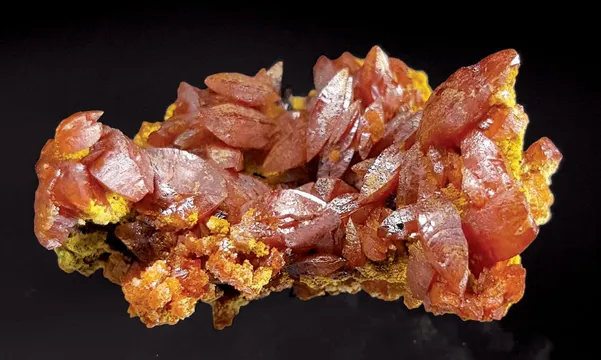
For collectors, San Carlos matters because its best vanadinite has a look unlike the thick, red Moroccan barrels that dominate the modern market. The classic Mexican material tends toward caramel, honey-orange, burnt red, tan-orange and brownish tones; the crystals are commonly elongated hexagonal prisms, skeletal or hoppered individuals, stacked sprays, laths and doubly terminated groups. On the best pieces, glassy colorless to white calcite rhombs grew around or among the vanadinite, giving the crystals an airy, embedded, three-dimensional appearance. Fine San Carlos wulfenite is much rarer, but the best examples are remembered for electric orange-red, gemmy tabular crystals of exceptional size for the locality.
Regional View
Country View
Specimens labeled simply “San Carlos District” almost always need interpretation. Older dealer and collection labels may say San Carlos District, San Carlos mine, Mina San Carlos, or Apex mine; the most precise modern locality for the famous vanadinite is the Apex mine, San Carlos, Manuel Benavides Municipality, Chihuahua. The broader district label remains useful in the marketplace because many old pieces were sold before the present locality hierarchy became standard, but serious collectors should preserve any old label language rather than “correcting” it away.


Search for specimens: View all specimens from San Carlos District, Mexico
The specimen-producing heart of the San Carlos District is the Apex mine at San Carlos in Manuel Benavides Municipality, Chihuahua. Modern locality references treat “San Carlos mine” as a historical or commercial name for the Apex mine, and that distinction matters: many good old specimens carry only the older name, while database records and recent dealer catalogues may use Apex mine for the same collector locality. The mine lies in the Sierra San Carlos of northeastern Chihuahua, in the desert country south of the Big Bend region.
The San Carlos orebody is a small oxidized magnetite-rich zinc-lead skarn and carbonate-replacement deposit. In the regional geological literature, the San Carlos Pb-Zn-Ag skarn deposit and several Pb-Zn-Cu-fluorite epithermal vein prospects are described along the margin of the San Carlos caldera near Manuel Benavides. The skarn deposit is positioned at the crest of the Laramide Sierra Azul anticline, where Lower Cretaceous dolomitic limestone and calcareous siltstone were intruded and metamorphosed by a granitic pluton associated with the roughly 31 Ma San Carlos caldera system.
The contact aureole is important because it explains the deposit’s mineral texture. Near the intrusive heat source, carbonate rocks developed forsterite- and diopside-bearing assemblages, grading outward into tremolite and recrystallized carbonates. In the ore zone, earlier calc-silicate material was replaced by a metasomatic association dominated by magnetite, calcite, galena and sphalerite. This is the primary framework beneath the collectible oxidized suite: a lead-rich, zinc-bearing, carbonate-hosted system with abundant calcite and iron oxides, later opened to supergene alteration.
Commercial mining was not driven by mineral specimens. The mine was worked for argentiferous galena and associated lead-zinc-silver ore, first briefly in the late nineteenth century and then again from about 1930 to 1952. ASARCO operated the mine through the 1950s. The classic specimen material was a byproduct of this mining and of later collecting in old workings, not a purpose-built mineral-collecting operation.
The best-known specimen production appears in several overlapping eras. Old San Carlos vanadinites entered collections and the market by the 1950s, and classic calcite-associated pieces continued to circulate through the 1960s and 1970s. Some dealer accounts and collection notes refer to fine material from the 1970s and 1980s, especially vanadinite crystals scattered on gemmy calcite. A later renewal came in 2018 and 2019, when major finds of vanadinite were reported from the Apex mine; those newer specimens broadened the supply but did not erase the premium attached to older, calcite-rich classics with strong form and provenance.
The ore bodies that matter for collectors are the oxidized, open-space parts of the lead system. Vanadinite occurs with calcite far more often than with thick barite or sandy matrix, and this is a key visual separator from Moroccan material. Common specimen matrices include sulfide-rich host rock, iron-stained carbonate, calcite druses and oxidized gossanous material. The most attractive pieces show vanadinite prisms emerging cleanly from white or colorless calcite rhombs; less attractive examples may be dense masses of small brown prisms with little contrast or many contacted terminations.
San Carlos wulfenite is a special case. The Apex mine is best known for vanadinite, but mineralogical references and dealer records repeatedly stress that the rare wulfenites are among the district’s great prizes. The finest examples are described as gemmy electric orange-red tabular crystals, with exceptional individuals reaching several centimeters; many smaller market specimens show orange tabs on white dolomite or calcite. Wulfenite from this locality is far less common than vanadinite and is easy to miss if a collector thinks of San Carlos only as a vanadinite source.
There is no reliable public collecting program for the old workings. The locality should be treated as permission-only, with the added hazards of abandoned underground mining: unstable workings, shafts, bad ground, desert remoteness and unclear surface or mineral-rights access. For most collectors today, San Carlos is a specimen-market locality rather than a field-collecting destination, and old labels, collection cards and dealer provenance are part of the value.
Vanadinite from the San Carlos District is prized for form and association more than saturated red color: the best Apex mine pieces show lustrous elongated hexagonal prisms, laths, skeletal or hoppered crystals, doubly terminated individuals and airy clusters in honey-orange, caramel, tan-orange, burnt red or brown tones, commonly with colorless to white calcite rhombs. Classic specimens often have crystals in the few-millimeter to roughly centimeter range, while select pieces and later finds produced larger individual crystals; a documented 3 cm hoppered crystal and several cabinet pieces with prisms over 1 cm show the locality at its most sculptural. Good pieces separate themselves by sharp undamaged terminations, visible three-dimensional growth, attractive calcite contrast and old or well-preserved locality provenance; ordinary pieces are usually darker, more crowded, more contacted, or lacking the calcite association that gives San Carlos vanadinite its signature look.
Beyond vanadinite, the district’s collectible suite is anchored by calcite and rare wulfenite, with the Apex mine also documenting descloizite, mimetite, hedyphane, dolomite, galena, sphalerite, magnetite, hematite, quartz and several skarn or ore minerals. Wulfenite is the great rarity: fine orange-red tabular crystals, especially on white dolomite or calcite, are scarce and sought after well beyond Mexican specialists. Descloizite is a more recent micro- to miniature-scale prize, reported as red-brown spherical aggregates of microcrystals on cryptocrystalline quartz. Mimetite and hedyphane reflect the arsenate side of the oxidized lead assemblage, and some older “endlichite” usage should be understood cautiously as arsenic-bearing vanadinite rather than a separate modern species. No type-locality mineral is known to define the San Carlos District; its importance is instead historical and aesthetic, built on a small group of distinctive secondary lead minerals from a very specific oxidized skarn-replacement setting.
The chief authenticity issue is locality discipline. “San Carlos District,” “San Carlos mine,” “Mina San Carlos,” and “Apex mine” may all appear on genuine old material, but they do not all carry the same precision. A serious label should ideally connect the specimen to the Apex mine at San Carlos, Manuel Benavides Municipality, Chihuahua. A label that says only “Chihuahua, Mexico” is weak for locality collecting, because Chihuahua has several vanadinite-producing or vanadinite-bearing districts, including Los Lamentos, Cuchillo Parado and Santa Eulalia-area occurrences.
Visual comparison helps, but it is not foolproof. Typical San Carlos vanadinite is commonly elongated, lathlike, hoppered or skeletal, in orange-brown to caramel colors, often with white or colorless calcite. Los Lamentos material can also be brownish and may include arsenic-bearing vanadinite; Moroccan material is usually more abundant, often redder, and commonly occurs on barite or different matrix styles. Mislabeling is therefore more likely than outright fabrication. Old “endlichite” labels should not be discarded, but the specimen should be catalogued with modern terminology as arsenic-bearing vanadinite unless analysis or a specific reference justifies other treatment.
No well-documented San Carlos-specific treatment or manufactured fake is established in the reliable sources consulted for this guide. The more realistic market problems are repaired crystals, trimmed matrices, upgraded vague labels and specimens from other Mexican localities being sold under the more desirable San Carlos/Apex name. As always with old Mexican vanadinite, repairs should be checked under magnification around crystal bases and across dense clusters; glue can hide well among calcite rhombs and iron-stained matrix.
Condition is critical because San Carlos pieces often owe their value to projecting prisms and open sprays. The vanadinite crystals are relatively soft and brittle, and hoppered terminations chip easily. Calcite is soft, cleaves readily, and can be bruised or etched by careless cleaning. Avoid acid cleaning: even weak acids will attack calcite and can permanently change the specimen’s character. Dust removal should be limited to a hand blower, a very soft brush, or careful low-pressure air used at a safe distance.
Fluorescence is not the reason to buy San Carlos material, but calcite from at least some specimens has been reported to fluoresce green under ultraviolet light. Treat this as a pleasant accessory feature, not a diagnostic test. The vanadinite itself contains lead, so normal mineral-handling hygiene applies: do not grind or lick specimens, wash hands after handling, and keep broken dust away from children and food areas.
Market availability is uneven. Small vanadinite-on-calcite specimens appear periodically, and later finds have made loose clusters and miniatures easier to obtain than they once were. Fine old calcite-rich pieces with elegant hoppered crystals, strong color, no damage and older provenance are still genuinely scarce. Wulfenite from San Carlos is much rarer than vanadinite and should be evaluated carefully for locality accuracy; a good, undamaged wulfenite from the Apex mine is a serious Mexican locality specimen even when small.
San Carlos has always had a quiet, almost under-labeled fame. It is close enough to the United States to feel familiar to North American collectors, yet it never became a mineral-tourism name like Ojuela. Its specimens often traveled modestly: a few orange-brown crystals on calcite, a handwritten “San Carlos, Chihuahua,” a dealer tag from a long-closed shop, perhaps no mention at all of the Apex mine. Then, when collectors learned the style, the pieces became difficult to ignore. The vanadinite did not shout with scarlet color; it won by architecture.
One of the most memorable modern descriptions came from Thomas P. Moore in a 2008 Mineralogical Record online note written just after he had finished his article on the locality. He described a small vanadinite from the old Apex mine as the best little example he had seen, despite having recently examined many pictures for the locality article. The specimen, in the Kiyoshi Kiikuni collection, was only 3 cm long, but it displayed exactly what makes San Carlos distinctive: hoppered form and lively orange color, the kind of single small object that can explain an entire locality better than a tray of lesser pieces.
A humbler but equally revealing episode comes from the 2015 Colorado Springs Mineralogical Society Pick & Pack account of a Tucson purchase. The writer was not celebrating a trophy bought in a hotel room; he was hunting the lower end of the show, among “mom and pop” dealers and five-dollar specimens. His best purchase in that category was a San Carlos hand specimen: tan to tan-orange vanadinite crystals scattered on gemmy calcite. The largest crystals were about 5 mm, and one photomicrograph singled out a 4.5 mm crystal showing the typical hexagonal cross section. Under ultraviolet light the calcite fluoresced green. That little specimen captures the real collecting appeal of San Carlos: even inexpensive pieces can carry the locality’s exact visual grammar.
The district also has a story of reappearance. For decades, San Carlos vanadinite never vanished entirely, but it stayed elusive. Old specimens circulated, new ones appeared occasionally, and then major vanadinite finds were reported in 2018 and 2019. Those finds shifted the market: collectors who had known San Carlos mostly from old labels suddenly saw fresh clusters, some without the classic calcite association. The newer pieces broadened the picture but also sharpened connoisseurship. A modern cluster can be excellent, yet an older calcite-rich miniature with hoppered orange prisms still has a different historical charge.
In 2023 the locality delivered a different sort of footnote. Thomas P. Moore’s online report noted two miniatures offered by Isaias Casanova of IC Minerals from what appeared to be a new find at the Apex mine. They were not the old sought-after wulfenites, and they were not the recent vanadinite clusters either. They were descloizite: red-brown spherical aggregates of microcrystals scattered on cryptocrystalline quartz. One 3.8 cm specimen was priced at $70, the other slightly larger at $80. The report’s tone was almost amused relief: the famous wulfenite had not returned, but the old lead mine had produced something genuinely different.