






A collector's guide to Dara-e-Pech pegmatite field, Afghanistan: its geology, mining history and notable minerals, illustrated with the 329 specimens documented from this locality on EarthWonders.
Key facts
The Dara-e-Pech pegmatite field occupies a storied place in the modern history of gem-crystal collecting: a rugged Kunar Province pegmatite district that has yielded superb spodumene, elbaite, morganite, beryl, cleavelandite, quartz, lepidolite, and rare tantalum-niobium species from miarolitic cavities in highly evolved rare-element pegmatites. In collector language it is often encountered under variant labels—Darra-i-Pech, Darra-e-Pech, Pech, Peech, Page, or simply “Pech Valley”—and older labels may place it broadly in “Nuristan” in the traditional northeastern-Afghan sense rather than the present-day province.
Geologically, the field belongs to the rare-metal pegmatite belt of northeastern Afghanistan. Its best-known bodies are Be-Nb-Ta-Li-rich granitic pegmatites emplaced in and around mafic to intermediate intrusive rocks, especially rocks of the Nilaw complex, with genetic ties discussed in the literature to the Laghman granitoid system. The pegmatites are not merely massive lithium bodies: the collector value comes from highly differentiated, pocket-bearing zones where quartz cores, blocky microcline, sugary albite, cleavelandite, lepidolite, tourmaline, beryl, and spodumene were able to crystallize freely.
The finest Dara-e-Pech specimens have a distinctive visual language. Pink to peach morganite sits as thick tabular hexagons on snow-white cleavelandite; green, blue, and bicolored tourmaline pencils pierce quartz and albite; lavender-pink kunzite and other colored spodumene crystals show etched faces, sharp chisel terminations, and strong pleochroism; and the best combination pieces have the improbable pastel balance that makes Afghan pegmatites so immediately recognizable across a room.
Regional View
Country View
The locality’s importance is both aesthetic and historical. The first reported gem elbaites and matrix specimens of kunzite and elbaite in the Pech pegmatites were found in 1959 near Goh Salak, south of Kala village, and by the early 1970s such crystals were reaching Kabul street markets. In the mid-1980s and early 1990s, Dara-e-Pech specimens began appearing in serious numbers at European and American mineral shows, changing the standard for Afghan pegmatite minerals and alerting collectors to the valley’s capacity for world-class morganite, elbaite, and spodumene.


Photo: Daderot / Wikimedia Commons
Search for specimens: View all specimens from Dara-e-Pech pegmatite field, Afghanistan
Dara-e-Pech is a rare-element granitic pegmatite field centered in the Pech Valley region of Kunar Province. The modern locality grid reference is centered near 34°57' N, 70°49' E, but specimen labels are notoriously elastic: “Pech Valley” material in the trade may include mines and pegmatites across a broader northeastern-Afghan collecting district, and older labels may use “Konar,” “Kunar,” “Chapa Dara,” “Nuristan,” or one of several spelling variants for the valley. For high-value specimens, a sublocality name such as Kanakana, Goh Salak, Gulsalak, Digal, Voradesh, Gamata, Kantiwa, Kala, or Bigal adds real provenance value.
The pegmatites are Be-Nb-Ta-Li-rich bodies hosted in a variety of rocks, with important gem-bearing bodies emplaced in gabbro-dioritic rocks of the Nilaw complex and spatially related to granitoids of the Laghman complex. Recent petrographic work in the Darai Pech valley recognizes a progression from less evolved plagioclase-microcline-biotite-muscovite pegmatites with schorl and sparse beryl, through albitized microcline and microcline-albite pegmatites with beryl, columbite-tantalite, schorl, kunzite, and polychrome tourmaline, to albite and albite-spodumene pegmatites carrying columbite-tantalite, cassiterite, cleavelandite, lepidolite, kunzite, and polychrome tourmaline.
Field measurements from recent studies document more than 20 pegmatite bodies in the Darai Pech area, with individual veins extending from several hundred meters to about 2.5 km and thicknesses from about 1 to 25 m in studied exposures. Earlier regional summaries describe rare-metal pegmatite veins and vein zones in northeastern Afghanistan reaching kilometer scale, and the collector-rich bodies are typically those with strong internal zoning, quartz cores, blocky feldspar zones, albite-rich replacement, lepidolite-cleavelandite-spodumene zones, and miarolitic cavities.
The internal structure is central to understanding the specimens. In the microcline-albite veins, researchers have described granite-pegmatite selvages, medium- to coarse-grained quartz-albite zones, blocky microcline, graphic quartz-albite-microcline zones, irregular albite complexes, and quartz cores. Spodumene-bearing zones may include white, pink, violet, and polychrome crystals, with transparent gem-quality spodumene concentrated in miarolitic cavities and quartz-core environments. Around mica nests, small plates of columbite-tantalite are reported; in more evolved albite-spodumene zones, cleavelandite, lepidolite, tourmaline, cassiterite, and tantalum-niobium minerals become increasingly important.
Mining has been almost entirely artisanal and small-scale, though the bodies themselves can be substantial. The first recognized gem finds were made in 1959 near Goh Salak by the sheepherder Djan Gul. Villagers around Kala soon began collecting crystals from pegmatites close to the valley floor and from more remote bodies on the surrounding slopes. In the 1960s and early 1970s, farmers plowing fields on the south bank of the Pech River and along the adjacent mountain slope found elbaite; by the early 1970s, crystals were being sold in Kabul markets as souvenirs. During periods when Afghan law reserved mineral exploitation to the Ministry of Mines, local miners reportedly worked at night and hid specimens until they could be sold.
The most productive mines named in the collector literature include Kala, Goh Salak, Voradesh, Kanakana, Gamata, Kantiwa, and Bigal. The “Field mines” near Kala begin close to cultivated fields, while Goh Salak includes the Lohi Maden, or “Big mine.” Kanakana is described as one of Afghanistan’s largest gem pegmatites, notable for blue indicolite elbaite and for pockets that have produced kunzite and morganite. Gamata is remembered for gemmy blue indicolite “pencil” crystals from the 1970s through the mid-1990s. Kantiwa has produced etched blue spodumene, green elbaite, and other colored spodumene. Bigal is associated with some of the finest morganite combination specimens from the valley.
Open-source satellite analysis has described multiple mining areas in the Pech Valley, including lower-altitude workings near villages and additional workings on ridge lines. Some areas reportedly contain more than 20 tunnels, with certain tunnels extending more than 300 m. Activity was documented at north and south mine areas between 2017 and 2022, including enlarged spoil piles, new buildings, and new mine-related infrastructure. The same reporting lists year-round mining potential at Dara-e-Pech, unlike higher-elevation Afghan localities whose seasons are sharply limited by snow.
Collecting access today should be regarded as closed to casual field collectors. The mines are local, remote, politically sensitive, and in places physically dangerous. Some routes to higher workings have been described as extremely narrow footpaths above sheer drops, and open reporting notes a lack of proper safety equipment at some workings. For collectors outside Afghanistan, Dara-e-Pech specimens are normally acquired through the international mineral trade, especially via Afghan and Pakistani dealer networks, long-established Western dealers, auction houses, museum deaccession or exchange histories, and contemporary online specimen markets.
Spodumene is the defining lithium mineral of Dara-e-Pech, occurring as long-prismatic, tabular, bladed, and locally etched crystals in spodumene-microcline-albite and spodumene-lepidolite-cleavelandite zones, especially around quartz cores and miarolitic cavities at Digal, Gulsalak, Kanakana, Kantiwa, and related Pech Valley workings. Documented crystals range from ordinary opaque white and grayish-white ore material to gemmy pink, violet, pale green, blue, yellowish, and polychrome crystals; recent geochemical work on Digal and Gulsalak material shows that color zoning is tied to changing trace-element contents, especially manganese and iron. Collector-grade pieces are judged by transparency, undamaged chisel or wedge terminations, strong pleochroism, attractive etching rather than corrosion, and intact association with cleavelandite, quartz, elbaite, lepidolite, or morganite; loose shards and cleaved pieces are common, while matrix crystals with sharp form and balanced pastel color are the prizes.
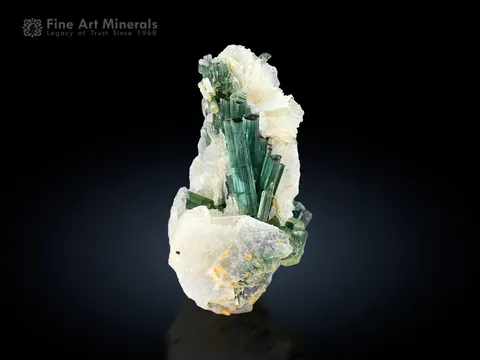
Elbaite from Dara-e-Pech is among the most coveted Afghan tourmalines, especially the second-generation green to blue “pencil” crystals and blue indicolite crystals from Pech Valley pegmatites such as Goh Salak, Kanakana, Gamata, and Kantiwa. The finest crystals are gemmy, lustrous, and delicately colored, commonly green, blue-green, blue, deep indigo, pink-green-pink, or bicolored, with complex terminations and associations with cleavelandite, quartz, lepidolite, spodumene, and morganite. Gamata produced important blue indicolite pencils 17 to 25 cm long in the 1970s through the mid-1990s, while Kanakana is especially associated with large blue indicolite and gem rough; the best pieces combine full termination, intact prism faces, saturated but natural color, and matrix context, whereas broken pencils, repaired crystals, and over-dark treated pieces are much less desirable.
Dara-e-Pech morganite is famous for thick tabular to equidimensional hexagonal crystals in cream, pale pink, peach-pink, and stronger rose tones, typically perched on cleavelandite with quartz, elbaite, kunzite, lepidolite, muscovite, smoky quartz, or tantalite-(Mn). Published descriptions record crystals from roughly 1 x 1 cm to 5 x 10 cm in ordinary material, while collector literature illustrates Pech Valley morganites to far larger cabinet and museum scale, including crystals around 20 to 25 cm and major combination specimens from Kanakana and Bigal. The signature high-end look is a sharp, glassy, tabular morganite rising cleanly from white cleavelandite or quartz, sometimes with a pale aquamarine core; color, completeness, transparency, and undamaged edges separate fine Dara-e-Pech morganites from the many paler, contacted, or cleaved examples.
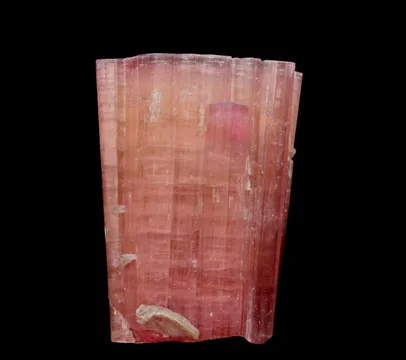
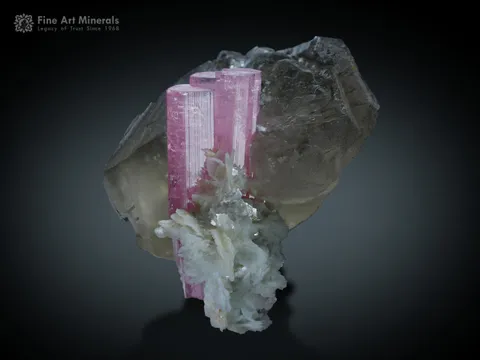
Tourmaline at Dara-e-Pech spans black schorl in less evolved plagioclase-microcline-biotite-muscovite pegmatites and colorful lithium tourmaline in the evolved albite-spodumene systems, so the name on a label can mean anything from dark accessory prisms to elite gem elbaite. The field’s collectible tourmalines include blue indicolite, green elbaite, rubellite, and bicolored crystals, commonly associated with cleavelandite, quartz, lepidolite, spodumene, and morganite in the same pockets that produced the locality’s pastel combination specimens. Good pieces show luster, transparency, natural color zoning, undamaged terminations, and convincing contact relationships with matrix; ordinary pieces are broken pencils, included rough, or single crystals lacking provenance to a named Pech Valley pegmatite.
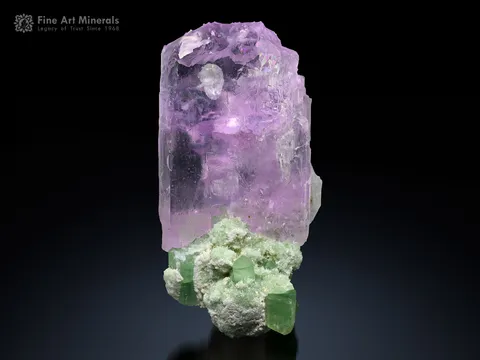
Kunzite is the pink to lilac spodumene variety that made Afghan pegmatites famous, and Dara-e-Pech examples occur as bladed to prismatic crystals, commonly vertically striated, pleochroic, and sometimes etched, in association with cleavelandite, quartz, lepidolite, elbaite, morganite, feldspar, and muscovite. Kanakana produced a 2015 giant pocket with 260 kg of spodumene, including about 40 kg of flawless razor-sharp crystals, many about 20 cm long and still larger pieces reaching 40 cm and several kilograms; other Pech Valley pieces reach cabinet to museum size, but matrix examples remain scarcer than loose crystals and shards. The best kunzites here combine saturated natural pink-lilac color, transparency, broad undamaged faces, crisp terminations, and a stable matrix setting; strong edge bruising, cleavages, sun-faded color, or suspicious orange-pink tones lower desirability.
Beryl at Dara-e-Pech includes morganite, aquamarine, goshenite, and less specifically colored beryl, occurring in albitized microcline pegmatites and evolved pocket zones with cleavelandite, quartz, muscovite, elbaite, lepidolite, and spodumene. Coarse-crystalline beryl is one of the marker minerals of the field’s intermediate pegmatite type, while the best collector specimens are not anonymous beryl masses but distinct hexagonal crystals—tabular morganite, pale aquamarine, or beryl with an aquamarine core and pink outer zone—set on contrasting white albite. For collectors, “Dara-e-Pech beryl” is strongest when the crystal has a clear varietal identity, sharp basal faces, attractive color, and undisturbed matrix; massive beryl, damaged crystal sections, and material with vague valley provenance are far more common.
Quartz is the architectural mineral of many Dara-e-Pech specimens: it forms cores in zoned pegmatites, colorless crystals on microcline, pale smoky crystals with morganite or elbaite, and matrix plates that once carried spodumene or beryl crystals before miners broke them off for gem rough. Published figures include Pech Valley quartz with blue elbaite inclusions and quartz associated with morganite, cleavelandite, spodumene, and smoky quartz; at Bigal, a celebrated 2012 specimen placed a large gem morganite vertically on colorless quartz crystals, microcline, and cleavelandite. Good quartz specimens from Dara-e-Pech are valued less as isolated quartz than as honest pegmatite context—clear, lustrous, undamaged crystals that frame a gem species or show unusual inclusions—while very dark smoky quartz on Afghan pieces deserves scrutiny for possible irradiation.
Albite is both a rock-forming and display-forming mineral in Dara-e-Pech, appearing as sugary masses, fine-grained albite zones, and bladed cleavelandite that provides the white matrix for morganite, kunzite, elbaite, fluorapatite, tantalite-(Mn), and quartz. In the field’s zoning sequence, albite becomes increasingly important in the more evolved pegmatites, and recent work describes a diverse albite complex between selvage zones and quartz cores, as well as sugary albite in quartz-spodumene-albite zones. Fine albite specimens from this locality are usually judged by their associated species: bright, clean, undamaged blades that contrast with pastel gem crystals are desirable, while granular albite without a display mineral is mainly of geological interest.
Lepidolite from Dara-e-Pech occurs in evolved spodumene-cleavelandite-lepidolite zones, commonly as sugary, granular, or coarse mica aggregates with cleavelandite, albite, kunzite, polychrome tourmaline, quartz, morganite, and tantalum-niobium minerals. It is an important visual and paragenetic companion rather than usually the headline species: pink to lilac lepidolite can set off green elbaite, peach morganite, or pink spodumene, and some major Bigal material included morganite resting on a substantial block of fine lepidolite. The best pieces show fresh lavender to pink color, sparkle, and a strong association with gem crystals; friable, dull, mica-rich matrix with no sharp companion mineral is abundant and much less collectible.
Cleavelandite, the platy variety of albite, is the classic Dara-e-Pech matrix mineral, forming white blades, sprays, and books that cradle morganite, kunzite, elbaite, quartz, lepidolite, tantalite-(Mn), and fluorapatite. In the field’s most evolved zones, cleavelandite increases along with rare-metal and gem mineralization, and recent descriptions specifically place lamellar cleavelandite with sugary lepidolite in spodumene-cleavelandite-lepidolite zones. For collectors, pristine cleavelandite matters because it supplies contrast and scale; snow-white, undamaged blades around a floating pastel crystal can make a specimen, while crushed albite, glue-filled contacts, or trimmed bases that cut through the cleavelandite reduce confidence and value.
Indicolite from Dara-e-Pech is the blue to blue-green elbaite that collectors associate especially with Pech Valley pockets at Kanakana, Gamata, and related workings. Gamata’s classic production included gemmy blue “pencil” crystals 17 to 25 cm long, though many were broken from quartz matrix and sold for faceting; Kanakana has produced important blue indicolite elbaite and, in 2012, specimens described as 150-kg pieces carrying large blue indicolite crystals. Fine indicolite specimens here are rare: the best show transparent blue to deep indigo color, glassy luster, complete terminations, and matrix with cleavelandite or quartz, while cleaved rough and repaired pencil fragments are much more often encountered.
Tantalite at Dara-e-Pech is a rare but important collector and paragenetic mineral, appearing as tantalite-(Mn) and broader columbite-tantalite mineralization in the evolved albitized microcline, albite, and albite-spodumene pegmatites. It is typically associated with albite or cleavelandite, lepidolite, quartz, feldspar, morganite, and other late-stage minerals; one notable Bigal specimen from the 2013 mining season carried a 2.5-cm gemmy red tantalite-(Mn) crystal beside a 6-cm morganite on quartz, feldspar, lepidolite, and cleavelandite. The best pieces are sharp, lustrous, well-isolated crystals with identifiable habit and strong matrix context; massive black grains or unverified “tantalite” plates in mica-rich matrix require analytical caution because columbite-tantalite group members are difficult to separate visually.
Feldspar in the Dara-e-Pech pegmatites includes microcline, oligoclase, albite, and cleavelandite, with blocky microcline and albite-rich zones forming a major part of the pegmatite architecture. Microcline can occur as large blocky crystals beneath quartz and cleavelandite in the most famous combination pieces, and pale feldspar matrices are reported with spodumene, hiddenite-labeled green spodumene, morganite, quartz, and tourmaline. Collectible feldspar from Dara-e-Pech is usually a supporting actor: sharp, blocky crystals or clean pale matrices add structure to gem combinations, while feldspar alone is seldom competitive unless unusually aesthetic, strongly zoned, or historically tied to a notable pocket.
Muscovite is widespread in Dara-e-Pech pegmatites, from biotite-muscovite assemblages in less evolved plagioclase-microcline veins to more evolved zones where muscovite increases as biotite wanes. It occurs as mica books, plates, silvery to yellowish accents, and fine mica-rich matrix with morganite, beryl, quartz, lepidolite, cleavelandite, schorl, and tourmaline; in Afghan pegmatites, mica nests are also important sites around which tantalum-niobium minerals may concentrate. Good muscovite pieces from this field are normally combination specimens where lustrous mica provides texture without overwhelming the gem crystal; bruised mica books and friable matrix are common, so undamaged, well-composed examples are preferred.
Smoky quartz from Dara-e-Pech occurs as light smoky to grayish crystals associated with morganite, elbaite, cleavelandite, and spodumene, and it can add valuable contrast to otherwise pastel pegmatite specimens. Collector literature illustrates Pech Valley morganite with smoky quartz, elbaite with smoky quartz and cleavelandite, and spodumene with smoky quartz; however, Afghan smoky quartz must be viewed with caution because artificial irradiation of pale quartz on Afghan and Pakistani pegmatite specimens is a documented practice. The best Dara-e-Pech smoky quartz is naturally plausible in tone, lustrous, and structurally integrated with the matrix; unnaturally dark quartz paired with orange-pink kunzite or overly vivid tourmaline should be treated as a warning sign rather than a bonus.
Green spodumene from Dara-e-Pech is sometimes marketed as hiddenite, and specimens include yellow-green to mint-green, transparent to translucent crystals, occasionally doubly terminated or bicolored with pale golden centers. Strictly speaking, collectors should distinguish trade “hiddenite” from chromium-colored hiddenite in the gemological sense; recent spodumene geochemistry from Afghan pegmatites shows generally low chromium in many analyzed crystals and attributes much color variation to manganese and iron relationships. Fine Dara-e-Pech green spodumene is valued for clarity, sharp terminations, pleasing green hue, and completeness, but the species’ perfect cleavage, color instability, and the possibility of irradiation-related color changes make careful provenance, handling, and disclosure especially important.
Chloritoid is an unusual Dara-e-Pech specialty and quite unlike the field’s pastel gem minerals: collectible pieces are dark green to nearly black, lustrous, tabular crystals and clusters, reportedly from a small number of significant finds, especially material that entered the market around the late 1990s through Herb Obodda. Fine specimens are rare because chloritoid is seldom seen in sharp, attractive collectible crystals, and clusters are much less common than broken single crystals; one documented miniature has tabular crystals to 3.6 cm, high luster, and a good termination, while another well-known thumbnail passed from Herb Obodda to Alex Schauss after the 2000 Tucson show. The best pieces are lustrous, complete, sharply tabular, and preferably ex-Obodda or otherwise well provenanced; ordinary black plates without form or history are far less compelling.
Other documented minerals from the Dara-e-Pech pegmatite field include bavenite, beryllonite, biotite, cassiterite, columbite-(Fe), columbite-(Mn), fluorapatite, fluornatromicrolite, grossular, hydroxylherderite, microcline, oligoclase, pezzottaite-(Cs), pollucite, scapolite, schorl, spessartine, tantalowodginite, topaz, tungstibite, viitaniemiite, wodginite, and zircon. The field is better known for rare and aesthetic occurrences than for type-locality species: pezzottaite-(Cs), viitaniemiite, fluornatromicrolite, tungstibite, and beryllonite are collector-significant rarities here, while purple fluorapatite has recently attracted scientific attention because U-Pb work on Dara-e-Pech apatite helped constrain Early Cretaceous magmatic-hydrothermal activity in the field.
Dara-e-Pech specimens require careful locality scrutiny. “Pech,” “Darra-i-Pech,” and “Dara-e-Pech” have been used broadly in the trade, and older labels may conflate the pegmatite field with the wider Pech Valley or with “Nuristan” as a cultural-geographic term. A specimen simply labeled “Afghanistan,” “Nuristan,” or “Pech Valley” may be perfectly genuine but not necessarily from the mapped Dara-e-Pech pegmatite field. Named sublocalities such as Kanakana, Gamata, Goh Salak, Gulsalak, Digal, Kala, Voradesh, Kantiwa, or Bigal materially improve the quality of the provenance.
The most important treatment concern is irradiation. Afghan and Pakistani pegmatite specimens—especially kunzite, tourmaline, quartz, topaz, scapolite, aquamarine, and fluorite—have been subjected to irradiation and sometimes subsequent light exposure or heating to alter color. A specifically documented warning sign for Afghan pegmatite specimens is unnaturally dark smoky quartz associated with kunzite that has taken on an orange-pink color. Overly saturated pink tourmaline, inky blue tips on aquamarine, emerald-green spodumene, or intense smoky quartz on otherwise pale pegmatite matrix should prompt questions about treatment history.
Kunzite and other spodumene require light-conscious display. Pink and purple spodumene can fade with prolonged exposure to strong light, and some blue or green Afghan spodumene is known to change color on exposure. The safest practice is low-light display, no sunny windows, and storage in the dark when not on view. Spodumene also has perfect cleavage; even large crystals can split, bruise, or chip along cleavage planes, so mounting and shipping must support the entire crystal rather than the base alone.
Morganite is usually more stable than spodumene but commonly shows edge bruising, basal contacts, cleaves, and repairs because tabular beryl crystals can be heavy and exposed on delicate cleavelandite. Examine the junction between morganite, cleavelandite, and quartz for glue, filled breaks, or reattached crystals. Matrix repair is not automatically disqualifying for old Afghan pieces—many were extracted and transported under difficult conditions—but it must be disclosed.
Elbaite and indicolite from Dara-e-Pech are particularly vulnerable to broken tips, repaired pencils, and reassembled matrix specimens. The long, slender, high-value crystals were historically broken from matrix for gem rough, and some later “matrix” pieces may be restored or aesthetically improved. Look for continuous crystallization at the contact, matching surface weathering, consistent luster, and absence of glue halos.
Chloritoid from Dara-e-Pech is a specialist rarity and should be bought with provenance whenever possible. The best-known material has an old-market history connected with Herb Obodda and late-1990s to 2000 circulation; because the species is dark and visually subtle, a sharp old thumbnail with pedigree can be more important than a larger but poorly formed plate.
Market availability is uneven. Commoner Dara-e-Pech material—loose kunzite, small morganite on albite, pale green or bicolored tourmaline, cleavelandite matrix, and broken spodumene crystals—appears regularly. Top-tier matrix morganite, blue indicolite, complete gemmy elbaite pencils, major kunzite combinations, and old-provenance rarities such as fine chloritoid or tantalite-(Mn) remain scarce and can move rapidly into private or museum collections.
The Dara-e-Pech story begins not with a formal mining company but with a sheepherder. In 1959, Djan Gul found gem elbaite and matrix specimens of kunzite and elbaite near Goh Salak, south of Kala village. When he brought the crystals back to Kala, local people understood quickly that the hills above the Pech River were not just pasture and rock. By the 1960s, villagers plowing with oxen on the south bank of the river and along the mountain slope bordering the fields were finding gem elbaite. Within a decade, these crystals were turning up in Kabul street markets, sold to tourists as souvenirs before the Western collector market fully understood what the valley could produce.
The legal setting gave those early finds a clandestine edge. Afghan law then reserved exploitation of geological resources to the Ministry of Mines, so farmers and villagers around Kala reportedly worked the pegmatites at night. The specimens were not immediately paraded in the village; they were buried, hidden, and later carried to Kabul for sale. The mines nearest Kala came to be called the Field mines because they began just beyond the cultivated fields—a wonderfully literal name for one of the great gem-crystal neighborhoods of northeastern Afghanistan.
The routes to some workings were as memorable as the minerals. Many Pech mines lay near villages on the valley floor, but others were high on ridges reachable only by dangerous footpaths. One path was described as only a few inches wide, with a vertical drop of 500 m off the edge. The romantic pastel specimens in cabinets today often began their journey on trails like that: quartz, cleavelandite, morganite, and spodumene carried down from steep ground by miners with little protective equipment and no margin for a misstep.
The Pech Valley also shaped the behavior of the international specimen market. At Goh Salak, the largest mine was called the Lohi Maden, the “Big mine,” and gem elbaite nodules from the area moved quickly to Peshawar. Faisal Umar Shinwari, an expert tourmaline dealer, coined one of the best expressions in the Afghan gem trade: “every parcel of gem rough has a king and a queen.” In other words, among a parcel of rough there might be two pieces that made the whole transaction worthwhile.
By the late 1970s, Western dealers were beginning to understand not only the value of the crystals but also the damage being done to them. Gamata produced gemmy blue indicolite “pencil” crystals 17 to 25 cm long during the 1970s, but many were broken off their quartz matrices and sold for cutting because sellers thought matrix reduced the price. When Rock Currier saw sacks of broken-off crystals brought to Landi Kotal, he was furious. After visiting the Umar Shinwari family in the late 1970s, Currier became, after Herb Obodda, one of the first Westerners to teach local dealers how to wrap and protect mineral specimens rather than treat them only as gem rough. He wrote long letters to Asmat Umar Shinwari explaining how to safeguard, carry, pack, and ship specimens, and even lent the family $500 while they were starting their mineral business.
The Kanakana pegmatite delivered one of the great modern pocket stories. In 2015 it produced a giant pocket containing 260 kg of spodumene in bicolored, purple, and pale green crystals. About 40 kg consisted of flawless, razor-sharp crystals, many around 20 cm long and 12 cm wide, with larger crystals reaching 40 cm and weighing 5 to 8 kg. Another Kanakana pocket yielded about a dozen specimens with morganite crystals 8 to 10 cm across on cleavelandite, quartz, and elbaite. A later January 2016 pocket produced a large quartz specimen with a 20-cm morganite crystal, two kunzite crystals, and a green-red bicolored tourmaline on the back.
One of the most famous Pech Valley specimens passed through a drama worthy of the piece itself. A man named Manidullah brought the specimen from the village of Waygal and sold it to Malem Haji, who was partnered with the German-based Afghan gem dealer Daoud Wafa. Negotiations dragged through 1987 and 1988, and the specimen remained hidden until the partnership ended. At Tucson in 1990, Daoud Wafa brought the still-uncleaned specimen out from under his bed at the Executive Inn and showed it with an asking price of $80,000. Wayne Thompson and partners Gene Meieran and Karl Kempf eventually bought it for $54,000. After cleaning and trimming, it was exhibited at the Tucson Gem and Mineral Show the next year, and its value was judged at $250,000. The specimen later passed through several dealers and entered the collection of the Mim Museum in Beirut.
Bigal added another chapter in 2012. From one of about 20 mine tunnels, some reportedly up to 300 m long, miners recovered a matrix of colorless quartz crystals on large microcline crystals with white cleavelandite blades and a vertical, totally gemmy morganite crystal 12 cm across. The same year produced specimens with large blue indicolite elbaites weighing around 150 kg. In the 2013 season, a Bigal tunnel yielded a specimen with a 6-cm morganite beside a 2.5-cm gemmy red tantalite-(Mn) on quartz, feldspar, lepidolite, and cleavelandite, plus another specimen with a lustrous 20-cm morganite with a pale aquamarine-colored core resting on a 25-cm block of fine lepidolite. Two green gemmy elbaite pencils to 14 cm and several kilograms of green gem rough came out as well, just before political problems reportedly halted mining in October 2013.

,_Darra_Pech,_Afghanistan_-_University_of_Arizona_Mineral_Museum_-_University_of_Arizona_-_Tucson,_AZ_-_DSC08522.jpg)