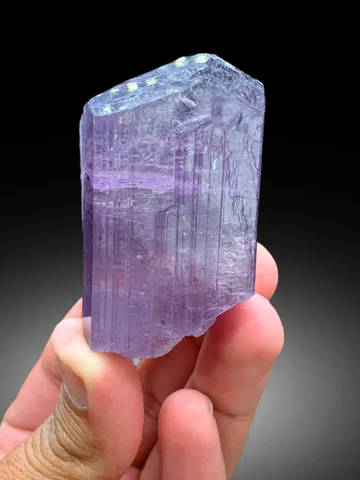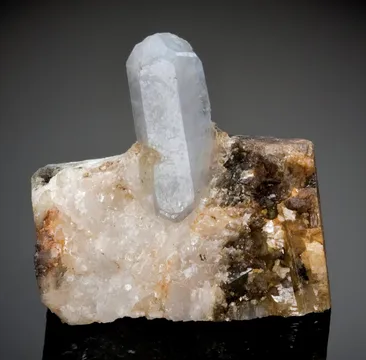
Dar-e-Zu mine, Afghanistan — famed Badakhshan lapis lazuli locality with sharp lazurite in white marble and rare afghanite/sodalite finds for collectors.
Key facts
Dar-e-Zu is one of the small but resonant names inside the great Sar-e-Sang lapis-lazuli district of Badakhshan, the high Hindu Kush source that made Afghan lapis the standard of comparison for the ancient world and still gives collectors their mental image of the species: midnight-blue lazurite in white calcite-marble, sparked by pyrite and accompanied by a suite of sodalite-group and cancrinite-group rarities. The mine lies within the Ladjuar Medam lapis deposit, in the Kokcha Valley system of Kuran wa Munjan District. In older and trade literature the name appears as Darreh-Zu, and it is often treated together with the broader Sar-e-Sang/Ladjuar Medam mines because the workings, dumps, labels, and specimen trade overlap across a compact but geologically complex skarn-and-marble belt.
The collector importance of Dar-e-Zu rests on that overlap: a legendary lapis deposit, a type-locality neighborhood for afghanite, and a specimen style unlike almost any other blue-mineral locality. The geology is not a simple “vein” source. Lapis-bearing bodies occur in calcite- and dolomite-marble, diopside skarn, forsterite-bearing calciphyre, and halogen- and sulfur-rich metamorphic assemblages interpreted as products of high-grade metamorphism and metasomatism of carbonate and evaporitic sedimentary rocks. This unusual chemical setting—sodium, chlorine, sulfur, carbonate, calcium, magnesium, aluminum, and silica available in the right proportions—allowed lazurite, sodalite, afghanite, marialite, nepheline, calcite, pyrite, diopside, phlogopite, and other species to develop in intimate, visually dramatic associations.
Regional View
Country View
The best specimens from the Dar-e-Zu/Sar-e-Sang system are not merely blue rocks. They are sharp, isolated lazurite or sodalite-group crystals set in white marble; marialite and afghanite pieces that become entirely different specimens under ultraviolet light; and lapis blocks where blue, white, gold, and mica-brown components form a natural mosaic. Fine pieces are judged by depth and evenness of blue, freedom from distracting calcite veining when the specimen is lapis, sharpness and isolation when the specimen is crystallized lazurite, and by confirmed species identity and fluorescence when the specimen is one of the more technical Sar-e-Sang rarities.
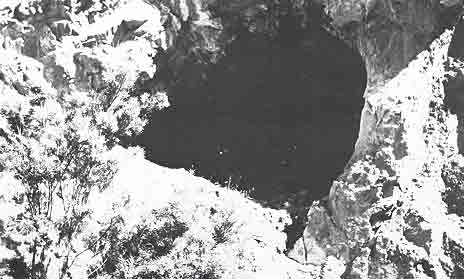
Photo: Pala International, Peter Bancroft archive
The old Darreh-Zu portal has been described in the gem literature and shown in Peter Bancroft’s classic Afghan lapis account as an exhausted working. That historical status is important for collectors: many specimens carrying a Dar-e-Zu or Darreh-Zu label belong to an older collecting and trading tradition, while newer material may be labelled more broadly as Sar-e-Sang, Ladjuar Medam, Kokcha Valley, or simply Badakhshan. Those names are not interchangeable in a strict curatorial sense, but the specimen market has long used them with varying precision, so old labels deserve to be kept and read carefully.
Search for specimens: View all specimens from Dar-e-Zu mine, Afghanistan
Dar-e-Zu mine is a sublocality of Ladjuar Medam, the “lapis mine” area at Sar-e-Sang in the Kokcha Valley of northeastern Afghanistan. It is recorded as a mine, with Darreh-Zu as an alternative historical spelling, and is situated only a short walk down-valley from Ladjuar Medan in the compact Sar-e-Sang mining area. Coordinates for Dar-e-Zu are approximate, but the setting is clear: the right-bank Kokcha River highlands of Badakhshan, among steep, barren slopes and high-elevation workings that have always imposed strong seasonal limits on mining.
The deposit type is best described as a high-grade metamorphic and metasomatic lapis-lazuli skarn-marble system. At Sar-e-Sang the lapis-bearing bodies lie in calcite- and dolomite-marble associated with diopside skarn and forsterite-bearing calciphyre. Research on the district has emphasized the importance of former evaporitic components: chlorine, sulfur, carbonate, and saline fluids are central to the formation of lazurite, sodalite-group minerals, scapolite/marialite, afghanite, pyrite, and related species. Peak metamorphic conditions in the scapolite-bearing rocks of Sar-e-Sang have been calculated at high-pressure amphibolite facies, about 750°C and 1.3–1.4 GPa, followed by retrogression and metasomatic overprinting that introduced or modified several of the halogen- and sulfur-bearing minerals collectors prize today.
The ore bodies are lens-like and layered rather than broad, uniform seams. In the broader Sar-e-Sang deposit, skarn and lapis bodies have been described as beds and lenses in a gray skarn band within thick white cipolin marble. Individual lapis-bearing zones may be only a few meters thick and laterally discontinuous, but the richest lenses produce compact blocks of unusually saturated blue stone. Larger masses commonly show zoning: mixed cores of feldspar, diopside, calcite, and lazurite; darker blue zones richer in fine-grained lazurite, diopside, and scapolite; and margins of calcite, diopside, forsterite, and pyrite. The presence of pyrite is not incidental decoration—it is one of the visible signs of the sulfur-rich chemistry that favors lazurite.
Historically, Sar-e-Sang is among the most important gem-mineral districts on Earth. Badakhshan lapis moved west into Mesopotamia and Egypt in antiquity and later became the raw material for true ultramarine pigment, the costly blue reserved for the most prestigious painting commissions before synthetic ultramarine was developed in the nineteenth century. The local workings were documented by European travelers and geologists over the nineteenth and twentieth centuries, and French and Soviet geological missions added modern petrological and economic descriptions in the 1960s and later. Pierre Bariand’s collecting and study in the district were especially important for mineral collectors because the work led to the description of afghanite and to better documentation of crystallized lazurite.
Mining methods have changed, but the terrain has not. Early mining exploited fire-setting—large wood fires were used to fracture the hard limestone and marble—while later work used dynamite. Blocks were carried down from workings high above the camp, then moved by pack animal toward Hazrat-Said and onward through Jarm and Feyzabad toward Kabul. Older gemological descriptions put the camp around 2500 m elevation and workings roughly between 2700 m and 3400 m, with access limited to the warmer months. Darreh-Zu itself has been described as a former mine, exhausted and abandoned, but Sar-e-Sang as a district has continued to produce lapis and collector material intermittently.
Operatorship in the modern period has been complicated. The older “royal mine” terminology belongs to an earlier Afghan governmental framework in which lapis was sorted and controlled officially. In the twenty-first century, Badakhshan lapis mining has also been entangled with informal extraction, armed-group taxation, smuggling routes, suspended contracts, and renewed government tendering. For collectors, the practical conclusion is simple: Dar-e-Zu is not a casual field-collecting locality. Access is controlled by terrain, season, security, local authority, and mine ownership; specimens should be acquired through reputable sources with clear locality information and an ethical provenance as far as that can be established.
Notable specimen finds attributed to Dar-e-Zu proper include afghanite with marialite, calcite, and pyrite. One documented Dar-e-Zu specimen in the Rob Woodside collection is a 12.3 cm marialite-on-afghanite piece photographed in ordinary light, and another Mindat MinID record documents an 8 x 7 cm Dar-e-Zu specimen of PXRD-confirmed marialite in calcite with tiny blue afghanites and pyrite, also photographed under long-wave ultraviolet light. In the broader Ladjuar Medam/Sar-e-Sang collecting environment, the most celebrated finds include 5 cm lazurite crystals, sharp rhombic dodecahedral lazurite on calcite, purple to gray-blue sodalite/hackmanite material in marble, and nepheline specimens associated with sodalite crusts.
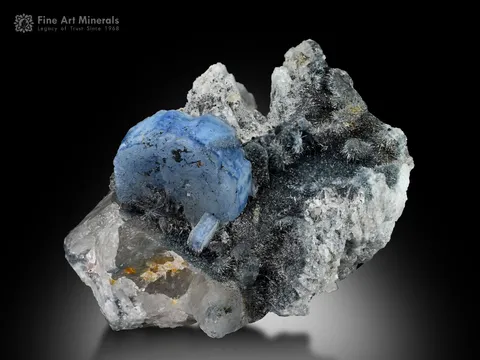
Sodalite from the Dar-e-Zu/Ladjuar Medam collecting environment is best understood as part of the same halogen- and sulfur-rich lapis-marble system that produced the locality’s lazurite and afghanite; labels may read Dar-e-Zu, Ladjuar Medam, Sar-e-Sang, or Kokcha Valley depending on when and through whom the specimen entered the market. The most desirable pieces are not ordinary massive blue sodalite but purple, gray-blue, or hackmanite-like sodalite in white calcite-marble, sometimes with pyrite and associated feldspathoids. Good specimens show discrete, lustrous crystal areas or bold color patches rather than dull, sugary aggregates; for fluorescent collectors, pieces with a strong UV response and stable documentation are especially desirable because sodalite, marialite, afghanite, and lazurite can be visually confused in this district.
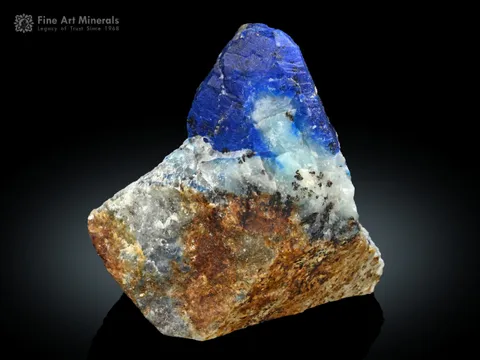
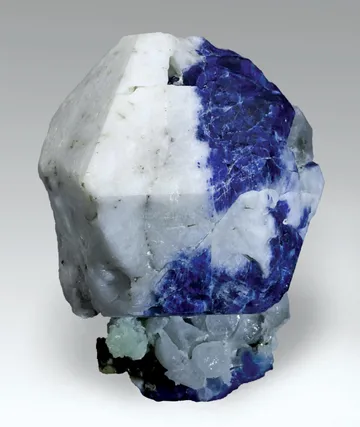
Lazurite is the mineral that made the Sar-e-Sang/Dar-e-Zu district famous, and the finest Dar-e-Zu-labelled pieces show the classic Afghan contrast: ultramarine to midnight-blue lazurite set against white calcite or marble, commonly with brassy pyrite and sometimes with phlogopite, afghanite, sodalite, or marialite nearby. The most important crystallized specimens from Ladjuar Medam are rhombic dodecahedrons, often modified by cube or octahedral faces, and historic studies note single crystals reaching about 5 cm; dealer and museum examples demonstrate that smaller, razor-edged crystals in balanced matrix can be more attractive than larger but bruised or overgrown masses. A top specimen here has deep, even blue color, clear crystal geometry, minimal chalky calcite veining across the faces, and enough matrix to prove its geological context without overwhelming the blue.
Afghanite is the signature rare species of the Sar-e-Sang lapis system and is directly documented from Dar-e-Zu with calcite, marialite, and pyrite; in the original type-locality context it occurs in thin veinlets cutting lazurite and in the broader collector trade it appears as pale to saturated blue crystals or grains in white calcite-marble and lapis-bearing matrix. Dar-e-Zu examples are especially appealing when afghanite is visibly distinct from the matrix rather than swallowed in massive blue lapis, and when marialite or calcite adds strong ultraviolet contrast. The best pieces combine confirmed identity, sharp or at least recognizable blue afghanite crystals, fresh white calcite, brassy pyrite accenting, and documentation tying the specimen to Dar-e-Zu or Ladjuar Medam rather than a vague “Afghanistan” label.
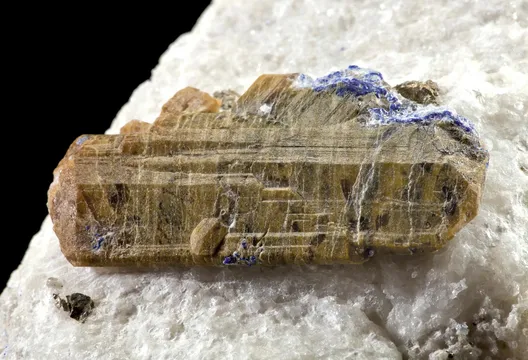
Nepheline from the Dar-e-Zu/Ladjuar Medam system is a connoisseur species, valued less for bright color than for its place in the feldspathoid-rich chemistry of the lapis deposit. Documented Sar-e-Sang nepheline material includes gray to whitish crystals, reported at more than 2 cm in some descriptions, with blue sodalite crusts or coatings and associations including calcite, phlogopite, and pyrite. The collector challenge is identification: nepheline can look like pale feldspar or altered matrix unless the crystal form is evident or analytical support is available, so better Dar-e-Zu-labelled examples are those with blocky to prismatic crystals, visible sodalite/lazurite association, and a label history precise enough to separate them from generic Afghan calc-silicate rubble.
Other documented minerals from Dar-e-Zu proper include marialite, calcite, and pyrite, with marialite particularly important because it may be colorless or white in daylight but bright under ultraviolet illumination. In the immediately surrounding Sar-e-Sang/Ladjuar Medam district, the assemblage expands to include haüyne, phlogopite, diopside, forsterite, scapolite-group minerals, amphiboles including richterite and tremolite, dravite, fluorapatite, gonnardite, gypsum, anhydrite, and other calc-silicate and evaporite-related species. Afghanite is the great type-locality mineral of the district, first described from Sar-e-Sang in 1968, while crystallized lazurite from Ladjuar Medam remains the world standard for the species in collector quality.
The first authenticity issue at Dar-e-Zu is locality precision. A label reading “Dar-e-Zu” should be treated as more specific than “Sar-e-Sang” or “Badakhshan,” but older Afghan and Pakistani trade labels are not always curatorial documents. Dar-e-Zu, Darreh-Zu, Ladjuar Medam, Lajur Madan, Sar-e-Sang, Sar-i Sang, Kokcha Valley, and Badakhshan have all appeared in overlapping trade usage. Preserve every old label, but do not assume a vague “Afghanistan” lapis or afghanite specimen can be upgraded to Dar-e-Zu without supporting provenance.
Species confusion is common. Blue feldspathoids from this district can look deceptively alike: lazurite, sodalite, haüyne, and afghanite may occur together, and marialite or nepheline can be hidden in pale matrix. Lazurite from top-quality lapis is typically non-fluorescent to weak under common collecting lamps, while sodalite/hackmanite, afghanite, marialite, calcite, fluorapatite, and related species may respond strongly under different UV wavelengths. Serious buyers should ask which mineral is being sold, whether the identification is visual or analytical, and what evidence separates a rare-species specimen from ordinary lapis-bearing marble.
Imitations and substitutes are a long-running problem in lapis generally. The gemological literature records glass, synthetic spinel, dyed jasper, plastic mixtures containing pyrite fragments and lapis powder, and Gilson imitation lapis as materials that have circulated as substitutes. These are more relevant to cabochons, carvings, beads, and massive lapis than to matrix specimens, but they matter when buying polished or cut material described as Dar-e-Zu or Sar-e-Sang. Natural lapis should not look like uniform blue plastic sprinkled with perfectly distributed metallic flecks; the real material has mineralogical texture, uneven calcite and pyrite relationships, and visible rock fabric.
Condition issues are typical of marble-hosted feldspathoid specimens. Calcite matrix bruises and cleaves easily; pyrite can be knocked from exposed edges; lazurite and sodalite faces may show contact marks, dull overgrowths, or sugary granular areas; and afghanite crystals are often small, included, or partly buried. Acid-cleaned or heavily trimmed pieces may lose useful geological context, especially if the goal is to document associations rather than display a single blue patch. For fluorescent pieces, check both daylight and UV photographs: a spectacular UV response does not compensate for a badly broken daylight specimen unless the piece is being bought specifically as a fluorescent display specimen.
UV collectors should handle Dar-e-Zu material thoughtfully. Multi-wavelength examination is often more informative than a single long-wave lamp: marialite, afghanite, calcite, fluorapatite, sodalite/hackmanite, diopside, and phlogopite can each respond best at different wavelengths. Hackmanite-like sodalite may show tenebrescence or color change behavior, so prolonged strong light exposure can alter display color in some pieces. Store photochromic sodalite specimens away from constant bright light, and document the appearance under daylight, long-wave, mid-wave, and short-wave UV if the specimen is being cataloged seriously.
Rarity varies sharply by species. Massive lapis from Sar-e-Sang is familiar in the trade, but sharp crystallized lazurite, well-localized Dar-e-Zu afghanite, and good nepheline or sodalite/hackmanite matrix specimens are far less common. Marialite-bearing fluorescent pieces have become more visible to collectors as UV photography has improved, yet precise Dar-e-Zu examples remain a niche within a niche. The best market pieces carry not only color and aesthetics but also old collection provenance, published illustration, analytical confirmation, or an unambiguous locality chain.
Ethical sourcing is a real consideration. Badakhshan lapis mining has been associated in modern reporting with illegal extraction, smuggling, armed-group revenue, and opaque contracts. That does not make every old specimen problematic, and many fine Dar-e-Zu pieces entered collections decades ago, but modern buyers should ask sellers what is known about the chain of custody. Older provenance, estate material, museum deaccession records, or long-held collector labels can add both ethical comfort and market value.
The Dar-e-Zu story begins in the same blue current that carried Sar-e-Sang lapis across the ancient world. Long before mineral collectors debated afghanite versus sodalite under ultraviolet lamps, Badakhshan lapis had already reached Mesopotamia, Egypt, and the prestige economies of the ancient Near East. The GIA account of Sar-e-Sang emphasized that lapis objects in the royal cemetery of Ur—cylinder seals, necklaces, animal figures, and human statuettes—testified to a trade linking ancient Iraq with Afghanistan over a distance of more than 2500 km. By the time medieval painters prized ultramarine, the stone had already spent millennia as a luxury object, a ritual material, and a marker of power.
Marco Polo’s report is the sentence every lapis collector eventually meets. He wrote of a mountain where “the finest azure in the world is found,” though the later GIA treatment notes that he did not personally see the mine. The line endured because it fits the place: a difficult mountain source, hidden in the high folds of Badakhshan, producing a blue so intense that it seemed less like a mineral color than a category of color itself.
The physical approach to Sar-e-Sang was never romantic in practice. Older route descriptions give two hard options from Kabul. One could travel by jeep through Charikar and the Panjshir valley, then continue the final 135 km by foot or horse over the Anjuman Pass. Or one could take the longer route through Salang Pass to Qonduz, then Khānābād, Taloqan, Feyzabad, and Jarm, ending still with a 40 km climb along the narrow Kokcha gorge. The mines were accessible only between June and November, and the working season at the royal mine was said to last at most five months. At camp, around 2500 m elevation, the blue blocks had already made a journey down from workings several hundred meters higher.
The old mining method feels almost impossible now: large wood fires were built against the hard rock to fracture it. Smoke-blackened walls in the mine entrance preserved the memory of that work. Later miners used dynamite, and after blasting they sorted the fragments for blue stone. The white or colorless blocks were thrown from the platform down to the dump hundreds of meters below. Mineral collectors should pause over that detail, because the old gem miners were not searching for crystal specimens. They wanted workable lapis. The very pieces discarded as insufficiently blue could contain the crystallized lazurite that later collectors would prize.
Pierre Bariand’s expeditions in 1964, 1967, and 1971 were driven by a problem familiar to mineralogists: lapis is a rock, but science wanted homogeneous crystals. The best blue carving material did not necessarily answer structural and chemical questions. In the discarded marble and cipolin, however, there were well-formed lazurite crystals—single crystals reaching about 5 cm, dominated by rhombic dodecahedral forms. That search for crystals, rather than carving stone, helped shift Sar-e-Sang from a gem source into a modern mineral locality.
One of the decisive collector-science moments came when afghanite entered the literature. Pierre Bariand, Fabien Cesbron, and Roger Giraud described the new mineral in 1968 from Sar-e-Sang, comparing it with minerals of the cancrinite group. The name did not honor a person or a mine owner; it honored Afghanistan itself. For collectors, afghanite remains one of the few species whose identity is inseparable from this district’s lapis-marble chemistry: a blue, complex sodium-calcium-potassium aluminosilicate with sulfate and chloride, born in the same chemically charged environment as lazurite.
Dar-e-Zu’s own image in the literature is quieter and more haunting. Peter Bancroft’s archive shows the portal of the Darreh-Zu mine and identifies it as exhausted. The photograph is not a glamour shot of crystals on velvet; it is a dark mouth in pale rock. For collectors accustomed to polished lapis boxes and sparkling pyrite in blue, that old portal is a useful corrective. The specimens began in a stark, steep, cold, dangerous place where miners searched tons of white and gray rock for a flash of blue.
The modern story is more troubled. Global Witness described Badakhshan’s lapis trade as a “business war,” with revenue from Kuran wa Munjan and nearby mining areas flowing to armed groups, strongmen, and insurgents. One elder from Kuran wa Munjan gave the line that collectors should remember before treating lapis as merely decorative: “This mine is itself a general...It will make people fight.” The mineral’s beauty and its political weight have never been easy to separate.
Pierre Bariand, Fabien Cesbron and Roger Giraud, “Une nouvelle espèce minérale : l’afghanite de Sar-e-Sang, Badakhshan, Afghanistan. Comparaison avec les minéraux du groupe de la cancrinite,” Bulletin de la Société française de Minéralogie et de Cristallographie 91, 34–42, 1968. Original description of afghanite from the Sar-e-Sang/Ladjuar Medam lapis deposit. https://www.persee.fr/doc/bulmi_0037-9328_1968_num_91_1_6184
J. Blaise and F. Cesbron, “Données minéralogiques et pétrographiques sur le gisement de lapis-lazuli de Sar-e-Sang, Hindou-Kouch, Afghanistan,” Bulletin de la Société française de Minéralogie et de Cristallographie 89, 333–348, 1966. Early modern mineralogical and petrographic study of the Sar-e-Sang lapis deposit. https://www.persee.fr/doc/bulmi_0037-9328_1966_num_89_3_5982
Jean Wyart, Pierre Bariand and J. Filippi, “Lapis-Lazuli from Sar-e-Sang, Badakhshan, Afghanistan,” Gems & Gemology 17(4), 184–190, Winter 1981. Essential gemological and locality account covering history, routes, mining methods, deposit geology, lapis quality, and crystallized lazurite. https://www.gia.edu/doc/Lapis-Lazuli-from-Sar-E-Sang-Badakhshan-Afghanistan.pdf
Shah Wali Faryad, “Metamorphic Conditions and Fluid Compositions of Scapolite-Bearing Rocks from the Lapis Lazuli Deposit at Sare Sang, Afghanistan,” Journal of Petrology 43(4), 725–747, 2002. Technical petrological study of the high-pressure calc-silicate assemblages and halogen-rich fluids behind the Sar-e-Sang mineral suite. https://doi.org/10.1093/petrology/43.4.725
Werner Schreyer and K. Abraham, “Three-stage metamorphic history of a whiteschist from Sar e Sang, Afghanistan, as part of a former evaporite deposit,” Contributions to Mineralogy and Petrology 59(2), 111–130, 1976. Important paper connecting Sar-e-Sang metamorphism with former evaporitic components. https://doi.org/10.1007/BF00371302
G. A. Yurgenson and B. P. Sukharev, “Localization of Lapis Lazuli Bodies of Badakhshan and Their Mineral Zonation,” International Geology Review 27, 230–237, 1985. Key work on the form, position, and mineral zoning of Badakhshan lapis bodies. https://doi.org/10.1080/00206818509466410
R. M. Woodside and Thomas P. Moore, “Famous mineral localities: The Sar-e-Sang lapis mines, Kuran Wa Munjan district, Badakhshan Province, Afghanistan,” The Mineralogical Record 45(3), 280–336, 2014. Major modern collector treatment of Sar-e-Sang, including Dar-e-Zu mineral records and specimen illustrations. https://www.mindat.org/reference.php?id=12910270
Mindat MinID C0M-Y5E, “Marialite, Afghanite, Pyrite, Calcite,” Dar-e-Zu mine. Documents an 8 x 7 cm Dar-e-Zu specimen with PXRD-confirmed marialite in calcite, tiny blue afghanites, and pyrite, illustrated in the 2014 Mineralogical Record Sar-e-Sang article. https://www.mindat.org/C0M-Y5E
Mindat gallery record E30-LV8, “Marialite, Afghanite,” Dar-e-Zu mine. Documents a 12.3 cm tall marialite-on-afghanite specimen from the Rob Woodside collection. https://www.mindat.org/sitegallery.php?loc=6990
J. C. Zwaan, F. C. Hawthorne, Maxwell Day and Brendan M. Laurs, “Cat’s-eye tremolite from Badakhshan, Afghanistan,” The Journal of Gemmology 36(1), 2018. Gem note documenting tremolite from the Dar-e-Zu mine and identifying the locality as one of the few known sources of gem-quality tremolite. https://gem-a.com/wp-content/uploads/2018/01/JoG-Spring-2018-ONLINE-d-1.pdf
G. J. Orris and J. D. Bliss, “Mine and mineral occurrences of Afghanistan,” U.S. Geological Survey Open-File Report 2002-110, 2002. Useful national-scale occurrence inventory for Afghanistan’s mines and mineral localities. https://www.usgs.gov/publications/mine-and-mineral-occurrences-afghanistan
Mindat: Dar-e-Zu mine, Ladjuar Medam, Sar-e-Sang, Badakhshan, Afghanistan — Primary locality page for Dar-e-Zu, including alternate name, position in the Sar-e-Sang hierarchy, and documented mineral list.
Mindat: Lazurite from Ladjuar Medam — Useful occurrence page for the world-class lazurite crystals of the immediate Ladjuar Medam/Sar-e-Sang district.
Mindat reference entry: Woodside and Moore 2014 — Bibliographic hub for the major Mineralogical Record Sar-e-Sang article and its locality/species cross-references.
Pala International: Lapis Lazuli from Afghanistan, by Peter Bancroft — Classic collector-friendly account with historical photographs including the Darreh-Zu mine portal and tailings.
GIA: Lapis-Lazuli from Sar-e-Sang, Badakhshan, Afghanistan — Essential seven-page gemological and locality article on the Sar-e-Sang deposits, mining, access, and lapis quality.
IUGS Geoheritage: The Sar-e-Sang Lapis Lazuli Deposit — Concise geological overview of the lapis bodies, host rocks, stratigraphic setting, and scientific importance.
Oxford Academic: Faryad 2002, scapolite-bearing rocks from Sare Sang — Technical petrology source for the high-pressure calc-silicate assemblages, fluids, and retrograde halogen-sulfur mineralization.
Persée: Bariand, Cesbron and Giraud 1968 afghanite description — Original afghanite species description from Sar-e-Sang.
Handbook of Mineralogy: Afghanite — Compact mineral-data sheet summarizing afghanite occurrence, association, type material, and references.
Global Witness: War in the Treasury of the People — Important modern context on conflict, smuggling, and governance concerns around Badakhshan lapis mining.
Afghan Witness / Centre for Information Resilience: Afghanistan’s mining sector under the Taliban — Broader recent context for Afghan mining governance and security since 2021.