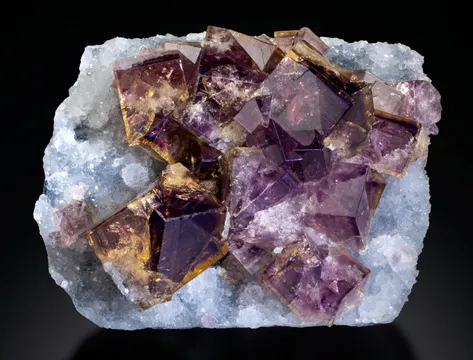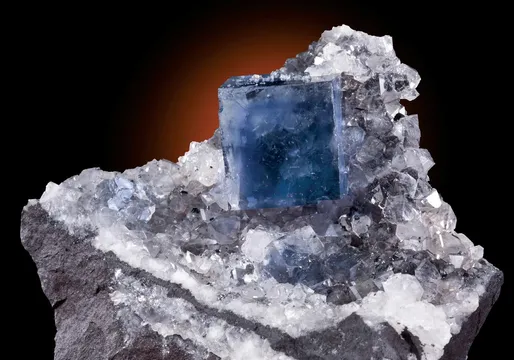
A collector's guide to Coldstones Quarry, UK: its geology, mining history and notable minerals, illustrated with the 68 specimens documented from this locality on EarthWonders.
Key facts
Coldstones Quarry is one of the key modern specimen localities of the Greenhow–Pateley Bridge district in North Yorkshire: a working limestone quarry that happens to cut through old Pennine lead–zinc–fluorspar veins on the crest of the Coldstones Dome. Its importance to collectors lies in that collision of industrial quarrying and old vein mining. The quarry is not a romantic abandoned hush or a Victorian level with a stable dump; it is a living aggregate operation, and the specimens have come episodically when blasting, benching, road widening, or deliberately arranged field-trip excavations have exposed the Coldstones Sun Vein, Garnet Vein, or their oxidized offshoots.
The geological setting is classic but locally distinctive. The quarry works thick Lower Carboniferous limestone near the southern margin of the Askrigg Block, close to the North Craven Fault System. Veins in this part of Greenhow carry a low-temperature Pennine assemblage dominated by fluorite, barite, calcite, galena, and sphalerite, but Coldstones is especially loved for the oxidized cavities: hemimorphite, smithsonite, cerussite, anglesite, rosasite, aurichalcite, cinnabar, and rare species such as prosopite, doyleite, and otavite. The best pieces have a compact, cabinet-friendly look rather than the broad theatrical size of Weardale fluorite: clear to pale violet and purple-edged fluorite cubes, brown to cream smithsonite crusts, sugary hemimorphite coatings, off-white cockscomb barite, bright galena, and small but sharp secondary lead minerals in the same vuggy veinstone.
Regional View
Country View
For a collector, the locality’s attraction is its mixture of recognizable hand specimens and analytical surprises. A small Coldstones plate may at first look like “just” pale fluorite with tan crusts, yet under the microscope it can resolve into hemimorphite blades, smithsonite coatings, minute cerussite, or even rare supergene phases that have made the quarry a serious reference locality in British mineralogy. That dual personality—accessible aesthetics on one hand, subtle secondary chemistry on the other—is why Coldstones has such a strong following among collectors of British minerals.

Photo: Wikimedia Commons
Search for specimens: View all specimens from Coldstones Quarry, UK
Coldstones Quarry, also known operationally as Pateley Bridge Quarry, lies on Greenhow Hill, west of Pateley Bridge and close to the village of Greenhow. It is a high-level limestone quarry in open moorland rather than a valley-side excavation, and that topographic position is part of its character: from the public Coldstones Cut viewpoint the quarry drops away in broad modern benches, while the old lead-mining ground and vein lines around Greenhow lie close at hand. The quarry is within the Nidderdale landscape and near, but outside, the Yorkshire Dales National Park boundary.
The deposit is best understood as a modern limestone quarry intersecting older Pennine-style lead–zinc–fluorite–barite mineralization. The worked limestone sequence is part of the Carboniferous succession around the Coldstones Dome and Greenhow anticline. The British Geological Survey memoir records that the Coldstones area sits beneath a major intra-Pendleian unconformity, with the Coldstones Limestone present beneath the erosion surface in the vicinity of the quarry and dome. In practical collecting terms, the important point is that the ore shoots of the Greenhow district are overwhelmingly limestone-hosted, while the overlying grit and shale units are generally much less productive.
Two named veins matter most to collectors: Coldstones Sun Vein and Garnet Vein. Both were old lead-fluorspar structures before the modern quarry exposed them in fresh faces and blast piles. The Sun Vein carried galena with fluorite, calcite, and barite, while Garnet Vein forms a loop with Sun Vein and cuts the crest of the Coldstones Dome. Garnet Vein was historically worked from an opencut and shafts, and in places it reached roughly 1.8 m wide. A flat known as Pendleton Pipe was worked on both sides of Garnet Vein under a dolomitized roof and contained sandy banded fluorite with calcite, barite, and a little galena.
The historic mining context is deep. Greenhow and Coldstones Hills were being mined by monastic interests in the medieval period, and later mining expanded through the 17th, 18th, and 19th centuries. By the later 18th century, the deeper shafts were troubled by water, and drainage levels from Brandstone Beck became central to the district. Gillfield Level was begun in 1782 by Overend & Co. and eventually reached Sun Vein; Cockhill Level was started nearby around the same period by Cleaver & Co. The old workings encountered by the modern quarry are the physical remains of that long lead-mining and fluorspar-working history.
Modern Coldstones is not a small specimen quarry but a major aggregate operation. Planning records describe more than fifty years of production of high-grade Carboniferous limestone and coated roadstone products, with formal planning consent for limestone extraction first granted in 1949 and current extraction authorized to 19 August 2047. The quarry produces crushed limestone for concrete, asphalt, road building, and aggregate use; small quantities of fluorspar-bearing material have also been recovered when mineralized rock is separated from quarry production.
Specimen production has been irregular and tied to access, exposure, and timing. Russell Society reports record organized visits in which members were escorted into the active quarry after safety briefings, sometimes with assistance from quarry staff and plant. Productive moments included digging into Sun Vein after an excavator removed the top few feet of the vein, working Garnet Vein exposures in the main quarry, checking recent blast piles, and examining bottom-level flats rich in calcite and barite. The best finds documented in recent collecting reports include galena, fluorite, cerussite, hemimorphite, anglesite, smithsonite, cockscomb barite on purple fluorite, malachite with fluorite and hemimorphite in massive barite, and large calcite vugs with fluorite and hemimorphite.
Collecting access today should be treated as restricted. Coldstones is an active commercial quarry operated by Heidelberg Materials UK, with blasting, mobile plant, steep benches, traffic, stockpiles, and old workings all present. The public can view the quarry safely from the Coldstones Cut, but mineral collecting inside the quarry is not casual public access. Specimens on the market generally come from earlier organized field trips, quarry staff recoveries, old collections, or material collected when permission and operational conditions allowed safe entry.
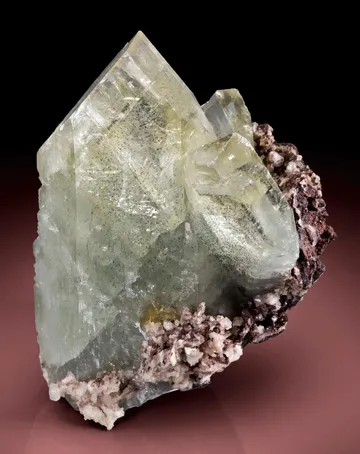
Fluorite is the signature collector mineral from Coldstones, usually in small to modest cubes rather than large display crystals, and the most desirable pieces show glassy colourless to pale violet crystals with purple edges, blue-violet zoning, or amber-purple tones on barite, calcite, galena, and secondary zinc minerals. Mindat photo records and dealer descriptions document specimens with fluorite crystals commonly in the 1–7 mm range, while older collector notes mention grey sulphide-included fluorite cubes reaching about 40 mm; pieces from the intersection of Garnet and Sun veins are especially recognizable when clear or white-centred fluorite carries purple edges beneath smithsonite or hemimorphite crusts. Good Coldstones fluorite is judged less by size than by freshness, transparency, colour contrast, and association: a sharp, glassy plate with hemimorphite, smithsonite, cockscomb barite, or cerussite is far more desirable than massive or corroded vein fluorite, which is common in weathered exposures.
Hemimorphite from Coldstones is a supergene zinc mineral of the oxidized vein cavities, typically appearing as clear, white, pale brown, tan, or light brown microcrystalline coatings and small bladed or tabular crystals on fluorite, galena, barite, and altered limestone veinstone. The best documented hand specimens include clear to pale brown hemimorphite covering clear fluorite to about 7 mm, light brown micro hemimorphite scattered over fluorite and galena, and small sprays of clear hemimorphite in pockets within massive barite from upper working areas. Attractive examples are those in which the hemimorphite is visibly crystalline rather than earthy, enhances the fluorite instead of masking it, and remains clean enough to show the underlying purple or colourless cubes; ordinary pieces are often tan crusts on friable or altered vein material.
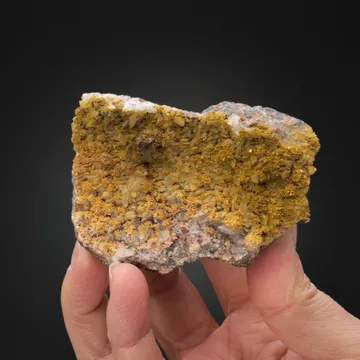
Smithsonite is one of the defining Coldstones secondary minerals, formed from alteration of primary zinc sulphides in oxidized cavities, and it ranges from earthy beige-brown coatings to cream, orange, and possibly cadmium-rich yellowish material. Specimen records show dark beige to brown micro smithsonite coating small purple fluorite crystals 4–5 mm across, cream smithsonite coating tabular barite while preserving the barite morphology, orange smithsonite with calcite on fluorite, and smithsonite pseudomorphs after calcite with minor cinnabar. The most collectable Coldstones smithsonite specimens are those where the mineral does something visually specific—coating barite blades, forming pseudomorphs, contrasting with purple-edged fluorite, or carrying red cinnabar—because much of the locality’s smithsonite is otherwise pale, earthy, and visually subtle.
Barite, traditionally written “baryte” in British literature, is a major gangue mineral in the Coldstones veins and occurs as off-white blades, roses, elongated fine-grained cockscomb groups, and tabular crystals in association with fluorite, calcite, galena, smithsonite, and pyromorphite. Field reports describe bottom-level flats full of calcite with later secondary calcite and elongated barite cockscomb groups, while later collecting produced a cockscomb barite cluster set on purple fluorite from a recent blast pile; dealer material also shows tabular barite almost completely coated by cream-coloured smithsonite. The best barite specimens from Coldstones have sculptural form and association—especially cockscomb barite on purple fluorite—whereas weathered baryte roses and friable vein barite are commoner and much less satisfying.
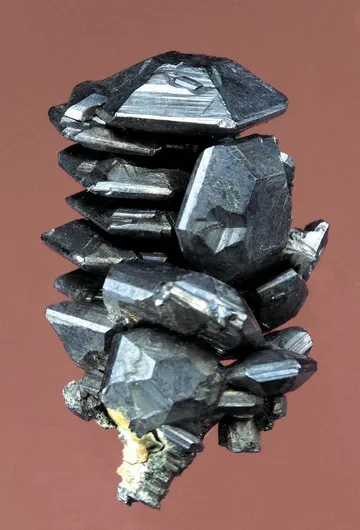
Galena is the principal historic lead ore at Coldstones and is present both as unaltered masses and as small crystals in the fluorite–barite–calcite vein assemblage. Recent field-trip accounts mention bags of unaltered galena excavated from Garnet Vein for museum use, a 100–150 mm thick galena vein in the upper eastern quarry face, dull grey galena crystals to about 6 mm on gemmy clear fluorite with hemimorphite, and specimens where galena is coated by micro cerussite. The best collector pieces are not simply heavy lumps of ore but balanced combinations: cubic or modified galena on clear or purple fluorite, ideally with cerussite or hemimorphite present and without the crumbling, altered condition that affects much exposed Coldstones sulphide material.
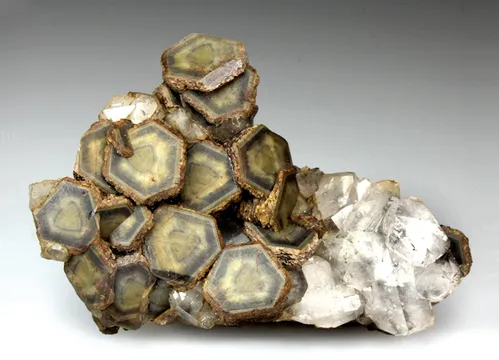
Calcite is both a major vein gangue mineral and one of the better display species from Coldstones when pockets open cleanly. Field reports describe nail-head calcite, secondary calcite in flats with barite, and a large calcite vug found just south of Garnet Vein on the east side of the quarry, lined with brown to clear stepped hexagonal crystals, including doubly terminated examples exceeding 40 mm, with associated clear fluorite to 10 mm and small vugs of hemimorphite. The most interesting calcites show habit change, including scalenohedral phantoms enclosed within later prismatic forms; ordinary calcite is abundant as dense vein material, but sharp, lustrous, pocket-grown crystals with fluorite or barite associations are the specimens worth singling out.
Other documented Coldstones minerals include sphalerite, cerussite, anglesite, aurichalcite, rosasite, cinnabar, pyromorphite, prosopite, doyleite, and otavite. The rare suite is especially significant: prosopite, doyleite, and otavite were reported from Coldstones as first British Isles occurrences, and the quarry’s pyromorphite has been analysed as near end-member material in small green prismatic crystals associated with barite and quartz in fractures in Namurian sandstone. Cinnabar is another collector-relevant rarity here, occurring as bright orange-red to brownish-red earthy coatings and patches in oxidized cavities, commonly tied to smithsonite-bearing material rather than primary mercury mineralization.
Coldstones labels deserve careful reading. Older specimens may be labelled “Coldstones Quarry, Greenhow,” “Pateley Bridge Quarry,” “Greenhow Hill,” “Appletreewick,” or simply “Yorkshire,” and not all are equally precise. The most desirable modern labels name Coldstones Quarry and ideally mention Garnet Vein, Sun Vein, the intersection of Garnet and Sun veins, a bottom-level flat, or a dated field trip. Because many specimens are small, complex, and coated, species identifications such as hemimorphite versus smithsonite, smithsonite versus cadmian smithsonite, and pale secondary crusts versus rare prosopite-related material should not be accepted uncritically without analytical support.
No widely publicized tradition of manufactured fakes is attached to Coldstones, but misidentification is a real risk. Earthy smithsonite, halloysite-like clay, altered zinc silicates, prosopite, and doyleite-bearing crusts can look deceptively similar in hand specimen. White to pale blue or chalky material should not be sold as a rare species from Coldstones unless it has a credible analytical history. Conversely, genuine rare minerals from the quarry may be visually unimpressive and are easily overlooked or damaged by over-cleaning.
Condition is the main practical issue. Much Coldstones vein material is naturally friable, weathered, ochreous, or partly decayed after exposure in quarry faces and blast piles. Fluorite can be corroded, galena may be dulled or oxidized, barite roses can be weathered, and thin coatings of hemimorphite or smithsonite can be abraded by careless trimming. Strong acid cleaning should be approached with caution: it can remove iron staining but may also undercut secondary coatings, loosen earthy smithsonite, and destroy the visual context of rare supergene phases.
The most marketable Coldstones specimens are small-cabinet and miniature pieces with obvious visual contrast: purple-edged or clear fluorite with hemimorphite; fluorite with cream to brown smithsonite; barite cockscombs on purple fluorite; galena with cerussite; and calcite pockets with fluorite. Larger display specimens exist but are less typical than compact association pieces. Fresh material appears only sporadically because the quarry is active and access is controlled, so supply on the market tends to come in small pulses from old collections rather than a continuous stream.
Collectors of fluorescence should not treat Coldstones as a primarily fluorescent locality in the way some North Pennine fluorites are discussed. Some fluorite may respond under ultraviolet light, but the locality’s serious appeal is paragenetic and associative rather than fluorescent. Handle coated specimens dry, use magnification before cleaning, and retain any old labels: provenance matters greatly for this locality, especially where a specimen may relate to a named vein exposure or one of the documented Russell Society visits.
Coldstones collecting stories are inseparable from quarry access. The memorable episodes are not solitary rockhound discoveries but tightly managed field days: hard hats, high-visibility clothing, safety briefings, quarry managers, active benches, and the continual awareness that the mineralized exposure of the day might be gone, buried, or processed by the next visit.
On 9 May 2015, ten Russell Society members arrived hoping the rain would hold off. Quarry Manager Shirley Everett had arranged something unusually generous for a mineral group: an excavator to remove the top few feet of Sun Vein, because that part of the quarry was not then being worked. Once the group descended into the opened vein, the reward came quickly—galena, fluorite, cerussite, and hemimorphite. John Davidson recorded finding a single 6 mm anglesite crystal on galena, while Arthur Nattrass later found rich malachite with purple fluorite and a small spray of clear hemimorphite in a pocket within massive barite near the primary crushing plant. In the upper eastern face, the group noted a 100–150 mm thick galena vein, probably part of Garnet Vein or an offshoot, but with little alteration. It was the kind of day that reveals Coldstones perfectly: a working quarry, a manager willing to help, one opened vein, and a suite of small but very telling minerals.
The following year, on 24 April 2016, eight Russell Society members and guest Charles Lamb came on an overcast but dry day. The upper workings were scanned first, but nothing noteworthy appeared. In the main quarry, they excavated bags of unaltered galena from Garnet Vein and left them for Killhope Museum. The collecting became more interesting lower down, where the quarry exposed good banded sections of Coldstone Limestones with interbedded shale and sandstone, and then old Garnet Vein material in the eastern face. Weathering had made much of the fluorite friable and unproductive, but near the bottom level—about 100 m below the quarry top—Garnet Vein was visible in both western and eastern faces as dense calcite with a little galena and fluorite.
Then Charles Lamb found the day’s standout pocket: a large calcite vug just south of Garnet Vein on the east side of the quarry. It held brown to clear, hexagonal, stepped calcite crystals, including doubly terminated crystals over 40 mm, with clear fluorite to 10 mm and small vugs of hemimorphite. Some calcites showed a particularly satisfying textural detail: scalenohedral phantoms locked inside later prismatic crystals. At the southern edge of the bottom level, Shirley Everett again changed the day by pointing out small flats full of calcite with later secondary calcite and elongated fine-grained barite cockscomb groups. Collectors filled bags with large, sometimes attractive specimens, and Tom Goodland added a hand-sized plate of lustrous fluorite from a minor vertical cross vein. The report’s closing image is very Coldstones: full bags and a 100 m vertical climb back to the car park.
In April 2018, the quarry had changed again. Ten collectors arrived on a bright crisp morning, including Bob Bucki on his first field trip and Kevin Garrod after the long drive from South Wales. The group followed the track down the northeast edge to the previous year’s major find, only to discover the essential truth of active-quarry collecting: the pocket had effectively vanished. All that remained was a wall of calcite flowstone over small pockets of hemimorphite. Garnet Vein gave fluorite with galena, but it was too friable and weathered to bother collecting; a few barite roses were similarly disappointing.
Sun Vein was buried, but Quarry Manager Richard Green had an excavator nearby and opened several trenches across it. The in situ fluorite appeared, though corroded and ochreous. Kevin Garrod decided he might do better elsewhere and was rewarded for moving away from the obvious spot: from a recent blast pile further along the bench he found a cockscomb barite cluster set on purple fluorite. Back at the trench, John Davidson found smithsonite and possibly cadmian smithsonite, and Ian Dossett found a good specimen at the last minute. Coldstones often works like that—nothing where last year’s find had been, then a single late piece that justifies the day.
There is also a wider industrial drama to the site. The Coldstones Cut, the great stone viewing platform above the quarry, reframes an active pit as public landscape. From below it can seem like a fortress or a cut through the hill; from its high platforms the visitor looks directly into the benches and haul roads that collectors can usually reach only by permission. It is a rare locality where the public monument, the active quarry, the medieval-to-modern mining history, and the specimen record all occupy the same hilltop.
Mindat: Coldstones Quarry, Greenhow, North Yorkshire — Primary online locality record with coordinates, locality hierarchy, mineral list, named veins, and references.
British Geological Survey: Geology of the Northern Pennine Orefield, Volume 2: Stainmore to Craven — The fundamental geological memoir for the Greenhow district, including the Coldstones Dome, Sun Vein, Garnet Vein, Pendleton Pipe, and historic fluorspar/lead workings.
Young, B., Ryback, G., Braithwaite, R. S. W. and Francis, J. G. (1997). “Prosopite, doyleite and otavite from Coldstones Quarry, Pateley Bridge, North Yorkshire.” Mineralogical Magazine, 61(409), 895–897. — Short communication reporting prosopite, doyleite, and otavite from Coldstones; an essential reference for the quarry’s rare supergene suite.
Young, B. (1989). “Cinnabar from the northern Pennines, England.” Mineralogical Magazine, 53, 388–389. — Includes Coldstones material and discusses cinnabar as a rare supergene mineral in oxidized lead–zinc assemblages.
Green, D. I. and Tindle, A. G. “The composition of pyromorphite from Coldstones Quarry, Greenhow, North Yorkshire.” Journal of the Russell Society, volume 25. — Analytical note on near end-member pyromorphite from fractures in Namurian sandstone at Coldstones.
Russell Society Newsletter, Issue 67, September 2015 — Contains the 9 May 2015 Coldstones field-trip report, including excavator-assisted work on Sun Vein and finds of fluorite, galena, cerussite, hemimorphite, anglesite, malachite, and barite.
Russell Society Newsletter, Issue 69, September 2016 — Contains the 24 April 2016 Coldstones report, including Garnet Vein galena, the bottom-level calcite vug, cockscomb barite, and lustrous fluorite.
Russell Society Newsletter, Issue 73, September 2018 — Contains the 21 April 2018 Coldstones report, including Sun Vein trenching, weathered Garnet Vein material, barite on purple fluorite, and smithsonite finds.
Heidelberg Materials UK: Pateley Bridge Quarry — Current operator page for the active limestone quarry, with address, material, and operational contact information.
North Yorkshire Council planning report for Pateley Bridge Quarry, 26 July 2022 — Useful official summary of planning history, production, quarry life, access roads, and operating context.
Northern Mine Research Society: Coldstones Quarry, Greenhow Hill — Concise modern description of the quarry’s altitude, scale, benches, aggregate output, and the two exposed mineral veins.
Northern Mine Research Society: Greenhow Mines — Good historical overview of the Greenhow and Coldstones mining district, drainage levels, lead workings, fluorspar recovery, and smelting.
Yorkshire Dales: Coldstones Quarry — Brief visitor-oriented description of the quarry’s setting and its relationship to the Coldstones Cut.
The Coldstones Cut: official site — Public-art and visitor information for the viewing platform overlooking the quarry.
Wikimedia Commons: Coldstones Cut overlooking Coldstones Quarry — Reusable photograph showing the quarry from the hilltop public artwork.
Fabre Minerals reference specimen: Smithsonite coating barite with fluorite, Coldstones Quarry — Dealer reference illustrating the cream smithsonite-on-barite habit and Coldstones association style.
Mindat photo gallery: Coldstones Quarry — Useful visual record of fluorite, smithsonite, hemimorphite, cinnabar, barite, pyromorphite, cerussite, and other documented specimens.