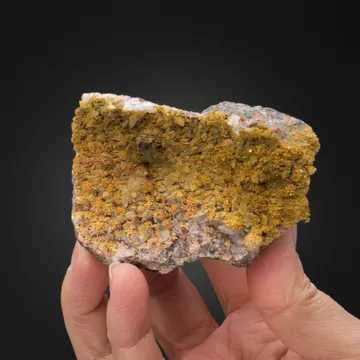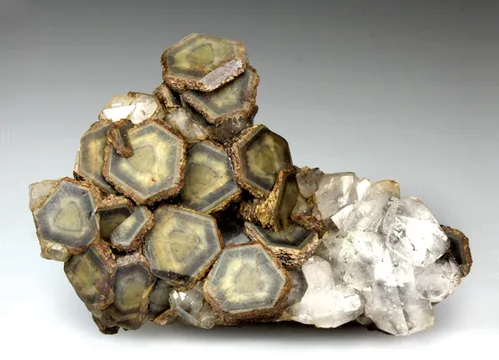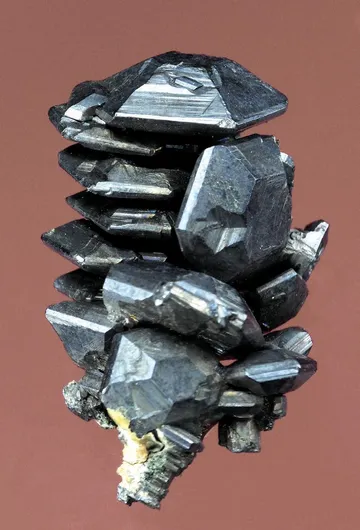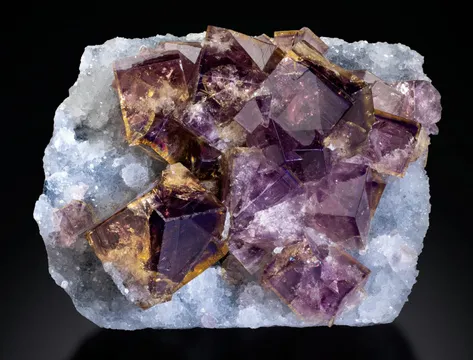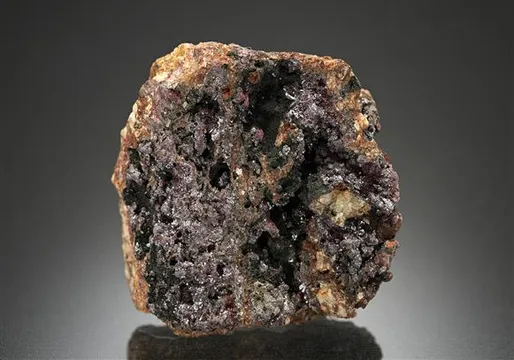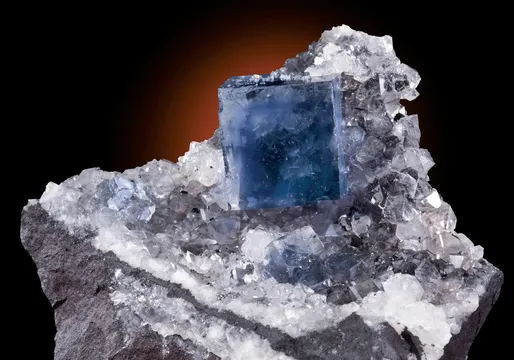
Dalmellington Mine, UK — Frizington baryte from the haematite system; glassy, prismatic crystals with honey-to-golden hues, scarce and prized by collectors.
Key facts
Dalmellington Mine is one of those deceptively small names that opens a large collector’s problem. On old labels it appears as “Dalmellington,” but the locality is not the Ayrshire mining town in Scotland; it is the Frizington-area iron-ore mine in the West Cumberland Iron Field of Cumbria, England. The name is understood through the Dalmellington Iron Company, a Scottish firm that worked the Holbeck or Holebeck iron mine at Frizington in the late nineteenth century. For collectors, that distinction matters enormously: a true Dalmellington attribution ties a specimen to one of the scarcer, more label-sensitive sources of classic Frizington baryte.
Geologically, Dalmellington belongs to the celebrated west Cumbrian haematite system, where iron-rich, saline hydrothermal fluids replaced Carboniferous limestone and produced high-grade haematite orebodies with only a small proportion of gangue minerals. That “small proportion” is precisely where the collector interest lies. In the Frizington mines, cavities and open spaces in haematite-rich carbonate ground yielded baryte crystals whose colour and surface character are inseparable from the iron field: pale yellow, honey, golden brown, blue-grey, and locally reddish from haematite dusting or inclusions, often set against dolomite, calcite, and iron-oxide matrix.
The best Dalmellington barytes are not ordinary tabular barites. They are old English classics: glassy, sharp, tapering, sometimes spear-like or unusually prismatic crystals, with a density and chisel-ended geometry that sets them apart from the broader, more familiar cockscomb barytes of many British vein fields. A top piece may show a single lustrous golden prism on calcite and dolomite, a long flat-topped crystal with surprising transparency, or an aesthetic cluster whose iron staining gives the crystal an internal ember-like warmth. Large, fine, unquestionably labelled examples are scarce, and many of the best-documented specimens now reside in old institutional or pedigree private collections.
Regional View
Country View
The locality’s appeal is therefore double: it is a crystallographic locality, represented in the British Museum study of unusual Frizington barytes, and it is a pedigree locality, where a single word on an old label can separate a specifically Dalmellington specimen from the much larger pool of “Frizington” or “Cumberland” material.
Search for specimens: View all specimens from Dalmellington Mine, UK
Dalmellington Mine is best treated as a historic Frizington iron-ore locality in the West Cumberland Iron Field, Cumbria, England. Modern mineralogical databases place it at Frizington, in the former Cumberland district, within the West Cumberland Iron Field. The essential caution is nomenclatural: “Dalmellington Mine” is a name found on old specimen labels, while the mining operation inferred behind those labels is Holbeck or Holebeck Mine, worked by the Dalmellington Iron Company. That company name, rather than a locally English place-name, explains why a Scottish-sounding word appears on classic Cumbria baryte labels.
The ore field is a metasomatic haematite province hosted chiefly by Carboniferous limestones along the western margin of the Lake District. In the broader Frizington-Egremont belt, iron-bearing fluids moved through faults and permeable strata, replacing limestone with massive red haematite and locally depositing gangue minerals in cavities, fractures, and residual open spaces. The best collector specimens came not from baryte mining, but from iron mining: baryte was a subordinate hydrothermal mineral accompanying haematite, dolomite, calcite, aragonite, quartz, and minor sulphides in the wider district. At Dalmellington, the documented collector species is baryte, with associated carbonate and iron-oxide matrix reported on known specimens.
The orebodies of the West Cumberland Iron Field were structurally controlled. Around Frizington, haematite mineralization is associated with faulted Carboniferous limestones near the sub-Permian unconformity, and the iron field’s gangue assemblage records the same brine system that produced the ore. Later geochemical work on Cumbrian haematite-mine barites included a Dalmellington specimen from the University of Aberdeen Museum and recorded it as barite from a haematite mine at grid reference NY 035 161, placing it firmly within the Frizington iron-ore setting rather than among the lead-zinc-baryte veins of the North Pennines.
Historically, Holbeck or Holebeck was active in the second half of the nineteenth century. The Dalmellington Iron Company, based in Scotland, is recorded in connection with the Frizington mine, and modern summaries identify Holbeck as opened in 1869 and worked until closure or abandonment in 1900. Contemporary mining directories and later mining-museum compilations also record Holebeck at Frizington among the company’s holdings. This places the specimen-producing period squarely in the classic era of West Cumberland iron mining, when large haematite mines around Frizington, Cleator Moor, and Egremont fed the iron and steel industry and, incidentally, released some of Britain’s finest baryte crystals.
Specific pocket histories are poorly preserved, which is typical for Frizington barytes: miners and dealers often recorded only “Frizington,” “Cumberland,” or a company-related name, and much of the material entered collections long before modern locality standards. Still, the known Dalmellington pieces point to open haematite-carbonate cavities rather than surface collecting. Described examples include pale golden, transparent, long tapering tabular crystals on haematite and dolomite matrix; a 10 cm British Museum crystal with only a small point of attachment and unusual accessory faces; a long light-yellow prismatic crystal over 14 cm in length; and small-cabinet specimens with baryte on calcite and dolomite. That combination of size, old labels, and matrix association is what gives Dalmellington specimens their special status.
Collecting access today should be regarded as closed unless explicit current permission is obtained from the landowner and mineral-rights holder. The old workings are historic iron mines, not casual collecting sites, and surviving ground in the Frizington area may include private land, obscured shafts, unstable spoil, and subsidence-prone industrial terrain. The collector market is therefore supplied almost entirely by old collections, dealer recycling, and estate material rather than new underground finds.
Under the American trade spelling “barite,” Dalmellington pieces are prized as scarce, old-label representatives of the Frizington iron-field style: BaSO4 crystals ranging from small thumbnails to dramatic cabinet-size examples, typically pale yellow to golden, honey-brown, or blue-grey, and commonly influenced by haematite inclusions, coatings, or iron-stained matrix. The most desirable examples are sharply terminated, lustrous, transparent to translucent crystals with a tapering tabular or prismatic habit, especially those perched on dolomite, calcite, or haematite-rich matrix rather than loose single crystals with uncertain district provenance. A Dalmellington attribution is strongest when backed by an antique label or a documented pedigree, because many similar West Cumberland barites were historically sold simply as “Frizington” or “Cumberland.”
In British mineralogical usage, “baryte” is the proper historic language for Dalmellington specimens, and it suits the locality’s museum pedigree. The classic Dalmellington barytes include pale-yellow to rich brown crystals from the Frizington mines, with both tabular and more elongate prismatic habits; Jessie M. Sweet’s British Museum study singled out Dalmellington and Parkside crystals for unusual small, grooved triangular faces developed between major crystal faces, and described a Dalmellington crystal 10 cm long with minimal attachment and well-developed faces on all sides. Fine collector pieces separate themselves by sharpness, gloss, translucency, attractive iron coloration, and unambiguous old provenance; average pieces are more simply iron-stained Frizington barytes whose exact mine cannot be proven.
Beyond baryte, the specifically documented Dalmellington mineral list is narrow: modern locality records list baryte as the sole valid mineral species, while described specimens from the mine commonly mention calcite, dolomite, and haematite or iron-oxide matrix as associations. No type-locality mineral has been verified for Dalmellington Mine. Its rarity is not based on a long species list, but on the quality and scarcity of authenticated baryte specimens from this particular Frizington iron-mine label.
The main authenticity issue is locality, not species. Baryte from the Frizington district is common enough in old collections, but Dalmellington-attributed baryte is much less common. A specimen labelled only “Frizington,” “Cumberland,” or “West Cumberland” should not be upgraded to Dalmellington without supporting provenance. Conversely, an old label reading “Dalmellington Mine” should be preserved exactly, even if a modern catalogue note adds “Holbeck/Holebeck Mine, Frizington, Cumbria” for clarity.
Mislabelling with the Scottish mining district is a real risk. Dalmellington is a well-known mining name in Ayrshire, Scotland, but the mineral specimens discussed here are the Frizington, Cumbria barytes associated with the Dalmellington Iron Company. A catalogue entry that says only “Dalmellington, Scotland” for a classic transparent golden or blue-grey baryte should be treated with caution and checked against label history, dealer provenance, and specimen style.
Condition is critical. The finest Dalmellington and Frizington barytes are glassy and sharply edged, but old examples often show tiny nicks on terminations, bruised prism edges, or contacts where crystals grew against the pocket wall. Minor edge wear is common and may be acceptable on nineteenth-century pieces, especially if the crystal is large, transparent, or well-pedigreed. More serious issues include repaired crystals, trimmed matrix that removes contextual evidence, and aggressive cleaning that strips the warm iron staining responsible for much of the locality character.
There are no well-established modern treatment traditions specific to Dalmellington baryte, but collectors should watch for general barite problems: concealed repairs along cleavage or attachment points, glued crystals on dolomite matrix, oiled or lacquered surfaces, and mismatched old labels. Baryte has perfect cleavage and high density, so long prismatic examples are vulnerable to impact despite looking robust. Store and transport them with support along the length of the crystal rather than pressure on the termination.
Market availability is low. General Frizington barytes appear periodically, including excellent old pieces, but Dalmellington-specific examples are much scarcer. Recent public offerings with strong pedigrees show why they attract attention: a small-cabinet baryte with calcite and dolomite, formerly in the Liebetrau, Greenbank, Sutcliffe, and Barstow collections, sold at auction in 2025 for $2,051. For a serious locality collector, a genuine Dalmellington label is a premium feature.
The best story at Dalmellington begins with a name that seems to point in the wrong direction. “Dalmellington” belongs naturally to Ayrshire coal and iron country, yet the collector specimen is Cumbrian: a Frizington iron-field baryte whose label remembers the company that worked Holbeck rather than the village around the shaft. That is why the word has a peculiar power on an old mineral label. To a casual buyer it may look like a mistake; to a West Cumberland specialist it is exactly the kind of awkward, historically loaded label that can make a specimen more desirable.
One of the old dealer-list descriptions captures the classic look in almost tactile language: fine, lustrous, transparent, pale golden, long tapering tabular crystals lying across haematite and dolomite matrix, with the reverse encrusted in bright little barytes. The same specimen carried an A. E. Foote label from Philadelphia, a reminder that these Cumbrian iron-mine barytes were circulating internationally long before modern locality databases tried to sort out the mine names.
The collector pedigree trail can be just as important as the crystal. A Dalmellington baryte sold in 2025 had passed through Richard “Dick” Barstow, Ralph Sutcliffe, Lindsay Greenbank, and Al and Sue Liebetrau before coming to auction. The specimen was only 6.2 cm long, but the combination of a sharp golden baryte crystal, calcite and dolomite matrix, internal phantoms under strong backlighting, and a chain of serious collectors pushed it into the territory where provenance becomes part of the specimen’s mineralogy. The auction description noted that many Frizington pieces lack mine-specific labels, and that only a select few Dalmellington examples had been seen over the years.
There is also a quieter museum story. Jessie M. Sweet’s 1930 paper on British barytes, written from the British Museum collection, did not treat Dalmellington as a dealer curiosity but as a crystallographic locality. Among thirteen Dalmellington and Parkside specimens showing unusual small grooved faces, one Dalmellington crystal, catalogued as B.M. 1907,383, measured 10 cm long and had only a small point of attachment, with faces developed around the crystal. That is the sort of specimen that explains the locality’s lasting reputation: not a mine famous for many species, but a mine capable of producing baryte crystals interesting enough to be measured, figured, and preserved.
Jessie M. Sweet, “Notes on British barytes,” Mineralogical Magazine and Journal of the Mineralogical Society, 22(129), June 1930, pp. 257–270 — The key crystallographic reference for British Museum barytes, including Dalmellington and Parkside crystals from Frizington and the 10 cm Dalmellington specimen B.M. 1907,383.
Free PDF of Sweet, “Notes on British barytes,” via RRUFF — Open-access scan of the full article, including the detailed discussion of unusual Frizington crystal faces.
J. G. T. Armstrong, J. Parnell, A. J. Boyce and L. A. Bullock, “Kilometre-scale compartmentalization of fluid sources to a fossil hydrothermal system,” Ore Geology Reviews 116, 2020, 103207 — Includes sulphur-isotope data for barite from Dalmellington Mine, sampled from the University of Aberdeen Museum, and places it in the West Cumbria haematite system.
British Geological Survey, “Geology of the west Cumbria district,” Sheet memoir for Whitehaven, Gosforth and Bootle — Essential geological context for the West Cumberland Iron Orefield, including the structural and stratigraphic controls on haematite mineralization near Frizington.
British Geological Survey Earthwise, “Haematite deposits of Cumbria” — Concise overview of the Cumbrian haematite deposits, their limestone replacement character, gangue minerals, and mining history.
Mindat, “Dalmellington Mine, Frizington, Arlecdon & Frizington, Copeland, Cumbria, England, UK” — Modern locality record noting the old-label problem, the inferred connection with Holbeck Mine, and baryte as the recorded species.
Richard W. Barstow mineral list, 1978 full PDF — Includes an old dealer description of Dalmellington Mine barytes from Frizington, with pale golden tapering tabular crystals on haematite/dolomite matrix and an A. E. Foote label.
Durham Mining Museum, Dalmellington Iron Co., Ltd. — Historical company record listing Holebeck at Frizington among Dalmellington Iron Company holdings.
Durham Mining Museum, Abandoned Mines Index: Holebeck — Records Holebeck iron ore mine at Frizington as abandoned in December 1900.
Mindat locality page for Dalmellington Mine, Frizington — Best single starting point for the modern locality identity and the “Dalmellington” label problem.
Mindat gallery for Frizington baryte — Useful for comparing Dalmellington-style specimens with the broader Frizington iron-field baryte suite.
BGS Earthwise: Haematite deposits of Cumbria — Clear geological background on the limestone-replacement haematite deposits that produced the baryte.
BGS memoir: Geology of the west Cumbria district — More detailed regional geology for the West Cumberland Iron Field.
Cambridge Core: Jessie M. Sweet, “Notes on British barytes” — Classic British Museum crystallographic treatment of baryte, including Dalmellington material.
RRUFF PDF: “Notes on British barytes” — Full readable scan of Sweet’s 1930 article.
Ore Geology Reviews PDF: Armstrong et al., 2020 — Modern geochemical work including Dalmellington barite sulphur-isotope data.
Durham Mining Museum: Dalmellington Iron Co., Ltd. — Historical company and mine-ownership context for Holebeck/Frizington.
Durham Mining Museum: Abandoned Mines Index, H — Quick reference confirming Holebeck iron ore mine at Frizington and its December 1900 abandonment.
MineralAuctions: Baryte with Calcite and Dolomite, Dalmellington Mine — Public auction record for a high-pedigree Dalmellington specimen sold in 2025.
Heritage Auctions: Baryte, Dalmellington Mine, Frizington — Auction description of an unusually long light-yellow Dalmellington baryte crystal.