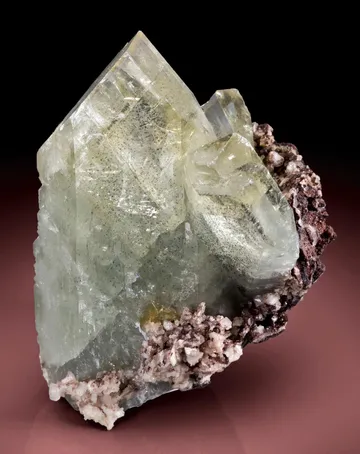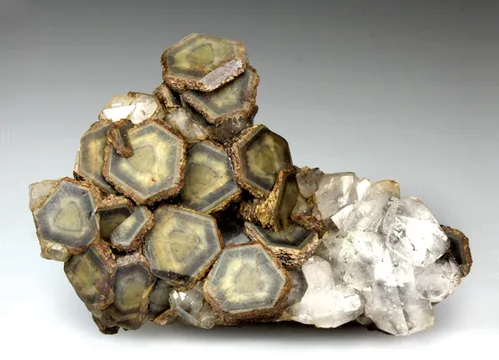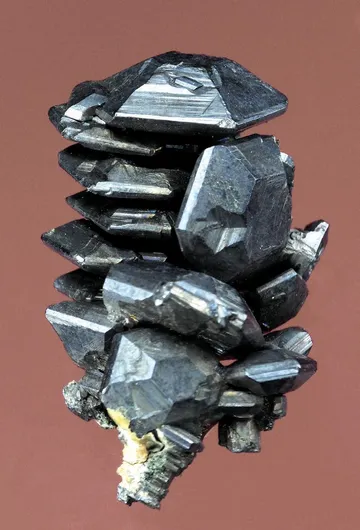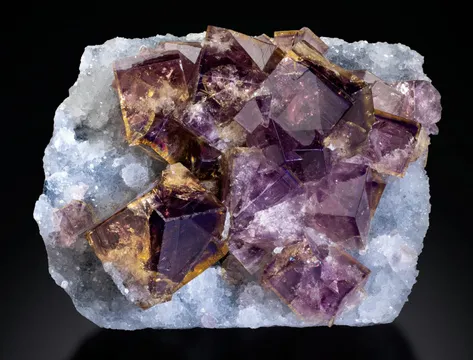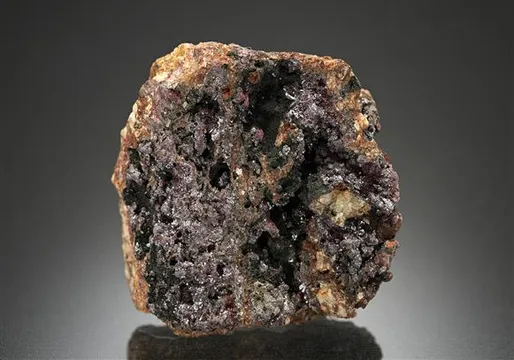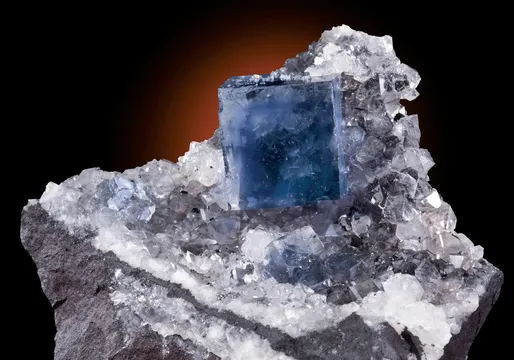
Judkins Quarry, UK - pivotal British locality yielding calcite and baryte crystals, dark sulfides, and the type-locality wooldridgeite, prized by collectors.
Key facts
Judkins Quarry, on Tuttle Hill at Nuneaton in Warwickshire, is a locality where British mineral collecting and British basement geology overlap unusually well. To the field geologist it is one of the great artificial windows into the Nuneaton Inlier: a large former roadstone quarry exposing Precambrian volcaniclastic rocks of the Caldecote Volcanic Formation, a well-marked Precambrian–Cambrian unconformity, Lower Cambrian Hartshill Sandstone, Ordovician lamprophyric intrusions, and Triassic cover on the eastern side. To the mineral collector it is best remembered for a small but distinctive fracture-controlled, low-temperature hydrothermal and supergene assemblage developed close to that unconformity: calcite, baryte, copper sulphides, galena, sphalerite, mottramite, vanadinite, malachite, azurite, cerussite and the type-locality mineral wooldridgeite.
The mineralization is not a great orebody in the classic British vein-field sense. Its charm is subtler and more specimen-focused: cavities and fractures yielding white to pink calcite, pale pink baryte rosettes, black to dark brown sphalerite, metallic bornite and chalcocite-related forms, brassy chalcopyrite, and late green to blue-green secondary copper and vanadium minerals. The best Judkins specimens have a compact Midlands quarry look—busy, contrasting, often cabinet-size rather than huge—with sharp scalenohedral calcite or baryte providing the stage for dark sulphides and small, high-interest rare species.
Regional View
Country View
Judkins is also historically important because it made a contribution well beyond collecting. The granophyric diorite exposed in the quarry supplied a key 603 ± 2 Ma U-Pb zircon age constraint for the Charnwood Terrane, and the quarry’s geological sections were important enough to be treated in Geological Conservation Review work. Mineralogically, its signature event was the recognition of wooldridgeite, Na2CaCu2(P2O7)2(H2O)10, named for the collector James “Jim” Wooldridge. Later discussion has complicated the story by raising the possibility that the Judkins material is post-mining or even post-collecting anthropogenic alteration, but for collectors that uncertainty is part of the locality’s modern fascination: Judkins is a quarry where ordinary-looking fracture minerals led to a new mineral name and a cautionary lesson about cleaning, alteration and analytical confirmation.

Photo:
Search for specimens: View all specimens from Judkins Quarry, UK
Judkins Quarry lies on the north-eastern side of the B4111 from Nuneaton to Atherstone, in the Nuneaton and Bedworth district of Warwickshire. Older labels may call it Judkins Quarry, Judkins’ Quarry, Judkins Tuttle Hill Quarry, Tuttle Hill Quarry, or simply Judkins, Nuneaton. The locality is private industrial land, and modern access is not equivalent to historic collecting access: the former quarry has been used for landfill and waste-management operations, part of the site is associated with Judkins Recycling Centre, and redevelopment proposals concern brownfield land around the former workings. The Warwickshire Local Geological Site documentation specifically notes that LGS status does not itself confer a right of access; anyone considering a visit needs landowner permission and must treat the quarry void, landfill infrastructure and recycling-centre areas as active or controlled industrial environments rather than open collecting ground.
Geologically, Judkins is a large former roadstone quarry cut into the Nuneaton Inlier. The northern part exposes Precambrian volcaniclastic and intrusive rocks of the Caldecote Volcanic Formation, overlain unconformably by Lower Cambrian Hartshill Sandstone that includes basal conglomeratic beds. The eastern side also shows Triassic rocks of the basal Mercia Mudstone Group, including Tarporley Siltstone Formation sandstones and basal breccia lying unconformably on the Precambrian tuffs. Ordovician lamprophyric diorite, commonly described as camptonite in local documentation, intrudes the older sequence as sills and dykes. The result is a compact but complex structural and stratigraphic cross-section, with the mineralization concentrated in fractures rather than in a large mineable vein system.
The collector minerals are tied particularly to the zone within roughly 10 to 20 metres of the Precambrian–Cambrian unconformity. The published description of the assemblage treats it as a dominant calcium-barium-copper suite, with subordinate zinc, lead and vanadium. Coarse calcite and baryte crystallized with copper sulphides during a low-temperature hydrothermal event along fractures; later exposure and oxidation produced supergene copper and lead minerals, vanadium species, and the delicate late-stage curiosities for which Judkins is best known among micromounters. This makes the locality more like a fracture-mineralization occurrence exposed by aggregate quarrying than a classic mine, and specimens tend to be judged by association, condition and locality character rather than by crystal size alone.
The principal sulphides include bornite, chalcocite, chalcopyrite, galena, sphalerite and tetrahedrite-tennantite-group material. Bornite and chalcopyrite are especially characteristic in Judkins collector lore because of pseudomorphic and acicular habits associated with calcite. Roy Starkey’s published and later forum comments describe bornite as the most common copper sulphide, much of it replacing earlier chalcocite, with platy, pseudohexagonal and prismatic forms; chalcopyrite is recorded both as flattened bisphenoidal crystals and as unusual acicular, slightly nodular crystals forming sheaf-like bundles or mat-like aggregates. Those copper sulphide specimens, together with mottramite and vanadinite, explain why Judkins has an importance out of proportion to the small amount of mineralized material actually preserved in collections.
Quarrying began in the nineteenth century. Local industrial-history records place William Cropper at the site in the 1840s, Cropper & Judkins or J. Judkins & Co. by about 1850, W. A. Judkins & Co. from 1864 until 3 July 1903, and Judkins Ltd. from 1903. The quarry expanded by land purchase and absorption of other workings, with Boon’s Quarry absorbed into the Judkins operation in 1955. In the 1970s the business passed into the Amey Roadstone Corporation orbit, and BGS memoir information later lists Judkins as an ARC Central operation producing sandstone, volcaniclastic and intrusive rock. The quarry worked for roadstone and aggregates rather than metal ore; the specimen suite was an incidental reward of hard-rock extraction.
Active mineral extraction ended in the mid-1990s, with the wooldridgeite paper specifying December 1996 as the cessation date following slope-instability problems. Landfilling had already begun in 1978 and continued after quarrying finished; later planning documents record that landfilling ceased in summer 2009, although capping, restoration, landfill-gas management, soil screening and household-waste recycling have all played roles in the site’s post-quarry life. The modern landscape includes the quarry void, restored landfill, remaining industrial access, the recycling centre, the Coventry Canal margin and the prominent conical spoil heap known locally as Mount Jud or Mount Judd.
The most important specimen finds appear to have been made during the late working and early post-working years, particularly in the 1980s and early 1990s, when collectors and researchers still had opportunities to examine fresh or semi-fresh mineralized fracture material. Wooldridgeite was found on a small number of specimens collected from a rockfall below the disused south-west face. The mineralization there included earlier coarse colourless scalenohedral calcite, weathered botryoidal chalcopyrite, corroded bornite pseudomorphs after chalcocite, and light pink baryte rosettes. That one restricted occurrence transformed Judkins from a good Midlands micro/locality into a type locality of international mineralogical interest.
Calcite from Judkins is the principal visual gangue and the mineral that most often gives the specimens their architecture: coarse colourless to white scalenohedra, pinkish calcite in sulphide-bearing material, and drusy to crystalline fracture linings that host baryte, sphalerite and copper sulphides. The better examples show clean, sharp calcite with contrasting dark sphalerite or metallic copper sulphides rather than massive carbonate alone; particularly desirable pieces preserve the Judkins paragenesis clearly, with calcite associated with baryte, sphalerite, chalcocite-bornite material, chalcopyrite, mottramite, vanadinite, malachite, azurite or, in rare micromounts, wooldridgeite. Size is typically modest to cabinet scale rather than monumental, and the best collector pieces are those where the calcite is bright and undamaged enough to frame the rarer species instead of obscuring them.
Judkins sphalerite is a locality mineral rather than a showy ore-field classic: dark brown to black, lustrous rounded crystal groupings and small crystals on matrix, commonly with calcite and baryte, and part of the minor zinc component of the calcium-barium-copper assemblage near the Precambrian–Cambrian unconformity. EarthWonders-listed examples document sphalerite groupings to about 0.4 cm on cabinet-size matrix with scalenohedral colourless calcite, matching the published and photo-documented association of sphalerite with calcite and baryte at the quarry. Good Judkins sphalerite specimens are therefore judged by freshness, contrast and clear association; ordinary pieces can look like dark specks in carbonate, while the best preserve discrete, lustrous sphalerite groups sitting visibly on a Judkins calcite-baryte matrix.
Barite, traditionally spelled baryte in much British literature, is one of the defining Judkins gangue minerals and is especially attractive where it forms pale pink to light pink “desert-rose” aggregates and small rosettes with calcite and copper sulphides. In the wooldridgeite-bearing paragenesis, baryte preceded or accompanied the sulphide-supergene story: pale baryte rosettes occur with coarse colourless scalenohedral calcite, chalcopyrite, bornite after chalcocite and later blue-green copper phosphate material. The better Judkins barytes are those with recognizable rosette or bladed aggregates, a pink cast, and crisp contrast against dark sulphides or white calcite; plain granular baryte from the quarry is much less desirable unless it carries mottramite, vanadinite, sphalerite or well-formed copper sulphide associations.
Other documented Judkins minerals include bornite, chalcocite, chalcopyrite, galena, cerussite, azurite, malachite, hematite, mottramite, vanadinite, tetrahedrite-tennantite-group material and wooldridgeite, with yarrowite also appearing in photo-documented sulphide associations. The rarest name on a Judkins label is wooldridgeite, the type-locality copper pyrophosphate; it forms minute blue-green to pale blue-green crystals and aggregates, originally described with calcite, chalcopyrite, bornite and baryte. Mottramite and vanadinite give Judkins unusual vanadium interest for a Midlands quarry, while the bornite/chalcocite/chalcopyrite suite supplies some of the locality’s most recognizable hand-specimen character.
Judkins specimens deserve careful label scrutiny because the quarry name has been used in several forms and because casual labels sometimes reduce the locality to “Nuneaton,” “Tuttle Hill,” or even “granite quarry,” despite the more complex volcaniclastic, sandstone and intrusive geology. A good label should ideally specify Judkins Quarry, Tuttle Hill, Nuneaton, Warwickshire, England, UK, and older material may carry Judkins Ltd., ARC, Tarmac, or collector provenance from the late twentieth-century Midlands collecting scene.
The main authenticity concern is not a flood of intentional fakes, but analytical uncertainty and overconfident naming of small secondary species. Wooldridgeite is the outstanding example: it is an accepted mineral name and Judkins is its type locality, but later commentary has raised the possibility that the original type-locality material may represent post-mining or post-collecting anthropogenic alteration, potentially linked to pyrophosphate-based cleaning agents. As a result, any “wooldridgeite” specimen from Judkins should be treated as a high-interest analytical specimen, not as something to buy purely on visual identification. Without credible provenance or analysis, pale blue-green specks on calcite or sulphide should be regarded cautiously.
Mottramite, vanadinite, malachite, azurite and other green-to-blue secondary minerals are also easy to overcall in hand specimen. Dark botryoidal or crusty material can be visually ambiguous, and some copper sulphide surfaces alter, tarnish or acquire secondary coatings that invite optimistic identifications. For higher-value examples, XRD, SEM-EDS, Raman or an old analytical provenance matters. The same applies to tetrahedrite-tennantite-group identifications and to any specimen sold as yarrowite, wooldridgeite or another uncommon copper sulphide/phosphate association.
Condition issues are typical of quarry fracture material. Calcite can be bruised, cleaved or etched; baryte rosettes and blades chip easily; sulphides may tarnish or show weathered surfaces; and small secondary minerals can be lost by hard brushing, acid cleaning, ultrasonic cleaning or prolonged soaking. Do not assume calcite-bearing Judkins specimens are safe for acid preparation: the carbonate is often part of the aesthetic and mineralogical context, and acid would also risk destabilizing delicate secondary phases. Wooldridgeite itself is soft, brittle, hydrated and non-fluorescent in the original description, so suspected examples should be kept dry, cool and handled as micromount material.
Fluorescence is not a major selling point for the locality. The original wooldridgeite description specifically records no fluorescence under long-wave or short-wave ultraviolet light, and common Judkins calcite should not be bought on the assumption of a dramatic response unless the individual specimen has been tested. The better collector value lies in paragenesis, rarity and locality significance.
Market availability is limited but not extinct. Judkins was collected actively enough that calcite-sphalerite-baryte and copper-sulphide specimens still circulate, especially from older British collections and dealers who handled Midlands material. Ordinary calcite or sphalerite examples can be modestly priced, while well-associated specimens with attractive baryte, acicular chalcopyrite, chalcocite/bornite pseudomorphs, mottramite, vanadinite or credible wooldridgeite provenance are much scarcer. Today, fresh self-collecting should not be assumed; serious collectors should regard Judkins primarily as an old-collection and occasional-market locality.
In 1932, F. Jones recognized the largest of the Judkins granophyric diorite intrusions and saw that it was unconformably overlain by Lower Cambrian strata. That observation carried a regional consequence. Wills and Shotton later compared the Judkins rock with the “markfieldite” of Charnwood Forest, helping establish that comparable Charnwood intrusions were Precambrian. Decades later, the quarry’s granophyric diorite would become still more important when zircon dating gave an age of 603 ± 2 Ma, making Judkins the rare quarry whose aggregate faces supplied a hard numerical anchor for the late Precambrian history of the English Midlands.
The industrial story is older and noisier. Local history places William Cropper at Judkins in the 1840s, with Cropper & Judkins or J. Judkins & Co. by 1850 and W. A. Judkins & Co. from 1864. The quarry grew by purchase and absorption, swallowing neighbouring workings and eventually incorporating Boon’s Quarry in 1955. Before the First World War, stone moved to Judkins wharf by narrow-gauge horse tramway, graded into bins for road material; by the early 1960s, photographs show Stanier Crab 2-6-0 No. 42945 shunting loaded stone hoppers from Judkins into the yard at Nuneaton Abbey Street station, with the crushing plant rising behind. The mineral specimens collectors prize today came out of a place built for roadstone, canal and rail traffic, not for cabinets.
The best mineral story begins in September 1989, when R. E. Starkey and Jim Wooldridge collected a suite of samples from Judkins that carried tiny pale-blue crystals. The crystals were small—up to about 0.2 mm in the original account—but distinct enough to demand investigation. Jim Wooldridge, a dedicated amateur mineralogist and gemmologist, died in 1995 before the mineral was formally described. Neil Hubbard later sent initial samples for single-crystal X-ray work to Frank Hawthorne’s group at the University of Manitoba. The resulting description named the mineral wooldridgeite for Wooldridge and placed the type material in the Manchester Museum under accession number MANCH:N13200.
The occurrence itself was almost comically restricted: only a small number of specimens from a rockfall below the disused south-west face. The new mineral formed blue-green rhombic-dipyramidal crystals and aggregates, perched on or among earlier calcite, chalcopyrite, bornite after chalcocite and pale pink baryte rosettes. The authors tried to reason through the source of phosphorus. The specimens had come from a spot 100 to 200 metres from the waste tip and tens of metres above it, so landfill seepage seemed unlikely; surrounding pasture made agricultural runoff unlikely as well. The paper’s cautiously memorable conclusion was that the phosphorus most probably came from normal groundwater or bird droppings. Later, the possibility of cleaning-related pyrophosphate chemistry would make the story still stranger.
Judkins also became a case study in what happens when a deep quarry refuses to sit quietly after extraction. In 2000, consultants working for the Waste Recycling Group recognized serious rock-slope stability problems in the former quarry, which had operated for about a century and reached roughly 100 metres deep. The remedial works read like an engineering inventory of a post-industrial cliff: 2,800 square metres of PVC-coated steel mesh for permanent stabilization on the uppermost lift, 8,000 square metres of steel mesh on selected lower faces, 10,200 square metres of hand-scaling, benching and scree regrading, plus catch fences, bunds and local rock bolts. In one area, a 6 metre rebound catch fence was built with posts set into concrete-filled 1.5 metre rubber tyres, braced by steel cables, with Maccaferri netting tensioned into a 3 metre high barrier. The same fractured faces that made cavities for minerals later demanded a different kind of attention.
Hawthorne, F. C., Cooper, M. A., Green, D. I., Starkey, R. E., Roberts, A. C. and Grice, J. D. (1999). “Wooldridgeite, Na2CaCu2(P2O7)2(H2O)10: A new mineral from Judkins Quarry, Warwickshire, England.” Mineralogical Magazine, 63(1), 13–16. The type-mineral description for Judkins wooldridgeite, including occurrence, associations, physical properties and type-material information.
Cooper, M. A. and Hawthorne, F. C. (1999). “The crystal structure of wooldridgeite, Na2CaCu2(P2O7)2(H2O)10, a novel copper pyrophosphate mineral.” The Canadian Mineralogist, 37(1), 73–81. Crystal-structure paper for wooldridgeite, important for understanding why the species attracted mineralogical attention beyond its tiny crystal size.
Ince, F., Starkey, R. E. and Wooldridge, J. (1991). “The geology and mineralogy of Judkins Quarry, Warwickshire.” UK Journal of Mines & Minerals, 10, 8–13. The key locality article for the quarry’s mineral assemblage, repeatedly cited in later Judkins and wooldridgeite literature.
Bridge, D. McC., Carney, J. N., Lawley, R. S. and Rushton, A. W. A. (1998). Geology of the country around Coventry and Nuneaton. Memoir of the British Geological Survey, Sheet 169. The principal BGS district memoir, with important sections on the Nuneaton Inlier, quarrying, Judkins geology and the mineralization near the unconformity.
Carney, J. N. and others, in Geological Conservation Review Series No. 20, Precambrian Rocks of England and Wales. Judkins’ Quarry section. Geological Conservation Review treatment explaining Judkins’ value for Caldecote Volcanic Formation exposures, Precambrian intrusions and the Precambrian–Cambrian unconformity.
Warwickshire Geological Conservation Group. “Warwickshire Local Geological Site: Site No. 12 Judkins Quarry.” Local Geological Site documentation summarizing the formations, conservation status, access caveat and mineralogical interest.
Mindat locality page: Judkins Quarry, Nuneaton and Bedworth, Warwickshire, England, UK — Best single mineral-species checklist and photo gateway for the locality.
Mindat wooldridgeite occurrence: Judkins Quarry — Occurrence page for the type-locality wooldridgeite record, including analytical data and current cautionary status.
Mindat wooldridgeite species page — Useful for the broader wooldridgeite status discussion, including the post-mining/post-collecting alteration question.
BGS memoir: Geology of the country around Coventry and Nuneaton — Essential geological context for Judkins, the Nuneaton Inlier and the quarry’s mineralization.
GeoGuide: Judkins’ Quarry — Readable Geological Conservation Review-style account of the quarry’s Precambrian and Cambrian significance.
Warwickshire Local Geological Site form: Judkins Quarry — Concise official conservation and access context, with geology and mineral-interest summary.
Nuneaton and North Warwickshire local history: Judkins Ltd. Tuttle Hill Granite Quarries — Valuable industrial-history photographs and operator timeline.
Warwickshire Industrial Archaeology Society database entry for Judkins Quarry — Short industrial-archaeology entry noting quarrying history, ARC takeover and later recycling-centre use.
FCC Judkins Quarry redevelopment site — Current land-steward and redevelopment context for the brownfield site.
Warwickshire County Council: Judkins Recycling Centre — Current public-facing information for the recycling centre occupying part of the Judkins site context.
Agg-Net: “Rockfall” — Engineering article using Judkins Quarry as a detailed case study in post-quarry rock-slope stabilization.
Wikimedia Commons: Judkins’ Quarry, Nuneaton photograph — Reusable overview photograph of the former quarry.