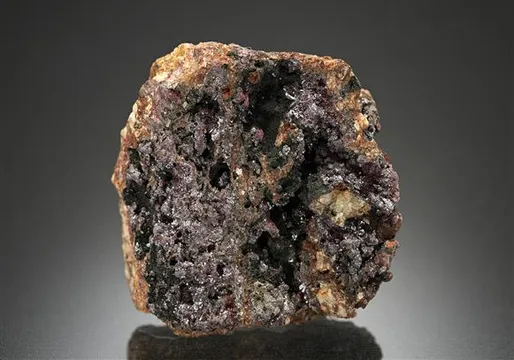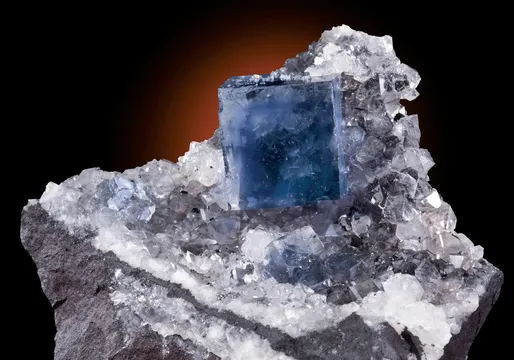
St Ives Consols, UK — a classic Cornish locality famed for old-mine chalcocite crystals, metallic tabular forms, and occasional native bismuth on quartz.
Key facts
St Ives Consols is one of the great old names of Cornish tin and copper collecting: a classic St Ives mine whose reputation rests on two quite different things. Geologically, it was famed for its “carbonas,” irregular replacement bodies in altered granite, rather than simply for ordinary narrow lodes. Mineralogically, it gave collectors some of the most characterful Cornish chalcocite specimens: metallic grey-black to jet-black crystals, commonly six-sided tabular or short-prismatic, with a weight and sharpness that immediately mark them as old British copper classics. Historically, the mine was one of the largest enterprises on the Stennack above St Ives, worked for much of the 19th century and later drawn into the early 20th-century St Ives Consolidated Mines group.
The best St Ives Consols specimens have a very specific look. Chalcocite occurs as chunky, lustrous, pseudohexagonal crystals, often on or with massive chalcocite, and the finest miniatures show freestanding, fat crystals approaching 2 cm, or unusual bladed groups several centimetres long. The mine is also notable for crystallized native bismuth on quartz from scarce 19th-century finds, making it more than a one-species locality for collectors who enjoy deep Cornish provenance.
Regional View
Country View
The locality lies on the southwestern fringe of St Ives, around Higher Stennack, in the St Ives mining district of west Cornwall. In specimen labels it may appear as St Ives Consols, St Ives Consolidated Mine, St Ives Consolidated Mines, or with the included names Wellesley Mine and Wheal Mary. For the collector, the important point is that the classic chalcocites pre-date modern collecting by generations: they are old-mine specimens, usually encountered through historic European, British, or American collections rather than through fresh field collecting.

Photo: Wikimedia Commons

Photo: Wikimedia Commons
Search for specimens: View all specimens from St Ives Consols, UK
St Ives Consols was a granite-hosted tin and copper mine in the St Ives district of west Cornwall, situated around the upper Stennack, roughly from the area of the Leach Pottery toward the fork where the Zennor road leaves St Ives. The mine is recorded under St Ives Consols and as including Wellesley Mine and Wheal Mary. The workings lay within the broader Cornubian metallogenic province, where late- to post-Variscan granites and their fracture systems focused tin, copper, sulphide, fluorite, quartz, tourmaline, and alteration assemblages.
The deposit style that made the mine famous was the carbona: a replacement body in altered granite developed close to lodes. In the St Ives district these were not simple vein cavities but irregular, pipe-like to tabular masses formed by wall-rock alteration and mineralization around fractures and lode intersections. The British Geological Survey memoir for the Penzance sheet describes the Great Carbona at St Ives Consols as developed in the hangingwall of Standard Lode, about 18 m by 18 m by 230 m, consisting of veinlets, bunches, and pipes in altered granite carrying pink and green feldspars. Cassiterite and copper ore were associated with pyrite and tourmaline, and parts of the structure were rich in fluorite.
Several lodes are associated with the mine, including North, Virgin, Caunter, Daniell’s, William’s, Lowry’s, and Kemp’s lodes. Historic accounts also name major shafts such as Wheal Mary, West and East Virgin, Old Sump, Cornish, and Millet shafts. The adit is recorded at about 20 fathoms below surface, and the deepest shaft at 200 fathoms. Standard Lode is especially important in the geological story, because the carbonas were encountered while working it; later studies of carbona-style tin mineralization describe No. 1 and Lowry’s carbonas as being followed on the 35- and 57-fathom levels, with the Great Carbona defined from about the 77-fathom level and enlarging southward.
The mine was restarted in 1818 by Sir Christopher Hawkins, and was developed in the 1820s and 1830s under James Halse, whose name is preserved in nearby Halsetown. By the mid-19th century St Ives Consols was one of the principal mines of the district. The mine’s most productive period was between the 1850s and early 1870s, when recorded black tin production was substantial and employment ran into the hundreds. In 1864 or 1865 the mine is recorded with 218 men, 59 women, and 104 boys, supported by two pumping engines, a stamps engine, two whims, and waterwheel stamps. The mine closed as a major working in 1875, though limited production continued from upper levels later in the 19th century. In 1907 it became part of St Ives Consolidated Mines Limited, with neighboring mines including Trenwith, Rosewall Hill, Ransom United, Goole Pellas, Georgia, and Giew. That revived group closed during the First World War, while Giew continued later.
Production figures compiled from J. H. Collins give the mine’s total recorded value to 1892 as £1,024,467, with black tin production from 1827 to 1892 amounting to 16,400 tons. The strongest decades were the early and middle 19th century: 4,739 tons of black tin from 1831 to 1840, 4,041 tons from 1841 to 1850, and a recorded best single year in 1859 of 340 tons of tin worth £24,010. Copper was a minor part of the recorded output by value, but copper minerals are crucial to the collector story because they gave the mine its chalcocite.
Modern field collecting at St Ives Consols should be regarded as effectively closed. The old mine ground is now part of the modern St Ives landscape rather than an open collecting site, and the underground workings remain a real hazard. There are no meaningful above-ground remains comparable to a remote Cornish dump where one might safely search for specimens. The collapse history is not abstract: in April 2018 a deep, narrow sinkhole opened in a St Ives car park at Garth-an-Creet and was linked to collapse of the old Cornish Shaft. For collectors, St Ives Consols is therefore an old-collection locality. The desirable specimens are those with historic labels, coherent provenance, and undamaged crystals, not newly field-collected pieces.
The notable mineral finds appear to have come chiefly from the copper-bearing portions of the mine and associated carbona/lode systems, but precise pocket-by-pocket collecting records are sparse, as is usual for many 19th-century Cornish classics. Surviving specimen evidence shows that St Ives Consols produced both matrix groups of chalcocite crystals and freestanding or near-freestanding crystals on massive chalcocite. Documented old specimens include miniatures with robust chalcocite crystals to nearly 2 cm, a divergent group with more than 25 flat-topped crystals to 1 cm, and a historic bladed miniature with chalcocite crystals to 4 cm, reportedly once in the possession of Lord Tynes in 1876. Native bismuth on quartz is recorded from very few finds, all apparently 19th-century, and good examples are considerably rarer than the chalcocite.
Chalcocite is the collector’s signature mineral from St Ives Consols, and the best examples are classic Cornish pieces rather than mere ore. Mindat records the locality habit as six-sided tabular to short-prismatic, with grey metallic to grey-black metallic colour, and surviving specimens confirm a range from small sharp crystals on matrix to highly aesthetic thumbnails and miniatures. The most admired pieces show crisp pseudohexagonal outlines, striated faces, bright metallic lustre, and either freestanding “fat” crystals approaching 2 cm or unusually bladed crystals reaching several centimetres; ordinary pieces are darker massive chalcocite with only scattered or bruised crystal faces. Associations include massive chalcocite and quartz, with the copper sulphide assemblage of the mine also including bornite and chalcopyrite, while the broader carbona environment ties the copper species to cassiterite, pyrite, tourmaline, fluorite, and altered granite. A premium St Ives Consols chalcocite should look architectural: sharp edges, complete terminations, minimal rub, and enough old-label provenance to separate it from the many other Cornish chalcocite localities.
Other minerals documented from St Ives Consols include actinolite, bornite, cassiterite, chalcanthite, chalcopyrite including the “blistered copper” variety, chlorite-group minerals, cuprite and chalcotrichite, dolomite, feldspar-group minerals, fluorite, hematite, limonite, native bismuth, opal or possible isopyre, pyrite, quartz, schorl, and tourmaline. Cassiterite was the great economic mineral of the carbonas, but collector-quality cassiterite from this mine is less familiar than the chalcocite. Native bismuth is the outstanding rarity: crystallized bismuth on quartz from St Ives Consols is recorded from very few 19th-century finds, and sharp crystals around 2 cm are exceptional for the locality. No accepted type-locality mineral is presently credited specifically to St Ives Consols in the standard locality literature; its importance is as a classic Cornish chalcocite and carbona locality rather than as a type-mineral source.
The principal authenticity issue with St Ives Consols is locality attribution. Cornwall produced chalcocite at a number of famous mines, including localities in the St Just, Redruth, Camborne, and St Ives districts, and old labels can be short, ambiguous, or written simply as “St Ives,” “Consols,” or “Cornwall.” A St Ives Consols attribution is strongest when supported by an old collection label, a dealer or museum record, and a habit consistent with the known locality: pseudohexagonal, tabular to short-prismatic grey-black chalcocite, commonly in thumbnail to miniature specimens, occasionally as particularly robust or bladed crystals.
No locality-specific tradition of treatment is associated with these pieces, but condition is a serious matter. Chalcocite is soft enough to show edge wear, rubbing, and bruised terminations, and the metallic lustre can be dulled by handling, old dust, or careless cleaning. Avoid aggressive cleaning, acids, or prolonged water exposure; old Cornish sulphides are best left with stable patina intact. Chalcanthite, where present as a secondary copper sulphate, should be treated as fragile and humidity-sensitive. Native bismuth pieces should be handled sparingly, kept dry, and protected from rubbing, as the stepped metallic surfaces are easily diminished.
The market supply is limited and episodic. Most St Ives Consols chalcocites appear from old collections, dealer back stock, auctions, and estate dispersals rather than from new discoveries. Good thumbnails and miniatures remain collectible and comparatively obtainable by classic British standards, but sharp, complete, lustrous specimens with crystals near or above 1 cm are much scarcer. Exceptional pieces with 19th-century provenance, unusual bladed habit, or nearly pristine freestanding crystals belong in a higher tier. Native bismuth on quartz from St Ives Consols is rarer still and should be considered a specialist Cornish rarity when well crystallized and well documented.
In the Stennack valley the mine was not a romantic ruin on a distant moor; it sat in the working life of St Ives itself. The stream name is tied to tin, and by the mid-19th century there were nineteen mines in and around the town. St Ives Consols, up at the top of the Stennack, became one of the largest. In 1832 James Halse built Halsetown nearby to house many of the workers who served the mine. A later Penlee House record of a sepia albumen print fixes the surface scene vividly: children and bal maidens working on the dressing floors beside the Stennack river, with the industrial mine ground occupying the area from the Leach Pottery up toward the Zennor road fork.
The Great Carbona was the kind of ore body that miners remembered in dimensions rather than adjectives. Modern discussions of the old survey plans describe it as extending roughly 900 feet and reaching 600 feet in depth, with a width of 50 to 70 feet in places. Geological memoirs give a more formal figure of about 18 m by 18 m by 230 m for the Great Carbona in the hangingwall of Standard Lode. However it is expressed, the point is the same: St Ives Consols was not merely following a narrow vein, but hollowing out a huge, irregular body of mineralized granite. The carbonas produced caverns whose roofs had to be supported by massive timbers.
In April 1843, that timber became the mine’s disaster. A workman’s lighted candle, fixed against a beam in the Great Carbona, set the timber alight. The fire burned for six weeks and destroyed that section of the mine. The episode is more than a dramatic footnote: it tells the collector something about the physical setting of the specimens. The chalcocite and associated minerals came from a mine where parts of the ore body were large enough, timbered enough, and rich enough to become a subterranean architecture of their own.
The human cost of the mine is preserved in the 1887 death of Edwin Trevorrow. On Tuesday, March 15, after the forenoon shift, Trevorrow and other miners were coming to surface when he entered the kibble, a skip used for hoisting, although regulations were posted in the account-house window and there was normally a footway. The circumstances were tangled: an abandoned shaft near the place where Trevorrow and his son had been working had run in the day before and blocked the footway. Captain Michell advised the men not to go down, but did not forbid them. Trevorrow was near the surface when the wire rope broke and the kibble fell 30 fathoms to the bottom of the shaft. He was 45, leaving a widow and a large family. At the inquest, Joseph Tonkin said he heard a shriek, then the fall; descending about 14 fathoms, he found Trevorrow dead. A piece of the wire rope was produced. It had not been long in use at St Ives Consols but had previously been used at Rosewall Hill, and witnesses admitted it had broken before, perhaps more than once. The jury returned “Accidental death,” but severely censured Captain Michell for not positively forbidding the men to descend by kibble.
The old workings have not entirely vanished from St Ives life. In April 2018 a hole opened in a car park at Garth-an-Creet: about 40 feet deep and 3 feet wide, linked after investigation to the collapse of Cornish Shaft, one of the old main shafts of St Ives Consols. It is a sharp modern reminder that the classic labels in drawers and cabinets came from an underground landscape still present beneath the town, even where the mine buildings have gone.