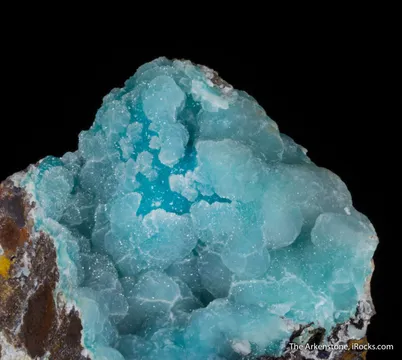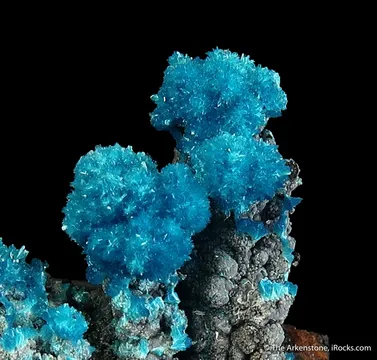
Christiana Mine, Greece — Lavrion's famed locality yielding azurite on gossan, malachite fibers, zinc- and copper-arsenates; prized for jewel-like secondary sp…
Key facts
Christiana Mine is one of the key specimen localities in the Kamariza sector of the Lavrion Mining District, southeast Attica: a compact, intensely mineralized part of one of the world’s great polymetallic ore fields. For collectors, its importance rests on three overlapping stories. First, it is part of the ancient and modern Laurion silver-lead-zinc mining landscape that helped make Lavrion a classic name in European mining history. Second, it lies in the supergene oxidation zone of carbonate-replacement Pb-Zn-Ag mineralization, where marble-hosted sulfide ore and reactive carbonate wall rock produced an exceptional secondary assemblage. Third, Christiana has yielded the kind of small, jewel-like secondary specimens that make Lavrion irresistible: electric-blue azurite on rusty gossan, malachite fibers and balls, green zinc-copper arsenates, quartz-lined cavities, calcite associations, and rare microminerals that require a careful label and a good microscope.
The mine belongs to the Mercati mines at Agios Konstantinos, historically Kamariza, within Lavreotiki. Its specimens are most often collected and traded as Christiana Mine, Kamariza, Lavrion, or Christiana 132, the last name reflecting a long-standing collector shorthand tied to the shaft elevation rather than to an official shaft number. The ore environment is classic Lavrion: sulfides such as galena, sphalerite, pyrite, and chalcopyrite in carbonate replacement bodies, later opened and altered by oxidizing waters into a gossan rich in copper, zinc, lead, iron, arsenate, sulfate, and carbonate minerals. The finest cabinet pieces from Christiana are usually not large single crystals in the alpine sense; they are dense, mineralogically complicated plates and vugs where color contrast and paragenesis are everything.
Regional View
Country View
Christiana’s collector reputation has risen especially on azurite-rich material from modern finds. Some pieces show sharp, translucent, vivid blue crystals only a few millimetres across, but with a saturation and glassiness unusual for Greek azurite. These are often set against limonite, malachite, calcite, conichalcite, olivenite, or other green arsenates, so a specimen may look simple from across the room and become a miniature mineralogical atlas under magnification. The locality is also scientifically important: Christiana is tied to the type-locality history of attikaite and zincowoodwardite, and to a wider Lavrion suite that includes zincolivenite, agardite-group minerals, tsumcorite-group species, rare arsenates, and layered double hydroxides.

Photo: Wikimedia Commons
The best way to understand Christiana specimens is to think in pockets and reaction zones, not in a single headline mineral. A superb Christiana piece may carry bright azurite, but its real value is often in the matrix: iron oxides preserving earlier carbonate habits, malachite replacing or lining copper-rich surfaces, calcite or quartz marking open space, and tiny green to blue-green arsenates that record the mobility of copper, zinc, calcium, lead, and arsenic in the oxidized ore.
Search for specimens: View all specimens from Christiana Mine, Greece
Christiana Mine is in the Mercati mines group at Agios Konstantinos, the old Kamariza mining area of the Lavrion Mining District, East Attica, Greece. The standardized locality hierarchy places it under Lavreotiki, East Attica, Attica, Greece. Published coordinates for the locality are approximately 37°44′02″ N, 24°01′13″ E, or 37.73416, 24.02048 in decimal degrees.
Geologically, Christiana belongs to the Kamariza part of the Lavrion system, where carbonate-replacement Pb-Zn-Ag-Au ores occur in marbles of the Attic-Cycladic metamorphic complex. The Kamariza unit includes thick marble horizons separated and overlain by schists, and the district was profoundly affected by Miocene extensional tectonics, granodioritic magmatism, hydrothermal circulation, and later oxidation. In the wider Lavrion district, five mineralization styles are recognized: porphyry Mo-W, Fe-Cu-Bi-Au skarn, skarn-free carbonate-replacement Pb-Zn-Ag-Au mineralization, and Pb-Zn-Ag vein and breccia systems. Christiana is specifically counted among the Kamariza carbonate-replacement deposits, along with Hilarion, Clemence, Jean Baptiste, and Serpieri.
The primary ore in this setting was dominated by galena, sphalerite, pyrite, chalcopyrite, and other sulfides and sulfosalts, with quartz, fluorite, and calcite as common gangue. Oxidation transformed that assemblage into the collector minerals for which Christiana is best known. Chalcopyrite supplied copper for azurite, malachite, brochantite, olivenite-group minerals, and other Cu-bearing species. Sphalerite supplied zinc for smithsonite, hemimorphite, adamite, zincolivenite, zincowoodwardite, and related phases. Pyrite and other iron sulfides supplied the iron oxide and sulfate environment in which goethite, hematite, jarosite, beudantite-group minerals, scorodite, carminite, and other arsenate-rich species could form. The carbonate host rock was not passive: marble cavities, dissolution surfaces, and replacement textures gave the later minerals open spaces in which to crystallize.
Christiana’s workings descended to sea level and slightly below it. The shaft serving the mine had loading docks at about 85 m and 5 m above sea level, while the shaft itself was constructed at an elevation of 132.64 m above sea level. That elevation is the source of the widely used collector and literature shorthand “Christiana 132” or “Shaft 132.” The French company’s actual shaft name was Puits Christiana, without an official number, so labels reading Christiana 132 are historically understandable but should not be treated as a formally numbered shaft designation.
Mining at Lavrion long predates the modern Christiana specimen market. The broader district records more than 5000 years of intermittent mining activity, beginning with prehistoric copper and galena exploitation, then reaching world-historical importance in classical Athens, when rich Kamariza mineralization helped support large-scale silver production. Modern operations began in the 1860s, first by reworking ancient slags and later by renewed underground mining. The French and Greek companies active at Lavrion worked the Kamariza and Plaka-Villia sectors, including Christiana and neighboring mines, into the late 20th century.
The modern mining operators most relevant to Christiana were tied to the Compagnie Française des Mines du Laurium, whose engineering practice explains the shaft-elevation numbering confusion preserved on collector labels. Modern Lavrion mining and metallurgy were not small-scale romantic ventures: the district had industrial plants, underground workings, ore dressing, roasting, smelting, and a large labor force. Today the industrial landscape is preserved in part through the Lavrion Technological and Cultural Park, while Lavreotiki as a whole is recognized as a UNESCO Global Geopark.
Collecting access must be treated conservatively. Christiana is part of a historically mined, archaeologically sensitive, and protected landscape. Old shafts, adits, flooded levels, unstable ground, and metalliferous waste are real hazards, and current field activity requires local permission, legal awareness, and respect for heritage protection. For most serious collectors, Christiana is now encountered through old collections, documented dealer specimens, legally obtained surface material, and recent pieces handled by local specialists rather than through casual underground collecting.
Documented specimen finds include Christiana azurites collected in the mid-2010s, with sharp, translucent crystals coating limonite matrix and associated with malachite. The celebrated small 2018 azurite find produced some of the finest Greek azurite crystals known to collectors, generally thumbnail to miniature in scale but unusually lustrous and saturated. Another 2018 altered copper pocket at Christiana produced rich green zincolivenite and cuprian adamite material. A 2014 second-level conichalcite find has also circulated among collectors, notable because precise level provenance is unusually valuable for Lavrion material. More recent Christiana azurite-malachite pieces from a May–June 2025 find show that small but attractive secondary copper specimens still enter the market, though access and provenance remain central concerns.
Christiana azurite is the locality’s signature display mineral, typically occurring as coatings, druses, and small sharp crystals of intense royal to electric blue on limonitic gossan, quartz, calcite, or mixed secondary copper-zinc-arsenate matrix; documented mid-2010s specimens include cabinet pieces with crystals around 2 mm, and the best 2018 material is prized for glossy, transparent to translucent crystals that are far more gemmy than most Lavrion azurite. Fine pieces are not judged only by size: the most desirable examples have vivid saturated color, bright luster, well-separated crystal faces rather than dull powdery crust, attractive contrast with green malachite or conichalcite, and a precise Christiana or Christiana 132 label; ordinary pieces tend to be flatter blue crusts with little sparkle or weak matrix composition.
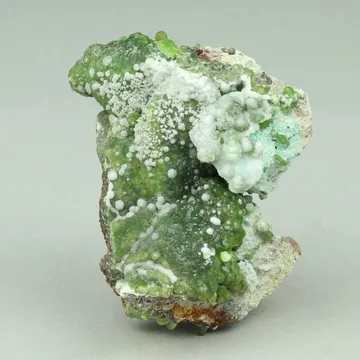
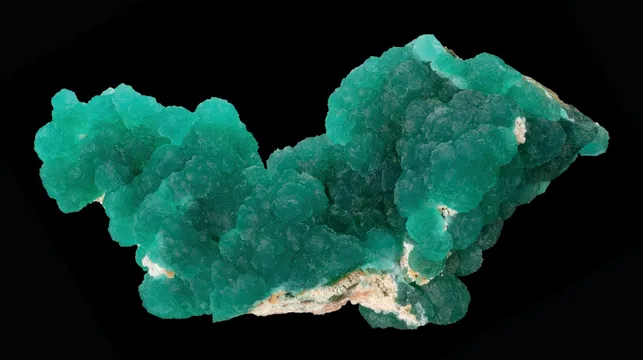
Christiana malachite is most valued as a lively green partner to azurite rather than as large standalone stalactitic malachite; it occurs as fibrous aggregates, small primary crystals, tufts, balls, and spherules on limonite, quartz, arsenocrandallite-rich pale matrix, calcite-bearing cavities, and blue azurite crusts. The best Christiana examples show fresh emerald to grass-green color, distinct fibrous or spherical texture, and strong contrast with crystallized blue azurite; recent May–June 2025 material has been described as unusually rich for Lavrion, while more ordinary specimens carry thin green smears or incomplete malachite coatings with little three-dimensional growth.
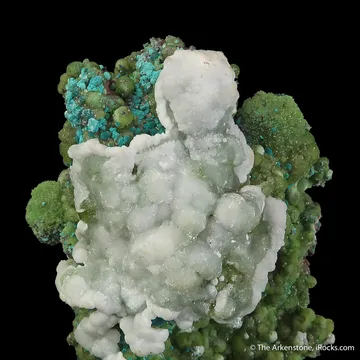
Calcite at Christiana is important less as an isolated show species than as a gangue mineral, pocket former, and paragenetic marker in the oxidized carbonate-replacement ore; it appears with azurite, malachite, adamite, conichalcite, quartz, smithsonite, goethite, and other secondary species, and Christiana specimens include quartz crystals with calcite caps as well as goethite pseudomorphs after scalenohedral calcite. Better calcite-bearing pieces show clean white to pale crystals or recognizable earlier calcite habits that give architecture to the secondary mineral assemblage, while routine pieces use calcite merely as pale matrix without sharp form or color contrast.
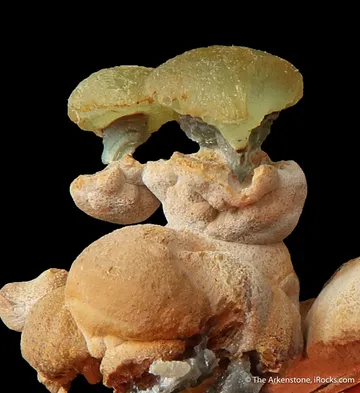
Christiana adamite occurs in the zinc-rich, arsenate-bearing oxidation assemblage as pale to bright green, yellowish, or copper-bearing crystals and aggregates, commonly with calcite, smithsonite, conichalcite, beudantite-group minerals, carminite, azurite, quartz, goethite, olivenite, fluorite, and malachite. Under magnification, Lavrion adamite can show wedge-like prisms and dipyramidal forms, and Christiana material is especially appealing when cuprian adamite adds green sparkle among azurite, malachite, zincolivenite, and iron oxide pseudomorphs; top specimens have rich coverage, crisp crystals, and a color distinct from adjacent conichalcite or zincolivenite rather than an undifferentiated green crust.
Goethite is one of Christiana’s essential framework minerals, forming from oxidation of iron sulfides and appearing as brown to black botryoidal, reniform, acicular, radiating, stalactitic, and pseudomorphic material within the gossan. Its most collectable role here is structural: Christiana specimens are known with goethite pseudomorphs after scalenohedral calcite, then coated or accented by azurite, malachite, zincolivenite, cuprian adamite, or calcite, giving a sculptural dark matrix for bright secondary minerals; the best pieces preserve sharp pseudomorph shape and glossy botryoidal surfaces, while common goethite is simply earthy brown iron oxide.
Christiana zincolivenite is a serious collector’s mineral because it sits at the analytical boundary between copper-bearing adamite and zinc-bearing olivenite, and visually it can appear as rich green crystalline sprays, coatings, or microcrystalline aggregates in the copper-zinc-arsenate assemblage. Particularly notable Christiana material came from an altered copper pocket found in 2018, where zincolivenite and cuprian adamite occurred together with azurite, malachite, calcite, and goethite pseudomorphs; superior examples show saturated green color, bright luster, and discrete crystallization, while ordinary pieces require analytical caution because green Lavrion arsenates can be visually deceptive.
Aragonite from Christiana belongs to the fragile carbonate side of the Lavrion oxidation assemblage, occurring as pale, white, bluish, fibrous, branching, or spray-like growths in association with adamite, copper-bearing adamite, conichalcite, zincolivenite, jarosite, goethite, olivenite, azurite, and malachite. At this locality, the most desirable aragonite is not merely present but intact: open sprays or delicate crusts that survive without bruising, with a clear Christiana label and a colored secondary mineral nearby; broken, chalky, or rubbed carbonate masses are far less desirable even when larger.
Brochantite is a minor but legitimate Christiana copper sulfate, best understood as part of the late oxidized copper assemblage with azurite and malachite rather than as a major display species. Specimens attributed to Christiana show brochantite with azurite, where dark to bright green microcrystals or fibrous crusts provide texture and color variation on copper-rich gossan; a good piece has identifiable green crystalline brochantite that is not simply malachite staining, and because the mineral can be visually confused with other green Lavrion copper phases, confidence rises sharply with analytical data, old labels, or reputable provenance.
Christiana conichalcite occurs as green secondary calcium-copper arsenate in the oxidized ore, appearing as crusts, nodules, tiny “orzo-like” microcrystals, and green accents with azurite, calcite, quartz, adamite, zincolivenite, malachite, and iron oxides. A documented 2014 find from the second level of the Christiana mine produced unusual conichalcite nodules, making level-specific provenance especially valuable; the best specimens show coherent nodular form or sparkling green microcrystals with clear association and locality detail, while ordinary green coatings can be difficult to separate visually from malachite, zincolivenite, or cuprian adamite without testing.
Beyond the headline species, Christiana’s mineral list is unusually rich for a single mine, with documented arsenates, sulfates, carbonates, oxides, hydroxides, silicates, and sulfides. Important recorded species include attikaite, zincowoodwardite, arsenocrandallite, arsenogoyazite, beudantite, carminite, scorodite, olivenite, agardite-(Ce), agardite-(La), agardite-(Y), auriacusite, arsendescloizite, arsentsumebite, tsumcorite, mawbyite, hidalgoite, segnitite, pharmacosiderite, bariopharmacosiderite, anglesite, cerussite, smithsonite, hemimorphite, quartz, baryte, fluorite, sphalerite, chalcopyrite, bournonite, jarosite, and gypsum. Attikaite has particular historical importance because the original description used the Christiana 132 designation, while zincowoodwardite is tied to Christiana and Hilarion as co-type localities; these rarities are normally micromount or analytical minerals, not eye-catching cabinet pieces, but they are central to Christiana’s scientific standing.
Christiana specimens should be bought with labels, context, and restraint. Lavrion labels have long used mixed spellings and hierarchies—Lavrion, Laurion, Laurium, Kamariza, Kamareza, Agios Konstantinos, Mercati, Christiana, Christiana 132, and Shaft 132—so an old label is valuable even when its wording is not modern. The key correction is that “Christiana 132” refers to the shaft-elevation convention, not to an official numbered shaft named by the French company. Do not discard that wording; preserve it as part of the specimen’s history, but record the modern locality as Christiana Mine, Mercati mines, Agios Konstantinos, Lavreotiki, East Attica, Attica, Greece.
The main authenticity concern is not mass faking in the sense of manufactured Christiana specimens; it is misidentification and overconfident naming within a very complex secondary assemblage. Green coatings may be sold as malachite, conichalcite, zincolivenite, cuprian adamite, olivenite, brochantite, or “mixed copper minerals” depending on the seller’s confidence and the analytical work behind the label. Zincolivenite and cuprian adamite are especially easy to blur visually. Serious buyers should favor pieces from dealers who state associations carefully, disclose uncertainty, and provide analytical confirmation for rare species.
Condition issues are typical of Lavrion secondary specimens. Azurite crystals may be tiny, exposed, and easily bruised. Malachite fibers and aragonite sprays are fragile. Calcite and quartz matrix can be chipped around vug edges. Goethite pseudomorphs may shed powder or have weak points where later minerals grew on iron oxide crusts. Micromount rarities often occur as sub-millimetre crusts, botryoids, or needles on friable gossan, so the loss of a small patch can be mineralogically significant even if it looks minor.
Arsenates and lead-bearing minerals are common in the Christiana assemblage. Normal display handling is safe with common-sense precautions: avoid inhaling dust, do not trim friable specimens indoors, wash hands after handling, keep specimens away from children and pets, and store labels with the specimen. Avoid soaking complex Lavrion pieces; water can loosen clays, sulfates, iron oxide crusts, and delicate secondary growths. Chemical cleaning is particularly risky because carbonates, arsenates, sulfates, and iron oxides respond differently.
Christiana material remains available, but good pieces are selective. Modest azurite-malachite and mixed secondary specimens appear regularly from Greek dealers and old collections. Fine azurites from the best 2018 material are much less common and can command strong prices despite small size. Zincolivenite-cuprian adamite specimens from the altered copper pocket are sought after by Lavrion specialists. Type-locality attikaite and zincowoodwardite material is normally micromount material and should be valued for documentation and analytical confidence rather than visual scale.
The most persistent Christiana story is hidden in a number. Generations of collectors have repeated “Christiana 132” as though it were an official shaft name, but the real origin is more mechanical and more interesting. The shaft was Puits Christiana under the Compagnie Française des Mines du Laurium. Its collar stood at 132.64 m above sea level, and company practice tied such figures to the elevation of the axle of the main wheel. The shorthand stuck. Labels, articles, specimen cards, and collector conversations turned an elevation into a mine name. For a locality where millimetre-scale minerals carry heavy scientific meaning, that half-remembered engineering detail matters: it is the difference between a romantic label and a historically precise one.
Christiana also has the kind of modern specimen history that passes quickly through the collector community. The mid-2010s brought vivid azurite-malachite plates from the mine, and by the time selected 2015 pieces reached the market, their character was clear: small, sharp azurite crystals, bright enough to hold their own against green malachite and rusty gossan. Then the 2018 azurite find changed expectations for Greek azurite. These were not large Tsumeb or Bisbee-style groups; they were compact, highly lustrous, saturated blue crystals whose quality made collectors reconsider what Lavrion could do in azurite. A thumbnail could carry more importance than a larger but duller plate.
The 2018 altered copper pocket added another layer. Instead of simply producing blue azurite and green malachite, it yielded rich zincolivenite and cuprian adamite material, sometimes on goethite pseudomorphs after calcite. In hand, such pieces can look like colorful gossan; under magnification they become a record of replacement, oxidation, and cation sorting—iron oxide preserving earlier carbonate form, copper and zinc entering arsenate structures, and late blue-green minerals growing over the wreckage of the orebody.
The conichalcite story is quieter but very Lavrion. A collector specimen traced to a 2014 second-level find at Christiana became notable not because it was huge, but because it preserved a precise underground context: green conichalcite from a specific level of a specific mine in a district where labels are often generalized. That kind of detail is gold to Lavrion collectors. In a mining field with thousands of shafts and a century and a half of modern specimen circulation, a level number can be as important as crystal size.