Hilarion Mine, Greece - Lavrion-area locality yielding adamite, smithsonite, aragonite and rare arsenates; prized for blue-green hues and precise labeling.
Key facts
Hilarion Mine sits in the Kamariza mines of Agios Konstantinos, within the Lavrion Mining District of southeastern Attica, a district where ancient Athenian silver mining, nineteenth-century industrial metallurgy, and modern specimen mineralogy overlap in an unusually concentrated way. For collectors, Hilarion is not merely another Lavrion sublocality: it is one of the named mines that gives real precision to a label in a district otherwise crowded with old “Laurium” and “Lavrion” attributions. Its reputation rests on supergene Pb-Zn-Cu-Ag mineralization in marble-rich carbonate-replacement ground, with oxidized ore zones that have yielded showy adamite, cuproadamite, smithsonite, aragonite, mixite, and a long tail of rare arsenates, sulfates, carbonates, and layered double hydroxides.
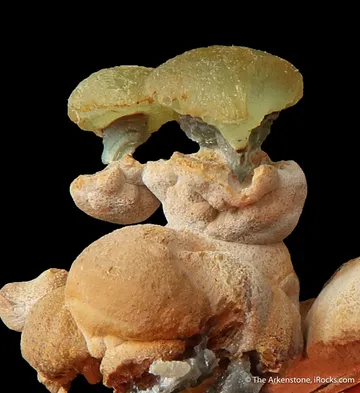
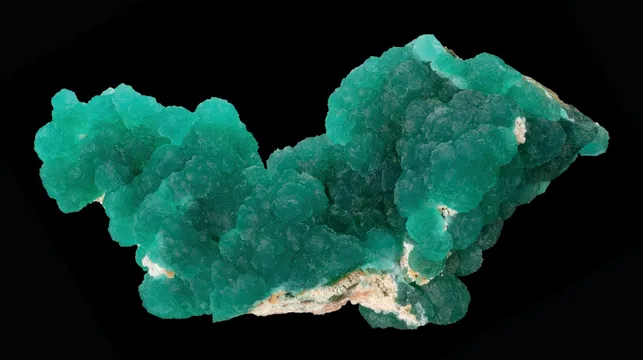
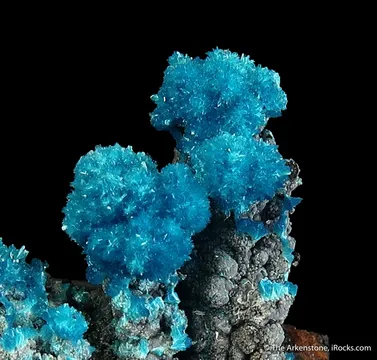
The mine’s best cabinet minerals have the unmistakable Lavrion look: pale to saturated blue-green secondary minerals on brown gossan, white carbonate contrast, and finely sparkling surfaces that repay close inspection. Hilarion smithsonites can be wet-looking, translucent, and globular; the adamites range from apple-green and turquoise cuprian crystals to sugary druses on smithsonite; aragonite may appear as seafoam-white to blue-green coral-like sprays; and rarities such as mixite, agardite-(Nd), hilarionite, zincowoodwardite, and kamarizaite make the locality important far beyond the display-case species.
Regional View
Country View
The setting is geologically complicated in exactly the way collectors like: marbles and schists of the Kamariza unit, late Miocene magmatic influence, sulfide replacement bodies, copper-rich late ore stages, and prolonged oxidation. That combination generated both attractive macro specimens and a micro-mineralogical laboratory. The name Hilarion itself carries historical weight, tied to Hilarión Roux, the Marseilles banker and industrial backer associated with the modern reactivation of Lavrion.

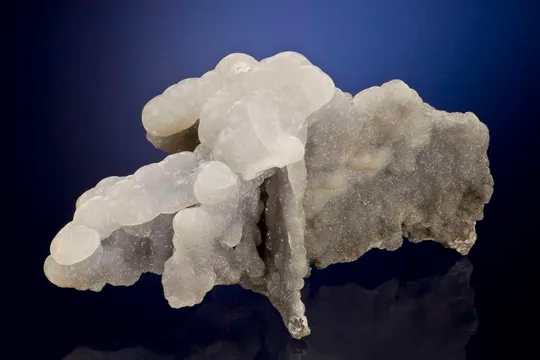
Photo: Wikimedia Commons
Although the photograph above is a Kamariza specimen rather than a Hilarion-specific label, it illustrates the rounded carbonate textures and pale glossy surfaces that make Kamariza smithsonite immediately recognizable. Hilarion’s more coveted pieces often add stronger blue-green coloration, copper-bearing associations, or sharper mine-level provenance.
Search for specimens: View all specimens from Hilarion Mine, Greece
Hilarion Mine belongs to the Kamariza mines at Agios Konstantinos, historically also written Kamareza, in the Lavrion Mining District of East Attica. The Kamariza mines include several collector-famous names—Hilarion, Jean Baptiste, Serpieri, Clemence, and related workings—and lie west of the town of Lavrion, in the old mining country between the Attic coast and the interior marble-schist hills.
The ore system is part of the Lavrion Pb-Ag-Zn district, best understood as carbonate-replacement and related polymetallic mineralization developed in a tectonically stacked metamorphic terrane. The Kamariza unit contains Upper and Lower marble horizons with Kamariza schists between them; ore deposition is localized in and near marbles, along marble-schist contacts, and in structurally favorable zones around the detachment-related architecture of the district. In the Kamariza area, primary sulfide assemblages include sphalerite, galena, pyrite, arsenopyrite, chalcopyrite, tetrahedrite-tennantite series minerals, enargite, and a suite of Ag-, Bi-, Sb-, As-, Sn-, and Cu-bearing sulfosalts. Hilarion and Jean Baptiste are especially important in the literature for the copper-rich Kamariza ore assemblage, including Bi-Ag-Cu-Pb-Sn sulfosalt complexity and rare microscopic phases.
For specimen collectors, however, Hilarion’s identity is dominated by what happened after primary ore formation. Oxidation of galena-sphalerite-pyrite-chalcopyrite-rich ore in a carbonate host produced supergene smithsonite, cerussite, hydrozincite, calcite, aragonite, gypsum, iron oxides, and an enormous range of arsenates, sulfates, chlorides, and copper-zinc secondary minerals. Published field photographs from the district show oxidized Lower marble at the Hilarion mixite locality, chalcanthite after chalcopyrite and pyrite at Hilarion, pseudo-octahedral copper-bearing adamite from Hilarion, and copper-bearing smithsonite from Hilarion. Those images capture why the mine is prized: it is not a single-mineral locality, but an oxidized ore environment where Zn, Cu, As, Pb, Fe, sulfate, carbonate, chloride, and locally rare-earth elements met in small cavities and fractures.
The deeper mining history of Lavrion begins long before the modern Hilarion name. The district has evidence of very early exploitation in the Final Neolithic/Early Helladic period around 3200 BC, and its Classical silver deposits were central to the Athenian economy. The high-grade “third contact” mineralization around Kamariza, discovered in antiquity around 483 BC, made the area particularly important because it allowed more continuous and large-scale mining than scattered shallow workings.
Modern Lavrion began in the 1860s. Andreas Kordellas recognized the potential of the ancient slags and wastes, and in 1864 Hilarion Roux, Giovanni Battista Serpieri, and partners founded the Roux-Serpieri-Fressynet enterprise, also known as Hilarion Roux et Cie. The early modern operation focused on reworking ancient metallurgical slags and wastes for silver-bearing lead, then grew into fresh ore mining and large industrial metallurgy. The Metallurgical Company of Lavrio and the Compagnie Française des Mines du Laurium later worked the district, including Kamariza mines such as Hilarion, Serpieri, Clemence, Jean Baptiste, and Christiana. Modern mining and metallurgical operations continued into the twentieth century, with the French company operating until 1981 and profitable sulfide mining ending in the late 1970s.
Hilarion was not only an ore mine but a passage into the layered industrial geography of Lavrion. The Hilarion workings connect, directly or through the broader Kamariza system, with named shafts, numbered mines, haulage routes, flooded lower levels, and neighboring mineralized areas. Modern cave-diving and mapping reports document flooded sections, preserved rails, wooden supports, and deep chambers in the Hilarion complex, including areas reached only after long underground approaches. Those reports are valuable to collectors because they reinforce a basic point: Hilarion is a real and extensive mine system, not a vague dealer label.
Collecting access today must be approached with restraint. Lavrion is a historically mined, archaeologically sensitive landscape with old shafts, unstable workings, dumps, flooded levels, private or restricted areas, and heritage concerns. Parts of the wider district fall under environmental or access restrictions, and some areas have suffered from uncontrolled specimen extraction. Serious collectors should not treat Hilarion as an open casual collecting site. The safest and most responsible way to obtain Hilarion material is through old collections, reputable Greek and European dealers, documented auction records, and specimens with precise mine or level information.
The most notable modern specimen finds from Hilarion include copper-bearing smithsonite, blue-green and green cuprian adamite, adamite with smithsonite, cuproadamite with calcite, blue-green aragonite sprays, mixite on gossan, and microcrystalline rare-species material from connecting tunnels and underground levels. Published and dealer-documented records mention a late-2014 find of turquoise to green cuprian and rare-earth-bearing adamite with smithsonite; a 2020 generation of notable blue to “silver” smithsonite specimens; a large seafoam-blue cuprian aragonite specimen with sprays rising several centimeters from the matrix; and type-locality material for minerals whose importance is measured in millimeters rather than cabinet dimensions.
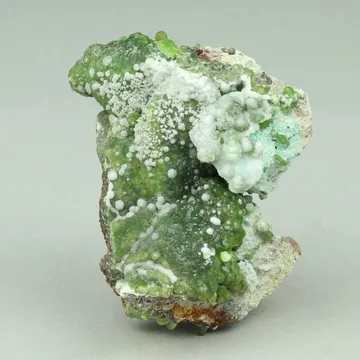
Adamite from Hilarion is one of the locality’s signature collector minerals, especially in its copper-bearing blue-green to turquoise and apple-green forms. The best pieces show bright, glassy to sparkling crystals or spherical aggregates on oxidized brown matrix, commonly with smithsonite coatings or underlying white zinc carbonate material; published Lavrion photographs also show Hilarion copper-bearing adamite as pseudo-octahedral crystals. A particularly discussed modern suite consists of cuprian, rare-earth-bearing adamite with smithsonite from a reported late-2014 find, ranging from small-cabinet specimens to a very large 160 x 130 x 80 mm matrix specimen. Strong Hilarion adamite should have saturated but natural color, visible crystal texture rather than a flat crust, clean contrast with smithsonite or gossan, and preferably a specific Hilarion/Kamariza attribution; ordinary pieces are thin green coatings, abraded druses, or pieces sold as “Lavrion adamite” without mine-level support.
Smithsonite from Hilarion is highly regarded when it appears as translucent, wet-looking botryoidal or spherical aggregates in pale blue, greenish blue, silvery white, or rare stronger blue tones. Fine examples can reach cabinet size; one documented Hilarion specimen measured 10.7 x 10.7 x 6.3 cm and was described as a 2020 find with unusually good blue color, spherical translucent aggregates, sparkling surface, and a tan fluorescent material in the rind. Hilarion smithsonite may occur with calcite, adamite, thin secondary coatings, gossan, and other Zn-Cu supergene minerals, and some pieces are marketed as copper-bearing or possibly rare-earth-influenced, although color claims are best trusted when supported by analysis. Good specimens combine continuous botryoidal coverage, translucency, silky to vitreous luster, undamaged high points, and a convincing Hilarion label; dull white crusts, bruised botryoids, and generic Lavrion attributions are much less desirable.
Aragonite at Hilarion is less common in the marketplace than adamite or smithsonite, but the best pieces are memorable: seafoam-white to light blue-green, copper-bearing-looking “tree” or coral-like sprays with millimetric crystals, sometimes rising well above the matrix. A documented large-cabinet Hilarion aragonite specimen from the Kurt Hefendehl collection measured 17.3 x 15.9 x 14.4 cm, with light seafoam-blue sprays transitioning into white aragonite and groupings rising up to about 5.0 cm. Collectors should look for intact branching form, clean blue or blue-white color in the deeper recesses, crisp spiky texture, and minimal bruising, because Hilarion aragonite is fragile and loses much of its appeal when the sprays are broken, dusty, or flattened into an indistinct carbonate crust.
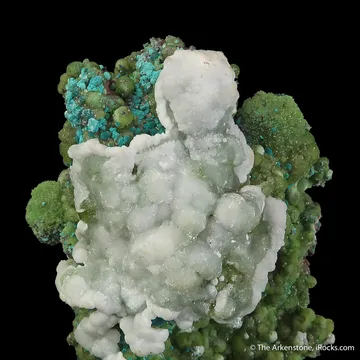
Cuproadamite from Hilarion occupies the visually rich but analytically tricky adamite-olivenite series territory that Lavrion collectors know well. Documented Hilarion examples include intense apple-green spherical crystal aggregates to about 0.6 cm associated with white calcite scalenohedrons on a miniature 3.3 x 2.6 x 0.6 cm specimen, as well as dark green cuproadamite with azurite in older collection material. The species is valued here for strong saturated green color, rounded to rosette-like crystal groups, lively vitreous luster, and sharp contrast against calcite or brown matrix. Because adamite, cuproadamite, zincolivenite, and olivenite can overlap visually, top Hilarion pieces are those with analytical confidence or a strong provenance from a knowledgeable dealer or collection, not simply a bright green label claim.
Calcite at Hilarion is chiefly a companion and textural mineral rather than the mine’s headline species, but it matters greatly in combination specimens. White calcite scalenohedrons associated with apple-green cuproadamite provide some of the most attractive Hilarion miniature compositions, and calcite or calcite-like fluorescent carbonate material has been noted in the rind of Hilarion smithsonite specimens. In a district crowded with pale carbonates, the better Hilarion calcite pieces are not merely white crusts; they are sharp, undamaged crystals that give structure and contrast to smithsonite, cuproadamite, adamite, or aragonite. Collectors should reward clean crystal form, association, and clear locality support over size alone.
Beyond the display minerals, Hilarion is important for rare and type-locality mineralogy. Hilarionite, Fe3+2(SO4)(AsO4)(OH) · 6H2O, is named for the mine and has its type locality in the Hilarion area. Agardite-(Nd), ideally NdCu6(AsO4)3(OH)6 · 3H2O, was described from a connecting tunnel between the second and third levels of the Hilarion Mine. Zincowoodwardite was first recognized from Christiana and Hilarion material, and Hilarion is a cotype locality. Kamarizaite, although named for the Kamariza mining area, has type material tied to dump material around old Hilarion Mine No. 13 and probable source material from the third level of the Hilarion area. Natroglaucocerinite is also associated with Hilarion in type-locality summaries, while documented Hilarion occurrences include mixite, chalcophyllite, chalcoalumite, ceruleite, caracolite, bukovskýite, cassiterite, chlorargyrite, connellite, hohmannite, mansfieldite, marioantofilliite, zdenĕkite, zincolivenite, and many other rare supergene species.
The principal authenticity problem with Hilarion specimens is not a flood of known fakes but precision: “Lavrion,” “Laurium,” “Kamariza,” and “Hilarion” are not equivalent labels. A specimen simply labelled Lavrion may be perfectly genuine, but it should not be upgraded to Hilarion without a credible old label, collector history, dealer record, or mineral association that truly supports that mine. Conversely, genuine Kamariza specimens are sometimes over-specified by later owners because Hilarion carries stronger market appeal.
The adamite-cuproadamite-zincolivenite problem deserves special care. Bright green or blue-green arsenate crystals from Hilarion may be labelled adamite, cuprian adamite, cuproadamite, or zincolivenite depending on chemistry and on the age of the label. Visual color alone is not enough. For high-value pieces, especially intense blue-green examples sold as rare-earth-bearing cuprian adamite or cuproadamite, analytical documentation is a real advantage. Older labels should be preserved even if later analytical terminology refines the name.
Smithsonite color claims also need judgement. Hilarion has produced desirable blue, greenish-blue, and silvery material, but “cuprian” or “REE-influenced” should be treated as a chemical claim rather than a purely visual description unless supported by analysis. Good smithsonite is commonly translucent and internally luminous; suspiciously flat color, surface-only staining, or a mismatch between color and texture should prompt caution. That said, natural Lavrion supergene color can be surprisingly vivid, especially in copper-rich Kamariza material.
Condition issues are typical of delicate oxidation-zone specimens. Smithsonite botryoids bruise on the high points and show contact wear easily. Adamite and cuproadamite druses lose sparkle when rubbed or dust-loaded. Aragonite sprays are fragile and should be handled as a trim-sensitive carbonate, not as a robust cabinet rock. Many Lavrion micro-specimens are mixtures of tiny, visually similar secondary minerals; aggressive trimming, soaking, acid cleaning, or ultrasonic cleaning can destroy diagnostic material and may dissolve or detach rare sulfate phases. Keep labels, old dealer tags, and any analytical notes with the specimen.
Some Hilarion material may fluoresce. Adamite is known as a fluorescent species and has been recorded from Hilarion with green response under shortwave ultraviolet light; calcite or carbonate-rich rind material on smithsonite may also respond. Fluorescence should be treated as an added observation, not as proof of identity. Because Hilarion specimens may contain arsenates, lead minerals, copper salts, and friable oxidation products, handle them with ordinary mineral safety discipline: wash hands after handling, avoid generating dust, and keep fragile or soluble material away from repeated moisture.
Market availability is moderate but uneven. Small adamite, smithsonite, and mixed Lavrion pieces appear regularly through Greek, European, and online dealers. High-quality Hilarion-specific smithsonite, large cuprian adamite with smithsonite, and sculptural aragonite are much less common and can command strong prices when size, color, and provenance align. Rare-species Hilarion material is often micro-sized and circulates mainly among specialists; its value depends less on visual impact than on correct identification and documented source.
Hilarion’s name begins not underground but in the offices and capital networks that revived Lavrion in the nineteenth century. Hilarión Roux, born in 1819 and based in Marseille, had the financial reach that Giovanni Battista Serpieri needed for the modern reworking of the ancient district. Roux’s company was backed by major commercial and banking interests, including connections to the Rothschild sphere, and his name became attached to a mining lease even though he preferred to remain in the background. That is how a collector label today—“Hilarion Mine”—carries the shadow of one of the men who helped turn ancient slag heaps and forgotten workings into one of Greece’s defining industrial enterprises.
One of the finest Hilarion stories belongs to the world of type-locality mineralogy. Agardite-(Nd) was discovered not as a hand-sized showpiece but in a small locality in a connecting tunnel between the second and third levels of the Hilarion Mine. The work involved local Lavrion specialists Alkiviadis Tsolakos and Christos Solomos, Professor Panagiotis Voudouris, and the Russian mineralogists Igor Pekov and Nikita Chukanov. The type specimen ultimately went to the Fersman Mineralogical Museum in Moscow under registration number 4020/1. The image recorded in the type-locality account is almost poetic in scale: blue-green sprays of agardite-(Nd) and agardite-(La), found by Vasilis Stergiou, with a field of view of only 6.2 mm.
Hilarionite, the mineral named for the mine itself, had a more stubborn birth. Material was first found during a 2009 field trip, but the initial quality and quantity were not enough for a complete description. A 2012 field trip finally supplied adequate material, leading to the description of the new Fe sulfate-arsenate hydrate and the naming of the species after Hilarion. The type locality is an underground working between the third and fourth levels of the Hilarion area, and type specimens were placed in both the Fersman Mineralogical Museum in Moscow and the Mineralogical Museum of the National and Kapodistrian University of Athens. It is a satisfying locality-mineral loop: the mine named for Roux later lent its own name to a mineral born from its oxidized passages.
Hilarion has also produced discoveries that read like a map correction. Kamarizaite was named for the old mining area whose name has largely disappeared from official maps in favor of Agios Konstantinos, even though collectors and local people still use Kamariza. Later discussion with one of the original describers helped narrow the exact discovery spot to a small dump around old Hilarion Mine No. 13. That in turn helped identify the probable underground source on the third level of the Hilarion area, and additional material from Hilarion and Jean Baptiste supported later crystal-structure work. The result is a reminder that old dumps are not anonymous rubble; in Lavrion they can be the last readable pages of a mine-level story.
At the deepest workings of Hilarion, nearly at sea level, another memorable find involved gypsum crystals up to 30 cm long, partly covered with alunite, a mineral relatively rare at Lavrion. Several boxes of the material were recovered and prepared for distribution to mineral collections. The preparation required thorough washing, a small practical detail that hints at the awkward beauty of Lavrion collecting: wet clay, soluble salts, fragile surfaces, and specimens that may look ordinary until a careful collector recognizes the unusual association.
A different Hilarion story unfolded in water. In May 2019, a group of dry cavers entered the mine complex and descended through dark, damaged, humid passages more than a century old. After more than an hour of slippery underground walking, they reached a chamber full of water—a “subterranean lagoon” that clearly continued below the surface. The question would not leave them alone: what was down there? Experienced cave and deep-wreck divers Erikos Kranidiotis and Stelios Stamatakis of the Addicted2H2O team were contacted with the invitation, “Are you interested in exploring this site?” Their reply captured the novelty: “Mine diving in Greece? That would be something different for sure!”
The first underwater exploration took place on 20 July 2019. Reaching the water was already a serious task, involving heavy dive gear carried through muddy, rocky mine passages. Underwater, the divers found a complex section of natural-rock chambers, wooden support columns, rail tracks still in place, three main corridors, and a main passage supported with four rows of wooden beams. The water was not seawater from the nearby Saronic Gulf, as some had expected, but fresh aquifer water at 20°C. When the pumps stopped after mining ceased, groundwater had filled and sealed the lower workings.
On 19 November 2019 the team returned and pushed farther into the sixth level. Support members again carried equipment deep into the mine, and the divers confirmed that the three flooded sections from the first exploration were interconnected. They found a fourth corridor accessible from a nearby dry section through a narrow downward-sloping entrance with rail tracks dating at least to the 1930s. Those rails connected the dry fourth level with the underwater sixth level and had once carried ore wagons. In practical diving terms, the discovery mattered because it created another exit route if something went wrong.
The Hilarion mapping work continued on 24 May 2020 with a tool designed by Stelios Stamatakis: the VPLOTTER. The team reached farther than before, ending at a small shaft used to deposit ore, and completed a two-dimensional map of 126 m of underwater passage. A 3D mapping visit followed on 25 May 2020. For mineral collectors, these reports are more than adventure writing. They show what abandonment, groundwater, and time did to the same mine that produced cabinet smithsonites and micro-type minerals. Above the water, visitors, collapses, and trash altered the workings; below it, the flooded levels preserved rails, timber, and geometry with eerie clarity. The divers’ own reflection is hard to improve: “Possibly the water element is what has protected and preserved the image of the mine when the miners ceased their works.”