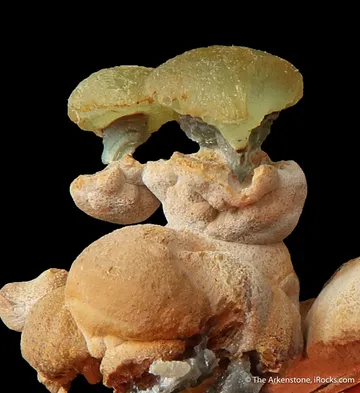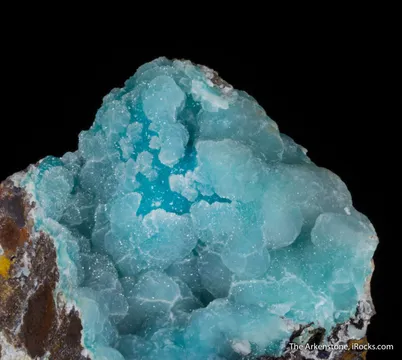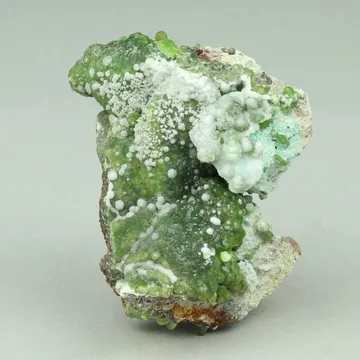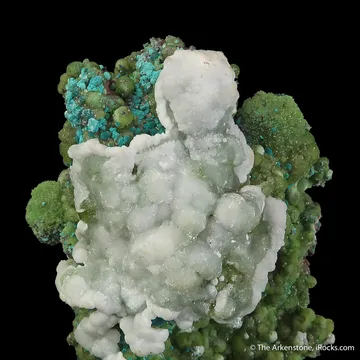
A collector's guide to Kamariza Mines, Greece: its geology, mining history and notable minerals, illustrated with the 97 specimens documented from this locality on EarthWonders.
Key facts
Kamariza is one of the indispensable names in European mineral collecting: a compact Attic mining field where ancient silver, nineteenth-century industrial mining, and modern systematic mineralogy all meet in the same marble-and-schist hills above Lavrion. The mines lie in the Agios Konstantinos area of the Lavreotiki peninsula, the old Kamariza of collectors’ labels, within the famous Lavrion Pb-Zn-Ag district. Geologically, their importance comes from carbonate-replacement and vein-breccia mineralization developed in the Kamariza Unit marbles and schists, related to Miocene magmatism, detachment faulting, and later deep supergene oxidation. For collectors, that means a remarkable combination: primary galena, sphalerite, pyrite, arsenopyrite, chalcopyrite, gersdorffite and sulfosalts below; and, in the oxidized zone, a profusion of carbonates, arsenates, sulfates, chlorides, and hydroxides that made Lavrion one of the most species-rich mining districts on Earth.
The best Kamariza specimens have a look that is instantly recognizable. They are often small to cabinet-size pieces of rusty, porous gossan or altered marble carrying bright secondary minerals: pale to apple-green adamite druses, blue-green cuprian adamite, pale botryoidal smithsonite, white to colorless calcite, delicate aragonite crusts and sprays, azurite from Christiana, turquoise serpierite from Serpieri, and innumerable microminerals that reward the binocular microscope. Kamariza also carries historical weight far beyond mineral collecting. The concealed, richer “third contact” ores around ancient Maroneia, now Kamariza, helped change Athenian mining from scattered shallow workings into large-scale underground production; in the modern era, the Hilarion, Clemence, Jean Baptiste, Serpieri and Christiana mines became key operating names for the Greek and French mining companies that revived Lavrion in the nineteenth century.
Regional View
Country View
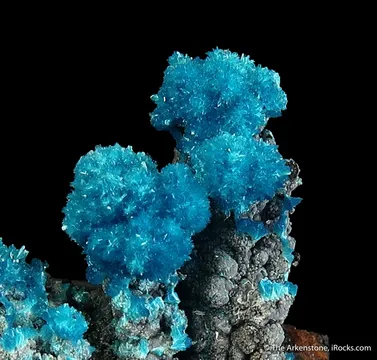
The locality is not a single neat shaft but a mining complex and collecting label covering several historically and mineralogically distinct workings. Hilarion is central to the modern fame of Kamariza for cuprian adamite, smithsonite, agardite-(Nd), hilarionite and related supergene assemblages. Jean Baptiste is essential for carbonate-replacement ore, classic smithsonite, and the type locality of ktenasite. Serpieri is bound to serpierite, glaucocerinite, zincaluminite-group material, and later dump finds. Christiana is remembered for azurite, attikaite and zincowoodwardite. The old Kamariza dumps, though much worked over, remain part of the story because many microminerals reached collectors through dump material rather than pristine mine walls.

Photo: Wikimedia Commons
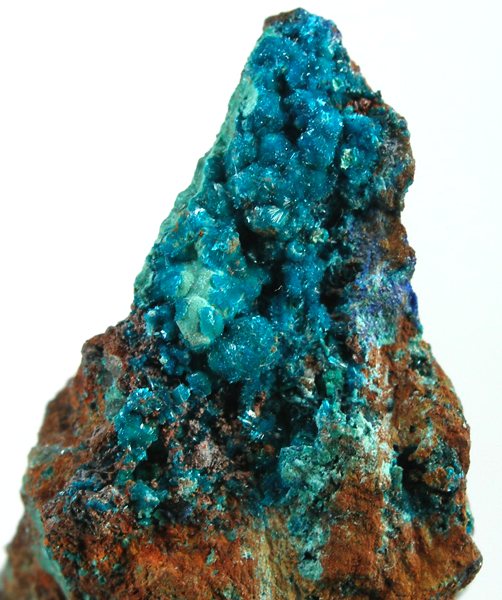
Photo: Wikimedia Commons
Search for specimens: View all specimens from Kamariza Mines, Greece
Kamariza belongs to the Lavrion mining district of southeastern Attica, a polymetallic Pb-Zn-Ag system developed where the Kamariza Unit, the Lavrion blueschist unit, and upper non-metamorphic rocks are cut by Miocene granitoids and related dikes. The district exposes the northwestern end of the Western Cycladic detachment system, and the ore bodies are strongly controlled by both structure and host lithology. In collector terms, the key rocks are the Lower Kamariza marble, Kamariza schist, Upper Kamariza marble, and the detachment-related fractured and mylonitic zones that provided pathways and traps for ore fluids.
The Kamariza mines are best understood as part of a district-scale hydrothermal system with several overprinted mineralization styles. Lavrion as a whole includes porphyry Mo-W mineralization, Fe-Cu-Bi-Au skarn, high-temperature carbonate-replacement Pb-Zn-Cu-Ag-Au mineralization, and Pb-Zn-Ag-Au vein and breccia mineralization. Kamariza is especially important for carbonate-replacement ore bodies and vein-breccia mineralization. The principal ore minerals include galena, sphalerite, pyrite, arsenopyrite, chalcopyrite, marcasite, gersdorffite, bismuthinite, native bismuth, native gold, and numerous Ag-, Bi-, Cu-, Pb-, As- and Sb-bearing sulfosalts. Quartz, fluorite and calcite are the principal gangue minerals in much of the replacement and vein ore.
Ancient miners distinguished the ore in practice even if not in modern geological language. The early, shallow and discontinuous oxidized ores at the first contact were worked from the fourth millennium BC onward. The great turning point was the concealed richer mineralization around Kamariza, the ancient Maroneia, at the third contact between the Lower Kamariza marble and the Kamariza schist. Its development in the early fifth century BC allowed far more continuous and large-scale mining and processing. This is the ore body that stands behind the celebrated Athenian silver revenues of 483 BC and the naval program of Themistocles.
Modern mining began in 1864 with renewed exploitation and resmelting of ancient slags, followed by large-scale industrial operations. Two main companies dominated the modern period: the Metallurgical Company of Lavrio, active from 1873 to 1927, and the French Mining Company of Lavrio, active from 1875 to 1981. Their operations centered heavily on Kamariza and Plaka-Villia, with the Hilarion, Clemence, Jean Baptiste, Serpieri and Christiana mines among the names most often encountered on old labels and in mineralogical records. These companies not only mined ore but also installed a full metallurgical complex, including roasting, briquetting of rich finely granulated ores, and reduction smelting.
Specimen mineralization is chiefly the product of deep oxidation of the primary sulfide ores. Lavrion’s oxidation zone reached exceptional thickness, locally extending far below modern surface levels because uplift, water-table changes and sea-level fluctuations promoted repeated oxidation and remobilization. Galena altered to cerussite and anglesite; sphalerite to smithsonite, hydrozincite and hemimorphite; chalcopyrite and other copper minerals to azurite, malachite, brochantite, antlerite, atacamite and related species; and arsenic-bearing primary minerals helped feed adamite, olivenite, mimetite, agardite-group species and a dense suite of rare arsenates and sulfates. The Kamariza specimens collectors value most came from cavities, gossan voids, replacement zones, old stopes and dumps where this chemical recycling created open-space crystal growth.
Collecting access today must be treated conservatively. Kamariza is an abandoned mining landscape with archaeological remains, unstable underground workings, protected geosites and private or public land-status complications. The broader Lavreotiki area is now recognized as a UNESCO Global Geopark, and the district should be approached as a cultural and geological heritage landscape rather than an ordinary rockhounding ground. Historically, collectors worked dumps and already disturbed material; any present field activity should begin with local permission, current legal checking, and avoidance of old underground workings. The dangers are real: shafts, false floors, bad air, rotten timber, hidden openings, collapses and crumbly oxidized stopes are part of the Kamariza terrain.
Notable specimen episodes include the 1990–1995 recovery of greenish aragonite from rich pockets in a long-abandoned and difficult-to-access part of the underground system, later understood to owe much of its color to inclusions of cuprian adamite. Hilarion produced fine cuprian adamite and smithsonite associations, including pseudo-octahedral adamite crystals and blue-green secondary assemblages. Jean Baptiste yielded important carbonate-replacement material and classic smithsonite, while also holding the type locality significance of ktenasite. Serpieri gave the district one of its most famous turquoise-blue sulfate species, serpierite. Christiana contributed azurite and several rare arsenate and sulfate assemblages, including material central to attikaite and zincowoodwardite.
Adamite is one of the signature collector minerals of Kamariza, especially from Hilarion and related Kamariza workings, where it occurs as pale green, blue-green cuprian, yellow-green, and locally aluminium- or manganese-bearing material on limonitic gossan, smithsonite, hydrozincite, calcite, quartz and altered marble. The finest pieces show lustrous crystalline druses, botryoidal crusts, radiating crusts, fan-shaped rosettes, bow-tie aggregates, prismatic crystals, and pseudo-octahedral crystals formed where terminal faces dominate the prism. Most Kamariza adamite crystals are small, typically millimetric, but strong specimens are not about size alone: they have bright color, sharp sparkle, clean contrast against iron oxide or white carbonate, and enough coverage to make the piece read as a specimen rather than a scattered occurrence. Cuprian adamite from Hilarion, particularly blue-green material with smithsonite or hydrozincite, is the classic look; adamite on colorless-white calcite druse over reddish marble is especially appealing when the adamite forms continuous lustrous coverage rather than isolated grains.
Calcite at Kamariza is both a major gangue mineral and an important display partner for the brighter supergene species. In the carbonate-replacement and vein systems it accompanies quartz and fluorite with galena, sphalerite, pyrite and chalcopyrite; in oxidized specimen pockets it appears as white to colorless druses, cleavable masses, crusts and small crystal linings on marble or gossan. Collector-grade pieces are usually valued less as “calcite alone” than for composition: sharp, glassy or snowy calcite providing a clean stage for adamite, smithsonite, aragonite, azurite, malachite or rare sulfate crusts. Better examples show fresh luster, undamaged crystal faces, and convincing locality texture—reddish marble, limonite cavities, or altered sulfide matrix—rather than loose white carbonate with no Kamariza character.
Fluorite from Kamariza is part of the primary to late hydrothermal gangue assemblage of the Pb-Zn-Ag replacement and vein-breccia ores rather than the dominant supergene showpiece. It is documented from multiple Kamariza-area workings and is expected with calcite, quartz, galena, sphalerite and oxidized Pb-Zn-Cu minerals. The most collectible Kamariza fluorite specimens show recognizable cubic habit or attractive translucent masses with good contrast against carbonate gangue, sulfides or gossan; ordinary pieces are often cleaved, massive, pale, or visually subordinate to calcite and sulfides. Because Lavrion fluorite labels are easily generalized to the district level, precise mine attribution—Hilarion, Jean Baptiste, Serpieri, Christiana or simply Kamariza mines—adds real value when it is supported by old labels or reliable collection history.
Kamariza aragonite is best known to collectors from greenish crusts and sprays recovered from rich underground pockets in the early 1990s, with notable material described from a difficult, long-abandoned part of the mine system. The color was long traded as “cuprian aragonite,” but on important specimens the pale green-blue tone is tied to inclusions and tiny aggregates of cuprian adamite; visible adamite micro-balls or crusts on the aragonite make that relationship especially satisfying. Most specimens from these pockets were small, commonly hand-size, because the material had to be removed from walls and carried a long distance; unusually large, complete cabinet examples are therefore highly desirable. Good pieces have undamaged delicate surfaces, even pastel color, coherent coverage, and adamite association without looking merely stained or dirty.
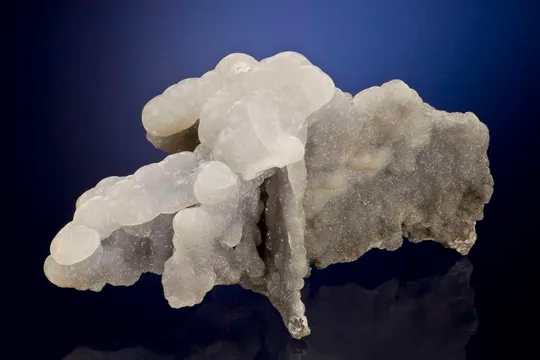
Smithsonite is one of the great Kamariza minerals, particularly from Hilarion and Jean Baptiste, where it formed by oxidation of sphalerite in the carbonate host. It occurs as white, pale grey, pale lavender, bluish, greenish and locally copper-bearing botryoidal to stalactitic masses, crusts, cavity linings and sparkling microcrystalline surfaces on limonite, altered marble and gossan. Hilarion smithsonite is significant enough to be rated among the important world occurrences for the species in mineral databases, and the finest Kamariza pieces have rounded, glossy botryoids with depth, subtle translucency, pleasing color and associated adamite or hydrozincite. Ordinary smithsonite is common in the district, but top pieces avoid chalkiness, bruised botryoids, sawed backs that dominate the specimen, and vague “Lavrion” labels that obscure whether the material is really from Kamariza.
Sphalerite is a primary ore mineral at Kamariza and the parent for much of the later smithsonite, hydrozincite and hemimorphite. In the carbonate-replacement ores it is associated with pyrite, chalcopyrite and galena, with quartz, fluorite and calcite as gangue; in skarn-related assemblages it appears with pyrite-galena farther from the granodiorite influence than the magnetite-rich zones. Collector sphalerite from Kamariza is usually appreciated in context rather than as large freestanding crystals: dark resinous to brown-black masses, grains or crystals in sulfide ore, sometimes with galena, pyrite, chalcopyrite, calcite or rare late secondary species. Better pieces show fresh luster, recognizable crystallinity or instructive ore texture, and strong association with later oxidation products; massive dull ore without contrast is commoner and much less desirable.
Beyond these familiar species, Kamariza is one of the world’s great micromineral and type-locality fields. Type-locality or type-related minerals tied directly to Kamariza-area workings include agardite-(Nd) and hilarionite from Hilarion, ktenasite from Jean Baptiste, serpierite from Serpieri, glaucocerinite from Serpieri, zincaluminite and natroglaucocerinite from Hilarion, attikaite from Christiana, zincowoodwardite from Christiana and Hilarion material, laurionite from Kamariza, zincolivenite from Kamariza dump material, and kamarizaite from the Kamariza mining area near Hilarion. The wider Kamariza–Esperanza–Km 3 neighborhood also yielded major rare-species records such as nickeltsumcorite, katerinopoulosite, katsarosite, drobecite, lazaridisite, voudourisite and niedermayrite. For the systematic collector, Kamariza is less a “one mineral” locality than a dense, layered chemical archive: Pb, Zn, Cu, Ag, As, Sb, Bi, Cd, Ni, Fe, sulfate, carbonate, chloride and arsenate minerals all concentrated into a few square kilometres of old workings and dumps.
Kamariza specimens are common enough in the European market that a collector can still buy authentic examples, yet precise labels matter enormously. A vague “Laurion” or “Lavrion, Greece” label may be perfectly honest, but it is less informative than “Hilarion Mine, Kamariza,” “Jean Baptiste Mine, Kamariza,” “Serpieri Mine, Kamariza,” “Christiana Mine,” or “Kamariza Dump.” Because Lavrion has many neighboring sublocalities with overlapping species, mislabeling is more often a matter of overgeneralization than deliberate fraud. Old German, Austrian, French, Greek and dealer labels may use Laurion, Laurium, Lavrio, Lavrion, Kamareza, Kamariza, Ilarion or Hilarion; preserving those spellings alongside a modern standardized label is preferable to “correcting” away evidence.
Adamite presents the most frequent identification traps. Pale green Kamariza adamite may be confused with conichalcite, austinite, olivenite, zincolivenite, agardite-group minerals or other green arsenates. Blue-green cuprian adamite may be casually sold as “cuproadamite,” an old varietal name rather than a species. Aluminium-bearing adamite labels also require care; serious pieces benefit from analytical documentation, especially where unusual color or composition is the selling point. The same caution applies to the many rare arsenates and sulfates from Kamariza: visual identification alone is often unreliable, and many valid species are micromount material requiring EDS, Raman, XRD or provenance from a known analyzed suite.
Smithsonite, aragonite, calcite and hydrozincite can also be confused in white to pale blue-green crusts. Kamariza aragonite sold as “cuprian aragonite” should be treated as a historical trade description unless analysis proves copper in the aragonite lattice; at least some celebrated greenish material owes its color to inclusions of cuprian adamite. Smithsonite is softer and more easily bruised than it appears, and botryoidal surfaces often show rubs, small impact marks and old contact bruises. Calcite on adamite specimens is fragile at crystal edges and reacts to acids; avoid acid cleaning except under expert control, because carbonates, limonite crusts, arsenates and sulfates can all be damaged or destabilized.
Condition expectations should be adjusted to the locality. Many Kamariza specimens came from oxidized, crumbly, iron-rich cavities and dumps, not from clean hard-rock pockets. Broken matrix edges, old trimming, gossan dust, repaired friable areas, and minor contacted crystals are common. The best display specimens are judged by the quality of their exposed mineralized face, not by whether every side is pristine. Micromounts, however, should be held to a stricter standard: a rare species represented by a few crushed grains is far less desirable than a small but intact spray, crust, fiber aggregate or crystal group with secure locality data.
Fluorescence can be useful but should not be oversold. Adamite is well known as a fluorescent mineral in general, and some Lavrion adamite responds attractively, but fluorescence varies with composition, activators and specimen condition. Use UV as an additional observation, not an identification. Handling precautions are sensible for many Kamariza minerals because arsenates, lead minerals, cadmium sulfates, copper salts and soluble secondary sulfates occur in the district. Keep specimens dry, wash hands after handling, do not create dust, and isolate delicate sulfate efflorescences from humidity swings.
Market availability is strongest for adamite, smithsonite, calcite combinations, serpierite micromounts, aragonite-adamite pieces, azurite, malachite, cerussite, anglesite and mixed secondary suites. Fine cuprian adamite from Hilarion and large, complete greenish aragonite pieces from the 1990–1995 pockets are significantly scarcer than routine Lavrion material. Type-locality microminerals range from obtainable to extremely rare; some are known mostly from analytical fragments, old specialized collections, or a handful of carefully documented finds. For high-value Kamariza purchases, the strongest assurance is a chain of evidence: exact mine name, old label, reputable dealer or collection history, and analysis where the species is rare or visually ambiguous.
The great Kamariza story begins not with a specimen cabinet but with a city making a military decision. Around ancient Maroneia, the area now called Kamariza, miners reached richer concealed ore at the third contact after millennia of smaller-scale work on shallower oxidized deposits. In 483 BC, the revenues from this silver were large enough to change Athenian politics. The normal expectation was distribution of mine income to citizens; Themistocles instead persuaded Athens to use the money for ships. The result was a fleet of triremes, and within a few years that fleet stood at the center of the Greek defense against Xerxes. For collectors holding a Kamariza adamite or smithsonite, the connection is unusually direct: the same hill system that later produced blue-green arsenates and white zinc carbonates also helped fund the Athenian naval power that fought at Salamis.
The physical scale of ancient Kamariza is still startling. In Maroneia alone, accounts based on Conophagos record more than 1000 shafts and roughly 120–150 km of galleries at the third contact from the Classical period. These were not romantic caverns but narrow industrial voids driven through marble and schist for ore. The ancient landscape above them was equally engineered: shafts, galleries, washeries, cisterns, ore-processing floors, slag and litharge residues. A collector walking the Lavreotiki hills is moving through a mining machine spread across the peninsula, much of it built before the word “geology” existed.
Kamariza’s name itself is a survival. Officially, Kamariza was renamed Agios Konstantinos on July 26, 1954, and modern maps increasingly use the new name. Yet collectors, miners and local specialists kept saying Kamariza. One account notes that the old name has almost vanished from maps, surviving only on a few road signs, while daily usage preserved it for the mining area around the hilltop near the church of Saint Nektarios. Mineralogy then fixed the old name in a new way: kamarizaite was named from material discovered in the dumps of the Kamariza mining area, with later clarification pointing to dump material around old Hilarion Mine No. 13 and related material from the Hilarion and Jean Baptiste levels. A vanished place-name became permanent again in a mineral species.
Some of the most vivid modern Kamariza field stories belong to the rare-species workers. Agardite-(Nd) was found in a small locality in a connecting tunnel between the second and third levels of the Hilarion Mine, guided by Lavrion specialists Alkiviadis Tsolakos and Christos Solomos and studied by Igor Pekov, Nikita Chukanov and co-workers. Hilarionite, named for the Hilarion Mine and ultimately for Hilarión Roux, was first noticed during a 2009 field trip, but the original material was not enough for a full description; a second field trip in 2012 finally yielded adequate specimens. These are not broad commercial “finds” in the Tucson-show sense. They are the outcome of patient underground navigation, exact sublocality knowledge, and analytical follow-through.
The 1990–1995 aragonite pockets are the kind of find collectors still talk about because they produced attractive cabinet specimens rather than only microscope rarities. The material came from a rich pocket area in a long-abandoned and difficult-to-access underground part of the Kamariza system. Specimens were removed from the walls and had to be hauled out a considerable distance. Many were only 2–4 inches across; large complete pieces were exceptions. The greenish tint made them famous as “cuprian aragonites,” but the more interesting truth is subtler: on notable examples, the color is linked to tiny inclusions and aggregates of cuprian adamite, so that two Kamariza classics—aragonite and blue-green adamite—are literally intergrown in the same aesthetic.
Modern Lavrion also had a harsher human history. In April 1896, some 1800 miners reportedly came up from the galleries, sealed exits, and declared a strike. Their demands were concrete: better wages, medical care, a nearby hospital, abolition of contractors who took part of their pay, housing, and Sunday as a day off. The confrontation turned violent; workers were shot, company guards were attacked, and the state sent forces to restore order. Even if a specimen label records only “Kamariza, Lavrion,” the modern mine names—Hilarion, Serpieri, Jean Baptiste, Clemence, Christiana—belong to this industrial world of shafts, hoists, furnaces, company towns, migrant labor and dangerous underground work.
Voudouris, P.; Mavrogonatos, C.; Rieck, B.; Kolitsch, U.; Spry, P.G.; Scheffer, C.; Tarantola, A.; Vanderhaeghe, O.; Galanos, E.; Melfos, V.; et al. “The Gersdorffite-Bismuthinite-Native Gold Association and the Skarn-Porphyry Mineralization in the Kamariza Mining District, Lavrion, Greece.” Minerals 8, 531 (2018). A key modern paper on Kamariza ore mineralogy, including the Clemence vein association, skarn-porphyry setting, native gold, bismuthinite and gersdorffite.
Voudouris, P.; Economou-Eliopoulos, M. “Mineralogy and chemistry of Cu-rich ores from the Kamariza carbonate-hosted deposit (Lavrion), Greece.” In Mineral Exploration and Sustainable Development, Millpress, Rotterdam, 2003, pp. 499–502. Focused specifically on Cu-rich ores in the Kamariza carbonate-hosted deposit.
Voudouris, P.; et al. “The Lavrion Mines: A Unique Site of Geological and Mineralogical Heritage.” Minerals 11, 76 (2021). The best concise overview of Lavrion geology, deposit types, mining history, supergene oxidation and type-locality minerals.
Ross, J.; Voudouris, P.; et al. “The Lavrion silver district: Reassessing its ancient mining history.” Geoarchaeology 36 (2021). Important reassessment of first-contact versus third-contact exploitation and the ancient significance of the Kamariza area.
Solomos, C.; Voudouris, P.; Katerinopoulos, A. “Mineralogical studies of a bismuth-gold-antimony mineralization in Kamariza Lavrion.” Bulletin of the Geological Society of Greece 36, 387–396 (2004). A Kamariza-specific study of precious-metal and Bi-Sb mineralization.
Katerinopoulos, A.; Solomos, C.; Voudouris, P. “Lavrion smithsonites: A mineralogical and mineral chemical study of their coloration.” In Mineral Deposit Research: Meeting the Global Challenge, Springer, 2005, pp. 983–986. Relevant to Kamariza smithsonite coloration and Lavrion’s classic Zn-carbonate specimens.
Pekov, I.V.; Chukanov, N.V.; Zadov, A.E.; Voudouris, P.; Magganas, A.; Katerinopoulos, A. “Agardite-(Nd), NdCu6(AsO4)3(OH)6·3H2O, from the Hilarion Mine, Lavrion, Greece: mineral description and chemical relations with other members of the agardite-zálesíite solid-solution system.” Journal of Geosciences 57, 249–255 (2011). Type description of agardite-(Nd) from Hilarion.
Pekov, I.V.; Chukanov, N.V.; Yapaskurt, V.O.; Rusakov, V.S.; Belakovskiy, D.I.; Turchkova, A.G.; Voudouris, P.; Magganas, A.; Katerinopoulos, A. “Hilarionite, Fe3+2(SO4)(AsO4)(OH)·6H2O, a new supergene mineral from Lavrion, Greece.” Geology of Ore Deposits 56, 567–575 (2013). Type description of hilarionite, named for the Hilarion Mine.
Chukanov, N.V.; Pekov, I.V.; Möckel, S.; Mukhanova, A.A.; Belakovsky, D.I.; Levitskaya, L.A.; Bekenova, G.K. “Kamarizaite, Fe3+3(AsO4)2(OH)3·3H2O, a new mineral species, arsenate analogue of tinticite.” Geology of Ore Deposits 52, 599–605 (2010). Type description of the mineral that preserves the Kamariza name.
Kokkoros, P. “Ktenasit, ein Zink-Kupfersulfat aus Lavrion (Griechenland).” Tschermaks Mineralogische und Petrographische Mitteilungen 1, 342–346 (1950). Original description of ktenasite, with Jean Baptiste as the Lavrion type locality.
Des Cloizeaux, M. “Étude de différents minéraux.” Bulletin de la Société Minéralogique de France 4, 89–96 (1881). Historical description relevant to serpierite from the Serpieri Mine.
Köchlin, R. “Ueber Phosgenit und ein muthmasslich neues Mineral vom Laurion.” Annalen des K.K. Naturhistorischen Hofmuseums 2, 185–190 (1887). Early work on Laurion minerals, including laurionite.
Rieck, B.; Kolitsch, U.; Voudouris, P.; Giester, G.; Tzeferis, P. “More new finds from Lavrion, Greece.” Mineralien-Welt 29, 32–77 (2018). Detailed modern account of new Lavrion finds, important for collectors of rare Kamariza-associated species.
Rieck, B.; Kolitsch, U.; Voudouris, P.; Giester, G.; Tzeferis, P. “Lavrion, Greece: More new finds from the famous mining district.” Mineralien-Welt 31, 6–21 (2020). Follow-up collector-oriented publication on new Lavrion mineral finds.
“Type Locality Minerals from the Lavrion Mining District.” Ελληνικός Ορυκτός Πλούτος. A valuable collector-friendly synthesis of Lavrion type minerals, including Kamariza, Hilarion, Jean Baptiste, Serpieri, Christiana and Esperanza species.
“Serpierite with Aurichalcite from Serpieri Mine, Kamariza Mines, Greece” — Fabre Minerals. A specimen video showing turquoise-blue acicular serpierite with aurichalcite from the Serpieri Mine, type locality for serpierite.
“tuc4635 AZURITE with OLIVENITE, Kamariza Mines, Greece” — Fabre Minerals. A specimen video of a Kamariza azurite association, useful for seeing the vivid blue secondary-copper look of the district.
Kamariza — You Go Culture. A virtual-tour style cultural presentation of Kamariza/Agios Konstantinos and its mining heritage.
Mindat: Kamariza Mines, Agios Konstantinos, Lavreotiki, East Attica, Greece — The essential locality database entry for species lists, sublocalities, photos and references.
Mindat: Hilarion Mine, Kamariza Mines — Key sublocality for cuprian adamite, smithsonite, agardite-(Nd), hilarionite and rare supergene assemblages.
Mindat: Jean Baptiste Mine, Kamariza Mines — Important Kamariza sublocality for carbonate-replacement ore, smithsonite, ktenasite and associated species.
Mindat: Serpieri Mine, Kamariza Mines — Important reference for serpierite, supergene copper-zinc sulfates and Serpieri-area species.
Mindat: Kamariza Dump — Useful for dump-derived microminerals and the broader Kamariza secondary suite.
Voudouris et al., “The Lavrion Mines: A Unique Site of Geological and Mineralogical Heritage,” Minerals 2021 — Best open-access scientific overview of the district’s geology, mineralization, history and heritage value.
Voudouris et al., “The Gersdorffite-Bismuthinite-Native Gold Association and the Skarn-Porphyry Mineralization in the Kamariza Mining District,” Minerals 2018 — The key Kamariza-specific ore-mineralogy paper.
Ross et al., “The Lavrion silver district: Reassessing its ancient mining history,” Geoarchaeology 2021 — Important for understanding the ancient first-contact and third-contact mining story.
Branko Rieck, “The Mines and Minerals of Lavrion – Ancient Mining History (II)” — Readable account of Maroneia/Kamariza, the 483 BC silver revenues and the Athenian naval program.
Type Locality Minerals from the Lavrion Mining District — A practical synthesis of type-locality minerals from Lavrion, with many Kamariza-related entries.
Lavreotiki UNESCO Global Geopark — Heritage context for the modern protected geological and cultural landscape.
Wikimedia Commons: Kamariza Mines category — Free-use images of Kamariza specimens and locality-related material.
Wikimedia Commons: SmithsoniteGrece.jpg — High-resolution image of a botryoidal smithsonite specimen from Kamariza.
Wikimedia Commons: Serpierite-271647.jpg — Image and specimen information for serpierite from the Serpieri Mine.
Lavrion Technological and Cultural Park: History — Good background on the modern industrial revival of Lavrion and its mining companies.
Kamariza — You Go Culture — Cultural and visitor-oriented background on Kamariza/Agios Konstantinos.