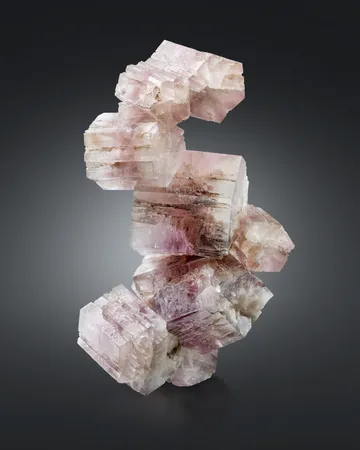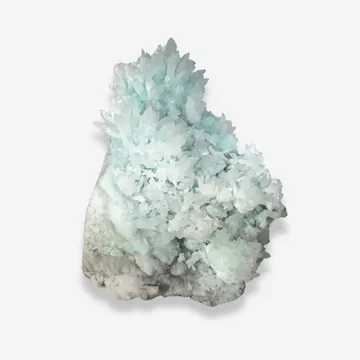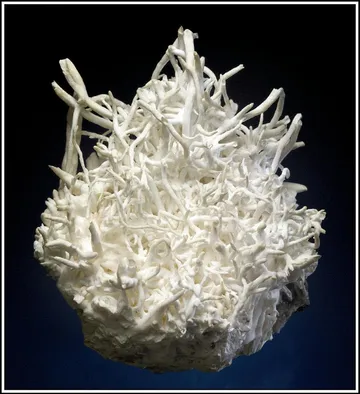
Aragonite - dramatic flos-ferri growths and pastel sprays; prized for sculptural forms, rarity of pristine pieces, and historic European localities.
Key facts
Aragonite is the orthorhombic polymorph of calcium carbonate (CaCO3), crystallizing distinctly differently from its sibling, calcite. For collectors, aragonite’s appeal lies in its dramatic habits and textures: delicate flos-ferri (“iron flowers”) coral-like growths, radiating acicular sprays, branching stalactites, pseudo-hexagonal cyclic twins, and botryoidal to cave-like deposits in pastel blues, whites, and honey tones. The best pieces seem frozen mid-bloom—snowy, silky-satined branches that twist and fork with sculptural grace, or seafoam-blue stalactites that evoke undersea corals.
Aragonite often forms in low-temperature hydrothermal or supergene environments, as well as in caves (anthodites/frostwork), hot springs, and oxidized zones of ore deposits. It is metastable at Earth-surface conditions and can convert to calcite over geologic time; in practice, well-kept specimens remain unchanged for generations. Because many aragonites grow as fragile, hollow, or fibrous aggregates, pristine condition is scarce and prized. The spectrum of availability runs from affordable Moroccan and Spanish pieces to historically important European classics from Austria and Central Europe that anchor advanced collections.
Aragonite has been collected for centuries, especially the iconic flos-ferri from the great iron and lead-zinc districts of the Alps and Central Europe. Museums in Vienna, Prague, and elsewhere enshrined 18th–19th century pieces from Styrian Erzberg, Bleiberg, and Horní Slavkov—still benchmarks today. Modern finds from Spain and Greece add vibrant color and variety, particularly sea-blue botryoidal aragonites and copper-tinted sprays.
Its popularity remains strong because:
Below are renowned sources that have shaped how collectors understand and value aragonite. Each owes its reputation to distinct habits, colors, or historic significance.
The Styrian Erzberg (Eisenerz) is one of the most celebrated sources of aragonite flos-ferri in the world. These snow-white, coral-like aggregates form astonishingly intricate branching masses with satiny luster and a feeling of motion and lightness. Many grew in iron-rich cavities, often with goethite/limonite staining that can subtly accent the branches. Historic pieces from the 18th–19th centuries are prized for their delicacy and completeness; larger masses with intact, undinged tips are rare showpieces and retain enduring market strength.
Lavrion’s oxidized Pb-Zn-Cu deposits yield aragonite of striking character: acicular sprays and stalactitic growths, sometimes with pastel blue to greenish hues attributed to copper-bearing solutions. Associations with smithsonite, hemimorphite, and iron oxides create beautiful contrasts. Modern finds range from delicate micro-sprays to showy stalactites, and while quantities have fluctuated, choice, undamaged specimens with vivid color remain highly sought.
Minglanilla (Cuenca Province) is famous for seafoam to turquoise-blue aragonite in stalactitic, botryoidal, and cavernous forms. The color—among the most attractive in the species—makes even small pieces pop in a case. Surfaces may show minute crystalline druse that sparkles under light. While material spans from abundant to scarce depending on zones worked, top pieces balance strong color, clean form, and minimal staining, and they are increasingly cherished as representatives of the “blue aragonite” aesthetic.
Color and Luster:
Form and Architecture:
Size and Proportions:
Condition:
Provenance:
Repairs:
Stabilization/Coatings:
Dyed/Altered Color:
Misidentification:
Handling:
Cleaning:
Light and Temperature:
Environment:
Storage:
With thoughtful selection and gentle care, aragonite rewards collectors with some of the most ethereal, sculptural forms in the mineral world—pieces that feel as much botanical as mineralogical, and endlessly captivating under the light.