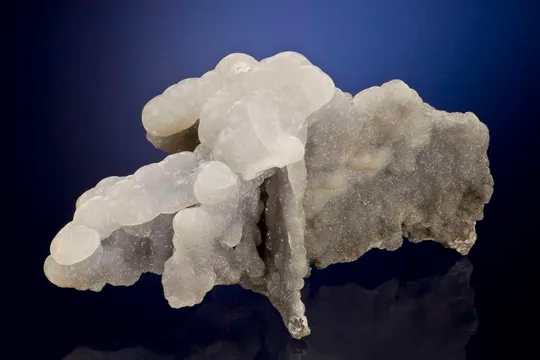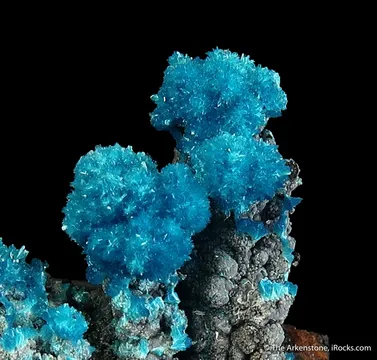
Jean Baptiste Mine, Greece — Lavrion district widely known for smithsonite and azurite/malachite, with ktenasite as a type locality, highly prized by collector…
Key facts
The Jean Baptiste Mine is one of the small but scientifically weighty Kamariza mines of the Lavrion district, southeast of Athens, in the old mining village area of Agios Konstantinos. To a collector, its appeal is not scale but concentration: a compact historic working in one of the world’s most species-rich mining districts, sitting in the carbonate-replacement Pb-Zn-Cu-Ag-Au system that made Kamariza such a classic name on European mineral labels. The mine belongs to the same Lavrion story as Hilarion, Clemence, Serpieri, and Christiana: argentiferous lead-zinc ores in marble and schist, later opened, oxidized, leached, and mineralogically rearranged into an extraordinary suite of carbonates, sulfates, arsenates, phosphates, halides, oxides, and Bi-bearing rarities.
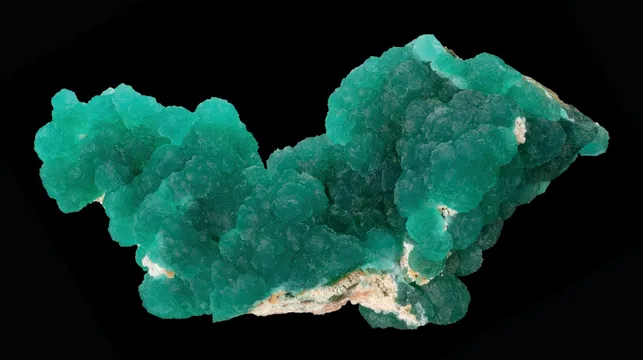
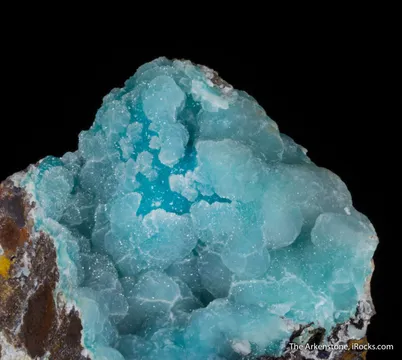
For display collectors, Jean Baptiste is best known for smithsonite—especially botryoidal, drusy, and replacement specimens in cream, honey, orange, green, and pinkish tones, often over limonitic gossan or older calcite/gypsum forms. Its azurite and malachite are more intimate Lavrion-style specimens: bright blue and green secondary copper minerals in cavities and crusts, valued less for isolated large crystals than for sharp color contrast and complex associations. For systematic collectors and micromounters, the mine has a still deeper importance: ktenasite, ZnCu4(SO4)2(OH)6·6H2O, has Jean Baptiste as its type locality, and the mine has also supplied modern study material for bismoclite, BiOCl, from the second level.
Regional View
Country View
Jean Baptiste sits within the Lavrion district’s remarkable geologic architecture: Kamariza Unit marbles and schists, Lavrion blueschist-unit rocks, Miocene intrusions and dikes, detachment-related deformation, and long-lived oxidation. In the Jean Baptiste deposit itself, published work illustrates a propylitic and kaolinite-sericite altered microdiorite dike, and massive carbonate-replacement galena ore in the Lower marble. The collector’s specimen is usually the last chapter of that system, formed after primary galena, sphalerite, pyrite, chalcopyrite, and associated gangue minerals were oxidized and partially dissolved, leaving open cavities and reactive carbonate host rock in which smithsonite, calcite, azurite, malachite, serpierite, ktenasite, adamite, carminite, and many other secondary species could crystallize.

Photo: HolDu, Wikimedia Commons
Search for specimens: View all specimens from Jean Baptiste Mine, Greece
The full modern locality is Jean Baptiste Mine, Kamariza Mines, Agios Konstantinos, Lavreotiki, East Attica, Attica, Greece. It is a small mine in the northwestern part of the underground mining area below Agios Konstantinos, in the central Kamariza sector of the Lavrion district. The mine is named for Giovanni Battista “Jean Baptiste” Serpieri, the Italian-born engineer and mining entrepreneur whose name is inseparable from the 19th-century redevelopment of Lavrion.
Jean Baptiste is part of the economically important carbonate-replacement mineralization of Lavrion. In the Kamariza district, these ores occur as stratabound lenses, bedded replacement bodies or mantos, and crosscutting chimney-like bodies in marble. The mineralization is dominated by pyrite, sphalerite, chalcopyrite, and galena, with quartz, fluorite, and calcite as common gangue; hydrothermal dolomite, calcite, siderite, ankerite, quartz, and sericite form part of the alteration envelope. Published Lavrion syntheses specifically cite Jean Baptiste among the Kamariza carbonate-replacement mines and illustrate massive carbonate-replacement galena ore within Lower marble from the mine.
That primary ore was only the beginning of the collector mineralization. Lavrion’s oxidation zone is one of the great supergene systems of the world, reaching exceptional depth because of prolonged uplift, exposure, sulfide oxidation, and repeated water-table changes tied to sea-level fluctuation. In practical collecting terms, the sulfides supplied Zn, Cu, Pb, Fe, As, Sb, Bi, Ag, and other elements, while the marble host supplied carbonate and open-space chemistry. Sphalerite oxidation fed smithsonite and hydrozincite; galena oxidation fed cerussite, anglesite, secondary silver minerals, and lead arsenates/phosphates; chalcopyrite and other Cu phases fed azurite, malachite, brochantite, serpierite, ktenasite, and allied species.
The Jean Baptiste workings were never among the large glamorous mines of Lavrion. A 2023 University of Vienna thesis summary describes the mine as small, connected by shafts to the more profitable Serpieri winding shaft, and marked by only a few stockpiles, implying limited economic yield. That small scale is part of its collector character: Jean Baptiste is not a source of mass-market ore specimens but a locality where old workings, small pockets, and later collector recovery have supplied highly specific pieces.
The broader mining history is far older than the modern mine name. Lavrion was worked from prehistoric times and became central to Athenian silver production in the Classical period. The discovery and exploitation of richer “third contact” mineralization around Kamariza in 483 BC changed the scale of Athenian mining, and the district’s silver helped finance the Athenian fleet. Modern mining and metallurgy began again in the 1860s with reworking of ancient slags and residues, followed by the Metallurgical Company of Lavrio and the French Mining Company of Lavrio, whose operations included Kamariza mines such as Hilarion, Clemence, Jean Baptiste, Serpieri, and Christiana. Those modern operations continued into the 20th century and left the underground and industrial landscape that collectors and researchers still reference today.
For specimen history, the most important documented Jean Baptiste find is not a giant pocket but the type-locality and research record. Ktenasite was described from Lavrion in 1950 and is tied to Jean Baptiste; later references describe the type-locality material as blue-green ktenasite with serpierite, glaucocerinite, and smithsonite. A modern bismoclite occurrence was found in the mine on 26 April 2014 by Branko Rieck, on the second level, and later provided material for single-crystal X-ray and Raman study. Dealer and collection records also document Jean Baptiste smithsonite specimens collected or traded in the modern collector period, including smithsonite collected in September 2015, unusual smithsonite after gypsum from a 2016 collection context, and cabinet-size cuprian green smithsonite from the Christos Spiromitros collection.
Access today must be treated conservatively. Lavreotiki became part of the UNESCO Global Geoparks Network in 2023, and much of the district is archaeologically, historically, naturally, or forest protected. Old Lavrion workings include deep shafts, unstable adits, poor ground, bad air risks, and heritage features that must not be disturbed. Serious collectors should assume that casual collecting underground is inappropriate without current permission and expert local guidance. Even dump collecting should be approached as permission-based activity within a protected geocultural landscape, not as an open collecting ground.
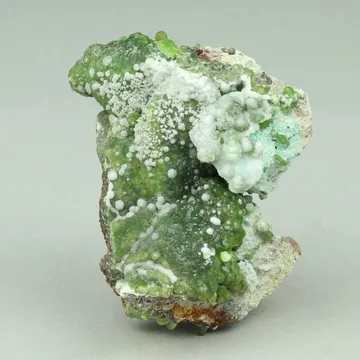
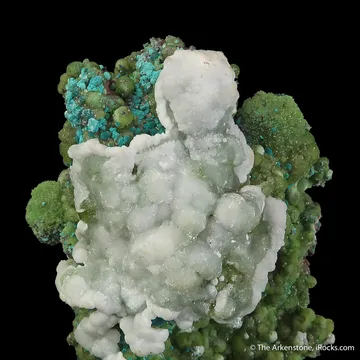
Smithsonite is the Jean Baptiste mineral most likely to interest display collectors: it occurs here as sparkling druses, botryoidal crusts, rhombohedral replacement crystals, and cast or epimorph-like forms after earlier carbonate or sulfate minerals. The mine has yielded orange smithsonite replacing drusy scalenohedral calcite, pistachio-green cuprian botryoidal plates on gossan, golden-pink botryoidal smithsonite after gypsum, and thicker botryoidal small-cabinet pieces with rounded “grape” surfaces; documented specimens range from miniature to large cabinet, including pieces over 20 cm across. Good examples show continuous, undamaged coverage, rounded but lively botryoids or sharp replacement forms, attractive contrast with brown limonite or white calcite, and a precise Jean Baptiste label; ordinary pieces are thinner, chalkier, abraded on high points, or too vaguely labeled as simply “Lavrion.”
Azurite from Jean Baptiste is a secondary copper mineral of vugs, coatings, and scattered crystal groups rather than a source of large isolated crystals. The best pieces are vivid deep blue, sparkling, and visibly crystalline on contrasting limonitic or carbonate matrix, commonly with calcite and malachite and, in the wider documented association set, adamite, zálesíite, fluorite, smithsonite, jarosite, natrojarosite, annabergite, rosasite, chalcopyrite, galena, serpierite, agardite, and olivenite. EarthWonders records a Jean Baptiste azurite-calcite-malachite specimen collected in 2003 at 9.5 x 6.0 x 2.5 cm, a useful scale for the kind of small-cabinet combination material serious collectors should expect; superior pieces have bright, unfaded blue crystals cleanly distributed across the matrix, while lesser examples read as dull blue staining or broken crust.
Calcite at Jean Baptiste is both gangue and specimen architecture: it is part of the primary carbonate-replacement system and also appears in later open-space assemblages with smithsonite, azurite, malachite, fluorite, pyrite, sphalerite, gypsum, adamite, quartz, conichalcite, agardite, arsenopyrite, bournonite, and austinite. In collector material it is often important because smithsonite grew on, around, or after it—most notably in documented orange smithsonite replacing a druse of scalenohedral calcite crystals on an 8 x 7.2 x 4.6 cm specimen, with individual replacement forms to about 1.9 cm. Fine calcite-bearing Jean Baptiste pieces therefore succeed when the calcite gives shape, sparkle, or contrast to the composition; plain calcite without smithsonite or copper-mineral association is much less distinctive in this district.
Malachite from Jean Baptiste is chiefly a companion and contrast mineral: fibrous aggregates, green coatings, small sprays, and localized crusts associated especially with azurite, and also documented with serpierite, gypsum, galena, chalcopyrite, fluorite, rosasite, brochantite, adamite, zálesíite, smithsonite, arsenopyrite, agardite, olivenite, hydrozincite, and spangolite. Its collector value here lies in balance—fresh green malachite against sharp blue azurite, white calcite, or pale smithsonite on rusty Lavrion matrix—rather than in large malachite masses. The best Jean Baptiste pieces preserve delicate fibers or primary green aggregates without smearing, abrasion, or excessive darkening; ordinary examples are thin, earthy, or visually subordinate to limonite.
Beyond these four display minerals, Jean Baptiste is a serious systematic locality. Ktenasite is the mine’s headline type-locality mineral, described as a zinc-copper sulfate and known here with serpierite, glaucocerinite, smithsonite, and gypsum. Bismoclite from Jean Baptiste was reported from the second level and became the subject of modern single-crystal X-ray diffraction and Raman spectroscopy. The mine is also specifically noted for adamite and carminite, and broader Jean Baptiste records include arseniosiderite, arsenopyrite, arthurite, atelestite, aurichalcite, austinite including copper-bearing austinite, baryte, berthierite, beudantite, beyerite, bismite, bismuthinite, bismutite, bismutoferrite, brochantite, cerussite, chalcophanite, chalcopyrite, chlorargyrite, chrysocolla, connellite, cuprite including chalcotrichite, delafossite, fluorite, gersdorffite, goethite, gypsum, hedyphane, hydrozincite, jarosite, kettnerite, maldonite-related Bi-Au alteration products, mimetite-group material, parnauite, preisingerite, rosasite, serpierite, siderite, zavaritskite, and zálesíite. Many of these are micromount-scale and should be bought with analytical documentation when the species name, rather than the aesthetic, is the value.
The principal authenticity issue with Jean Baptiste material is locality precision. “Lavrion” or “Laurium” on an old label may be historically honest but scientifically broad; “Kamariza” is better; “Jean Baptiste Mine, Kamariza” is better still. Because neighboring Kamariza mines—Hilarion, Serpieri, Christiana, Clemence, and others—produce visually overlapping secondary minerals, collectors should be wary of upgraded labels that turn a general Lavrion specimen into Jean Baptiste without old documentation.
Species identification can also be treacherous. Lavrion is famous precisely because it produces many visually similar blue-green, pale green, white, yellow, and brown secondary minerals in intimate intergrowths. Smithsonite, calcite, aragonite, hemimorphite, hydrozincite, aurichalcite-like coatings, rosasite, serpierite, ktenasite, brochantite, conichalcite, adamite, and zálesíite can be miscalled in hand specimen, especially when they occur as crusts. For high-value smithsonite, type-locality ktenasite, bismoclite, carminite, or Bi-bearing rarities, visual identification alone should not be considered adequate. Raman, XRD, SEM-EDS, or a trustworthy analytical provenance is preferable.
Condition matters sharply on Jean Baptiste smithsonite. Botryoidal surfaces bruise on the highest domes, and drusy coatings can dull if cleaned aggressively. Replacement pieces after calcite or gypsum are structurally interesting but can be fragile, hollow, or partly supported by friable gossan. Avoid soaking complex Lavrion specimens unless you are certain of the assemblage: soluble sulfates, delicate arsenates, clayey allophane-like material, and powdery oxidation products can be altered by water, acid, or ultrasonic cleaning. Dry mechanical dust removal under magnification is usually safer.
Azurite should be kept dry and away from unnecessary heat or acidic environments. Malachite fibers can be soft and should not be scrubbed. Smithsonite is more robust but still scratches and chips; attractive botryoidal surfaces deserve the same handling care as a polished gem surface. Specimens containing arsenates, lead minerals, bismuth compounds, or soluble sulfate efflorescences should be handled with standard mineral-collector hygiene: wash hands after handling, keep dust out of the breathing zone, and avoid storing friable material where loose particles can contaminate drawers.
Jean Baptiste specimens are not common in the way that broad Lavrion specimens are common. Good smithsonite appears periodically from old collections, Greek dealers, and auction material, but attractive, well-labeled Jean Baptiste pieces are a finite resource. The market rewards precise locality, old collection history, unusual habits such as smithsonite after calcite or gypsum, and intact color contrast. Micromount rarities from Jean Baptiste may be inexpensive in size but expensive in documentation; without analytical support, their value should be treated cautiously.
Jean Baptiste is one of those Lavrion mines whose best story begins with a smallness that turns out to be misleading. The mine was not a great industrial giant; it had only a few dumps around the shaft and was connected by shafts to the more profitable Serpieri winding shaft. Yet this modest working became the type locality for ktenasite and later supplied bismoclite material important enough for modern crystallographic study. In Lavrion, a poor-looking piece of oxidized mine wall or gossan can be more consequential than a ton of ore.
The most concrete modern episode is dated to 26 April 2014, when Branko Rieck found bismoclite in the Jean Baptiste Mine. The occurrence was on the second level, in the Agios Konstantinos part of Kamariza. Later work showed that the bismoclite formed in the highly specialized Bi-Au alteration environment: maldonite, Au2Bi, broke down to native gold and native bismuth, and chlorine-bearing aqueous solutions then altered the Bi-bearing material to bismoclite and other secondary bismuth phases. It is a very Lavrion kind of story—gold, bismuth, chlorine, marble-hosted oxidation, and an old mine level all converging in material small enough that most casual collectors would walk past it.
Ktenasite gives Jean Baptiste an older scientific afterlife. Kokkoros described the mineral in 1950 as a zinc-copper sulfate from Lavrion, and later mineralogical references fixed Jean Baptiste as the type occurrence. The classic type-locality association is not a showy cabinet fantasy but a compact, intellectually satisfying assemblage: blue-green ktenasite with serpierite, glaucocerinite, and smithsonite. A modern description of Lavrion type-locality minerals illustrates blocky blue-green ktenasite with blue serpierite and white smithsonite from the second level of the Jean Baptiste Mine. It is the kind of specimen whose importance is in the label, the microscope, and the chemistry as much as in the display case.
The name of the mine carries the 19th-century Lavrion revival inside it. Giovanni Battista Serpieri arrived in a district that had already made Athens rich in antiquity, but modern industry saw value not only in untouched ore but in ancient waste. The redevelopment of Lavrion began with slags, residues, and modern metallurgy, and grew into a landscape of shafts, railways, smelting plants, and company towns. The Jean Baptiste label therefore has two historical layers at once: the ancient Athenian silver field beneath it, and the industrial Lavrion of Serpieri, the Greek company, and the French company above it.
Panagiotis Voudouris et al., “The Lavrion Mines: A Unique Site of Geological and Mineralogical Heritage,” Minerals, 2021, 11, 76 — The essential modern synthesis for Lavrion geology, deposit types, oxidation-zone mineralogy, and mining heritage; includes Jean Baptiste as a Kamariza carbonate-replacement mine, illustrates massive galena ore from Jean Baptiste, and lists ktenasite as a Lavrion type-locality mineral from Jean Baptiste.
P. Kokkoros, “Ktenasit, ein Zink-Kupfersulfat aus Lavrion (Griechenland),” Tschermaks Mineralogische und Petrographische Mitteilungen, 1950, 1, 342–346 — Original description reference for ktenasite, the Jean Baptiste type-locality mineral.
Ktenasite, Handbook of Mineralogy — Concise mineralogical reference noting Kamariza/Lavrion occurrence and associations including glaucocerinite, serpierite, smithsonite, gypsum, namuwite, and schulenbergite.
Irene Liebhart, Branko Rieck, Manuela Zeug & Gerald Giester, “New single-crystal X-ray diffraction and Raman spectroscopic data of natural bismoclite BiOCl,” Austrian Journal of Earth Sciences, 2025, 118(1), 133–139 — Modern crystallographic and Raman study of bismoclite from Jean Baptiste, including the 2014 second-level discovery context.
Irene Liebhart, “Contributions to the mineralogy of the Lavrion mining district, Greece,” MSc thesis summary, University of Vienna, 2023 — Summarizes work on guérinite, bismoclite, and tzeferisite; includes Jean Baptiste notes on bismoclite, mine connections, sparse stockpiles, adamite, and carminite.
B. Rieck, U. Kolitsch, P. Voudouris, G. Giester & P. Tzeferis, “Weitere Neufunde aus Lavrion, Griechenland,” Mineralien-Welt, 2018, 29(5), 32–77 — Important modern “new finds” reference tied to numerous Jean Baptiste species, including bismoclite and several Bi-bearing and secondary minerals.
H. Hanke, “Laurion — ein Rückblick auf die Funde der letzten drei Jahre,” Mineralien-Welt, 1998, 9(2), 37–45 — Cited occurrence reference for Jean Baptiste malachite.
A. Katerinopoulos & E. Zissimopoulou, Minerals of the Lavrion Mines, Greek Association of Mineral and Fossil Collectors, Athens, 1994, 304 pp. — Foundational book-length Lavrion reference, repeatedly cited in later literature.
B. Ottens & P. Voudouris, Griechenland: Mineralien-Fundorte-Lagerstätten, Christian Weise Verlag, Munich, 2018, 480 pp. — Major modern locality and collector reference for Greek minerals, including Lavrion.
Jean Baptiste Mine, Mindat — Core locality page for coordinates, hierarchy, species list, and occurrence links.
Smithsonite from Jean Baptiste Mine, Mindat occurrence page — Useful association data for Jean Baptiste smithsonite, including calcite, azurite, serpierite, gypsum, adamite, hydrozincite, and other documented companions.
Azurite from Jean Baptiste Mine, Mindat occurrence page — Association data and gallery access for Jean Baptiste azurite.
Calcite from Jean Baptiste Mine, Mindat occurrence page — Association data for calcite in the Jean Baptiste assemblage.
Malachite from Jean Baptiste Mine, Mindat occurrence page — Association data and reference trail for Jean Baptiste malachite.
Bismoclite from Jean Baptiste Mine, Mindat occurrence page — Focused record for the Jean Baptiste bismoclite occurrence and its published references.
Ktenasite mineral data, Mindat — Mineral page identifying Jean Baptiste as the type occurrence for ktenasite.
“The Lavrion Mines: A Unique Site of Geological and Mineralogical Heritage,” Minerals, 2021 — Best single open-access technical overview of Lavrion geology, ore systems, supergene mineralogy, and mining heritage.
Lavreotiki UNESCO Global Geopark, UNESCO — Current geopark overview and heritage context for the district that contains Jean Baptiste.
Ancient Lavrion, UNESCO World Heritage Centre Tentative List — Cultural and historical background on the ancient and modern Lavrion mining landscape.
“Contributions to the mineralogy of the Lavrion mining district, Greece,” Ελληνικός Ορυκτός Πλούτος — Readable summary of recent Lavrion mineralogical thesis work, including Jean Baptiste bismoclite.
Wikimedia Commons: Ktenasite and serpierite from Jean Baptiste Mine — Verified open-license photograph of Jean Baptiste ktenasite and serpierite.
Mineral Auctions: Cuprian smithsonite from Jean Baptiste Mine — Market record for an 11.1 cm pistachio-green Jean Baptiste smithsonite from the Christos Spiromitros collection.
Mineral Auctions: Smithsonite after gypsum from Jean Baptiste Mine — Market record for an unusual Jean Baptiste smithsonite cast/epimorph after gypsum.
Fabre Minerals reference specimens page including Jean Baptiste smithsonite after calcite — Dealer archive with specimen descriptions and sizes for Jean Baptiste smithsonite and related Lavrion material.