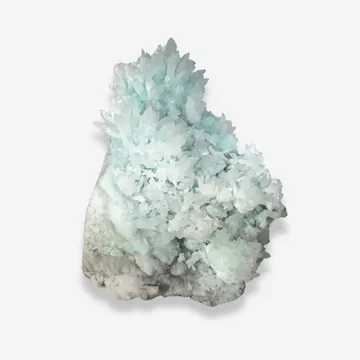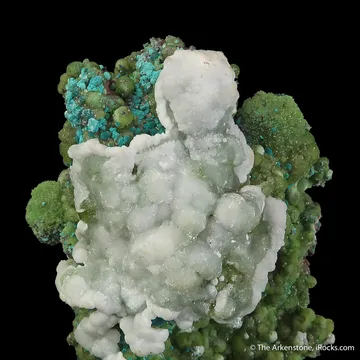
Sounion no. 6, Lavrion, Greece — noted for vivid copper-bearing smithsonite and blue aurichalcite, with a diverse range of supergene minerals prized by collect…
Key facts
Sounion mine no. 6—better known to many European collectors as the Exi Mine, “exi” meaning “six” in Greek—is one of the modern collector landmarks of the southern Lavrion field. It lies in the Agrileza–Aghia Varvara sector near Sounion, on the southeastern tip of Attica, within the immense Lavrion Pb-Zn-Cu-Ag mining district. Lavrion is not a single mine in the ordinary sense but a dense archaeological, industrial, and mineralogical landscape: marble, schist, detachment structures, Miocene intrusions, carbonate-replacement ore, veins, breccias, gossans, dumps, slag sites, ancient washeries, and modern workings all crowded into a peninsula that looks out toward the Aegean.
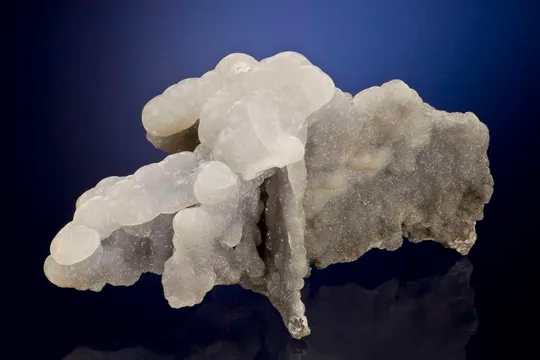
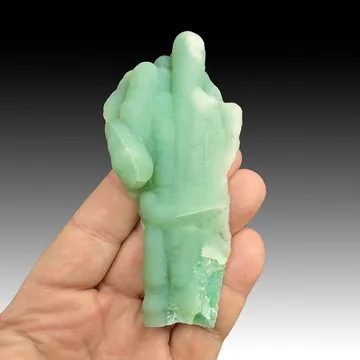
The collector importance of Sounion no. 6 rests on the oxidized zinc-copper suite. Its best-known recent specimens are vivid green copper-bearing smithsonite on brown gossan, commonly enlivened by sky-blue aurichalcite, white calcite, hemimorphite, and local rosasite. These are not huge crystals in the Tsumeb or Kelly Mine sense; the beauty is in sparkling botryoidal crusts, translucent apple-green spheres, tight vugs, and clean contrast. Good pieces have a bright, almost confectionary surface without the chalky deadness that ordinary oxidized carbonate crusts can show.
The mine is also a serious systematic locality. Beyond the familiar display minerals, the documented list includes a broad range of supergene sulfates, arsenates, phosphates, carbonates, chlorides, and oxides. A 2025 study of material found at the northern entrance brought special attention to an unusual phosphate-sulfate association with phosphosiderite, mitridatite, jahnsite-(NaFeMg), fluorapatite, collinsite, jarosite, and natrojarosite—evidence that Sounion no. 6 still matters not only to thumbnail and miniature collectors, but to researchers working at the edge of Lavrion’s astonishing secondary-mineral chemistry.
Regional View
Country View
Lavrion’s setting explains why a comparatively small mine can produce such complex mineral associations. The district belongs to the Attic-Cycladic crystalline belt, where marbles and schists were affected by detachment-related deformation, Miocene magmatism, hydrothermal mineralization, and later deep oxidation. Primary galena, sphalerite, pyrite, chalcopyrite, arsenopyrite, and related ore minerals were attacked by oxygenated waters moving through fractured carbonate rocks. The result was an exceptionally thick supergene zone in which sphalerite could become smithsonite, hydrozincite, and hemimorphite, while copper, lead, arsenic, sulfate, phosphate, chloride, and carbonate activity generated a catalogue of species that few districts on Earth can approach.
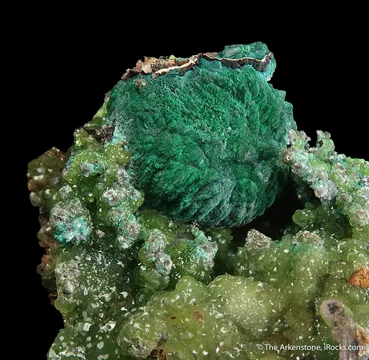
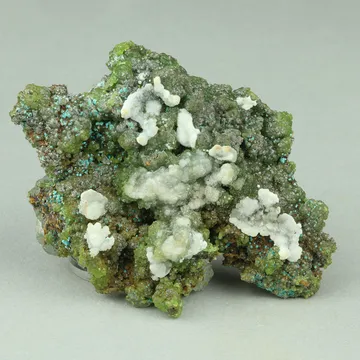
For the eye, Sounion no. 6 is above all a mine of small-scale color. The classic look is an iron-brown, porous oxidized matrix carrying glossy green smithsonite in rounded aggregates, with white calcite either as rhombic to rounded crystals or as partial overgrowths. Aurichalcite may appear as pale to sky-blue sprays or soft fibrous crusts, most effective when it forms a blue accent against the green smithsonite rather than smothering it. The best pieces are clean, balanced, and specific in their labeling: “Sounion Mine No. 6,” “Mine No. 6, Agrileza,” “Aghia Varvara,” or “Exi Mine” all point to the same collector neighborhood, but precise old and modern labels add real value.
Search for specimens: View all specimens from Sounion mine no. 6, Lavrion, Greece
Sounion mine no. 6 is recorded as Mine No. 6 of the Agrileza mines, Lophos, Lavreotiki, East Attica, Attica, Greece. The mine sits in the broader Lavrion Mining District and is historically associated with the Aghia Varvara or St. Barbara mining area near Sounion. Its WGS84 coordinates are given as about 37.68089 N, 24.01739 E. The locality has two entrances: a southern entrance in Spitharopoussi, now reported collapsed, and a northern entrance in Agrileza. The southern entrance is described as having been the main entrance during the mine’s active period.
The ore system belongs to the Lavrion family of detachment-related polymetallic deposits. Lavrion as a whole contains several genetically related ore styles: porphyry Mo-W or Mo-Cu mineralization, Fe-Cu-Bi-Au skarn, high-temperature carbonate-replacement Pb-Zn-Cu-Ag-Au mineralization, and Pb-Zn-Ag-Au vein and breccia systems. In collecting terms, Sounion no. 6 is best understood through the supergene overprint on sulfide-rich ore in carbonate host rocks: oxidized zinc and copper minerals line vugs and fractures in brown gossanous matrix, while iron oxides, quartz, calcite, hemimorphite, and residual sulfides provide the stage on which the bright secondary species grew.
The primary ore minerals documented in the mine’s mineral list include galena, sphalerite-equivalent zinc sources represented by the oxidation products, chalcopyrite, chalcocite, covellite, arsenopyrite, pyrite, marcasite, bournonite, and famatinite, together with gangue and secondary minerals such as quartz, calcite, dolomite, siderite, ankerite, fluorite, gypsum, and aragonite. The secondary suite is much richer: smithsonite, hydrozincite, hemimorphite, aurichalcite, rosasite, malachite, azurite, brochantite, linarite, cyanotrichite, devilline, schulenbergite, spangolite, mimetite, pyromorphite, corkite, conichalcite, adamite, arseniosiderite, dufrénite, diadochite, and several phosphates and sulfates have all been recorded.
Lavrion’s mining history is among the longest in the Mediterranean. Regional mining and metallurgy began by the transition from the Neolithic to the Bronze Age, around 3200 BC, and the district became a pillar of Athenian wealth during the Classical period. The silver-bearing lead ores of Laurion helped finance the Athenian fleet and the celebrated silver coinage of Athens. After long decline and abandonment, modern mining revived in the 19th century with the exploitation of ancient slags and tailings, reopening of old works, and the formation of the Greek Lavrion Metallurgical Company and the Compagnie Française des Mines du Laurium. Modern industrial mining in the district continued into the late 20th century; major operations had ceased by the 1970s, and wider mining activity finally ended by the closing years of the century.
For Sounion no. 6 specifically, modern collector sources repeatedly place it in the Aghia Varvara/St. Barbara sector and describe it as an abandoned mine with surviving entrances, workings, and dumps. It is also bound to the human history of the district through Christos Kapellas, the Lavrion miner, collector, and dealer for whom the type-locality mineral kapellasite was named. Kapellas spent much of his working life in the ore haulage of the Exi Mine, and his collection later became part of the Lavrion Mineral Museum. That connection gives the locality an unusually direct bridge between working mine, collector tradition, and institutional mineralogy.
Specimen recovery has come in pulses. Dealers and auction records document a spring 2015 find of yellowish-green to bluish-green smithsonite spheroids with white calcite and minor aurichalcite. A later winter 2020/2021 discovery produced vivid green cuprian smithsonite, in places with hemimorphite, calcite, and bluish rosasite; contemporary market commentary described it as one of the strongest Lavrion smithsonite finds of recent years. By late 2021, small but bright thumbnails and miniatures were already moving quickly through the market, with apple-green translucent spheres on brown gossan and larger pieces showing blue aurichalcite, colorless calcite, and white hemimorphite.
The 2023 phosphate-sulfate occurrence was found not as a glamorous cabinet pocket but in a stone wall near the northern entrance. That detail is exactly the kind of Lavrion surprise that keeps systematic collectors alert: a mine famous in the trade for green smithsonite also yielded dark and light pink phosphosiderite, amber to orange-brown jarosite-natrojarosite, yellow jahnsite-(NaFeMg), white to grey fluorapatite spheres, mitridatite, and colorless to white collinsite. The studied material was preserved in the National Museum in Prague and in the private collection of Ivan Prachař.
Collecting access today must be treated conservatively. The locality is in a protected archaeological, historical, and natural landscape, and public sources caution that abandoned mine visits require permission, land-status awareness, and serious safety precautions. The broader Lavreotiki UNESCO Global Geopark includes expert-guided educational access to historic mining tunnels, but that should not be confused with permission to enter abandoned workings independently. In practical collecting terms, most serious collectors should acquire Sounion no. 6 specimens through documented old collections, reputable Greek sources, or dealers who can preserve precise sublocality data.
Smithsonite is the signature modern display mineral of Sounion mine no. 6: bright copper-bearing green to bluish-green ZnCO3 in lustrous botryoidal crusts, spheroids, and tight vug linings on oxidized brown matrix. Published market records for the mine describe yellowish-green vitreous to resinous spheroids with rounded white calcite rhombs from a spring 2015 find, soft bluish-green spheres up to about 5 mm in a vug, apple-green translucent spheres in thumbnails and miniatures, and later early-2022 material with apple-green spheroids to about 3 mm and minor sky-blue aurichalcite. The winter 2020/2021 discovery produced some of the most sought-after pieces: vivid green cuprian smithsonite with white calcite, hemimorphite, and locally bluish rosasite, typically in miniature to small-cabinet sizes. The best Sounion no. 6 smithsonites are not simply green; they are cleanly translucent, evenly lustrous, undamaged on the high points of the botryoids, and set against contrasting gossan, calcite, hemimorphite, or aurichalcite so the color reads from across a case.
Aurichalcite from Sounion mine no. 6 is valued chiefly as a delicate blue accent in the same oxidized zinc-copper assemblage that produced the mine’s green smithsonite. It appears in specimen descriptions as minor blue-green to sky-blue material on the backs, edges, and vug surfaces of smithsonite-calcite pieces, and collector field accounts also single out the Exi Mine for fine aurichalcites along with azurite and flos ferri-type carbonate growths. On good examples it forms soft fibrous sprays or velvety crusts rather than thick massive coatings, and the finest combinations use aurichalcite’s powder-blue color to sharpen the contrast between apple-green smithsonite, white calcite or hemimorphite, and brown gossan. Ordinary pieces can look merely fuzzy or bruised; better ones show fresh color, intact fibers, and a balanced association that makes the mineral identifiable without overpowering the smithsonite.
Calcite at Sounion mine no. 6 is both a gangue mineral and an aesthetic partner to the zinc-carbonate suite. The typical collector calcite here is white to colorless, occurring as rounded rhombic crystals, partial coatings, or small contrasting aggregates on green cuprian smithsonite and brown oxidized matrix; dealer records describe white calcite partly covering vivid green smithsonite and associated with hemimorphite and bluish rosasite, while earlier Exi Mine pieces show white calcite rhombs set with yellowish-green smithsonite and minor aurichalcite. The broader Sounion no. 6/Aghia Varvara area is also associated in collector literature with flos ferri-type carbonate forms, including the “cat’s tail” style in the north wing of the Exi Mine, where aragonite-calcite distinctions may require caution. The best calcite-bearing specimens from this mine are those in which the calcite is bright and undamaged, adds white relief without hiding the smithsonite, and preserves a natural paragenetic relationship rather than looking like a later, visually distracting crust.
Other documented minerals from Sounion mine no. 6 make the locality far more than a smithsonite pocket. The recorded list includes 66 valid minerals, among them adamite and copper-bearing adamite, agardite-(La), anglesite, antlerite, azurite, brochantite, cerussite, chlorargyrite including bromian chlorargyrite, conichalcite, corkite, cuprite, cyanotrichite, devilline, dufrénite, fluorapatite including carbonate-rich fluorapatite, fornacite, fraipontite, goethite, gypsum var. selenite, hemimorphite, hetaerolite, hydrozincite, linarite, malachite, mimetite, murdochite, pyromorphite, quartz, rosasite, schulenbergite, siderite, spangolite, and vauquelinite. The 2023 phosphate-sulfate association is particularly important: phosphosiderite forms dark to light pink crystals and aggregates, fluorapatite occurs as white to grey spherical aggregates and sprays, collinsite grows as white to colorless columnar and lanceolate crystals on fluorapatite, and jahnsite-(NaFeMg) is a rare species whose occurrence at the Exi Mine adds considerable systematic interest. Lavrion as a whole is famous as the type locality for many minerals, but Sounion no. 6 itself is best described as a productive sublocality within that larger type-locality district rather than as the named type locality for the classic Lavrion species.
The chief authenticity issue with Sounion mine no. 6 is locality precision, not a notorious fake unique to the mine. Old labels may say “Sounion,” “Laurium,” “Lavrion,” “Aghia Varvara,” “St. Barbara,” “Exi Mine,” or “Mine No. 6,” and all can be compatible depending on age and translation. “Agrileza mines, Lophos” is the modern Mindat-style locality framework, while “Sounion #6” is common in the trade. Serious collectors should preserve both old-label language and modern reconciliation rather than replacing one with the other.
Mislabelling within the district is a real risk because Lavrion is a maze of named mines, numbered workings, ancient holes, modern adits, dumps, and old dealer conventions. A generic “Lavrion” label is not wrong for older material, but it is less valuable than a specific Sounion no. 6 attribution. Conversely, an attractive green Lavrion smithsonite should not be upgraded to “Exi Mine” without supporting provenance. Sounion no. 6 material has a recognizable look—green cuprian smithsonite with white calcite, hemimorphite, aurichalcite, rosasite, and brown gossan—but the broader district contains similar supergene assemblages, so visual style alone is not proof.
The bright green color of Lavrion smithsonite does not by itself imply dyeing. Mineral-chemical work on Lavrion smithsonites has shown that copper can be incorporated into smithsonite as a ZnCO3-CuCO3 solid solution, so natural green coloration is entirely plausible. That said, as with all porous carbonate specimens, suspiciously uniform neon color, color concentrated in cracks, or unnatural staining of matrix should be examined under magnification. A good Sounion no. 6 smithsonite should show mineral luster, natural botryoidal growth, and color that belongs to the carbonate rather than to a surface wash.
Condition matters strongly. Smithsonite botryoids abrade on their highest points, aurichalcite fibers crush easily, and calcite edges can be bruised or cleaved. Many specimens are on crumbly iron-oxide gossan, so matrix integrity is as important as the show face. Avoid over-cleaned pieces: acid or aggressive mechanical cleaning can dull smithsonite, remove fragile aurichalcite, or leave calcite looking etched. Water-soluble or humidity-sensitive sulfate species in the wider mine assemblage, including jarosite-related and other sulfate occurrences, should be stored dry and handled as systematic specimens rather than washed.
Rarity depends on species and quality. Green smithsonite from the 2015 and 2020/2021 finds is obtainable but no longer abundant in top condition; fine miniatures and small cabinets with strong color and balanced associations command more attention than ordinary crusts. Aurichalcite-only pieces from the mine are less commonly seen than smithsonite combinations, and the 2023 phosphate-sulfate material is primarily a systematic and micro-collector occurrence. Vauquelinite, spangolite, jahnsite-(NaFeMg), collinsite, phosphosiderite, and similar rare species should be bought with analytical confidence whenever possible.
The name “Exi” sounds almost too simple for such a complicated mine: just “six.” Yet in Lavrion that simplicity is deceptive. One modern locality entry untangles the mine into two mouths, the collapsed southern entrance in Spitharopoussi and the northern entrance in Agrileza. The southern entrance was the working entrance in the mine’s active days; the northern entrance is the one that later appears in scientific field photographs and in the 2023 phosphate study. A single numbered mine thus becomes two approaches, two valley stories, and a reminder that Lavrion localities are often historical puzzles as much as mineral localities.
One of the most human details attached to Sounion no. 6 is Christos Kapellas. He was not an outside academic dropping in for a sample; he was a Lavrion miner, collector, and mineral dealer from Agios Konstantinos who knew the orebodies from work underground. Most of his working life was spent in ore haulage at the Exi Mine. Later, when the new copper-zinc chloride kapellasite was named for him, the tribute recognized a kind of knowledge that formal mineralogy often depends on but rarely sees: the miner’s memory of galleries, pockets, and rock changes. His collection became part of the Lavrion Mineral Museum, and his sons continued the family’s connection by presenting self-collected Lavrion specimens to the museum.
The 2020/2021 smithsonite find reads like the kind of small but decisive event that changes a locality’s market profile. In winter, from an old mine in a district worked for thousands of years, came vivid green cuprian smithsonite with white calcite and hemimorphite, locally with bluish rosasite. By late 2021, thumbnails and miniatures were already appearing in dealer updates, some described as bright apple-green, translucent spheres set singly or in clumps on brown gossan. Larger miniatures combined the green carbonate with blue aurichalcite, colorless calcite, and white hemimorphite. These were not anonymous green crusts: they were the kind of small, high-color Lavrion pieces that make collectors stop scrolling.
The 2023 phosphate occurrence is a different sort of story, quieter and more scientific. Ivan Prachař found the studied material in a stone wall near the northern entrance of Mine No. 6. Out of that unglamorous setting came an association that had not previously been published from the deposit: pink phosphosiderite, orange-brown jarosite-natrojarosite, yellow jahnsite-(NaFeMg), white to grey fluorapatite spheres, mitridatite, and colorless to white collinsite. The field of view in the published photographs is measured in millimeters—1.7 mm, 1.9 mm, 2.2 mm, 3.5 mm—yet the chemical implication is district-scale: a rare pocket of phosphorus-rich supergene activity in a mining district otherwise dominated by arsenates and sulfates.
A 2010 field-trip account gives the Exi Mine its place in the lived landscape between Lavrion and Sounion. After photographing Plaka and Vilia, then eating grilled sprats and octopus at the harbor in Laurion, the party moved south to the dumps and open cuts around the St. Barbara church. First came the Exi Mine open cut, its adits and dumps; then the Maria Mine, with small open cuts, adits, and cisterns for service and drinking water. Across the slopes were ancient marble-quarry dumps said to be connected with the stone for the Temple of Poseidon. That juxtaposition is pure Lavrion: mineral dumps, mine mouths, ancient water engineering, lunch by the port, and the temple at Sounion all in the same day.
Vrtiška, L.; Prachař, I.; Vrtišková, R.; Dolníček, Z. (2025). “Study of phosphate and sulphate association from the Mine No. 6 ‘Exi’ in the Lavrion mining district (Greece): chemistry and PXRD data.” Bulletin Mineralogie Petrologie 33(1), 1–13. The key modern scientific paper focused specifically on Mine No. 6, documenting phosphosiderite, mitridatite, jahnsite-(NaFeMg), fluorapatite, collinsite, jarosite, and natrojarosite.
Mindat: Mine No. 6, Agrileza mines, Lophos, Lavreotiki, East Attica, Attica, Greece. The principal online locality record, with coordinates, alternate names, entrance notes, mineral list, photos, and references.
Voudouris, P.; Melfos, V.; Spry, P. G.; Bonsall, T. A.; Tarkian, M.; Economou-Eliopoulos, M.; et al. (2021). “The Lavrion Mines: A Unique Site of Geological and Mineralogical Heritage.” Minerals 11, 76. A broad geological and mineralogical synthesis of the Lavrion district, including deposit types, supergene alteration, mining history, and type-locality significance.
Katerinopoulos, A.; Solomos, C.; Voudouris, P. (2005). “Lavrion smithsonites: A mineralogical and mineral chemical study of their coloration.” In Mineral Deposit Research: Meeting the Global Challenge, Springer, pp. 983–986. Important for understanding natural color in Lavrion smithsonite, including copper substitution in smithsonite.
Rieck, B.; Tzeferis, P. “Type Locality Minerals from the Lavrion Mining District.” A collector-friendly review of Lavrion type-locality minerals and the people behind them, including Christos Kapellas and his connection to the Exi Mine.
Anthony, J. W.; Bideaux, R. A.; Bladh, K. W.; Nichols, M. C., eds. Handbook of Mineralogy: Vauquelinite. Lists the Exi Mine near Laurium among documented vauquelinite localities.
Hanke, H. (1998). “Laurion—ein Rückblick auf die Funde der letzten drei Jahre.” Mineralien-Welt 9(2), 37–45. Listed in the Mindat references for Mine No. 6.
Wendel, W.; Rieck, B. (1999). “Die wichtigsten Mineralfundstellen und Bergbauanlagen Lavrions.” Lapis 24(7–8), 24–33, 90. Listed in the Mindat references for Mine No. 6 and central to modern collector locality usage in Lavrion.
Rieck, B.; Kolitsch, U.; Voudouris, P.; Giester, G.; Tzeferis, P. (2018). “Weitere Neufunde aus Lavrion, Griechenland.” Mineralien-Welt 29(5), 32–77. Listed in the Mindat references for Mine No. 6 and cited by the 2025 phosphate study for earlier Exi Mine fluorapatite and collinsite.
Rieck, B.; Kolitsch, U.; Voudouris, P.; Giester, G.; Tzeferis, P. (2020). “Lavrion, Griechenland: Weitere Neufunde aus dem berühmten Bergbaurevier.” Mineralien-Welt 31(3), 6–21. Listed in the Mindat references for Mine No. 6.
Rieck, B.; Kolitsch, U.; Voudouris, P.; Giester, G.; Tzeferis, P. (2022). “Neubestimmungen aus dem Bergbaubezirk Lavrion, Griechenland.” Mineralien-Welt 33(5), 6–20. Listed in the Mindat references for Mine No. 6.
The Mineralogical Record, “What’s New in the Mineral World,” report 6/22. Market commentary on the 2020/2021 Sounion mine no. 6 cuprian smithsonite discovery, including apple-green thumbnails and smithsonite with aurichalcite, calcite, and hemimorphite.
Mindat: Mine No. 6, Agrileza mines, Lophos, Lavreotiki, East Attica, Attica, Greece — Best single reference for modern locality name, coordinates, alternate names, mineral list, photos, and bibliography.
Vrtiška et al. 2025, Bulletin Mineralogie Petrologie: Mine No. 6 “Exi” phosphate-sulfate association — Essential research paper for the 2023 phosphosiderite–jahnsite-(NaFeMg)–fluorapatite–collinsite occurrence.
The Lavrion Mines: A Unique Site of Geological and Mineralogical Heritage — Comprehensive geological and mineralogical overview of the Lavrion district.
Ancient Lavrion, UNESCO World Heritage Centre Tentative List — Authoritative summary of Lavreotiki’s archaeological, mining, metallurgical, and historical importance.
Lavreotiki UNESCO Global Geopark — Current geopark overview, including Lavrion’s mineralogical diversity and cultural landscape.
The Mineralogical Record: What’s New in the Mineral World, 6/22 — Contemporary collector-market note on the Sounion no. 6 cuprian smithsonite find.
Spirifer Minerals: Smithsonite, calcite new find from Lavrion — Dealer record for a winter 2020/2021 Sounion #6 cuprian smithsonite with hemimorphite, calcite, and rosasite.
Weinrich Minerals: Smithsonite with calcite, aurichalcite, malachite, azurite — Useful market record for a small-cabinet Sounion #6 smithsonite combination specimen.
Mineral Auctions: Smithsonite with calcite, Sounion Mine No. 6 “Exi Mine” — Auction record documenting spring 2015 material with smithsonite, calcite, and aurichalcite.
Mineral Auctions: Copper-bearing smithsonite, Sounion Mine No. 6 — Recent auction record for early-2022 apple-green smithsonite with minor sky-blue aurichalcite.
Wendel Minerals: Lavrion Trip 2022 — Field-trip style photo essay with observations on Aghia Varvara/Exi Mine and nearby Lavrion mining landmarks.
Seilnacht: Calcite und Aragonite aus Laurion — German collector article noting calcite, aragonite, and “cat’s tail” flos ferri-style material in the north wing of the Exi Mine.
Handbook of Mineralogy: Vauquelinite — Mineral reference listing Exi Mine near Laurium as a documented vauquelinite locality.