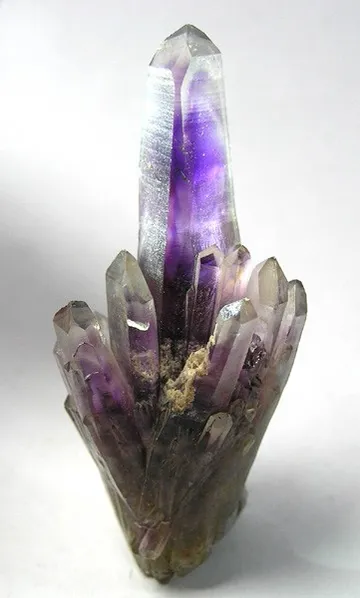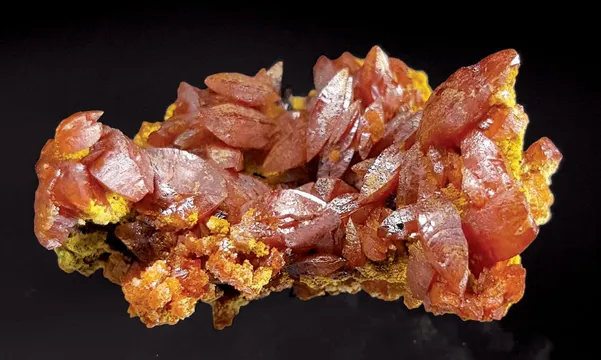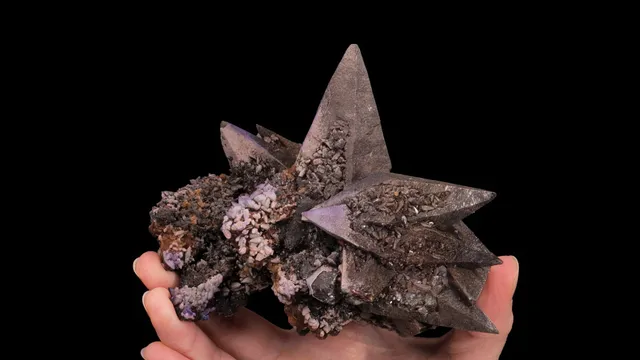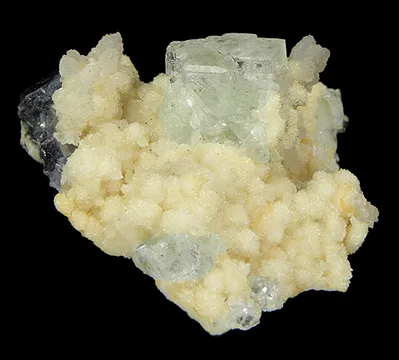
Chihuahua, Mexico — a mineral province famed for agate belts, carbonate-replacement deposits, and notable meteorite finds; prized for calcite, mimetite, wulfen…
Key facts
Chihuahua is not a single specimen locality so much as a mineral province: a large northern Mexican state where volcanic agate fields, carbonate-replacement silver-lead-zinc districts, uranium-bearing rhyolites, desert gypsum flats, geode mines, skarns, and even one of the most consequential meteorite falls in science all share the same label on mineral drawers. For collectors, “Chihuahua, Mexico” most often calls up three very different visual worlds. The first is the agate belt of northern Chihuahua—Laguna, Coyamito, Moctezuma, Agua Nueva, Las Choyas, and Crazy Lace material—where polished nodules and vein pieces can show razor-fine fortification banding, tight eyes, reds and oranges against white or gray, and the depth effect lapidaries call shadow. The second is the great carbonate-replacement mining belt around Santa Eulalia, Naica, Los Lamentos, and related districts, famous for calcite, gypsum, mimetite, hemimorphite, wulfenite, fluorite, galena, sphalerite, and richly oxidized secondary suites. The third is the extraterrestrial Allende meteorite fall near Pueblito de Allende, whose calcium-aluminum-rich inclusions have yielded a remarkable list of type minerals and whose fragments remain among the most studied pieces of matter in planetary science.
The geological unity behind much of Chihuahua’s ore-mineral fame is the Mexican carbonate-replacement-deposit belt. At Santa Eulalia and Naica, metal-bearing hydrothermal fluids invaded Cretaceous limestones, exploiting beds, folds, faults, dikes, and permeability contrasts to form mantos, chimneys, skarns, and breccias. Those bodies supplied centuries of silver, lead, zinc, and copper-bearing ore, and they also left the open spaces, oxidized cavities, and late carbonate-sulfate pockets that mineral collectors recognize immediately: creamy to peach calcite, glittering druse, brown iron-oxide gossan, yellow mimetite, black goethite, blue azurite, and transparent gypsum. At Naica, the same deep, warm, chemically buffered system produced the legendary giant gypsum crystals of the Cave of Swords and Cave of Crystals—scientifically extraordinary, visually unforgettable, and not a normal specimen-collecting source.
Regional View
Country View
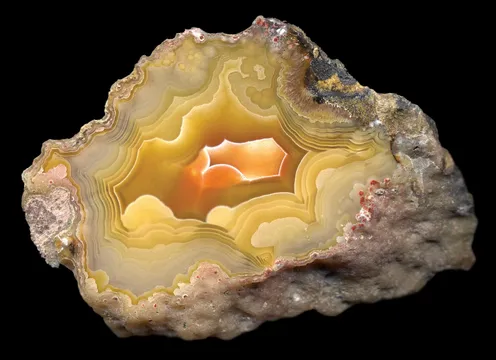
In the agate country, the host rocks and collecting style change completely. Laguna and related nodular agates occur in volcanic terrain north of Chihuahua City, with classic deposits around Estación Ojo Laguna, Rancho Borunda, Rancho Coyamito Norte, and neighboring ranches. These are not cabinet minerals in the usual crystallized-matrix sense; their best faces are revealed by sawing and polishing. Fine pieces are judged by saturation, band density, contrast, complete fortification pattern, translucency, lack of saw or polish defects, and whether the cut captures the nodule’s architecture rather than simply making an attractive slice.

Photo: Wikimedia Commons

Photo: Wikimedia Commons
Search for specimens: View all specimens from Chihuahua, Mexico
As a collector label, Chihuahua covers a state-scale group of localities rather than a single mine. The most specimen-important metal deposits are carbonate-hosted Ag-Pb-Zn systems and related skarns. Santa Eulalia, east of Chihuahua City, is the classic example: mineralization is divided into West Camp and East Camp, with the West Camp historically dominated by massive sulfide mantos and chimneys and the East Camp by intrusion-centered skarn and related massive sulfide bodies. Buena Tierra and Potosí are principal West Camp names; San Antonio is the best-known East Camp mine name on specimen labels. The ore assemblage is comparatively simple in its primary sulfide stage—galena, sphalerite, pyrite, pyrrhotite, and locally chalcopyrite, arsenopyrite, silver sulfosalts, and calc-silicate gangue—but the collector’s suite is far richer because oxidation, late fluids, and open cavities produced calcite, gypsum, hemimorphite, mimetite, cerussite, aurichalcite, smithsonite, goethite, fluorite, and many minor species.
Santa Eulalia’s historical importance goes beyond mineral collecting. Spanish mining activity at Santa Eulalia is tied to the early colonial development of Chihuahua itself: a seventeenth-century silver discovery by Diego del Castillo was followed by richer early-eighteenth-century developments, and the need for a better administrative and supply center helped lead to the founding of Chihuahua City in the valley at the junction of the Chuvíscar and Sacramento rivers. In mineralogical terms, Santa Eulalia is one of Mexico’s great long-lived mining districts, with specimen labels spanning old oxidized workings, twentieth-century production, and late twentieth-century and early twenty-first-century dealer finds. The best collector pieces tend to come from open pockets in gossanous limestone or skarn: bright mimetite on iron-stained matrix, calcite with hematite or sulfides, hemimorphite lining cavities, and gypsum or aragonite forms that were protected enough to survive extraction.
Naica lies in Saucillo Municipality southeast of Chihuahua City and is another major carbonate-replacement and skarn-related system, historically mined for lead, zinc, and silver. Peñoles controlled the mine from 1964, and formal operations were suspended indefinitely in 2015 after flooding. The company’s own summary records Naica as one of Mexico’s important lead mines, with production in 2014 of milled ore, silver, lead, and zinc concentrates, and describes the deposit as underground mantos and chimneys. For collectors, Naica is inseparable from gypsum: water-clear selenite plates and spears from mine cavities, large museum display crystals preserved from old workings, and the inaccessible giant-crystal caves. Collectible Naica gypsum on the market generally comes from mine pockets and older collections, not from the protected Cave of Crystals.
The northern agate localities are a separate collecting universe. Laguna agate from the Estación Ojo Laguna area and Rancho Borunda is prized for vivid fortification banding and unusually crisp color separations. Coyamito, roughly north of the Laguna area on Rancho Coyamito Norte, is noted for tight patterns, eyes, and strong reds, oranges, and yellows. Agua Nueva, Moctezuma, Huevos del Diablo, and related deposits fill out the northern Chihuahua agate belt. Crazy Lace agate, from the Sierra Santa Lucía area near Ejido Benito Juárez in Buenaventura Municipality, is typically a vein or replacement-style material rather than the classic Laguna-style volcanic nodule: it is celebrated for chaotic looping, lace-like banding and busy graphic patterns, and it has long been a staple of lapidary collecting.
Las Choyas, in Aldama Municipality, supplies the famous “coconut” geodes of Chihuahua. These rounded nodules are mined rather than picked casually from a roadside, and they may be hollow, partly filled, or solid. The typical collector interior is a chalcedony or agate rind with quartz druse, amethyst or smoky quartz, calcite in dogtooth, nailhead, rhombic, or sheet-like habits, plus smaller or rarer species such as goethite, hematite, mordenite, pyrolusite, celestine, siderite, and gypsum. The commercial appeal lies in the surprise of opening them; the scientific appeal lies in their complex sequence of silica, carbonate, iron, manganese, and zeolite deposition.
Chihuahua’s specimen access today is mixed and should be treated conservatively. Major mines such as Naica and Santa Eulalia are industrial or former industrial properties, with underground hazards, company control, flooding, security, and legal restrictions. The Cave of Crystals is not a collecting locality. Many agate deposits are on private ranches or claims; permission and local guidance are essential, and commercial rough often reaches the market through established Mexican diggers and dealers. Las Choyas and related geode material is commonly sold commercially, but field access has historically depended on mine or ranch arrangements, not an open public collecting model. Older labels are common, sometimes excellent, and sometimes imprecise—“Chihuahua,” “Santa Eulalia,” “Naica,” “Laguna,” and “Mexican coconut geode” all deserve closer locality scrutiny when a specimen is important.
Chihuahua agate is the state’s most widely recognized collector material, with the most famous nodular varieties coming from northern volcanic fields around Estación Ojo Laguna, Rancho Borunda, Rancho Coyamito Norte, Agua Nueva, Moctezuma, and related ranch deposits, while Crazy Lace agate from Sierra Santa Lucía near Ejido Benito Juárez represents a distinctive vein/replacement style in limestone. Laguna-type nodules range from small egg-sized pieces to larger grapefruit or cantaloupe-sized rough, and the best cut faces show saturated red, orange, yellow, pink, white, and gray fortification bands with exceptionally sharp linework and a three-dimensional shadow effect. Coyamito is especially valued when the cut captures tight eyes, complete banded centers, and strong warm colors; Crazy Lace is judged more by lively all-over pattern, whole lace panels, and contrast than by classic concentric fortification. Ordinary Chihuahua agate is attractive lapidary rough, but top pieces combine complete design, translucency, color density, and a polish that reveals the internal architecture without flat dead zones or distracting fractures.
Chihuahua calcite is most closely associated with the carbonate-replacement mines and geodes: Santa Eulalia yields scalenohedral, rhombohedral, dogtooth, drusy, and iron-oxide-coated forms from oxidized cavities in limestone and skarn, Naica produced large calcite associated with sulfides, fluorite, pyrite, and gypsum, and Las Choyas geodes commonly contain dogtooth, nailhead, rhombic, amber, brown, white, or sheet-like calcite on quartz or chalcedony. The best Santa Eulalia pieces have crisp undamaged points, pleasing gossan contrast, and associations such as mimetite, hemimorphite, goethite, hematite, gypsum, or sulfides; “black calcite” from the district is typically calcite coated or included by hematite and then overgrown by later calcite. In Las Choyas geodes, calcite quality depends on whether the crystals sit cleanly in the cavity rather than being broken by cracking or saw work, and the most appealing examples place gemmy amber or chocolate-colored scalenohedra against sparkling quartz, amethyst, or blue-gray chalcedony.
Chihuahua gypsum ranges from common desert-rose aggregates from arid playas and dunes to some of the most famous selenite crystals ever documented at Naica, with additional collector material from Santa Eulalia and other carbonate-replacement districts. Naica’s Cave of Swords and Cave of Crystals produced enormous, transparent gypsum beams in subsurface cavities, but those chambers are scientific and mining-history landmarks rather than normal collecting sources; market specimens from Naica are typically smaller water-clear plates, blades, or spear-like crystals from mine cavities and older collections. Santa Eulalia is known for more delicate gypsum habits, including curved “ram’s horn” forms and frosty coatings on calcite or gossan, while desert roses from Chihuahua are sand-included rosettes whose appeal is sculptural rather than gemmy. Good Chihuahua gypsum has intact terminations, clean transparency where expected, minimal cleavage bruising, and stable matrix attachment; ordinary pieces are easily scarred, cloudy, cleaved, or abraded.
Quartz in Chihuahua is most collectible in two forms: macrocrystalline linings in geodes and hydrothermal quartz associated with ore deposits. Las Choyas geodes may contain clear, smoky, or amethyst quartz as drusy linings, individual points, or overgrowths on chalcedony and calcite; the strongest pieces preserve both halves of a geode, show a sharp transition from agate or chalcedony rind to sparkling quartz cavity, and may include contrasting calcite, goethite needles, hematite, or manganese oxides. Santa Eulalia and related mining districts also produce quartz as gangue with sulfides, iron oxides, and secondary minerals, but it is usually the association rather than the quartz alone that gives such specimens value. A good Chihuahua quartz specimen has clean luster, intact points, a meaningful association, or a striking geode composition; ordinary quartz-lined coconuts are common unless the color, geometry, fluorescence, or associated calcite elevates them.
Chihuahua feldspar is of special interest because of the rare crystallized moonstone-style feldspar from the Pili or La Pili mine area, variously labeled over the years as Pili Mine, Fili Mine, Camargo, Concho, or Saucillo Municipality. These specimens are not the usual polished feldspar cabochon material; they occur as tabular to blocky, transparent to translucent feldspar crystals on matrix, commonly with pale gray, tan, cream, olive, or color-variegated tones and a pearly to bluish schiller when oriented correctly. Reported associated augite and etched-out calcite point to open vugs in an igneous or skarn-related setting rather than a simple pegmatite-style cabinet occurrence. The best feldspar pieces from Chihuahua are crystallized, lustrous, and visibly adularescent, with individual crystals up to several centimeters; lesser specimens may be compositionally interesting but visually dull if the schiller is weak, the crystals are chalky, or the matrix is damage-heavy.
Chihuahua moonstone is a collector curiosity because it occurs as crystallized feldspar rather than merely tumbled or cut gem rough, with the classic material attributed to the Pili Mine area and a small market appearance in the mid-1990s. Contemporary and collector discussions describe tabular to blocky crystals reaching roughly 3 to 3.5 cm, showing fine milky blue adularescence or “moon shimmer,” and in some cases analyzed or interpreted as sanidine or anorthoclase rather than the familiar jewelry-store usage of moonstone. The best pieces must be judged in hand under moving light: strong blue sheen, sharp terminations, transparency, and undamaged crystal clusters matter far more than body color alone. Because labels vary between Pili, Fili, Camargo, Concho, and Saucillo, a serious Chihuahua moonstone specimen gains value from old provenance, photos, or analysis tying it to the recognized crystallized feldspar find.
Goethite from Chihuahua appears both as an iron-oxide mineral of oxidized ore zones and as a delicate accessory in silica geodes. In Las Choyas geodes it may form small black needles, chisel-like crystals, sprays, inclusions, or dark accents on quartz and chalcedony, giving otherwise pale interiors a dramatic graphic quality; in Santa Eulalia and similar districts it occurs with hematite, limonite, calcite, mimetite, hemimorphite, and other secondary species in gossanous cavities. Mojina Mine and other Chihuahua localities are also documented for goethite, though the collector market more often sees it under broader district labels. Good specimens either show sharp black goethite crystals aesthetically placed on quartz, or rich velvety, botryoidal, radiating, or pseudomorphic iron-oxide masses with minimal powdering and no oiling; ordinary pieces are simply brown limonite-stained matrix without distinct form.
Azurite is much scarcer from Chihuahua than from Mexico’s later famous Milpillas production in Sonora, so Chihuahua pieces should be approached as locality specimens rather than as competitors for world-class azurite aesthetics. The San Antonio Mine in the East Camp of Santa Eulalia is a documented Chihuahua source, and Sierra Rica in Manuel Benavides Municipality has produced uncommon rosette-style azurite with malachite or dolomite. Typical desirable Chihuahua azurite occurs as deep blue platy, bladed, blocky, or rosette aggregates on gossan, dolomite, malachite, chrysocolla, or oxidized carbonate-replacement matrix. The best pieces show strong blue color, actual crystal form rather than powdery stains, and a credible old locality label; misattribution is a real concern because some Mexican azurites from other states, especially Zacatecas or Sonora, have circulated under vague or incorrect Chihuahua labels.
Chihuahua chalcedony is most familiar as the rind, lining, or solid fill of Las Choyas “coconut” geodes and as the microcrystalline silica body of the northern agates. In Las Choyas material it commonly forms gray, blue-gray, white, tan, or banded layers around a quartz-lined cavity, sometimes with green shortwave fluorescence along thin margins or agate zones, and it may occur with quartz, amethyst, smoky quartz, calcite, goethite, hematite, manganese oxides, and mordenite. In the agate fields, chalcedony becomes valuable when banding, color zoning, fortification, eyes, or shadow effects turn it into named agate rough. Good Chihuahua chalcedony has a clean waxy luster, unbroken rind, attractive translucency or fluorescence, and a relationship to the geode’s interior architecture; ordinary material is massive, pale, fractured, or cut without regard for the best pattern.
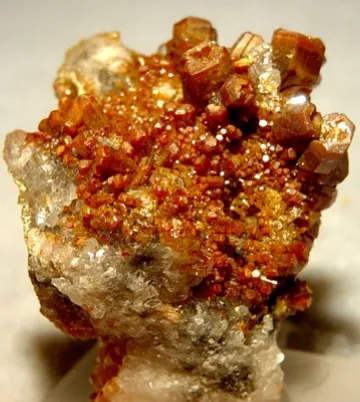
Chihuahua mimetite is a classic secondary lead arsenate of oxidized Pb-Zn-Ag districts, with Santa Eulalia and San Pedro Corralitos among the labels collectors watch for. The Congreso-León Mine at San Pedro Corralitos is associated with older bright yellow to orange-yellow botryoidal, globular, and crystalline mimetite, including material long valued as classic Mexican mimetite, while Santa Eulalia localities such as Potosí and San Antonio can produce yellow, greenish, or honey-colored mimetite on calcite, limonite, gossan, or oxidized limestone. The most desirable pieces show lustrous rounded aggregates, distinct prismatic crystals, saturated color, and an undamaged display surface; lesser examples are dull crusts or friable coatings. Because mimetite specimens from San Pedro Corralitos and Santa Eulalia can look similar in broad style, a precise mine label and provenance are important, especially for pieces claimed to come from older named finds.
Chihuahua andradite is best represented in collections by dark garnet specimens from skarn or contact-metasomatic settings, particularly Ojos Españoles Mine near General Lázaro Cárdenas in Julimes Municipality, where lustrous black melanite-style andradite crystals have been documented as sharp dodecahedra and clusters reaching around 2 cm. Santa Eulalia’s skarn mineralization also provides a geological home for andradite in the broader district suite, though it is less commonly the star mineral on market specimens than calcite, hemimorphite, mimetite, or sulfides. Good Chihuahua andradite has bright luster, sharp equant crystal form, brown translucency on thin edges or highlights, and a balanced matrix; ordinary material is black, granular garnet without individual crystals or with heavy contacts on the display face. The Ojos Españoles specimens are especially appealing because they give Chihuahua collectors a cabinet-scale garnet style quite different from the state’s agates and carbonate-replacement minerals.
Beyond these species, Chihuahua is exceptionally rich in documented minerals and rarities. Los Lamentos remains one of the great names for Mexican wulfenite, with orange to butterscotch crystals from oxidized lead-zinc bodies. Santa Eulalia is important for hemimorphite, cerussite, smithsonite, aurichalcite, aragonite, fluorite, galena, sphalerite, anglesite, and a long list of secondary and skarn species. Naica adds world-famous gypsum, major galena-sphalerite-calcite-fluorite associations, and cave minerals of unusual scientific interest. Peña Blanca in Aldama Municipality is the type area for margaritasite, a cesium-bearing uranyl vanadate. The Allende meteorite fall near Pueblito de Allende is a type locality for several extremely rare extraterrestrial minerals, including allendeite, grossmanite, hexamolybdenum, hutcheonite, majindeite, and related CAI-hosted species that are scientifically important but normally microscopic rather than collectible as hand specimens.
Chihuahua specimens reward precise labeling. “Chihuahua, Mexico” is acceptable for inexpensive lapidary agate or older drawer specimens when nothing more is known, but serious material should be narrowed whenever possible: Estación Ojo Laguna, Rancho Borunda, Rancho Coyamito Norte, Sierra Santa Lucía, Las Choyas, Santa Eulalia Mining District, San Antonio Mine, Potosí Mine, Naica Mine, Los Lamentos, Peña Blanca, Ojos Españoles Mine, or Allende meteorite. The state is large, the mineral styles are diverse, and vague labels erase most of the specimen’s geological meaning.
Agate mislabeling is common. Crazy Lace agate from Sierra Santa Lucía has sometimes been marketed with names implying a connection to Laguna agate, even though classic Laguna material comes from a different northern Chihuahua agate field. Laguna, Coyamito, Agua Nueva, Moctezuma, and other Chihuahua agates can also be confused with one another when sold as polished halves or slabs, especially if the rough has passed through multiple dealers. Dye is not the defining problem with serious Laguna and Coyamito material—natural color is the attraction—but any unusually garish slab should still be examined for dye concentration in fractures, saw marks, or porous zones. Re-polishing, resin filling, and glued display bases should be disclosed.
Las Choyas geodes are abundant enough that ordinary examples remain affordable, but quality varies sharply. Cracked geodes may have broken calcite points, loose druse, repaired halves, glue along the seam, or sprayed coatings that improve gloss on sawed edges. Fluorescent chalcedony is a plus when real, but shortwave response should be tested rather than assumed from a seller’s generic “UV reactive” description. Many “Mexican coconut geodes” are sold without exact mine detail; that may be fine for casual collecting but not for locality-focused cabinets.
Naica gypsum needs careful handling and equally careful marketing language. Transparent selenite from Naica is soft, cleavable, easily bruised, and sensitive to abrasion; fingerprints, rubs, and cleavage feathers are common. Claims that a specimen came from the Cave of Crystals should be treated with skepticism unless supported by exceptional documentation, because the famous giant-crystal caves were not normal specimen sources and later became inaccessible and flooded. Most legitimate collectible Naica gypsum is from mine cavities, older mine output, or museum-dispersed material, not removed from the iconic chamber.
Santa Eulalia and Naica calcite, mimetite, hemimorphite, and gossan specimens often show natural etching, iron staining, pocket clay, and minor contact damage. These are not automatically flaws; they are part of the district’s oxidized-mine character. The important distinction is between honest pocket wear and post-collecting damage. Mimetite and other arsenates should be handled sensibly: wash hands after handling, avoid dust, and do not soak fragile crusts or botryoidal aggregates. Peña Blanca uranium minerals such as margaritasite and associated uranyl species require radioactive-mineral protocols and are not casual display pieces for living spaces or children’s collections.
Meteorite material from Allende is a separate authenticity problem. Genuine Allende fragments are dark CV3 carbonaceous chondrite pieces with chondrules and pale calcium-aluminum inclusions, but the name is famous enough that ordinary terrestrial rocks and other meteorites may be represented as Allende. Buy from established meteorite dealers, insist on provenance, and be wary of vague claims unsupported by specimen history. For type-mineral interest, remember that most Allende type species are microscopic research minerals in thin sections or polished mounts, not visible crystals for conventional display.
Market availability remains strong for Chihuahua agate, Crazy Lace agate, Las Choyas geodes, and modest Santa Eulalia calcite or gypsum. Fine Laguna and Coyamito pieces with old provenance, exceptional pattern, and first-rate polish command much stronger prices. Good Naica selenite has become more desirable since mine suspension and flooding, but broken, cloudy gypsum is still common. High-grade mimetite, hemimorphite, Los Lamentos wulfenite, crystallized moonstone from Pili, and sharp Ojos Españoles andradite are much less routine and should be bought with better labels, photos, and provenance whenever possible.
The most cinematic mineral story in Chihuahua begins not in a show case but in a hot, wet mine tunnel below Naica. In April 2000, miners driving new workings for Industrias Peñoles broke into a chamber at roughly 300 meters depth and found themselves in a space no ordinary collecting trip could prepare them for: a forest of pale, translucent gypsum beams crossing the room like frozen searchlights. The Cave of Crystals was not merely a pocket with large crystals; it was a lethal geological greenhouse. Temperatures around 48 to 58 °C, combined with extreme humidity, made ordinary breathing and movement dangerous. Researchers entering the chamber later needed special cooling suits, strict time limits, and logistical support more like cave rescue than mineral collecting.
The scale of Naica is almost impossible to translate into normal specimen language. A fine cabinet gypsum might be six centimeters thick and prized because it is water-clear; the Cave of Crystals contained gypsum beams measured in meters. The 1910 Cave of Swords had already made Naica famous for large selenite, with sword-like crystals up to about two meters, but the 2000 chamber moved the district into another category entirely. Geologist Juan Manuel García-Ruiz famously called it the “Sistine Chapel of crystals,” and the phrase stuck because it captured both the grandeur and the sense that one was looking at a natural interior too perfect to be treated as a mine cavity.
Scientifically, the wonder was not just size but patience. The crystals grew while submerged in mineral-rich water held for long periods near the boundary where anhydrite dissolves and gypsum precipitates. The system had to be hot, stable, and chemically balanced: too much disturbance and the giant beams would never have developed. When pumping kept the mine dry, humans could briefly enter the cave; when mining ceased and flooding returned, the cave moved back toward its natural condition. For collectors, that is a useful corrective. Naica’s most famous crystals are not trophies that should have been cut apart. They are a record of an underground environment that functioned on a timescale completely unlike mining.
A second Chihuahua story arrives from the sky. In the early morning of February 8, 1969, a brilliant fireball crossed northern Mexico and broke apart near Pueblito de Allende, south of Chihuahua City and near Parral. The fall scattered thousands of black fusion-crusted stones over a long strewn field; smaller pieces were recovered toward one end of the field and larger masses toward the other, with many 5 to 15 kg individuals found around Pueblito de Allende, San Juan, Rancho Blanco, and Santa Ana. At least two tons were recovered, an extraordinary amount for a scientifically precious carbonaceous chondrite.
The timing could hardly have been better for science. Allende fell only months before Apollo 11 returned lunar samples, when laboratories were being prepared for extraterrestrial material and planetary scientists were hungry for pristine early Solar System matter. Its pale calcium-aluminum-rich inclusions turned out to contain some of the oldest solid material available for study, and later work on those inclusions and related components yielded a remarkable sequence of new minerals. In a mineral cabinet, a slice of Allende looks modest beside a glowing Laguna agate or a Naica gypsum blade: dark matrix, small rounded chondrules, pale inclusions. Under a microscope and in an ion probe, however, it becomes one of Chihuahua’s greatest mineralogical localities.
The founding story of Chihuahua City is also a mining story. Santa Eulalia’s silver drew people into a difficult mountain setting east of the present city. The ore was the reason for the settlement; the terrain was the problem. In 1709, when authorities considered where to establish the administrative center of the mining district, the choice came down to remaining in Santa Eulalia or founding a more practical town in the nearby valley where water and expansion were easier. Tradition preserves the decision as a split vote among local notables, broken by Governor Antonio de Deza y Ulloa in favor of the valley. The result was the Real de Minas de San Francisco de Cuéllar, the nucleus of Chihuahua City. In that sense, the mines did not merely produce specimens and bullion; they helped decide where one of northern Mexico’s great cities would stand.