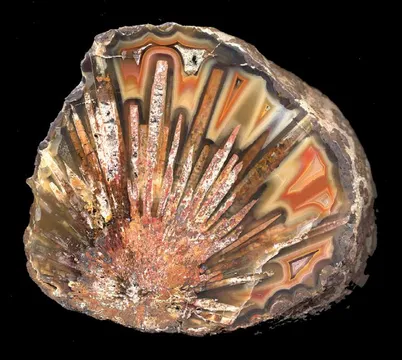
Estación Ojo Laguna, Mexico — premier agate locality for Laguna Agate, a nodular, banded chalcedony with vivid colors, sharp fortifications, and parallax bands.
Key facts
Estación Ojo Laguna is one of the indispensable names in serious agate collecting: the source district for Laguna Agate, a volcanic-hosted, nodular banded chalcedony whose best pieces have become benchmarks for color, fortification structure, and optical depth. The agate field lies in the desert mountains east of the railroad stop and playa-lake country of Ojo Laguna in northern Chihuahua, within the broader Sierra del Gallego agate province. Rather than being an ore mine in the metallic sense, it is a network of agate-producing claims and small excavations where vesicles and amygdules in altered volcanic rock yielded nodules, geodes, and occasional vein-like bodies of chalcedony and quartz.
For collectors, the locality matters because Laguna Agate is not merely colorful; it is organized. Fine nodules can show tight, architectural fortifications in raspberry red, orchid, lavender, orange, yellow, gray, white, and clear chalcedony, commonly with the brightest colors drawn inward toward the heart of the nodule. The classic aesthetic is a polished nodule half or thick end cut with a natural rind left on the back: desert-battered outside, jewel-box geometry inside. The best pieces show crisp color breaks, complete concentric structure, and the prized “shadow” or parallax effect, in which transparent bands lying beside opaque bands seem to move or deepen as the specimen is tilted under light.
Historically, Estación Ojo Laguna sits among the great northern Mexican agate localities that entered the collector market after roads and ranch access opened Chihuahua to American lapidaries and mineral collectors. By the late twentieth century, named claims such as El Puerto, La Alianza, Buena Fe, Ojo de San Martin, El Mesquite, Santa Monica, La Morita, and Ojo Laguna had built a reputation for material that could rival or exceed the visual impact of better-known world agates. The locality’s importance is magnified by scarcity: the finest material came from relatively small zones, often worked by hand, and fresh high-grade rough has never been abundant.
Regional View
Country View
The locality is also a useful lesson in specimen labeling. “Laguna Agate” is a variety and trade name tied to the Ojo Laguna field, while specimen labels may say Ojo Laguna, Estación Ojo Laguna, Rancho Borunda, El Puerto, La Alianza, El Arcoiris, Buena Fe, or simply Chihuahua, Mexico. For high-end collecting, the more specific the claim provenance, the better—especially because different claims produced different visual signatures, from La Alianza’s fine banding and frequent shadow effect to El Puerto/Conejeros pieces celebrated for exceptional 1995–1996 production.

Photo: Wikimedia Commons
Search for specimens: View all specimens from Estacion Ojo Laguna, Mexico
The Estación Ojo Laguna agate deposits are volcanic-cavity deposits: silica mineralization filled vesicles, amygdules, fractures, and locally vein-like openings in Tertiary volcanic rocks of the northern Chihuahua agate belt. Modern mineralogical work on Chihuahua agates places Ojo Laguna with other major deposits such as Coyamito, Moctezuma, Huevos del Diablo, and Agua Nueva in the Rancho El Agate andesite volcanic unit, a quartz-poor to quartz-free latitic andesitic host in which silica-rich fluids repeatedly deposited chalcedony and quartz. In hand specimen, that history is recorded as rhythmic banding, sharp fortification geometry, microcrystalline chalcedony layers, clear chalcedony windows, quartz centers, iron-bearing inclusions, and color zoning.
The productive ground is not a single pit but a string of claims and diggings extending for several miles along a north-south mountain ridge east of Estación Ojo Laguna. Collectors’ literature records 13 claim names on the mountain as of the late 1990s: Ojo de San Martin, El Puerto, Laguna, Santa Monica, La Alianza, El Hormiguero, La Morita Uno, Buena Fe, Diana, El Mesquite, El Mesquite 1, La Morita, and Ojo Laguna. Some later or separate collecting labels also refer to El Arcoiris and Conejeros. Most of the productive zones are high on the ridge, and many early workings had no road access, which explains both the limited production and the amount of hand-dug trenching and tunneling visible in field photographs.
The agate occurs mainly as nodules, commonly described from hen-egg size to large-cantaloupe size, though most collector pieces on the market are smaller cut faces, end cuts, halves, slabs, and cabochon stock. The outer rind is an important clue: classic Laguna nodules can have rough, pitted, potato-like skins, commonly with greenish to blue-green coatings or stained volcanic rind. Inside, the best nodules show complete fortification structures with tight, even bands and strong color contrast. Ordinary pieces may still be attractive but can be dominated by cloudy quartz, dull gray chalcedony, fractures, heavy inclusions, or incomplete patterning.
Mining has always been selective because the agates are not evenly distributed through the mountain. Surface collecting supplied early material, but as loose nodules disappeared, miners opened small holes, trenches, and hand tunnels following the agate-bearing zones. Some operations used mechanized equipment, notably at La Alianza, but the work remained difficult: good nodules occur irregularly, the host rock can be very hard, and much excavation yields only low-grade nodules with black carbonate-rich interiors, white quartz, or insufficient color. The best finds were therefore often pocket-like episodes rather than steady ore production.
The locality’s modern collecting history is especially tied to small-scale miners, ranch access, and claim ownership. Early names associated with the commercial development of Laguna Agate include Jose Banda, Marcos Tarango, Fred Moreno, Victor Salgado, and the physician-prospector Ralph Mueller. Rosario Villalobos is credited in collector accounts with the first filed claim, El Mesquite. Later accounts place important control of high-grade production in the hands of local claim owners and the Carrillo family, with outside dealers sometimes arranging limited mechanized mining or purchasing agreements rather than open collecting.
Access today should be treated as private, restricted, and non-recreational unless a collector has explicit permission from the landowner or claim holder. The agate fields are not public rockhounding ground. Much of the classic material now circulating came from old collections, older dealer stocks, lapidary caches, or limited modern mining. That history is part of the appeal: a top Laguna nodule is not simply a colorful quartz specimen but a piece from a finite, rugged Chihuahuan field whose best pockets are famous precisely because they were small.
Agate from Estación Ojo Laguna is the classic Laguna Agate: nodular chalcedony and quartz from volcanic cavities, prized for tight fortification banding, “holly leaf” angularity, and a palette that can run through raspberry red, orchid, lavender, pink, orange, soft yellow, gray, white, and clear chalcedony in the same cut face. Good specimens range from small cabinet polished end cuts to large nodule halves; rough nodules are often egg- to cantaloupe-sized, though fine complete nodules are far scarcer than slabs and fragments. The brightest color commonly lies toward the center, where translucent layers may alternate with opaque bands to create the sought-after shadow effect. La Alianza material is especially associated with fine banding and parallax, while El Puerto/Conejeros is remembered for exceptionally fine production in the mid-1990s. The best pieces are unfractured, complete or naturally balanced nodules with sharp band definition, more than two strong colors, little distracting quartz, and minimal mossy or sagenitic interruption unless the inclusions add to the design.
Other documented minerals and varieties from the Estación Ojo Laguna field are essentially members of the silica-and-iron assemblage: quartz, chalcedony, fortification agate, Laguna Agate as a named agate variety, and goethite. Mindat photo associations also record rare sagenitic material in Laguna Agate; these needle-like or plume-like inclusions can be visually interesting, though for traditional high-grade Laguna collecting, clean fortification and color usually outrank heavy inclusions. The locality is not known as a source of valid type-mineral species; its “type” significance is instead varietal and cultural—Laguna Agate was originally described from Ojo Laguna and remains one of the standard named agates by which collectors judge Mexican nodular agates.
The first authenticity issue is not synthetic manufacture but locality inflation. Brightly banded agates from Chihuahua are often loosely sold as “Laguna,” and labels can drift among Laguna, Coyamito, Agua Nueva, Moctezuma, and generic “Mexican agate.” True Laguna material should show the locality’s characteristic fine fortification, vivid but natural color zoning, and appropriate nodule/rind character. A vague “Chihuahua agate” label is not equivalent to Estación Ojo Laguna provenance.
The second issue is dye. Natural Laguna can be so vivid that beginners may suspect every saturated piece, but dyed agate normally betrays itself by unnaturally even color, color pooled in cracks, saturated blues or neon tones inconsistent with the locality, or color bleeding through porous zones. The classic Laguna palette is strong but layered: red, pink, orchid, lavender, orange, yellow, gray, white, and clear bands occur as discrete growth zones rather than as a uniform wash. Because dyed agate and dyed “lace” agates are common in the decorative market, high-end buyers should rely on trusted dealers, old labels, claim provenance, and, for expensive pieces, careful microscopic inspection of cracks and porous quartz centers.
Condition is central to value. Laguna nodules commonly contain fractures, and collectors have long used the phrase “black widow” for characteristic black fractures that can cut through otherwise beautiful pieces. A single healed or stable line may be acceptable in a large display face, but open cracks, glued breaks, resin-filled gaps, or sawn faces that hide instability should be disclosed. Look especially at the transition between rind and polished face, where fractures can enter from weathered surfaces, and at quartz-rich centers, which may chip or undercut during polishing.
Preparation is normally lapidary, not “as found.” Most serious Laguna specimens are sawn and polished to reveal the banding; this is expected and desirable. What matters is the quality of the cut: a good face should be flat enough to read the banding, polished without orange peel, and oriented to maximize complete fortifications. Over-thin slabs can look decorative but lack specimen presence; over-polished freeforms may erase the geological character of the nodule. The strongest collector pieces preserve some natural rind so the object still reads as a nodule from the volcanic host.
Fluorescence can add interest. Some Laguna pieces show yellow-green, creamy, or stronger green fluorescence in parts of the chalcedony or associated opaline material under UV, and modern research on Chihuahua agates has shown that uranium/uranyl-related luminescence and trace-element effects can be significant in chalcedony. UV response should be considered a bonus rather than a primary identifying test. Handle polished faces as quartz: they are durable, but they scratch softer materials, chip on edges, and should not be cleaned in harsh chemicals or ultrasonics if the specimen has fractures, quartz-lined cavities, repaired seams, or possible dye.
Market availability is uneven. Small polished pieces and cabochons are consistently obtainable, but fine old-time nodules with complete fortification, strong multi-color contrast, clean condition, and reliable Ojo Laguna or claim provenance are genuinely scarce. The best pieces now often come from established collections, old dealer stock, or carefully curated lapidary holdings rather than fresh mine runs. Prices rise sharply with size, completeness, absence of fractures, band fineness, color contrast, shadow effect, and documented claim source.
The place itself is part of the story. Estación Ojo Laguna is not the same as the slightly larger Ojo Laguna settlement on the west side of the lake; it is the railroad-side ranching community on the opposite shore. In the rainy season, the playa can fill and overflow, sending water across the road south of town and making a second temporary lake. Field accounts describe the transformation vividly: flowers blooming, bushes greening, and birds—ducks, cranes, swans, gulls—appearing in a landscape many collectors imagine only as dry Chihuahuan desert. The mountains east of the tracks rise roughly 1,500 feet, and the white scars of old agate workings can be seen from a distance.
The early trade had a wonderfully local economy. Before mechanized attempts and formal dealer arrangements, residents who had collected small parcels of agate from the surface brought them to the grocery store of Señor Alfonso Bustamonte in Estación Ojo Laguna. They sold or traded the agate for groceries. Bustamonte developed a reputation for paying well enough that buyers came to him when they could not obtain enough rough from Jose Banda, Marcos Tarango, and Fred Moreno. That is the kind of origin story agate collectors love: not a corporate mine office, but a village store where sacks of nodules became flour, beans, supplies, and eventually show-table treasures in the United States.
The claim names also have their own poetry. El Mesquite, the first claim, was named for the low mesquite brush around it. La Alianza means “the alliance,” reflecting the partnership of Armando Mendoza of Estación Ojo Laguna and Fernando Flores of Chihuahua City. Its alternate hill name, Cerro Las Hermosas—Hill of the Beautiful Ones—could hardly be better suited to the material. El Puerto’s Conejeros area takes its name from “rabbit holes,” referring to the many small hand tunnels dug into the slope in search of nodules. Conejeros became legendary because in 1995 and 1996 it produced some of the finest Laguna Agate collectors had seen.
Mining was rarely romantic in practice. Before roads and equipment, surface nodules were collected first, and then small holes followed. When the agate was rich enough and the rock allowed it, miners dug tunnels by hand along the productive zones. These workings could become dangerous and quickly “muck bound,” clogged by their own waste rock until it was easier to abandon them and start again elsewhere. Production stagnated for years, then surged in memorable episodes: one account records about 500 pounds of rough Laguna mined at Ojo Laguna in April 1993, while another describes a spring 1993 Laguna No. 1 operation yielding about 250 kilograms of rough marketed as New Laguna agate.
La Alianza’s mechanized episodes show how deceptive an agate mountain can be. In 2002, Eugene Mueller and partners brought in a CAT 320 excavator after arranging permission with Armando Mendoza and Fernando Flores. The first job was not digging agate but repairing the washed-out road; heavy rains in August and September commonly damaged access, and a larger machine was judged impractical for the route. Once cutting began, the ground alternated between hard and unexpectedly soft rock. The good agates were “very good,” but painfully scarce. The crew encountered groups of thousands of nodules with black siderite or white quartz interiors, then after hours of machine work, suddenly one good nodule would appear. Equipment trouble added insult to scarcity: during a 30-day rental, the excavator “slept” for nine days. When the rock was finally divided, the operation had produced only enough good agate to cover expenses.
The 2014 La Alianza operation reads almost like a field diary of modern collecting in northern Mexico. Plans were kept quiet because of security concerns. Eugene Mueller and Jose Luis Villegas arrived in early October expecting a house, only to find that workers building a new power line had filled the available lodging in town. Armando and his wife took them in. The mornings began with breakfast at Armando’s house; evenings ended with a meal waiting after the mine. The miners lived without heat or heated water, with family members and animals moving through the rhythm of the household. At the mine, Mueller worked at least five areas on the hillside, trying not only to recover agate but to expose ground that could later be worked by hand. Good agates came out, including red-and-white banded material and fine La Alianza specimens, but again not enough to satisfy everyone.
Even the village animals entered the legend. During the 2014 operation, Mueller wrote about “The Pigs of Estacion Ojo Laguna.” He noticed one pig trotting along the road with an oddly determined purpose—neither walking nor running, but moving as if she knew exactly where she was going. The same pig reappeared on different streets, still determined. Before dawn one morning, dogs barked and a pig squealed; later, she appeared again, undiscouraged. At one point she seemed to be headed out of town on the south road, perhaps to freedom, only to turn up back in Estación Ojo Laguna that evening. The solution arrived when a group of pigs wandered calmly down the street together. The dogs did not harass them. The solitary traveler, it seemed, had not been seeking escape so much as company and backup.