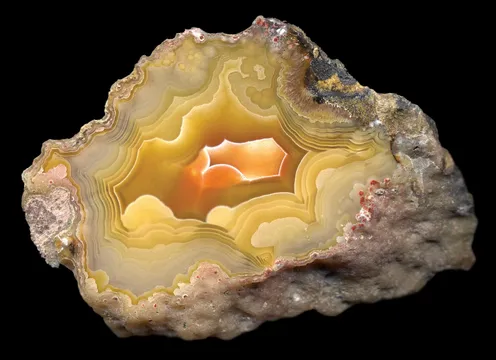
Rancho Coyamito, Chihuahua, Mexico; renowned agate locality featuring Coyamito Agate: banded nodular chalcedony, vivid color zones, and dramatic pseudomorphs.
Key facts
Rancho Coyamito is one of the great agate localities of northern Mexico: not a metal mine, not a single cavern of quartz, but a cluster of small, hard-won silica pockets in vesicular volcanic rock of the Sierra del Gallego region of Chihuahua. Its collector importance rests on “Coyamito Agate,” a nodular, banded chalcedony from the Rancho el Agate andesite, a late Eocene volcanic unit whose vesicles and amygdales were later invaded by silica-rich fluids. The best Coyamito pieces are instantly recognizable in the hand: compact nodules with rusty-brown skins, saturated outer color, tight banding, vivid reds and yellows, lavender to purple zones, quartz-lined cavities, and, in the finest examples, dramatic pseudomorphs where chalcedony and later quartz preserve the forms of earlier carbonate crystals.
The locality matters because it sits at the intersection of lapidary beauty and mineralogical complexity. Coyamito is not merely “pretty agate.” Published analytical work on Chihuahua agates has tied Rancho Coyamito material to a quartz-poor to quartz-free latitic host rock, multiple generations of chalcedony and macrocrystalline quartz, iron-oxide and iron-hydroxide pigment inclusions, uranium-bearing violet bands, and conspicuous pseudomorphic textures. For collectors, that means a polished half can show far more than color: it may record repeated fluid pulses, partial cavity filling, wall-parallel growth, rupture-and-refill textures, and the ghost architecture of crystals that vanished before the agate reached its final form.
Regional View
Country View
Historically, Coyamito belongs to the celebrated northern Chihuahua agate belt that drew American rockhounds, lapidaries, dealers, and later academic researchers from the mid-twentieth century onward. The name has sometimes been used loosely in the trade for material from nearby ranches, but the classic Rancho Coyamito material—especially from the La Fortuna/Los Alamos and La Sonoreña areas—has a narrower look and a higher collector premium. Its finest slices balance density of color with readable structure: not muddy color alone, not empty fortification alone, but crisp band architecture energized by purple-yellow, red-white, rose, orange, mustard, and blue-gray contrasts.
Search for specimens: View all specimens from Rancho Coyamito Chihuahua, Mexico
Rancho Coyamito lies in the Sierra del Gallego area of Ahumada Municipality, Chihuahua, within the broader northern Mexican agate province between Villa Ahumada and Ojo Laguna. The productive material is best understood as nodular agate and associated quartz in vesicles of volcanic rock rather than as an ore deposit in the mining sense. Modern locality databases record the site as Rancho Coyamito, also associated with the La Fortuna Claim, and list quartz, chalcedony, and agate as the verified mineral record.
The geological host is the Rancho el Agate andesite, described in recent mineralogical and geochemical work as a quartz-poor to quartz-free latite within the El Sueco–Sierra del Gallego volcanic complex. The volcanic pile in the area includes older tuffs and volcaniclastic rocks, voluminous intermediate-to-mafic lava flows, later rhyolitic units, and basaltic rocks. The agates occur mainly in former gas cavities in the upper parts of lava flows. Those cavities were later filled by silica-bearing fluids, producing wall-lining agates: successive layers of chalcedony grew parallel to the cavity walls and, in many nodules, were followed inward by macrocrystalline quartz.
The mineralization is episodic. Good Coyamito sections commonly show multiple chalcedony generations, quartz crusts or crystal-lined centers, and interruptions or cross-cutting features that indicate more than one pulse of silica-bearing fluid. The colors are not random dyes of chalcedony but the record of inclusions and defects at microscopic scale. Red and yellow zones are dominated by iron-bearing micro-inclusions, with hematite and goethite playing a major role in the visible color. Violet Coyamito bands have drawn special study because they behave much like amethystine quartz: the purple color has been linked to iron-related color centers, uranium-associated radiation effects, and uranyl luminescence detectable by cathodoluminescence.
In collecting language the “ore bodies” at Coyamito are small pay zones and pockets in extremely tough andesite. The important areas repeatedly named in collector literature are Los Alamos, La Fortuna, and La Sonoreña. Los Alamos lies west of the ranch house and includes the older La Fortuna workings; La Sonoreña lies north of the ranch house and covers a canyon system with several discrete deposits. Within La Sonoreña, named areas reported by The Gem Shop include Old Coyamito, Creek, El Matachin, Las Morenitas, and the Japanese deposit. These are not interchangeable labels: each small pit or pocket may yield a distinct size range, skin, internal color balance, or pseudomorph style.
The old La Fortuna working was first cleared of surface agates and then mined by hand. The classic working developed into a long trench, roughly six to eight feet wide, up to five feet deep, and more than seventy-five feet long. Early mining relied on pick, pry bar, and hand sorting in a hard volcanic host. Mechanized mining did not come to Coyamito until much later, when Eugene “Gene” Mueller of The Gem Shop worked Coyamito deposits with permission from the Carrillo family in the early 2000s. That modern work helped bring fresh Coyamito material to collectors after decades in which the old surface supply had largely disappeared.
The ranch ownership and claim history are central to provenance. The broader Coyamito ranch was historically associated with the Carrillo family and later divided into Rancho Coyamito Norte and Rancho Coyamito Sur. Material sold under the Coyamito name has, at various times, included agate from nearby ranches such as Coyamito Norte, Coyamito Sur, La Gregoria, Derramadero, Aparejos, Sueco, and related areas; this is one reason serious collectors value precise labels such as La Fortuna, Los Alamos, La Sonoreña, Creek deposit, or Japanese deposit when they are credibly preserved.
Collecting access today should be regarded as private and closed unless permission is arranged with the landowner or legitimate claim holder. The known northern Chihuahua agate deposits are on private ranch land and under claim; casual collecting is not appropriate. Modern production is selective, costly, and localized. Much rough is cut and evaluated close to the source rather than sold in bulk, because top Coyamito pieces command enough value that orientation, sawing, and polishing decisions are economically important.
The notable finds from Rancho Coyamito fall into several collector categories. Small, intensely colored nodules with tight outer banding form the classic material. Larger Los Alamos pieces can reach exceptional sizes for the locality and may show lavender and yellow bands with molds or casts of earlier minerals. La Sonoreña is celebrated for variety, and the Creek deposit is especially associated with pseudomorphs—chalcedony and agate after aragonite or carbonate crystal groups—often preserved in open cavities. A Los Alamos deposit called Los Fresnitos was reported as producing iris agate in a large proportion of recovered nodules, adding another optical specialty to a locality already known for color and pseudomorph form.
Agate is the defining mineral expression of Rancho Coyamito, occurring as compact nodules and cavity fillings in the Rancho el Agate andesite; the best pieces show rusty-brown skins, hollow or partly hollow interiors, strong color concentrated toward the outer banding, and combinations of red, orange, mustard yellow, rose, white, lavender, violet, and blue-gray chalcedony. Good Coyamito agate is not judged only by brightness: the desirable examples have coherent fortification or wall-lining structure, strong contrast, intact husk or nodule form, and minimal fractures across the main face. Los Alamos material is noted for larger nodules and muted to dark lavender-yellow combinations, while La Sonoreña pockets are prized for variety, including small red-rich nodules, dark or nearly black banding in some areas, and the best-known pseudomorph agates. The exceptional pieces are those in which color, banding, quartz centers, tubes, or pseudomorphs work together rather than competing visually.
Quartz at Rancho Coyamito is most often encountered as the crystalline and macrocrystalline stage within agate nodules: thin crusts, drusy centers, crystal-lined pockets, quartz cores, and quartz involved in the replacement of earlier carbonate forms. Recent studies of Chihuahua agates describe a typical growth sequence from microcrystalline or spherulitic chalcedony into fibrous chalcedony and finally macrocrystalline quartz, sometimes repeated or interrupted by later chalcedony. Collector-quality quartz from Coyamito is therefore usually valued in context rather than as isolated crystals: a clean quartz center framed by saturated agate, a sparkling cavity behind pseudomorphic forms, or euhedral crystals that complete the visual depth of a polished half. Specimens with quartz that is intact, bright, and well-positioned are more desirable than those where the center is crushed, muddy, iron-stained in an unattractive way, or cut away by poor orientation.
The verified mineral list for Rancho Coyamito is deliberately short: quartz, chalcedony, and agate. Its rarity value is not based on a long suite of species or on being a type locality for a named mineral species, but on unusual textures and color mechanisms within SiO2. The important “rarities” here are mineralogical features inside the agate: chalcedony and macrocrystalline quartz replacing earlier carbonate crystals, small relics of former calcite detected analytically, iron-oxide and iron-hydroxide inclusions that generate red and yellow bands, violet chalcedony with amethyst-like color centers, and pocket-specific phenomena such as tubes, hollow centers, iris effects, and micro-inclusion patterns from the Japanese deposit.
Coyamito is one of the Mexican agates most often admired for colors so strong that new collectors may suspect dye. The locality’s reds, yellows, pinks, oranges, and violets are natural in documented material, and recent spectroscopy supports natural color mechanisms for both iron-pigmented red/yellow bands and violet amethyst-like bands. That said, agate in the wider marketplace is commonly dyed, and the name “Coyamito” has commercial value, so mislabeling is the bigger concern. Ask for locality precision when possible: “Rancho Coyamito” is good, but “Los Alamos,” “La Fortuna,” “La Sonoreña,” “Creek deposit,” or “Japanese deposit” is better if the chain of custody is credible.
The most common locality-specific mislabeling problem is not an outright fake agate, but neighboring Mexican material sold under the more valuable Coyamito name. Historical accounts state that agates from several nearby ranches and districts were marketed as Coyamito, especially during earlier decades of rough trading. For top-value purchases, compare the specimen’s look with documented Coyamito material: rusty-brown rind, generally small nodular form, color strength toward the outer banding, frequent hollow centers, and the distinctive pseudomorph tradition of the ranch. Laguna agate can resemble Coyamito in quality and color, but Laguna more often shows extremely crisp, ornate fortification patterns with color commonly concentrated toward central zones, while Coyamito often carries stronger outer color and a smoother, reddish-brown skin.
Condition is critical. Coyamito nodules form in hard andesite and are liberated by demanding work; fractures, bruised cavities, missing husk, saw wandering, undercut soft zones, and incomplete polish all reduce value. A flat, mirror-polished face is not cosmetic fussiness here—it is part of how the specimen works optically. Coyamito’s depth, parallax, translucent glow, and color contrast depend on a clean optical window. Wavy polish, rounded faces, or dull finishing will mute even strong material.
Pseudomorphs deserve special attention. Broken or sawn-through pseudomorphic sprays can still be attractive, but the best examples preserve recognizable crystal architecture, ideally with strong color banding wrapped around or filling the form. Look for natural continuity of bands through the pseudomorphic area, absence of obvious glue or resin fills, and a preparation that shows the structure without sacrificing too much nodule form. Hollow pseudomorph pieces are fragile at protruding edges and should be handled like sculptural specimens, not like ordinary lapidary slabs.
Fluorescence and radiation-related color are of scientific interest rather than a handling hazard for normal collecting. Violet Coyamito bands may show uranyl-related luminescence under short-wave ultraviolet light in studied samples, and heating experiments have shown that violet color can bleach under prolonged high-temperature annealing. Do not heat, torch, aggressively clean, or oil valuable Coyamito specimens without knowing exactly what you are doing. Routine display away from harsh heat and direct prolonged sunlight is prudent, especially for thin slices and violet-rich pieces.
Market availability is limited but not absent. Coyamito appears regularly enough that a patient collector can find polished halves, pairs, slabs, and occasional pseudomorphs, but the best material is expensive and often disappears into specialized agate collections. Small attractive pieces remain obtainable; large, intact, high-contrast nodules with documented ranch provenance, clean quartz centers, iris effects, or exceptional pseudomorphs are substantially rarer.
Coyamito’s story begins in the old northern Chihuahua agate boom, when the newly opened Highway 45 helped American rockhounds push south from El Paso into country where colorful agates could still be picked from the surface. The first Rancho Coyamito agates are credited in collector literature to Dave Harris, who operated El Paso Rock & Lapidary Supply from 1945 to 1952. Those early decades created both the romance and the confusion of the name. Beautiful agates moved north in quantity, but locality labels were often broad, and material from neighboring ranches could be absorbed into the market as “Coyamito” if it looked the part.
The old La Fortuna workings preserve the memory of the hand-mining era. Before machines, miners cleared the surface and then attacked the andesite with hand tools. The working became a narrow, physical trench: six to eight feet wide, up to five feet deep, and more than seventy-five feet long. That scale says much about the deposit. This was not an open quarry of abundant agate; it was a fight with hard volcanic rock for small pockets of nodules. The agate-bearing zone proved shallow, with agate no deeper than about six feet below the surface in the modern account of Gene Mueller’s work, and pseudomorph specimens concentrated mostly in the upper three feet.
Gene Mueller’s 2003 mechanized operation changed the rhythm of Coyamito mining. Working with permission of the Carrillo family and accompanied in one phase by Pat McMahan, Mueller brought in an excavator—the first mechanized mining reported for the Coyamito deposits. The method was careful rather than brute-force: the excavator made six- to eight-foot passes with its bucket, cutting thirty-inch benches while helpers searched through the bucket path and rubble for nodules. The andesite boulders were not small. Some weighed up to 500 pounds and had to be broken with twenty-pound sledgehammers, each blow a wager that a cavity inside might hold agate rather than emptiness.
La Sonoreña gives the best sense of how pockety the ranch really is. The area lies north of the ranch house in a canyon with an east-flowing drainage, and old diggings dot the slopes. Near the mouth of the canyon stood an old stone corral, built without mortar from piled stones, six feet high and laid out as a rectangle about fifty yards by thirty yards. It was already described as well over a century old when Mueller camped there during his April 2004 mining operation—a stark ranch landmark beside a modern hunt for collectible silica.
Mueller divided his La Sonoreña work into numbered areas. Area 1, closest to camp, had many small old hand diggings running up a shallow slope and more extensive diggings in line on the hillside. The old miners had followed float uphill until they reached host rock, then worked the rock until they became muck-bound. Some spots held no agate; others yielded periodically. The host rock was full of holes, but not full of agates—a perfect field summary of many volcanic agate deposits. Still, this area produced fine contrasting banding, some unusually dark or black-banded pieces, and typical teardrop-shaped nodules of fairly consistent size.
Area 2, about fifty yards west at the same elevation where a wash dropped steeply into the arroyo, had been worked hard in the past. The rocks there ranged from twenty to one hundred pounds and were riddled with cavities. Mueller tried it for three days and found only three agates of exceptional quality. They were large, with yellow and violet banding and a little moss agate, reminiscent of Agua Nueva material he had mined several miles to the south in 2000. The result was maddening: proof that the pocket could produce superb stones, but so little agate for the work required that even an experienced miner could not easily explain why the old-timers had labored so heavily there.
Area 3 looked more promising because the old diggings were more extensive. It did produce larger agates: one- and two-pound nodules were common, and several weighed more than five pounds. Yet size was not enough. The general quality was mediocre, and no exceptional pieces appeared. Area 4, higher up near a saddle between a tall mountain and a large hill, required a road before it could be tested. Its nodules were rounder, red was the dominant color, and many carried a contrasting white or pink band just under the surface. The quality was high enough that about half the production was graded as number-one material, though the agates were scattered in very hard host rock.
Then came the last act at La Sonoreña: Area 5. After walking the canyon and studying old workings, Mueller noticed a large old excavation partly hidden by a low hill, easy to miss until one stood nearly on top of it. It had not been worked as hard as the others. There, in the final three days, he found agates of all sizes and qualities, including a good proportion of clear, colorless material. His best day of quality production for the entire operation came on the very last day—the same day he loaded the excavator onto a truck to be returned to Chihuahua City. It is the kind of ending every field collector recognizes: the deposit finally speaks just as the machine is leaving.
Another modern story is the quiet transformation of value. Johann Zenz recalled visiting the Tucson Showplace run by Gene Mueller when the Carrillo family had just delivered a large shipment of Coyamito rough. Mueller worked through the night sorting and dividing the rough fairly into twenty-five-pound jute sacks. By morning they were ready for sale at prices remembered as moderate. That image now feels like another era. Today, with top Mexican agates commanding intense collector attention, rough Coyamito is far less likely to be sold casually by the sack. Much of it is cut and judged at or near the source so that no extraordinary nodule disappears as anonymous bulk rough.