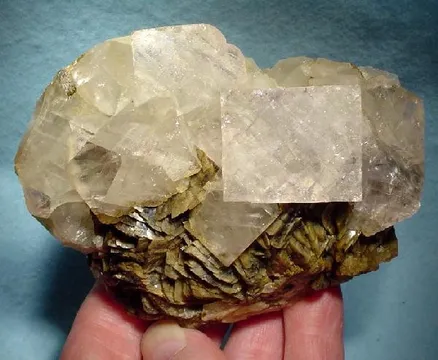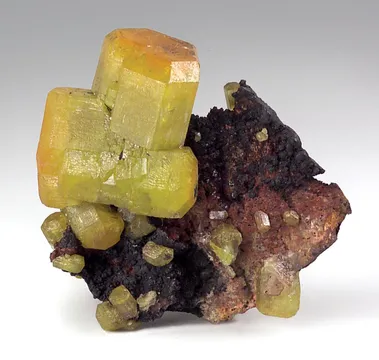
Zinnwald, Germany - historic Erzgebirge locality famed for tin-tungsten greisen, zinnwaldite lithium mica, wolframite, scheelite, and quartz and cassiterite.
Key facts
Zinnwald is one of the great old names of the Erzgebirge: a tin, tungsten, and lithium-mica district perched on the Saxon side of the German–Czech border, paired geologically and historically with Cínovec just across the line in Bohemia. For collectors, its importance rests on three overlapping identities. It is a classic granite-greisen ore deposit; it is the namesake locality for zinnwaldite, the lithium-bearing dark mica series that became central to both 19th-century mineralogy and 21st-century lithium exploration; and it is a European classic for tungsten minerals, especially old “wolframite” material, scheelite, and the rare lead tungstate stolzite.
The deposit is developed around the cupola of the Zinnwald/Cínovec rare-metal granite within the Altenberg–Teplice volcano-plutonic complex of the Eastern Erzgebirge. The old miners worked a very distinctive set of gently dipping quartz-rich ore veins, locally called “Flöze” in analogy with coal seams, together with steeper “Morgengänge” and greisen bodies. The essential specimen-making assemblage is immediately recognizable: milky to smoky quartz, bronze-brown to dark greenish zinnwaldite mica, cassiterite, wolframite–ferberite, scheelite, fluorite, topaz, and a long tail of bismuth, copper, arsenate, phosphate, and uranium-zone minerals. The best pieces have the dense, weighty look of a tin-tungsten greisen: lustrous black tungsten crystals, brown-black cassiterite, sugary to massive quartz, mica books and rosettes, and, in the most desirable scheelite specimens, pale cream to honey crystals perched on quartz and zinnwaldite.
Regional View
Country View
One must read old labels carefully here. “Zinnwald” may mean the Saxon village and mines at Zinnwald-Georgenfeld, the adjacent Bohemian Cínovec side, or the broader Zinnwald–Cínovec mining district as collectors historically understood it. This is not a trivial distinction for modern cataloguing, but mineralogically the border cuts across a single rare-metal granite system. Old European collections often preserve the older German locality name even for pieces that would now be assigned more precisely to Cínovec, Zinnwald-Georgenfeld, or to the cross-border district.

Photo: Wikimedia Commons

Photo: Wikimedia Commons
Search for specimens: View all specimens from Zinnwald, Germany
Zinnwald lies at the crest of the Eastern Erzgebirge, immediately on the German–Czech border south of Altenberg. The mining field belongs to the Zinnwald–Cínovec rare-metal system, a granite-hosted greisen deposit formed in and around a highly evolved albite–zinnwaldite granite cupola emplaced into rhyolitic volcanic rocks of the Altenberg–Teplice caldera. The country rock picture is simple in outline but wonderfully productive in detail: granite, rhyolite, quartz porphyry, and related volcanic rocks, overprinted by fluorine-rich post-magmatic fluids that converted feldspathic granite into quartz–mica–topaz–fluorite greisen and mineralized the fracture system with tin and tungsten minerals.
The old mine geology is organized around gently dipping fractures produced during cooling and contraction of the granite cupola. These flat-lying cracks were filled by high-temperature mineralizing fluids and became the famous “Flöze,” the seam-like ore veins that dominated the historic workings. On the German side, the visitor-mine geological account describes 13 such seams, generally about 0.2 to 1.0 m thick, filled with large quartz crystals, zinnwaldite, cassiterite, and wolframite. The steeper fractures, or “Morgengänge,” acted as fluid pathways and later as convenient mine passages linking one flat ore zone to another. Where the fluids attacked the granite more pervasively, they produced greisen bodies: quartz- and zinnwaldite-rich replacement rock with topaz and fluorite, locally less richly mineralized than the veins but volumetrically important for the modern lithium resource.
For a specimen collector, the distinction between the vein material and the greisen bodies matters. The classic display pieces generally came from open spaces, vein selvages, mined ore zones, and old sorted material rather than from the massive greisen that now interests lithium geologists. Quartz-rich seams produced crystals, plates, and pockets with zinnwaldite books, cassiterite, wolframite-group crystals, scheelite, fluorite, and the secondary lead tungstate stolzite. The broader greisen assemblage adds topaz, fluorapatite, feldspar remnants, muscovite/sericite, fluorite, cassiterite, wolframite, minor scheelite, and sulfides. Modern drill-core descriptions also emphasize zinnwaldite-albite granite containing quartz, albite, K-feldspar, Li-Fe-F mica, sericite, and accessory topaz, fluorite, zircon, cassiterite, and clay minerals.
Mining began as medieval tin working in the Saxon-Bohemian frontier zone. Zinnwald itself is recorded in 1378, and the broader Krupka/Graupen–Cínovec–Zinnwald tin country was already active by the late medieval period. In the Saxon Zinnwald field, the Tiefer Bünau Stolln, begun in 1686, became the key drainage and access adit. The Tiefe Hilfe Gottes Stolln was driven at a deeper level in the 19th century, and the remaining Saxon mines were consolidated in 1852 as the Gewerkschaft “Vereinigt Zwitterfeld zu Zinnwald.” Tin remained the older economic driver, but tungsten became increasingly important after the mid-19th century, particularly once wolframite could be valued for tungsten steel, hard tools, armaments, and later lamp filaments.
The ownership and operating history is typically Erzgebirgian: aristocratic lordship, small mining unions, speculative investors, wartime strategic demand, state involvement, and finally museum and exploration use. Josef Jakob of Vienna bought Vereinigt Zwitterfeld in 1856 with an eye to wolframite and tungsten steel. In the early 20th century, the district saw modernization of both mining and dressing, including magnetic separation of cassiterite and wolframite from 1906. The Pels “Gnade Gottes an der Landesgrenze” field briefly produced important wolframite from Flöz 6 between 1905 and 1910, later passing into Vereinigt Zwitterfeld. World War I and World War II both made Zinnwald strategically important for tungsten and lithium mica. On the German side, tin and tungsten mining ended at the close of World War II, while production on the Czech side continued until 1990.
Lithium mica was not merely a modern afterthought. Lithium-bearing mica from the Altenberg–Zinnwald area was being used experimentally in Dresden mineral-water preparations by the 1840s, and zinnwaldite from the district was scientifically described and named in 1845 by Wilhelm von Haidinger. From the late 19th century onward, lithium mica became an economic by-product, with Zinnwald serving for decades as Germany’s principal domestic lithium source. Modern exploration resumed in earnest after 2010. Deutsche Lithium and later Zinnwald Lithium interests carried out drilling, bulk sampling, resource modelling, metallurgical work, and mine-planning studies focused on deeper zinnwaldite-bearing greisen horizons beneath the old tin-tungsten workings.
Collecting access today should be approached as a heritage and mine-safety matter, not as an open collecting locality. The historic German workings are represented by the Besucherbergwerk “Vereinigt Zwitterfeld zu Zinnwald,” a public visitor mine operated in the preserved Tiefer Bünau Stolln system. The visitor mine is valuable for seeing the geology underground, but that does not imply permission to collect. Old dumps, exploration areas, protected heritage structures, and modern project ground may have legal, environmental, and safety restrictions. Serious collectors should rely on documented old specimens, reputable dealers, museum deaccessions where legitimate, and clearly provenanced modern material from lawful channels.
The most important specimen sources were the historic mine workings themselves, sorted ore and mine-run material, old mine-manager and engineer collections, and later halden and museum material preserved during safety works and geological investigations. The visitor mine records that crystallized minerals encountered during mining were separated and sold as display specimens, while mine officials and collectors retained aesthetic and rare pieces. Notably, a suite was purchased at Zinnwald by Goethe from the stonecutter Mende, and remnants of the collection of mine administrator M. Thieleman are displayed at the visitor mine. A systematic deposit sample collection has also been built there since 2007.
Quartz is the structural mineral of Zinnwald specimens: it fills the old flat-lying “Flöze,” forms vein gangue with zinnwaldite, cassiterite, wolframite-group minerals, scheelite, and fluorite, and also occurs as newly formed quartz in greisen replacing the granite around the seams. The most characteristic collector pieces show milky to smoky quartz rather than water-clear alpine-style crystals; good examples have sharp, lustrous crystal faces, contrasting dark zinnwaldite mica books or tungsten minerals, and enough open-space growth to escape looking like merely broken vein quartz. Historically, the pure white seam quartz was valuable enough to be sorted from mine dumps and underground workings for porcelain and glass-related uses, so attractive crystal groups were competing with an industrial by-product stream; the pieces that survived as specimens tend to be those with strong associations, smoky color, pocket texture, or old labels.
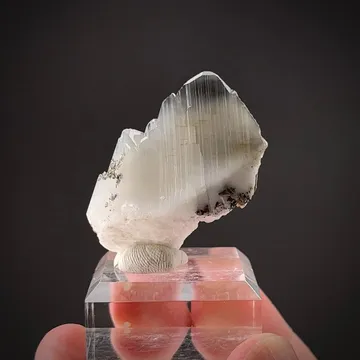
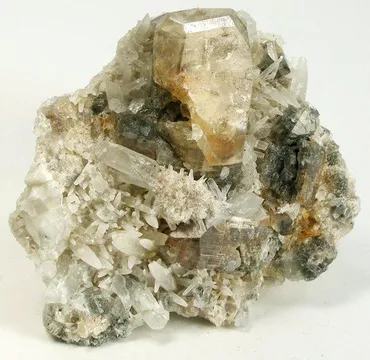
Scheelite from Zinnwald is one of the most appealing specimen species from the district, typically occurring with quartz, smoky quartz, fluorite, zinnwaldite, and, less commonly, wolframite-group minerals, cassiterite, baryte, zeunerite, russellite, and other secondary phases. The best crystals are pale cream, grey-white, honey, or brownish, often sharply tetragonal and bright on contrasting quartz or mica-rich matrix; many pieces are miniature to small-cabinet in feel rather than large display monsters, though individual specimens can be visually powerful because scheelite’s high luster and density give even modest crystals real presence. Ordinary Zinnwald scheelite is scattered, embedded, or visually lost in pale quartz, while superior pieces show isolated, undamaged crystals with strong form, useful contrast, and a clean association that immediately places them in the Sn-W-Li greisen environment.
Fluorite is part of the fluorine-rich signature of the Zinnwald granite-greisen system, but fine fluorite specimens are much scarcer than the locality’s mineral list might suggest. Documented associations include quartz, smoky quartz, scheelite, zinnwaldite, zeunerite, baryte, chalcopyrite, fluorapatite, siderite, cassiterite, and bismuth minerals, and collector-grade pieces may show small cubic fluorite crystals gathered on quartz and sharp pseudohexagonal plates of zinnwaldite. The color range is generally not the saturated purple-and-green display style of famous German fluorite districts; Zinnwald fluorite is more often valued for locality, association, and rarity, including occasional dark radiation-influenced “Stink-Fluss” material. The desirable pieces are those with distinct cubes, clear association with zinnwaldite or scheelite, and unambiguous old Zinnwald/Cínovec provenance.
Cassiterite is the historic heart of Zinnwald: the tin oxide that drove the medieval and early modern mine economy and occurs in the quartz-zinnwaldite-topaz greisen and vein assemblage. In specimens it is usually dark brown to black, highly lustrous where fresh, and commonly associated with zinnwaldite, quartz, stolzite, wolframite-group minerals, fluorapatite, fluorite, muscovite/sericite, and minor scheelite. Much ore cassiterite is granular, nested, or intergrown, so collector quality depends on distinct crystal form, luster, exposed faces, and contrast against pale quartz or mica-rich matrix. Zinnwald cassiterite is not typically about huge isolated “Chinese-style” crystals; its appeal is a classic European tin-greisen setting, old-label provenance, and association with the very minerals that tell the deposit’s Sn-W-Li story.
Zinnwaldite is the locality’s namesake mineral and the visual glue in many specimens: bronze-brown, brown-black, dark greenish, or grey-brown lithium-bearing mica forming books, laminae, rosettes, and pseudohexagonal plates in quartz-rich vein and greisen material. The most attractive pieces show sharp mica plates or books standing clearly on quartz, ideally with scheelite, cassiterite, fluorite, stolzite, or wolframite-group minerals, rather than merely a micaceous greisen mass. Modern nomenclature treats “zinnwaldite” as a series name within lithium-rich dark micas rather than a simple single-species label in all contexts, so analytically careful collectors should not be surprised to see related terms such as siderophyllite, polylithionite, trilithionite, or lepidolite-like mica in the literature. For cabinet appeal, however, a clean, old, well-formed zinnwaldite specimen from its namesake district remains one of the essential Erzgebirge classics.
Calcite is a documented but secondary collector mineral at Zinnwald, far less central than quartz, zinnwaldite, cassiterite, scheelite, fluorite, and wolframite-group minerals. It belongs to the broader late-stage and vein assemblage, appearing with the sulfide-, baryte-, fluorite-, and carbonate-bearing parts of the district rather than defining the main greisen ore. Collector specimens are therefore judged mainly by context: a little colorless to white calcite on quartz, fluorite, or sulfide matrix can complete a paragenesis, but isolated calcite from Zinnwald is seldom compelling without an old label or an association that ties it securely to the locality. Good pieces are uncommon because the mineral is not what miners or early collectors saved from Zinnwald unless it accompanied more interesting ore minerals.
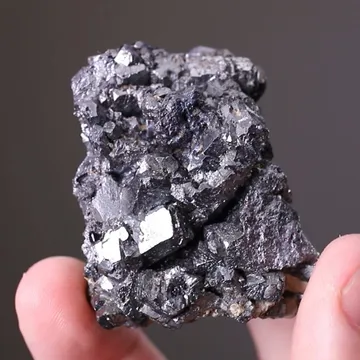
Ferberite-rich wolframite is one of Zinnwald’s most historically charged minerals, but old labels usually say “wolframite,” and not every antique tungsten specimen has been chemically resolved into modern wolframite-series nomenclature. The material is typically jet black to brown-black, dense, lustrous, and tabular to bladed, commonly striated, occurring in the quartz-zinnwaldite ore seams with cassiterite, quartz, scheelite, fluorite, and topaz-bearing greisen. Technical descriptions of the Zinnwald/Cínovec veins record large wolframite crystals in massive white to milky quartz, and collector-market examples show sharp tabular crystals, commonly contacted where they broke from pocket walls or vein selvages. The best ferberite/wolframite specimens from Zinnwald combine distinct crystal form, old provenance, and a believable Sn-W vein association; caution is warranted with unanalysed “ferberite” labels because the district’s old terminology predates modern species-level precision.
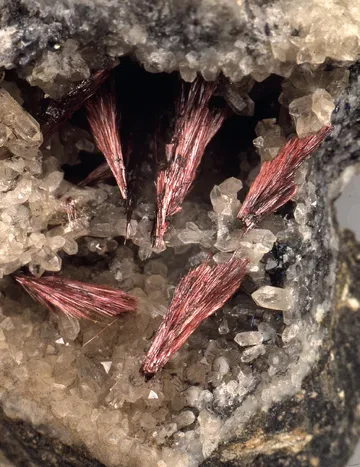
Beyond these headline species, Zinnwald is notable for a long and unusually instructive suite of rarities. Stolzite, PbWO4, is the standout: the Zinnwald–Cínovec district is its type locality, and old specimens may show tiny yellow, orange, brown, or cockscomb-like tetragonal crystals on smoky quartz, zinnwaldite, cassiterite, or oxidized matrix. Topaz, especially pyknite-style material, is a major greisen mineral rather than merely an accessory curiosity. The district also records baryte, fluorapatite, beryl, molybdenite, native bismuth, bismuthinite, bismutite, stannite, kësterite, ferrokësterite, sphalerite, galena, chalcopyrite, arsenopyrite, hematite, goethite, siderite, dolomite, uranium and copper secondaries such as zeunerite, torbernite, autunite, olivenite, malachite, azurite, chrysocolla, and a suite of rare REE, Nb-Ta, Bi, Pb, and As-bearing species. For the advanced collector, the locality is less a single-mineral destination than a compact textbook of evolved granite, greisen alteration, Sn-W ore, fluorine-rich hydrothermal chemistry, and oxidation-zone mineralogy.
Zinnwald specimens reward provenance work. Because the deposit straddles Germany and the Czech Republic, old labels may read Zinnwald, Cínovec, Cinvald, Böhmisch Zinnwald, Sächsisch-Zinnwald, Erzgebirge, Krušné hory, Bohemia, Saxony, or simply “Zinnwald.” None of these is automatically wrong, but the precision differs. A piece sold today as “Zinnwald, Germany” should ideally have evidence that it came from the Saxon side—Vereinigt Zwitterfeld, Zinnwald-Georgenfeld, Tiefer Bünau Stolln, Gnade Gottes an der Landesgrenze, or another German-side reference—rather than from the broader cross-border district. Conversely, rejecting every old “Zinnwald” label because the modern map would place part of the mining district in Czechia is historically naïve.
The commonest authenticity problem is not outright faking but overconfident relabelling. “Ferberite” may be old wolframite-group material without analysis. “Zinnwaldite” is both a historically important locality name and a complicated lithium-mica series term; analysis may place individual micas nearer siderophyllite, polylithionite, trilithionite, or related compositions. “Fluorite from Zinnwald” should be scrutinized because attractive fluorite is genuinely uncommon from the district, and specimens from other Erzgebirge localities can be more visually typical of what buyers expect from German fluorite. Scheelite and stolzite labels also deserve attention: both are dense tungstates, but their habits, associations, and fluorescence behavior differ, and small yellowish crystals on Zinnwald matrix should not be accepted as a rare species without good documentation.
Condition is a major factor. Quartz matrix is tough, but cassiterite and wolframite/ferberite crystals often have contacted or broken bases from vein extraction. Zinnwaldite books and rosettes can be cleaved, bent, friable, or dulled by clay and iron staining. Fluorite may be chipped along cube edges and cleavages. Scheelite is fairly heavy and brittle enough that exposed crystals suffer bruising, especially on older miniatures that moved through European collections for a century or more. Stolzite is much softer and more fragile; even good old pieces may require magnification and should be protected from abrasion.
Fluorescence can be useful but should not replace identification. Scheelite is famous for its blue-white response under shortwave ultraviolet light, though response can vary with molybdenum content and matrix. Some Zinnwald fluorite, including dark “Stink-Fluss” material, may have radiation-related features and should not be confused with more intensely colored fluorites from other Saxon districts. Uranium-bearing secondaries such as zeunerite, torbernite, autunite, and related arsenates/phosphates are documented from the district; small specimens are normally manageable with standard radioactive-mineral hygiene, but they should be stored labelled, kept out of living spaces if appreciably active, and handled without generating dust.
Market availability is modest. Zinnwaldite, quartz-zinnwaldite pieces, scheelite on quartz, cassiterite, and occasional ferberite/wolframite appear with some regularity, especially from old European collections and dealer stock. Fine fluorite, strong cassiterite crystals, large clean tungsten crystals, and convincing type-locality stolzite are much harder. Aesthetics can be understated compared with flashier world localities, so the premium rests heavily on history, label quality, species significance, and a specimen’s ability to show the greisen assemblage clearly. The best purchases are not necessarily the brightest pieces, but the ones with old handwriting, precise mine names, undamaged crystals, and mineral associations that could only belong to a classic Sn-W-Li greisen district.
Zinnwald’s first surprise is that the miners called its ore veins “Flöze,” seams, even though they were not coal seams at all. The term made perfect sense underground. The richest ore bodies lay flat or gently inclined, stacked one above another in the granite cupola, and were followed laterally like a seam in a coal mine. In a district where granite, rhyolite, and pneumatolytic fluids wrote the script, the miners borrowed the vocabulary of another mining world because the geometry under their lamps demanded it.
The tungsten story begins with frustration at the tin furnace. Erzgebirge miners and smelters had long cursed the heavy black ore that spoiled tin smelting, dragged tin into the slag, and foamed like a wolf at the melt. Agricola knew the problem in the 16th century and Latinized the image as “lupi spuma,” wolf’s foam. Later generations turned the annoyance into a strategic metal. Zinnwald wolframite helped bridge that change: by the 19th century, what had once been a metallurgical nuisance became a valuable ore for tungsten steel, hard cutting tools, military steel, and lamp technology. The visitor-mine history preserves the sharp reversal: wolframite went from troublesome contaminant to one of the reasons investors bought and modernized the mine.
Goethe’s Zinnwald visit gives the locality its most literary specimen story. In July 1813 he visited Zinnwald and Altenberg, entered the Tiefer Bünau Stolln, and acquired a suite of minerals from the Zinnwald stonecutter Mende. The episode is small, but it captures the way the district sat at the intersection of science, travel, collecting, and industry. Zinnwald was not merely a mine that produced ore; it was a place where educated travellers could buy mineral suites, descend into the workings, and carry home a physical summary of a frontier ore field.
The silver-and-copper episode of 1845 is a reminder that even famous tin-tungsten districts have side stories. Carl Christian Loose, the last Lauenstein mining official under the Hohenthal lordship, wrote to the Royal Mining Office in Freiberg about a parcel of mixed ore from Reichetrost Fundgrube at Zinnwald. For several years, miners had been laboriously separating small pockets of chalcopyrite, tetrahedrite-group ore, and sphalerite encountered while winning tin ore. By the time the parcel was finally delivered to Muldenhütten at Trinity 1851, it amounted to 20.1 Zentner. The recorded metal content was 80 pounds of silver and 1 Zentner 20.6 pounds of copper, and the payment was 30 talers, 20 neugroschen, and 9 pfennigs. In collector terms, it is an extraordinary footnote: the sulfides that today enliven a specimen label were once marginal, stubborn, hand-sorted material whose value had to be argued through official channels.
The mid-19th-century investment drama reads like a compact industrial novel. In 1852, the remaining Saxon Zinnwald mines were combined as Vereinigt Zwitterfeld zu Zinnwald. Four years later the whole union was purchased by Josef Jakob, a Viennese merchant and banker who understood the promise of tungsten steel. Jakob was not chasing romance; he wanted control of the raw material. For a time the calculation looked bold and modern, but markets, metallurgical uncertainty, and the costs of mining wore down the enterprise. The mine changed hands again after bankruptcy and sale in the 1860s, leaving collectors today with a locality where old labels may carry not only a species and place name, but traces of repeated attempts to make a difficult ore body pay.
World War I transformed the mine again. Wilhelm Seifer bought Vereinigt Zwitterfeld in 1910 and pushed through radical modernization of the dressing plant and underground operation. Capital shortages led to English financing through the Saxon Tin and Wolfram Mining Company, but the outbreak of war altered everything. In 1915, Stahlwerk Becker AG took over the Zinnwalder Bergbau union under wartime conditions, and the district’s tungsten became strategic. On the Bohemian side, the Lobkowitz mines were seized by the Austro-Hungarian military authority, the Köppenschacht was expanded as the Militärschacht, and hundreds of prisoners of war were employed. The specimens that emerged from this period are therefore not just “old European classics”; they are objects from a mining field repeatedly drawn into the machinery of European conflict.
Lithium gives the locality its strangest time arc. Around 1843, lithium mica from Altenberg-Zinnwald was used in Dresden in Struve’s mineral-water establishment for preparing lithium-bearing medicinal waters—an early industrial use of a mineral group that many miners had once treated as waste. By 1869 the district recorded lithium-mica concentrate production, and from 1924 to 1945 Zinnwald supplied mica for lithium-salt production at the Hans Heinrich works at Langelsheim. In the 1940s, lithium mica became tied to war-important products such as bearing metal and welding flux. In the 21st century, the same mica that gave the locality its mineral name returned as a battery-metal target. Zinnwald’s lithium story is not a modern discovery bolted onto an old mine; it is a long revaluation of a mica that collectors have admired for generations.