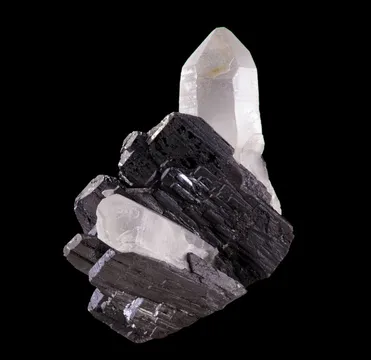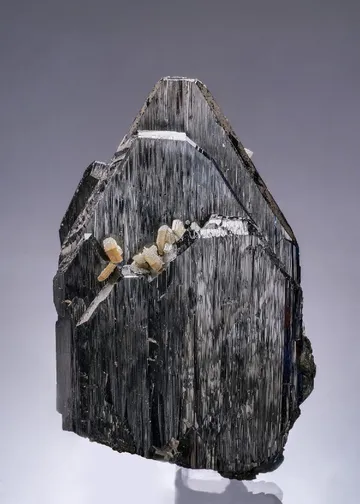
Ferberite - iron-rich wolframite with stout blade-like prisms and deep black luster; forms in hydrothermal tin-tungsten deposits; prized on quartz or fluorite.
Key facts
Ferberite is the iron-rich end member of the wolframite series (Fe2+WO4–Mn2+WO4, with huebnerite as the manganese-rich end). It crystallizes in the monoclinic system and is best known for stout bladed to blocky prisms with pronounced parallel striations and a deep iron-black color. Fresh crystals have a bright metallic to submetallic luster and remarkable heft—ferberite is dense, and even small crystals feel heavy in the hand. It typically forms in hydrothermal and greisen environments associated with tin–tungsten systems, most famously at Panasqueira (Portugal) and multiple Chinese W-Sn deposits.
For collectors, ferberite’s appeal lies in the interplay of powerful crystal geometry and sharp contrast on matrix. Top pieces show thick, lustrous blades perched on snow-white quartz, bristling arsenopyrite, pastel fluorite, or green fluorapatite—dramatic combinations that elevate what might otherwise be a “black metallic.” Ferberite’s perfect cleavage means pristine terminations are coveted; when combined with striking associations, the species produces highly aesthetic, museum-level specimens.
As the principal ore mineral of tungsten in many districts, ferberite has been mined for industry since the 19th century. Its collector status rose with classic European finds (Panasqueira, Cínovec) and spiked again with prolific Chinese discoveries in Hunan and Inner Mongolia beginning in the 1990s–2010s. Today, ferberite occupies a respected niche among “black metallics,” comparable to fine hematite or sphalerite: accessible at modest sizes yet capable of spectacular, world-class display pieces.
Panasqueira is the archetype for fine ferberite. Crystals are typically thick, lustrous blades to blocky prisms, often arranged in sculptural groups on drusy quartz. Classic associations include sparkling arsenopyrite and, most famously, emerald-green fluorapatite crystals that provide superb color contrast. Many clusters are repaired due to ferberite’s perfect cleavage, but pristine tips and intact, balanced compositions remain the benchmark. Top pieces show jet-black luster, stout geometry, and complementary matrix minerals that create an unmistakable “Panasqueira look.”
Yaogangxian produced many of the “textbook” modern ferberites: sharp, jet-black blades with bright metallic luster, hosted on snow-white quartz or accompanied by pastel to purple fluorite, arsenopyrite, and occasional calcite. The composition is often elegant and vertical, with well-isolated crystals showing crisp terminations and fine striations. Collectors prize the contrast and cleanliness of these pieces—when undamaged and unrepaired, they rank among the finest contemporary ferberites.
Ferberite is dense but relatively soft (Mohs ~4–4.5) and has perfect cleavage—handle gently.
With attention to crisp luster, clean terminations, and strong matrix contrast, ferberite can be a striking highlight in any suite of ore minerals or classic European/Asian localities.