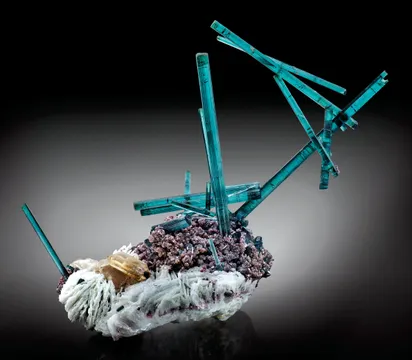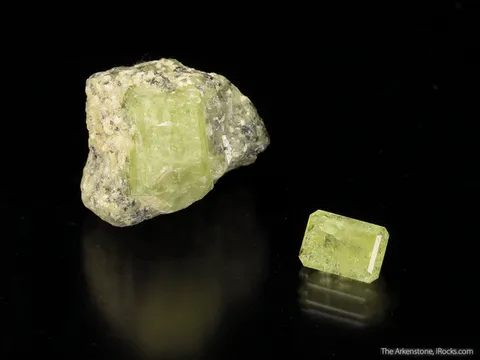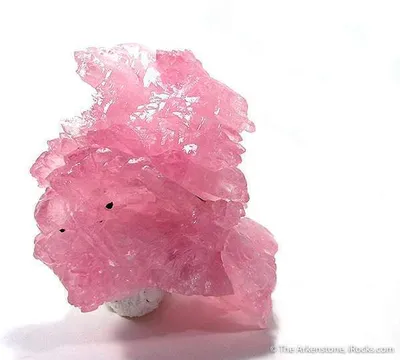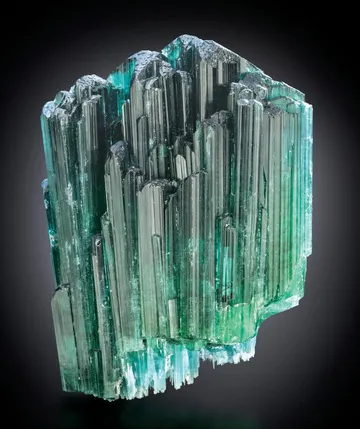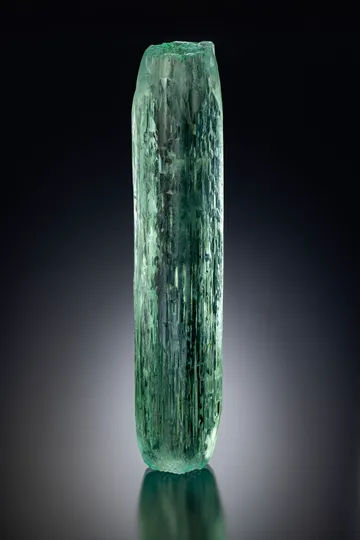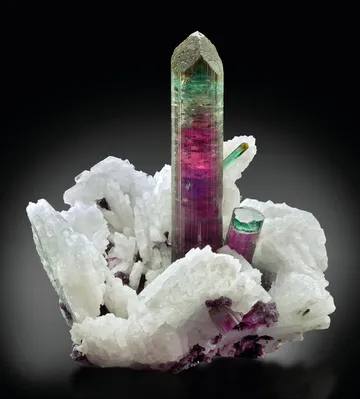
Virgem da Lapa, Brazil - classic pegmatite locality producing gem elbaite in greens, blues and pinks, blue topaz, and pocket crystals prized by collectors.
Key facts
Virgem da Lapa is one of the classic specimen names of the Araçuaí–Salinas pegmatite country of northeastern Minas Gerais, a district where the language of gem mining and the language of fine mineral collecting overlap almost perfectly. The locality is not a single mine but a group of hard-rock, granitic pegmatites northwest of the town, best known in collections under mine names such as Limoeiro, Xanda, Manoel Mutuca, Toca da Onça, and Laranjeiras. These bodies belong to the Coronel Murta–Virgem da Lapa pegmatite field of the Araçuaí Pegmatite District, within the Eastern Brazilian Pegmatite Province, and are intruded into schists of the Salinas Formation. Their importance rests on a rare combination: gem elbaite in strong greens, blues, pinks, and bicolors; superb natural blue topaz; purple to beige hydroxylherderite; lepidolite; cleavelandite; quartz; beryl varieties including morganite, aquamarine, and heliodor; and a suite of rarer phosphates and sulfosalts that mark the pegmatites as chemically evolved.
The best Virgem da Lapa specimens have a very particular look. They are not merely loose gem crystals: the great pieces are pocket specimens from hard, relatively unaltered pegmatite, where glassy tourmaline or topaz stands on cleavelandite, quartz, lepidolite, or feldspar. The famous 1970s production yielded lustrous, deeply striated tourmaline prisms, chisel-ended blue topaz crystals, and unusually large herderite-group crystals, often with the crispness and spatial separation that collectors prize in matrix specimens. Because these pegmatites were hard rock rather than soft, thoroughly kaolinized bodies, the crystals could be remarkably fresh—but the same hardness made mining expensive and destructive, and blasting undoubtedly cost the district many crystals before they ever reached a collector’s tray.
Regional View
Country View
Virgem da Lapa’s reputation was made rapidly. Although the pegmatites were first worked for industrial minerals during World War II, the collector-class discoveries belong mainly to the mid-1970s, when Limoeiro and Xanda became synonymous with green elbaite, blue topaz, feldspar-lepidolite matrices, and herderite-group crystals of exceptional size. By the early 1980s, classic pockets had already become history: Limoeiro was abandoned, some Xanda workings had caved or been buried, and the easy pockets had been cleaned out. That brevity is part of the locality’s allure. The specimens carry the visual energy of a short, intense mining episode rather than a long, steady industrial career.
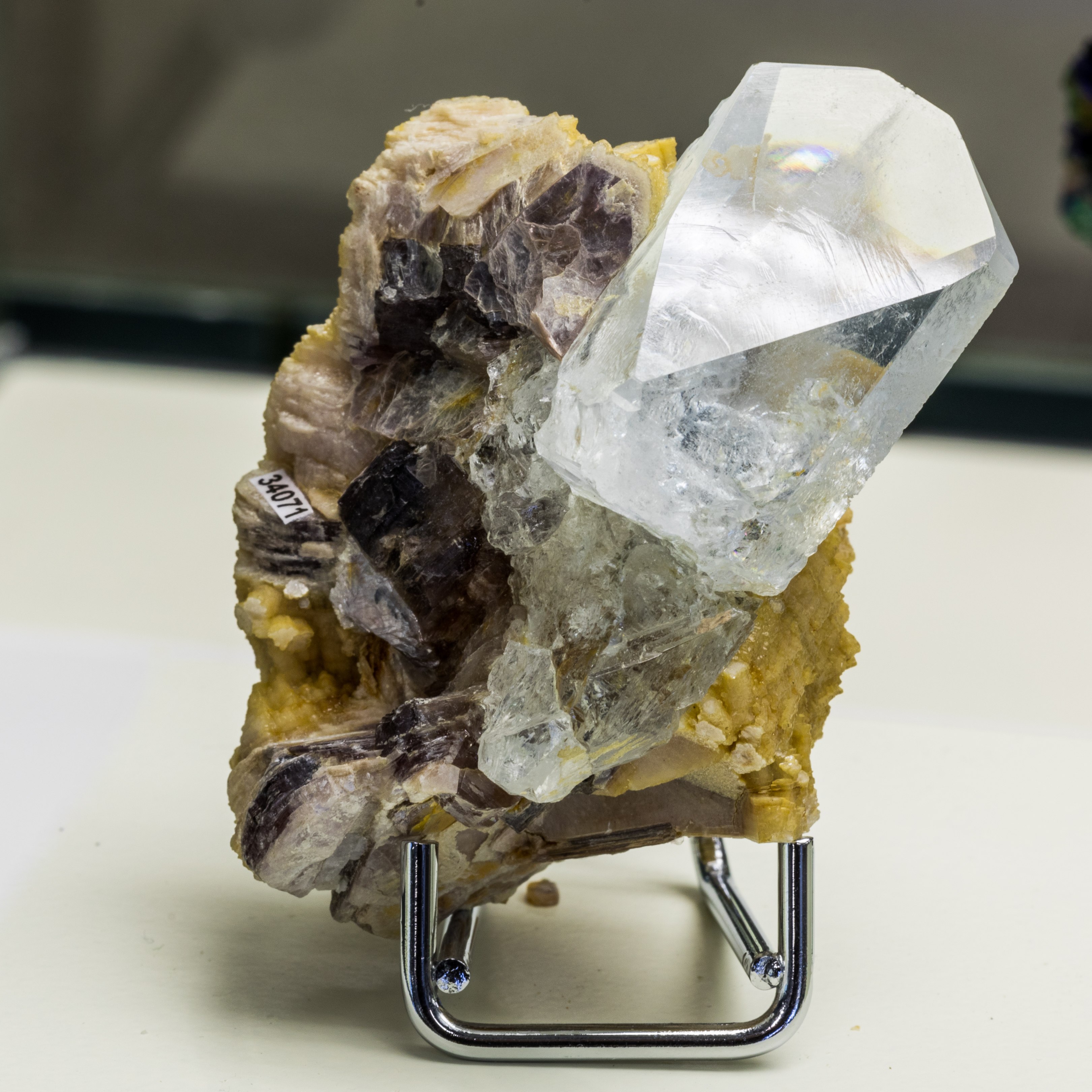
Photo: Wikimedia Commons

Photo: Wikimedia Commons

Photo: Wikimedia Commons
Search for specimens: View all specimens from Virgem da Lapa, Brazil
The classic Virgem da Lapa mines are complex granitic pegmatites in the Araçuaí–Salinas district, on the western end of the Jequitinhonha River pegmatite belt. The group is composed of near-horizontal, tabular to lens-shaped pegmatite bodies that are notably less altered than many Minas Gerais gem deposits. This unaltered condition is central to the character of the locality: instead of crystals weathered loose in clay, the finest specimens formed in primary pockets near quartz cores, attached to feldspar, quartz, albite, and lepidolite, and had to be won from hard pegmatite by underground mining, hand tools, and explosives.
The major mines traditionally cited for the group are Limoeiro, Xanda, Manoel Mutuca, Toca da Onça, and Laranjeiras. Limoeiro is described as a flattened lens 2 to 4 meters thick, hosted by dark gray, finely banded quartzitic biotite schist. The pegmatite outcrop was about 200 meters long, with a gentle northwest dip and a structure typical of primary zoned pegmatites: a thin muscovite contact, a feldspathic border zone of feldspar, quartz, and muscovite, coarser material inward, and a milky quartz core. The gem pockets occurred near the core and were unusually common, reportedly averaging roughly one pocket per square meter. They ranged from small cavities only a few centimeters across to cavernous openings around 2 meters in diameter. The pocket indicators were highly collector-relevant: massive lepidolite and albite with embedded black tourmaline, followed by pocket linings of albite, quartz, microcline, and lepidolite carrying green elbaite prisms, topaz, hydroxylherderite, and other species.
Xanda lies about 2.5 kilometers south-southwest of Limoeiro. Its outcrop was shorter, about 135 meters, but the body was thicker, lens-shaped, and averaged roughly 7 meters across, striking northwest and dipping 20–25 degrees northeast in tourmaline-rich quartz-biotite schist. Xanda shares much of Limoeiro’s mineralogy but with tourmaline, garnet, and biotite in its fine-grained border zone, and beryl close to the milky quartz core. The mine became famous for topaz as well as tourmaline; some of the best blue topaz crystals were found at the ends of irregular, sharply turning underground tunnels that followed the pegmatite for as much as 150 meters.
The mining history has two chapters. The first was industrial: during World War II the pegmatites were worked for commercial beryl, mica, and quartz, and after demand fell the area was largely abandoned. Open pits near the later Xanda mine produced commercial beryl from about 1960 to 1973. The second chapter began in 1974, when underground work at Xanda and nearby bodies led to the pocket discoveries that made the locality famous to gem dealers and specimen collectors. Limoeiro briefly became a hive of activity; in 1975 around 200 garimpeiros worked there, but by mid-1976 the accessible pockets had largely been removed and only about 30 miners remained. Virgem da Lapa’s peak specimen production was concentrated in a few years, especially 1974–1978, and included many tons of predominantly green and bicolored tourmaline for cutting and collecting, green tourmaline crystals up to 33 cm long and 2.4 kg, deep blue tourmaline up to 1.2 kg, blue topaz crystals up to 30 kg, purple hydroxylherderite to about 7 cm, and green beryl crystals around 15 cm on feldspar.
The Toca da Onça pegmatite is particularly important for modern locality documentation. It is an essentially zoned, complex pegmatite intruded into Salinas Formation mica schists. Its primary assemblage is K-feldspar, quartz, and muscovite, with accessory tourmaline, cleavelandite, lepidolite, topaz, apatite, columbite-tantalite, amblygonite, spodumene, and morganite. Specimen records from Toca da Onça include topaz on quartz, lepidolite crystals, schorl, and etched beryl showing aquamarine and morganite zones. Historically it was known for blue tourmaline as well as topaz-bearing pockets.
Collecting access today should be regarded as private, historical, and uncertain rather than open. The classic mines were on private land, and the old literature already describes abandoned adits, bulldozer-stripped workings, cave-ins, backfilled tunnels, and seasonal access problems. Any field visit requires local permission, current safety information, and realistic expectations: the locality is famous because of past pockets, not because casual collecting on dumps reliably yields classics. Most serious collectors will encounter Virgem da Lapa through old-stock specimens, dealer material, estate collections, or pieces simply labelled by municipality when the precise mine name has been lost.
Elbaite is the signature collector species of Virgem da Lapa, with the best crystals showing the combination that made the district famous: sharp, lustrous, striated prisms in green, deep blue, pink, and bicolored zones, often perched on albite, quartz, microcline, or lepidolite rather than recovered as loose gem rough. Limoeiro yielded long green elbaite prisms from pockets near the milky quartz core, including a documented 33 cm, 2.4 kg gem-quality green crystal, while Xanda and Manoel Mutuca added important blue material; the Mutuca prisms could be unusually stout for blue tourmaline and were valued for cutting across the c-axis into fine “sapphire-blue” gems. The most desirable specimens from the Virgem da Lapa group are not simply colorful but balanced: undamaged terminations, glassy luster, visible color zoning, and natural matrix are the features that separate a collection-grade piece from ordinary broken tourmaline fragments or cuttable rough.
Topaz from Virgem da Lapa is most prized in natural blue crystals from Limoeiro, Xanda, and Toca da Onça, where the best pieces show blocky to chisel-ended orthorhombic form, pale to medium blue color, etched but sharp faces, and—at the highest level—matrix association with quartz, albite, lepidolite, or feldspar. Blue topaz crystals from the group reached remarkable weights, with historical accounts noting crystals as heavy as 30 kg, though fine undamaged cabinet specimens are far scarcer than the production figures suggest because many crystals were broken, blasted, discarded before their value was understood, or cut. The elite Virgem da Lapa topaz specimen is a natural, complete, translucent-to-transparent blue crystal with crisp termination and believable old provenance; matrix examples, especially a blue topaz visibly set into quartz or feldspar from Toca da Onça, stand well above loose singles in collector desirability.
Lepidolite at Virgem da Lapa is both an aesthetic species and a geological signal: miners at Limoeiro recognized massive lepidolite with albite and embedded black tourmaline as a sign that gem pockets were close, and the pocket linings themselves could carry well-formed lepidolite crystals. The classic material ranges from lavender-pink crystalline masses and plates to sharper crystal aggregates associated with elbaite, albite, quartz, and topaz, with Toca da Onça documented for small lepidolite crystal groups and Xanda-Limoeiro material famous for lepidolite as matrix under tourmaline and herderite-group species. Good specimens show color, crystal form, and clean association rather than sugary mica rubble; the finest pieces use lepidolite as a compositional foil, its soft lilac plates contrasting with green elbaite, blue topaz, or pale cleavelandite.
“Tourmaline” on Virgem da Lapa labels may mean gem elbaite, schorl, or older group-level identifications, and that distinction matters: gemmy green, blue, pink, and bicolored elbaite are the value-bearing species, while black tourmaline is important mainly as an accessory and pocket indicator. At Limoeiro, black tourmaline embedded in lepidolite-albite walls announced nearby pockets containing green elbaite, while Toca da Onça records include schorl crystals and gem tourmaline production; Manoel Mutuca supplied thick blue crystals prized for faceting, and the broader district was known for green and bicolored material in quantity. As specimens, Virgem da Lapa tourmalines are judged by intact terminations, saturation without excessive darkness, transparency, undisturbed prism faces, and especially association with original pocket matrix; generic “Brazil tourmaline” pieces without mine or municipality confidence are much less desirable than documented Xanda, Limoeiro, Toca da Onça, or Manoel Mutuca examples.
Quartz at Virgem da Lapa is mostly valued as matrix and pocket architecture rather than as the principal prize, but it is essential to the locality’s best compositions. The pegmatites commonly have milky quartz cores, and gem pockets near those cores lined quartz together with albite, microcline, and lepidolite; Toca da Onça produced notable topaz-on-quartz specimens, including large cabinet pieces where a pale blue topaz crystal is wedged into or perched against terminated quartz. The quartz may be milky, etched, or partly recrystallized, and condition varies; collectors should favor pieces where quartz provides clean height, termination, and natural context for topaz or tourmaline instead of merely acting as a broken white support.
Muscovite is one of the fundamental rock-forming and pocket minerals of the Virgem da Lapa pegmatites, present at contacts, in feldspathic border zones, and in matrix assemblages with albite, quartz, microcline, lepidolite, and tourmaline. At Limoeiro, a thin light-colored muscovite layer marked the pegmatite contact with schist before miners entered the feldspar-quartz-muscovite border zone, and Xanda specimens include pseudo-hexagonal yellow muscovite crystals on white albite. The best collector pieces are not just mica books but sharp, bright, well-positioned rosettes or pseudo-hexagonal plates that help document the pegmatite environment; loose damaged mica is common, while attractive muscovite in matrix association with tourmaline, feldspar, or albite is far more worthwhile.
Virgem da Lapa herderite-label specimens are best understood in the historical collector sense, because the famous material from the district is widely documented as hydroxylherderite, especially from Xanda and Limoeiro. The classic crystals are unusually large for the species, purple, beige, or color-change in some reports, and can form sharp pseudo-octahedral or twinned crystals on albite, lepidolite, and tourmaline-bearing pegmatite matrix; historical accounts describe purple gem hydroxylherderite crystals to around 7 cm, while later locality summaries and museum/dealer records note Xanda among the world’s important sources. Fine pieces are judged by form and surface first—sharp faces, readable twinning, translucency, and freedom from bruising—because dull broken phosphate fragments with old “herderite” labels do not carry the same importance as complete Xanda-style crystals.
Feldspar at Virgem da Lapa occurs as both framework and specimen matrix, chiefly K-feldspar, microcline, and albite including cleavelandite, and it is one of the reasons the locality’s best specimens look so architectural. Limoeiro pockets were lined with albite and microcline together with quartz and lepidolite, while Xanda and Toca da Onça records document albite-cleavelandite and K-feldspar in association with muscovite, topaz, tourmaline, and beryl; even high-quality commercial feldspar accumulated on the Xanda dumps, a reminder that specimen mining operated alongside industrial pegmatite material. Good feldspar specimens from Virgem da Lapa have sharp blocky microcline or bladed cleavelandite providing clean contrast and support for gem species; massive feldspar without aesthetics is geological context, not a premium collectible.
Indicolite from Virgem da Lapa is concentrated in the blue tourmaline story of Xanda, Manoel Mutuca, Toca da Onça, and related workings, with the Mutuca mine especially noted for thick, deeply etched blue prisms that could yield unusually large faceted stones. Some crystals looked pale in the rough but produced an intense blue when cut in the right orientation, and the best material differed from many narrow blue tourmaline “pencils” by being broad enough to cut across the c-axis. For mineral collectors, the premium indicolite is a natural crystal or matrix specimen with unmistakable blue color, good termination, and a secure Virgem da Lapa sublocality; ordinary dark blue-green tourmaline fragments, heated cut stones, and vague “Minas Gerais indicolite” labels should not be treated as equivalent to documented Manoel Mutuca or Xanda material.
Morganite is a subordinate but well-documented beryl variety in the Virgem da Lapa municipality, especially at Toca da Onça, where specimen records show etched beryl crystals with aquamarine and morganite zones and geological descriptions include morganite in the accessory assemblage of the zoned pegmatite. It does not define Virgem da Lapa the way topaz, elbaite, and hydroxylherderite do, but it rounds out the classic evolved-pegmatite suite alongside aquamarine, heliodor, cleavelandite, lepidolite, and tourmaline. Good morganite pieces from here are valued when they show recognizable hexagonal beryl form, pink color, and honest pegmatite association; etched, incomplete, or weakly colored crystals remain interesting locality specimens but are far below the district’s tourmaline and topaz classics.
Other documented minerals from Virgem da Lapa and its sublocalities include albite, cleavelandite, amblygonite, apatite, aquamarine, heliodor, biotite, columbite-tantalite series minerals, garnet, hematite, kyanite, plagioclase, rhodochrosite, schorl, spodumene, tantalite, titanite, zircon, microlite, geocronite, and rare phosphates such as greifensteinite. Xanda is particularly important for hydroxylherderite and has also been cited for bismuthian geocronite and microlite in classic literature, while Toca da Onça adds a well-described accessory assemblage including apatite, amblygonite, spodumene, columbite-tantalite, and morganite. The locality is not primarily celebrated as a type-locality district; its fame rests instead on world-class crystallization and the unusual breadth of evolved pegmatite species preserved in pocket specimens.
Virgem da Lapa labels deserve careful reading. The most valuable specimens normally carry a mine name—Limoeiro, Xanda, Toca da Onça, Manoel Mutuca, or Laranjeiras—rather than only “Brazil” or even “Minas Gerais.” Because Brazilian pegmatite material circulated through Teófilo Otoni, Governador Valadares, international gem dealers, and later estate collections, older pieces are frequently labelled only by municipality or by a simplified “Virgem de Lapa” spelling. That is not automatically a problem, but specimen style should match the claim: Limoeiro and Xanda classics often show hard-rock pocket matrix with albite, lepidolite, quartz, microcline, and etched or striated gem crystals, not just loose tumbled-looking rough.
The most common authenticity issue is not outright fakery but overbroad or upgraded provenance. “Virgem da Lapa” may be applied loosely to attractive Minas Gerais tourmaline, topaz, or herderite-group material because the name carries weight. For topaz, be cautious with isolated blue crystals lacking old provenance: commercial blue topaz is commonly treated in the gem trade, while Virgem da Lapa’s fame is for natural blue crystals from pegmatite pockets. Matrix, old labels, published collection history, and characteristic association with quartz, albite, lepidolite, or feldspar are valuable safeguards. For tourmaline, cut stones and gem rough may have been heated to lighten or brighten blue and green colors; this matters far more to gem buyers than to specimen collectors, but it should still be disclosed when a piece is presented as natural-color gem material.
Condition is a central value factor. The mines were hard-rock operations that used explosives, and historical accounts specifically note crystal destruction from blasting. Expect contact marks, etched faces, bruised terminations, and repaired matrix on larger topaz and tourmaline pieces. Carefully inspect topaz terminations and prism edges, elbaite caps and bases, cleavelandite blades, and lepidolite supports. Hydroxylherderite crystals can be fractured or subtly cleaved; transparency and sharp pseudo-octahedral form are worth paying for only when the crystal is genuinely intact.
Hydroxylherderite from Virgem da Lapa may be labelled as herderite, hydroxylherderite, or simply “herderite group,” especially on older specimens. That ambiguity is normal in historical collections, but high-value pieces should ideally have analytical confidence or a reputable old pedigree. Some Virgem da Lapa hydroxylherderite has been noted for unusual color behavior, so view fine examples under consistent lighting before judging color. As with many pale phosphates and micas, avoid prolonged harsh sunlight and handle matrix specimens from the base, not by projecting crystals.
Market availability is uneven. Small elbaite, topaz, lepidolite, and feldspar specimens still appear regularly enough under the Virgem da Lapa name, but true classics—large green Limoeiro elbaite, Xanda blue topaz on matrix, strong blue Manoel Mutuca indicolite, and sharp hydroxylherderite—are limited old-stock or collection-circulation pieces. The district’s short peak production, early abandonment of some workings, and the high attrition of hard-rock mining all support strong prices for complete, well-documented specimens.
The Virgem da Lapa story has the compressed drama of a boom camp. The pegmatites had been known industrially before they became famous aesthetically: World War II demand drew attention to beryl, mica, and quartz on land tied to the family of Sérvio Getúlio Ursine, nicknamed “Xanda.” When wartime demand vanished, so did much of the activity. For years the ground waited. Then, in 1974, underground tunnels were driven into the pegmatite veins of what collectors now know as the Xanda mine, and a different kind of wealth appeared—not just beryl for industry, but crystals that could stand in the front rank of the mineral world.
At Limoeiro, the work became almost feverish. Around 200 garimpeiros were active there in 1975, chasing a flattened pegmatite lens only a few meters thick but unbelievably rich near its core. The pocket indicators were practical, visual, and exact: massive lepidolite and albite, black tourmaline embedded in the walls, then cavities lined with albite, quartz, microcline, and lepidolite. Some pockets were only centimeters across; others opened to about 2 meters. One of the prizes was a green tourmaline crystal 33 cm long, 7 cm in diameter, and 2.4 kg in weight, a single crystal large enough to make the locality’s name permanent. Yet the boom burned quickly. By mid-1976 only about 30 miners remained, and the accessible pockets had largely been cleaned out.
Xanda had its own folklore. Some tunnels reached about 150 meters into the pegmatite and did not proceed in neat engineer’s lines. They turned sharply, making odd “S” curves that seemed irrational on a map. At the ends of those turns, however, miners found the pockets containing the largest and best blue topaz crystals from the deposit. The old explanation was not geometry but instinct: the garimpeiros had a sixth sense for gems.
The same mine also produced one of the great cautionary tales in Brazilian specimen mining. Before systematic tunneling, local farmers had already encountered blue topaz crystals. They did not recognize their value and threw them onto the dumps, damaging or destroying crystals that would later have been regarded as superior specimens. On another occasion, after a party, miners pushed a stick of dynamite into the pegmatite and blew through into an adjacent pocket, destroying at least ten superb topaz crystals. It is a painful episode for any collector to imagine: a whole pocket of blue topaz turned into fragments in a moment.
The social life of the mine was as complicated as the pegmatite. Xanda was private land, rented to a tenant who supplied equipment and rented it to garimpeiros, with first choice to buy what they found. Under that system, bargaining power was not equal, and many specimens disappeared from the normal channel. The miners had a word for the man who sold crystals secretly to avoid commissions or payments: curiango, after a Brazilian night bird. Virgem da Lapa had more curiangos than most mines, at least according to the accounts preserved by gem writers who knew the district during its active years.
Manoel Mutuca added a different kind of surprise: blue tourmaline crystals that sometimes looked too pale or too etched to be spectacular at first glance, yet cut across the c-axis into a saturated, highly desirable blue. Many blue tourmalines are narrow “pencils,” too slim to yield large stones in that orientation, but Mutuca’s prisms could be thick, sometimes nearly as wide as they were long. That geometry changed their destiny. The mine produced rough capable of faceted blue tourmalines over 50 carats, placing an otherwise small sublocality into the conversation about the finest blue tourmaline gems from Minas Gerais.
Cassedanne, Jacques P., and Jack Lowell. “Famous Mineral Localities: The Virgem da Lapa Pegmatites.” The Mineralogical Record, vol. 13, no. 1, 1982, pp. 19–28. The classic collector-locality article on the Virgem da Lapa pegmatites, cited for the district’s mines, minerals, maps, and major 1970s specimen production.
Proctor, Keith. “Gem Pegmatites of Minas Gerais, Brazil: The Tourmalines of the Araçuaí Districts.” Gems & Gemology, vol. 21, no. 1, Spring 1985, pp. 3–19. A primary English-language account of the Araçuaí–Salinas tourmaline district, with detailed sections on Virgem da Lapa, Limoeiro, Xanda, Manoel Mutuca, production, geology, and mining history.
Proctor, Keith. “Gem Pegmatites of Minas Gerais, Brazil: Exploration, Occurrence, and Aquamarine Deposits.” Gems & Gemology, vol. 20, no. 2, Summer 1984, pp. 78–100. Background for the broader northeastern Minas Gerais pegmatite province, early exploration, gem mining methods, and the historical development of the regional trade.
Gauzzi, T., et al. “A cathodoluminescence-assisted LA-ICP-MS study of topaz from different geological settings.” Brazilian Journal of Geology, vol. 48, no. 1, 2018, pp. 161–176. Includes Toca da Onça topaz and summarizes the pegmatite’s setting in the Coronel Murta–Virgem da Lapa field, host rocks, primary assemblage, and accessory minerals.
Pedrosa-Soares, Antonio Carlos, José Marques Correia-Neves, and Othon Leonardos. “Tipologia dos pegmatitos de Coronel Murta – Virgem da Lapa, Médio Jequitinhonha, Minas Gerais.” 1990. A regional pegmatite-typology paper for the Coronel Murta–Virgem da Lapa field in the Araçuaí Pegmatite District.
Neves, C. J. M., A. C. P. Soares, and R. R. Valle. “Geoquímica e gênese do pegmatito Limoeiro (Virgem da Lapa, Minas Gerais).” Anais do XXXI Congresso Brasileiro de Geologia, 1980, pp. 2134–2148. A key cited study on the geochemistry and genesis of the Limoeiro pegmatite.
Dunn, P. J., D. E. Appleman, and J. A. Nelen. “Hydroxyl-herderite from Brazil and a guide to species nomenclature for the herderite/hydroxyl-herderite series.” The Mineralogical Record, vol. 10, no. 5, 1979. Important for understanding Brazilian herderite-group nomenclature and the hydroxylherderite material associated with classic Minas Gerais pegmatites, including Virgem da Lapa references in later locality literature.
Bancroft, Peter. Gem and Crystal Treasures. Western Enterprises and The Mineralogical Record, 1984. A major collector reference cited repeatedly for Virgem da Lapa specimen photographs and stories, including Xanda and Manoel Mutuca pieces.
Virgem da Lapa, Minas Gerais, Brazil — Mindat — The central locality database page, with sublocalities, species list, photographs, and bibliography.
Xanda Mine, Virgem da Lapa — Mindat gallery — Useful for seeing the range of Xanda specimens, including topaz, elbaite, hydroxylherderite, lepidolite, albite, muscovite, and feldspar associations.
Toca da Onça pegmatite, Virgem da Lapa — Mindat — A focused sublocality page for the zoned complex pegmatite famous for topaz, tourmaline, lepidolite, beryl, and associated pegmatite minerals.
Toca da Onça pegmatite gallery — Mindat — Photo-based reference for Toca da Onça topaz-on-quartz, lepidolite, schorl, and etched beryl specimens.
Gem Pegmatites of Minas Gerais, Brazil: The Tourmalines of the Araçuaí Districts — GIA — The most useful published narrative for Virgem da Lapa’s mining history, mine geology, production, and tourmaline/topaz stories.
Gem Pegmatites of Minas Gerais, Brazil: Exploration, Occurrence, and Aquamarine Deposits — GIA — Regional context for the Minas Gerais pegmatite province and its early gem-mining history.
A cathodoluminescence-assisted LA-ICP-MS study of topaz from different geological settings — Brazilian Journal of Geology — Technical reference for topaz, including Toca da Onça’s geological setting and mineral assemblage.
Minerals of Virgem da Lapa — Wikimedia Commons — Open-image gallery useful for visual comparison of topaz, elbaite, lepidolite, hydroxylherderite, quartz, and feldspar specimens.
Gemas e minerais de coleção — Recursos Minerais de Minas Gerais — Portuguese-language overview of Minas Gerais gem and collector-mineral resources, including Araçuaí and Virgem da Lapa context.