A collector's guide to Porcupine Pocket, Pederneira Mine, São José da Safira, Brazil: its geology, mining history and notable minerals, illustrated with the 20 specimens documented from this locality on EarthWonders.
Key facts
Porcupine Pocket is one of the defining named pockets of the Pederneira Mine, the great modern Brazilian tourmaline locality in the São José da Safira pegmatite district of eastern Minas Gerais. Its importance rests on a precise combination of geology, timing, and aesthetics: a large miarolitic cavity opened in 2001 within the Dada’s Tunnel workings of a highly evolved, lithium- and boron-rich pegmatite, producing long, slender, steely blue to blue-green elbaite tourmaline crystals on lepidolite, quartz, cleavelandite, and albite-rich matrix. In a mine famous for pockets with distinct “personalities,” Porcupine Pocket is among the easiest to recognize: the best pieces have a spray-like, upward-thrusting architecture, with thin blue prisms rising from lilac lepidolite and pale feldspathic matrix like bristles from a living object—an effect that gave the pocket and its signature Smithsonian specimen their name.
Regional View
Country View
The Porcupine Pocket matters because it arrived during Pederneira’s extraordinary early-2000s run, when the mine shifted decisively from a source of gem rough into one of the world’s great specimen-producing pegmatites. The pocket produced several named pieces now embedded in modern collecting lore, including “The Porcupine,” “The Sailboat,” “The Blue Star,” “Legs,” and “The Hat.” Its crystals introduced another Pederneira-specific habit: long antilogous tourmalines, commonly steely blue, reaching roughly 35 cm in length while remaining only about 2 cm thick. That geometry is beautiful, but unforgiving; many crystals broke naturally in the pocket or during extraction, and the Porcupine production became a benchmark for the professional reconstruction methods now expected on major Pederneira specimens.
At their finest, Porcupine Pocket specimens are not merely blue tourmalines from Brazil. They are spatial objects: tourmaline rods crossing lepidolite mounds, quartz points or plates giving mass and contrast, white cleavelandite or albite flashing through the lavender matrix, and occasional accessory herderite/hydroxylherderite adding mineralogical interest. Good specimens show distinct blue to teal saturation, high luster, clean terminations, readable growth structure, and enough original matrix to prove the crystals’ natural orientation. Ordinary examples may still be attractive, but the great ones feel architectural—delicate, improbable, and unmistakably Pederneira.
Search for specimens: View all specimens from Porcupine Pocket, Pederneira Mine, São José da Safira, Brazil
Porcupine Pocket belongs to the Pederneira Mine, locally Lavra da Pederneira, in the municipality of São José da Safira, Minas Gerais, Brazil. The mine lies in the Safira pegmatite district of the Eastern Brazilian Pegmatite Province, near other classic tourmaline-producing pegmatites such as Cruzeiro, Aricanga, Golconda, and Jonas. The district is made up of highly evolved rare-element pegmatites hosted largely by metamorphic rocks—especially mica schists, paragneisses, and quartzites—and related to post-collisional granitic magmatism in the Araçuaí orogen. At Pederneira, the gem pockets are part of a complexly zoned pegmatite system enriched in boron, lithium, beryllium, albite, muscovite, elbaite, beryl, and accessory niobium-tantalum oxides and phosphates.
The mine is developed on two principal pegmatite bodies known through the Dilo and Dada workings. These bodies are subparallel, tabular, and broadly concordant with the schistosity of the country rock, separated by a mica-schist septum. In most places the pegmatites are relatively thin, but in the productive zones they swell into inclined, columnar bodies more than 15 meters thick; these columns have supplied most of the gem and specimen production. The subhorizontal parts of the pegmatites are dominated by quartz, feldspar, biotite, muscovite, black tourmaline, and local garnet. In the enlarged columnar sections, biotite largely disappears and tourmaline becomes a major component with muscovite and garnet, signaling the chemically evolved zones most attractive to specimen miners.
The productive cavities are miarolitic pockets developed near the core zones. A typical highly evolved Pederneira pocket is lined with quartz, cleavelanditic albite, and lavender mica generally described in the specimen trade as lepidolite. Large rooted tourmalines may pass from black schorl-like bases into multicolored elbaite toward the cavity, while the spectacular collector crystals are often second-generation “pencil” tourmalines, isolated or grouped, with high gem quality and sharp terminations. Pederneira pockets are commonly found collapsed, with heavy roof crystals broken and scattered onto the cavity floor. That geological reality is central to understanding Porcupine Pocket: the best specimens were not simply lifted intact from a perfect geode, but recovered as a complex natural puzzle of crystals, matrix, and attachment points.
The broader Pederneira story began in the 1940s, when a farmer named Pacheco found a muscovite-bearing outcrop after a storm and sold barrels of mica to Americans working nearby during World War II. The mine then fell dormant until the 1980s, when Geraldo Neves reopened the old working without success. He was followed by the miner Natinho, who reportedly struck an enormous pocket of bicolored tourmaline and deep red rubellite after only a short advance. Dilermando Rodrigues Melo and his son Dilermando Rodrigues Filho—“Dilo,” whose name became attached to Dilo’s Tunnel—then leased the mine with Julio Cipriano and produced large quantities of tourmaline, morganite, quartz, and albite through the first modern era, although documentation from that time is poor.
The second great era began in 1999 in the upper workings, Dada’s Tunnel, under a partnership associated with José Menezes de Sousa, Wilson Tomich, Saint-Clair Fonseca Jr. (“Keké”), José Miranda da Costa Jr., Eustacio Neves, Dada, and José de Oliveira Rocha (“Deca”), the landowner. Daniel Trinchillo and Fine Minerals International became deeply involved in documenting, preparing, marketing, and later helping guide the specimen-producing program. By 2010, Fine Minerals International had begun a more systematic geological and underground exploration effort, including mapping and core drilling, to understand the geometry of the pegmatite columns and locate remaining productive ground.
Porcupine Pocket was discovered in 2001 in Dada’s Tunnel, after the Keke’s, Giant Quartz, Sharon Stone, Proud, Rocket, and Afghan pockets had already demonstrated the mine’s exceptional potential. It was described as a very large pocket, probably the largest yet encountered in Dada’s Tunnel at that point, and it produced one of the most distinctive blue tourmaline assemblages at Pederneira. The pocket yielded long, thin, steely blue crystals, many in sprays and matrix groups, along with a small number of large named specimens that became reference examples for the find. “The Porcupine,” a 37 cm tourmaline-on-lepidolite specimen, entered the Smithsonian Institution collection; “The Sailboat,” at 61 cm, was recorded as the largest crystal group recovered from the pocket; “Legs,” a 20 cm tourmaline spray, was noted as an unrepaired floater with no obvious point of attachment.
The Pederneira Mine is private, active or inactive access should be assumed to be restricted, and collecting is not a casual field-collecting opportunity. Public locality records list Fine Minerals International as owner/operator, while recent video coverage of the mine describes contemporary local control and development under Marco Tironi. For collectors, the practical point is simple: any visit, purchase, or provenance inquiry should proceed through the current owners or authorized dealers, not through independent collecting. Porcupine Pocket specimens on the market today are almost entirely older-pocket material, traded through established collections, dealers, auction archives, and documented online specimen records.
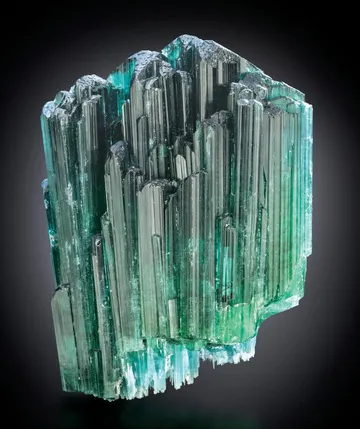
Porcupine Pocket tourmaline is the steely blue, blue-green to teal elbaite suite that gave the find its lasting identity: long, slender, striated prisms, mostly antilogous in habit, in extreme cases reaching about 35 cm long while only around 2 cm thick, with many crystals mounted on lilac lepidolite, white cleavelandite/albite, quartz, and locally tourmaline-rich matrix. The signature pieces are sprays and bristling groups rather than isolated gem pencils; the pocket’s best-known named specimens include “The Porcupine,” “The Sailboat,” “The Blue Star,” “Legs,” and “The Hat.” Smaller documented examples show lustrous blue-green indicolite crystals from a few centimeters long on mixed lepidolite and albite, while exceptional cabinet pieces may combine two habits in the same group—thin, transparent teal rods alongside stout, darker blue crystals. Fine specimens are separated from ordinary Porcupine material by intact or convincingly restored terminations, strong steely-blue saturation, transparent windows, original matrix context, attractive crystal spacing, and fully disclosed repair history; because the pocket was large and partly collapsed, multi-repair specimens are normal, but unrepaired matrix examples and floaters command special respect.
Quartz from Porcupine Pocket is important chiefly as the structural and visual partner to the tourmaline, appearing as colorless to pale smoky crystals, quartz matrix, and occasional sizeable crystals incorporated into tourmaline groups; in the celebrated “Blue on Blue” cabinet specimen, a quartz crystal about 9.0 x 4.3 cm was recorded on the backside of the piece, colorless except for lilac lepidolite included near its base. Porcupine quartz is not the dominant species in the way it was in the earlier Giant Quartz Pocket, but when present it gives the blue tourmalines a clean, glassy counterpoint and helps anchor long, delicate prisms that otherwise would read as loose rods. Good Porcupine quartz associations preserve both species naturally: tourmaline crystals emerging from or crossing quartz without awkward added-looking contact, sharp quartz faces rather than bruised broken mass, and enough lepidolite or albite to tie the specimen back to the pocket’s lavender-and-white matrix aesthetic.
Other documented Porcupine Pocket minerals include lepidolite, albite/cleavelandite, and herderite or hydroxylherderite associations. One recorded small-cabinet specimen carries tourmaline crystals to 4.5 cm with herderite twins, lepidolite, and quartz; auctioned Porcupine examples also describe white bladed albite dusted with lavender lepidolite, as well as feldspar fragments on tourmaline-rich groups. The pocket is prized less for type-locality mineralogy than for a very specific paragenetic look: steely blue elbaite rising from a lithium-rich pegmatite matrix, with quartz, pale feldspar, and lilac mica providing the stage.
Porcupine Pocket authenticity is mostly a question of reconstruction, disclosure, and attribution rather than outright fake tourmaline. Laboratory-grown tourmaline crystals are not a normal threat in this part of the fine-mineral market; the real danger is a specimen whose repairs, restored contacts, added matrix, or pocket assignment have been blurred by sales language. Pederneira pockets—Porcupine especially—were commonly collapsed, and long pencil-like tourmalines often broke into multiple sections. A repaired Porcupine Pocket specimen can still be important, beautiful, and fully collectible, but the number and nature of repairs should be known. Cleanly rejoining a natural break is one matter; building an attractive group from unrelated crystals or hiding major restoration at attachment points is another.
Inspect Porcupine tourmalines under magnification and, when appropriate, longwave UV to look for adhesive in contacts and around terminations. Follow the striations across breaks; they should continue logically. Check whether color zoning and internal growth features align across repaired sections. On matrix pieces, look for suspiciously perfect joins between tourmaline bases and lepidolite or albite, unnatural glue menisci, restored white feldspar, or bruised cleavelandite blades painted over with preparation work. Because some Porcupine crystals are naturally thin and rod-like, broken tips, rehealed-looking ends, pressure bruises, and tiny edge chips are common condition issues.
Pocket attribution deserves special care. “Porcupine Pocket” should ideally be supported by an old label, direct provenance from Fine Minerals International or the Pederneira partnership, publication history, auction documentation, or a convincing match to the pocket’s known blue, slender, lepidolite-associated habit. A blue Pederneira tourmaline is not automatically Porcupine; the mine produced several blue and blue-green pockets, including Big Blue, Blue-Green, Blue Gem, Azul Bien Grande, and Bi-Color Steel. Conversely, a slender steely-blue crystal on lilac lepidolite with early-2000s documentation has a much stronger claim.
The most available Porcupine specimens are small to small-cabinet pieces that entered the market through earlier collections and auction dispersals. Large matrix groups, named pieces, and unrepaired specimens are scarce to essentially unavailable in normal dealer stock. Market value is driven by color saturation, completeness, crystal length, matrix aesthetics, provenance, publication history, and repair disclosure. A modest Porcupine example can still be highly desirable because it represents one of Pederneira’s great named pockets; the finest pieces belong in the same collecting conversation as the top modern tourmalines from any locality.
The Porcupine Pocket arrived in the middle of a year that veterans of the mine still describe in nearly unbelievable terms. Pederneira had already produced a succession of major pockets—Rocket and Afghan among them—when the miners opened a still larger cavity in Dada’s Tunnel. At first the find must have looked less like a ready-made treasure chamber than a mineralogical wreck: long blue crystals, broken sections, matrix blocks, loose pieces, subtle differences of diameter and color, and enough fragments to overwhelm the informal repair methods that had worked on smaller pockets.
That is the hidden story behind Porcupine’s famous beauty. The pocket forced the operation to professionalize the reconstruction process. Pieces were moved into a special room, laid out and sorted by color tone, diameter, size, association, and any other clue that might reunite a crystal with its original matrix. One photograph from the 2015 Mineralogical Record monograph shows a team member working through the fragments, while in the background a large lepidolite matrix carried small white stickers marking possible reattachment points. That matrix became the base of “The Porcupine,” the pocket’s namesake specimen.
The work could stretch far beyond ordinary specimen preparation. Reconstructing one large Pederneira specimen could take several months to half a year before the piece was even ready for final decisions among the partners. Then a major specimen might be disassembled again, packed, transported to the United States, cleaned, reassembled, repaired or restored as needed, mounted on a Lucite base, labeled, photographed, priced, and only then shown to serious buyers. The timeline from pocket to collector could be a year or more; for the largest pockets, it could extend for several years. Porcupine Pocket is therefore a reminder that many of the most graceful tourmaline specimens in modern cabinets passed through a long interval of controlled chaos before they became display objects.
The names themselves read like a roll call of modern Brazilian tourmaline: “The Porcupine,” “The Sailboat,” “The Blue Star,” “Legs,” “The Hat.” “The Porcupine,” at 37 cm, was eventually acquired by the Smithsonian Institution and displayed as one of the great blue-green contrasts to its later reddish-pink Pederneira “Cranberry Crown.” “The Sailboat,” at 61 cm, was recorded as the largest group recovered from the pocket. “Legs,” a 20 cm floater spray, was singled out because it showed no obvious point of attachment and no repair—an almost miraculous survival in a pocket where many crystals broke into several sections and some needed more than ten repairs.
One of the most fascinating Porcupine objects to appear publicly was the Gerhard Wagner Collection’s “Blue on Blue,” offered by Heritage Auctions in 2015. It was described not merely as attractive but as a formation puzzle: thin, long teal-blue prisms occurred with stout, wide, darker blue tourmalines in the same specimen, the longest slender crystal measuring about 23.5 x 0.8 cm and the two stout crystals approaching 10 cm across their terminations. One of the thick crystals even enclosed a doubly terminated thin tourmaline. That combination—two sharply different habits in one Porcupine specimen—captures why the pocket continues to interest serious collectors beyond color alone. It is not just beautiful; it asks mineralogical questions.