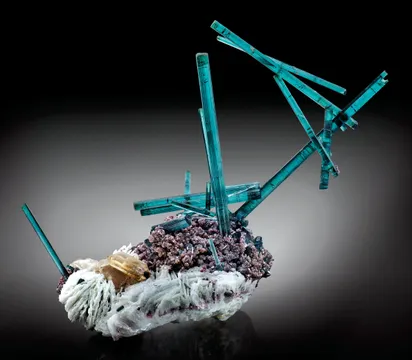
Burkhard’s Pocket, Pederneira Mine, Brazil — a premier locality for red-and-blue tourmalines in evolved pegmatite, with pristine pockets and striking matrix.
Key facts
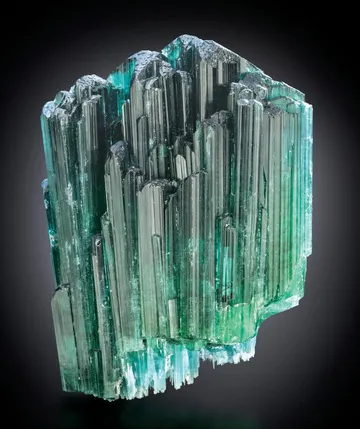
Burkhard’s Pocket is one of the named modern pockets that made the Pederneira Mine a reference locality for matrix tourmalines rather than merely a source of gem rough. It belongs to the lithium-, boron-, and beryllium-enriched granitic pegmatite system of São José da Safira in eastern Minas Gerais, within the great Eastern Brazilian Pegmatite Province. At Pederneira, the important specimen pockets occur in highly evolved core zones of the Dada and Dilo pegmatite bodies, especially where otherwise thin tabular pegmatites swell into steep, column-like productive zones. Burkhard’s Pocket, encountered in 2006 and named for Burkhard Pohl, is remembered for saturated red-and-blue bicolored tourmalines, white cleavelandite of unusual thickness, quartz, and lepidolite. Its finest specimens have the unmistakable Pederneira stagecraft: transparent to translucent tourmaline pencils rising from a dense, snowy matrix, with red cores, blue rinds, greenish to yellowish terminal zones, and a crispness of termination that makes even modest-sized crystals read as important.
Regional View
Country View
What separates Burkhard’s Pocket from the broader Pederneira production is not maximum size. The largest crystals were reported at around 15 cm, with an average closer to 9 cm, small by the standards of the mine’s largest named pockets. Its importance lies in a very particular combination of color, habit, preservation, and matrix. The pocket had collapsed, yet the floor remained comparatively intact, allowing miners to recover specimens that show the original pocket landscape. The published suite includes cabinet pieces to 27 and 38 cm across, a 17 cm tourmaline group with quartz and cleavelandite, smaller crystals on stark white albite, and a singular 12 cm specimen described as the only known Pederneira example in which a tourmaline crystal is completely overgrown by quartz.
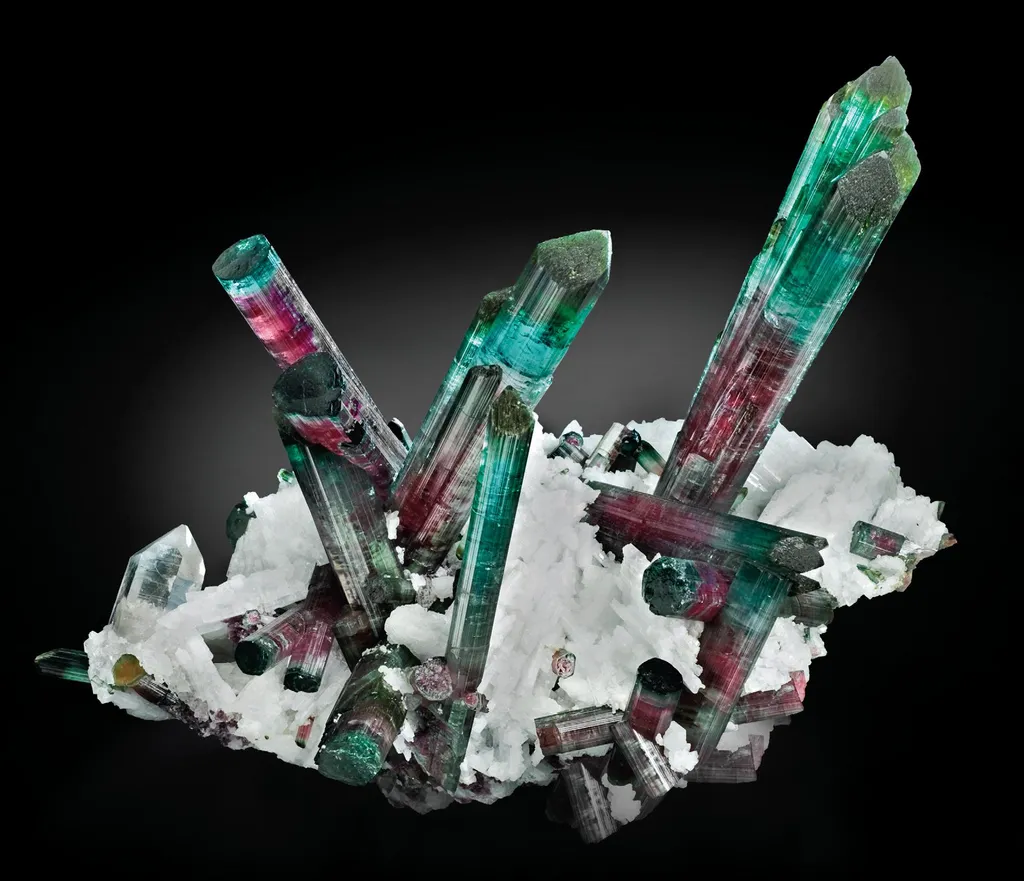
Photo: EarthWonders specimen 6944; Mineralogical Record figure 233, Malte Sickinger photo
Search for specimens: View all specimens from Burkhard’s Pocket, Pederneira Mine, São José da Safira, Brazil
Pederneira is a complex granitic pegmatite deposit in the São José da Safira district of Minas Gerais, a district that also includes such famous pegmatites as Cruzeiro, Aricanga, Golconda, and Jonas. The mine lies near the Córrego da Pederneira at roughly 700–750 meters elevation, in schist country rock. Geological work on the mine describes two principal subparallel tabular pegmatite bodies, known in mining terms through the Dilo and Dada workings, separated by a mica-schist septum. The bodies are generally thin, commonly on the order of 50 cm to 2 meters, but they locally swell into steep, prismatic columns more than 15 meters thick; these swollen, highly evolved sectors supplied most of the specimen production.
The deposit is not an “ore body” in the base-metal sense. Its economic value has shifted through time from muscovite to gem rough to collector specimens. The productive pegmatite zones are built around quartz, feldspars, mica, albite, cleavelandite, lepidolite-group mica, tourmaline, beryl, phosphates, and accessory Nb-Ta oxides. The best tourmaline-bearing cavities occur along a highly evolved “pocket plane” separating upper and lower core zones. In these pockets, quartz, cleavelandite, and lepidolite line the cavity walls, while gem tourmaline formed as first-generation crystals rooted deeper in the pegmatite and as later “pencil” crystals, either isolated or in clusters.
The mine’s earliest recorded phase began in the 1940s, when a farmer named Pacheco reportedly discovered a muscovite-bearing outcrop after a major storm. Wartime demand for mica briefly brought outside attention, but the deposit did not prove large enough as a muscovite operation and passed back into local hands. A second era began in the 1980s in what became known as Dilo’s Tunnel, when Natinho, working with landowner José Oliveira Rocha, “Deca,” struck a rich tourmaline pocket after only a short advance. Dilermando Rodrigues Melo and his son Dilo acquired the pocket contents, and the mine became a notable tourmaline source, though that early production was poorly documented by modern specimen standards.
The modern Pederneira story began in 1999, when Dada discovered a new pegmatite outcrop roughly 100 meters above the old lower workings. Dada’s Tunnel produced Keké’s Pocket late that year and attracted a partnership that became known as M. Pederneira Limited. The principal names in the modern operation included Junior Tomich, José Menezes, Saint-Clair Fonseca Jr. (“Keké”), Miranda, Eustacio Neves, Dada, and landowner Deca, with Burkhard Pohl joining the partnership in 2006. This phase was unusual because specimen recovery became a primary goal. Pockets were not simply blasted for gem rough; miners used careful unloading, diamond chain saws, hydraulic equipment, wrapping, boxing, transport, documentation, and later laboratory preparation to preserve matrix specimens.
Burkhard’s Pocket belongs to that modern Dada’s Tunnel era. It was found in 2006 shortly after Burkhard Pohl joined the team and measured about 2 cubic meters. The pocket was totally collapsed when discovered. Rather than abandoning it as rubble, miners unloaded it slowly, shard by shard, and found that the floor was still relatively intact. Some specimens were recovered unrepaired, and the bottom of the pocket was cut out carefully with a diamond chain saw. That careful extraction is central to the character of the surviving pieces: they are not just loose gem tourmalines but portions of an original pocket floor, with tourmaline, cleavelandite, quartz, and lepidolite preserved in architectural relationship.
Collecting access should be understood accordingly. Pederneira is a private underground mine, not a casual field-collecting site. Important Burkhard’s Pocket specimens entered collections through the mine partnership, major dealers, auctions, published collections, and later resale. Any modern specimen purporting to be from Burkhard’s Pocket should be judged on documentation, pocket-specific habit, and condition disclosure, not merely on the fact that it is a Pederneira tourmaline on albite.
The tourmalines from Burkhard’s Pocket are classic Pederneira elbaite-style crystals but with a pocket signature sharp enough to be recognized by experienced collectors: both flat, analogous terminations and pyramidal, antilogous terminations occur, both styles are bicolored blue and red, and all of the published crystals are described as translucent with strong saturation. In the antilogous crystals, the base shows a red core wrapped by a blue rind, then shifts about two-thirds of the way up into more solid blue before ending in dark green to yellow terminal zones; in the flat-terminated crystals, the red core and blue rind continue nearly to the final centimeter, where a sudden blue cap appears. Reported individual crystal lengths are mostly modest for Pederneira, averaging about 9 cm and reaching around 15 cm, but the best specimens compensate with glassy, razor-sharp terminations, vivid zoning, and placement on thick white cleavelandite with quartz and occasional lepidolite. Good Burkhard’s Pocket tourmaline is therefore not judged simply by size; it is judged by whether the crystal shows the red-blue zoning clearly, whether the termination is complete and lustrous, whether the matrix is original and balanced, and whether any restoration is cleanly disclosed.
Cleavelandite from Burkhard’s Pocket is more than a neutral base for tourmaline: it is one of the identifying features of the pocket. Published descriptions emphasize that the albite blades are distinctly thicker than typical Pederneira cleavelandite, approaching nearly 6 mm, with little transparency and a stark, solid white color. On the best specimens this heavy, ruffled cleavelandite gives a high-contrast platform for the red-blue tourmaline, and its mass helps explain why Burkhard’s pieces often feel more sculptural and compact than more delicate “spray” specimens from other pockets. Collectors should look for crisp, undamaged blades or rosettes that have not been excessively trimmed down, natural seating for the tourmaline, and a matrix that frames the color rather than swallowing it; ordinary pieces lose much of the Burkhard’s character when the albite is chalky, abraded, or merely used as a repaired support.
Quartz in Burkhard’s Pocket occurs as a matrix and associated species with the tourmaline and cleavelandite, and it is unusually important because of one published specimen: a 12 cm example described as the only known Pederneira specimen showing a tourmaline crystal completely overgrown by quartz. More typical Burkhard’s quartz appears as clear to pale crystals or masses that add sparkle and structural support to the white cleavelandite, rather than as the dominant species. The best quartz-bearing pieces use quartz compositionally, giving the tourmaline an airy perch or a transparent counterpoint to the dense albite; less successful pieces are those where quartz is broken, cloudy, intrusive, or distracts from the pocket’s defining red-blue tourmaline and solid-white cleavelandite contrast.
The specifically documented Burkhard’s Pocket assemblage is narrow but choice: tourmaline, cleavelandite, quartz, and lepidolite are the minerals repeatedly attached to published specimens. Lepidolite appears as a lavender to pinkish mica accent in some pieces, adding a third color note between the tourmaline and albite. No verified type-locality mineral is tied to Burkhard’s Pocket in the sources used for this guide. In the broader Pederneira pegmatite, however, documented minerals include albite, beryl, elbaite, rossmanite component in some pink tourmaline, foitite in dark green to black zones, dravite- or schorl-like black tourmaline in other parts of the pegmatite, fluorapatite, orthoclase, helvine, hydroxylherderite, mica-group minerals including lepidolite, quartz, and spodumene, with cassiterite, Nb-Ta oxides, pyrochlore-group minerals, spessartine, rhodochrosite, pyrite, and altered phosphate masses also noted in the mine’s geological discussion.
Burkhard’s Pocket specimens should be bought as named-pocket Pederneira material, not as generic Brazilian tourmaline. A convincing piece should show some combination of the pocket’s red-and-blue tourmaline zoning, sharp terminations, white thick-bladed cleavelandite, and documented association with quartz or lepidolite. The best labels will name Burkhard’s Pocket, Pederneira Mine, São José da Safira, Minas Gerais, Brazil, and ideally include provenance to the Pederneira partnership, Fine Minerals International, a published collection, a Mineralogical Record figure, or a reputable auction/dealer record.
The central condition issue is repair. This is not a minor footnote at Pederneira; it is part of the locality’s collecting reality. Many major Pederneira pockets were collapsed, and long, slender tourmaline crystals commonly broke either naturally in the pocket or during extraction. Expert reassembly along original lock-fit contacts is normal and often acceptable on fine Pederneira pieces, especially when the crystal, matrix, and break surfaces genuinely belong together. Undisclosed repairs, mismatched crystals added to matrix, polished terminations, restored tips, dyed or oiled matrix, and vague “Pederneira-style” attributions should be treated seriously. On Burkhard’s material, “unrepaired” examples are especially desirable because the pocket did yield some unrepaired specimens despite collapse.
Common condition concerns include bruised terminations, edge chatter on cleavelandite blades, detached or reattached tourmaline bases, cleavelandite that has been heavily trimmed to stabilize the specimen, and small lepidolite losses. Quartz associations should be checked for repaired contacts and for hidden adhesive where quartz meets albite or tourmaline. The tourmaline itself is relatively durable as a mineral, but gemmy zones, terminations, and repaired bases are vulnerable to shock. Avoid ultrasonic cleaning, steam cleaning, and repeated soaking; use air, a soft brush, and conservative dry cleaning unless a professional preparator advises otherwise.
Fluorescence is not a major value driver for Burkhard’s Pocket pieces. The collector appeal lies in daylight color, transparency, luster, zoning, and matrix composition. Display lighting matters: transmitted or raking light can reveal the red core, blue rind, and greenish terminal zones more effectively than flat front lighting. Strong direct sunlight should be avoided for long-term display, both as a general precaution for colored gem minerals and because heat cycling is unwise for repaired matrix specimens.
Market availability is limited but real. Burkhard’s Pocket appears in published collections, on EarthWonders specimen records, in auction archives, and occasionally in dealer or private-collection offerings. Prices vary sharply with size, completeness, repair disclosure, color saturation, and documentation. A small, clean, pocket-correct crystal on quartz or albite can be more desirable than a larger but clumsy repaired matrix. For serious Pederneira collectors, Burkhard’s Pocket occupies the same collecting category as the mine’s other named discoveries: a specimen is valued not only as tourmaline, but as an example of a particular pocket’s mineralogical “handwriting.”
When Burkhard’s Pocket was opened, it did not present itself as a pristine crystal cathedral. It was collapsed. The roof had come down, and the first view was rubble, not orderly rows of tourmaline. That could have been the end of the story in a rough gem operation: pry out whatever crystals could be sold, discard the broken matrix, and move on. Instead, the Pederneira crew unloaded it slowly, shard by shard. Beneath the collapse they found something crucial: the pocket floor was still comparatively intact. The disaster had not erased the original mineral landscape.
The pocket had been named for Burkhard Pohl, who joined the Pederneira partnership in 2006. Almost immediately after his arrival, the mine encountered this roughly 2-cubic-meter cavity. It was not gigantic by Pederneira standards, but it was important enough to demand patient work. The largest crystals were only around 15 cm, and the average crystal was around 9 cm, but the pocket’s character was unmistakable. The crystals were red and blue, translucent, saturated, and sharp; the cleavelandite was thick, white, and visually forceful. The mine’s crew realized that if they could save the pocket floor, they could preserve something more valuable than loose gem sticks.
The extraction became a slow act of reconstruction before the specimens had even left the ground. Some areas of the floor had apparently been protected by the fallen top portions of the pocket. The miners considered another possibility as well: perhaps fluid in the cavity had slowed the collapse, cushioning the fall enough to leave the lower crystal landscape alive. With patience and a diamond chain saw, they cut the bottom of the pocket out. That detail is central to understanding why Burkhard’s pieces look the way they do. They are not arbitrary assemblies of bright crystals; the best are rescued fragments of the original pocket bottom.
The published sequence around Burkhard’s Pocket shows the path from underground survival to collector cabinet. A specimen is found in the collapsed pocket, cleaned, reconstructed where necessary, placed on a table in the Pederneira house, then trimmed and cleaned again in a professional laboratory before reaching the market. The process is almost geological in its own right: first the pegmatite makes the pocket, then collapse breaks it, then miners and preparators read the break surfaces and crystal footprints as a puzzle. In Pederneira language, a good restoration is not decorative invention. It is a return to where the crystal grew.
One Burkhard’s object became a small legend because it overturned expectations even within a mine famous for surprises. It was a 12 cm specimen in which quartz had completely overgrown a tourmaline crystal. Pederneira produced tourmaline on quartz, tourmaline with quartz, tourmaline beside quartz, and quartz that supported tourmaline; but this complete quartz overgrowth was recorded as the only known example of its kind from the mine. In a locality where each named pocket is remembered for a signature, that single object gave Burkhard’s Pocket an additional calling card beyond its red-blue crystals and thick white albite.