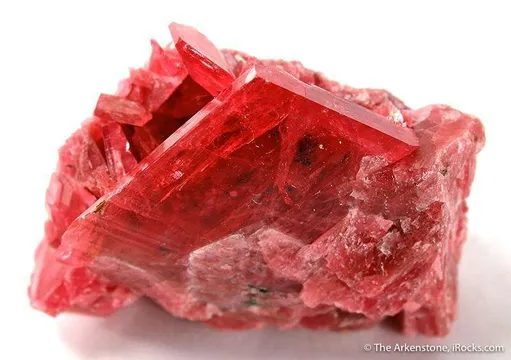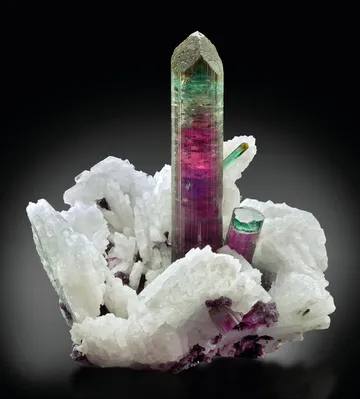
Mutuca Mine, Brazil — pegmatite locality famed for large gem-quality blue to blue-green elbaite (indicolite), often with quartz matrix and prized for color, si…
Key facts
Mutuca Mine, best treated on older and more precise labels as the Manoel Mutuca Mine or Manoel Mutuca claim, is one of the small but outsized gem-pegmatite localities of the Virgem da Lapa area in northeastern Minas Gerais. It belongs to the Araçuaí Pegmatite District of the Eastern Brazilian Pegmatite Province, the great rare-element pegmatite belt that has supplied Brazil with tourmaline, beryl, topaz, lithium minerals, phosphates, feldspar, quartz, and collector-grade pocket assemblages for generations. Within that already famous country, Mutuca’s claim to fame is narrower and sharper: thick, gem-quality elbaite, especially blue to blue-green indicolite, in crystals substantial enough to command both the gem cutter’s and the specimen collector’s attention.
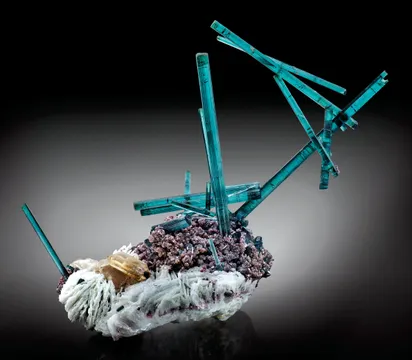
The locality matters because it produced blue elbaite with an unusual combination of mass, color, and crystal presence. Many Brazilian indicolites are pencil-like crystals—beautiful but narrow, dark, or too fractured for large stones. Mutuca’s best crystals could be stout, deeply etched, and richly colored, with some rough yielding a sapphire-like blue when oriented and cut across the c-axis. For the specimen collector, the magic lies in the tension between gem rough and cabinet mineral: much of the finest material was cut, so surviving whole crystals and especially matrix pieces are genuinely scarce.
Regional View
Country View
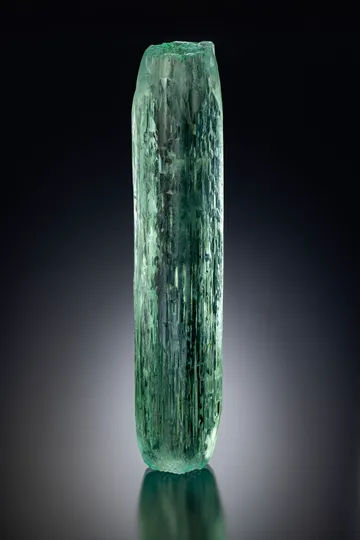
The best Mutuca specimens have a very particular look: vitreous, striated prisms in saturated green, blue-green, or true indicolite blue, often with etched sculptural surfaces or “windows” where late fluids, growth interruption, or dissolution modified the prism. The most desirable pieces retain sharp terminations, strong transparency when backlit, and enough thickness to show internal color rather than simply appearing dark. Matrix examples with quartz are among the most coveted because they preserve the pocket context that the cutting trade so often erased.
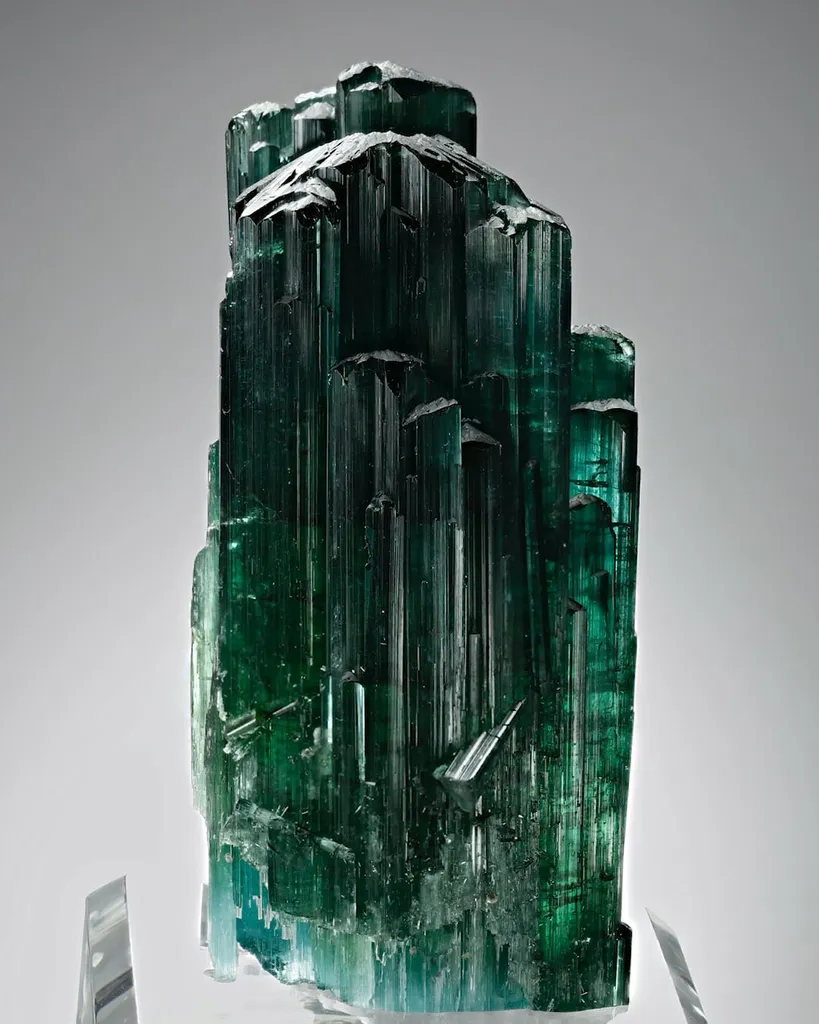
Photo: EarthWonders
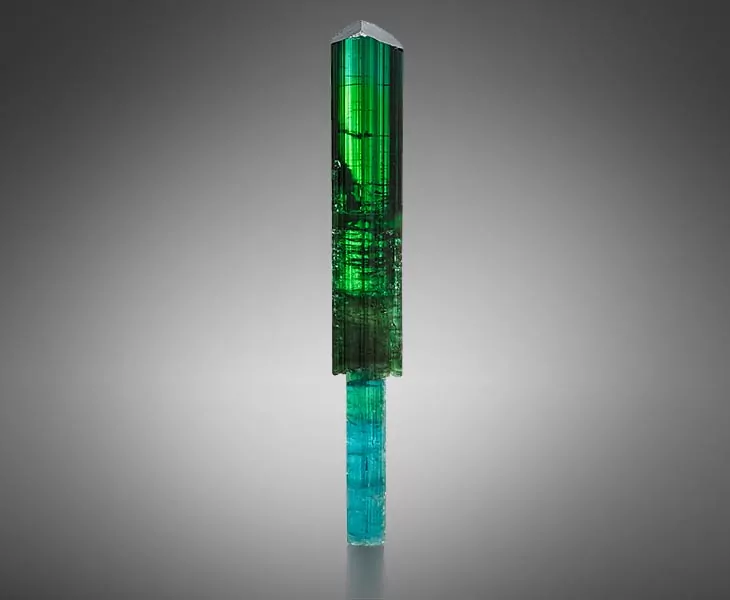
Photo: Mardani Fine Minerals
Search for specimens: View all specimens from Mutuca Mine, Brazil
Mutuca is part of the Virgem da Lapa group of gem pegmatites, a cluster historically counted with Limoeiro, Xanda, Manoel Mutuca, Toca da Onça, and Laranjeiras. These deposits sit in the Jequitinhonha-region pegmatite country between Araçuaí, Coronel Murta, Salinas, and Virgem da Lapa, an area long famous for elbaite, topaz, beryl, feldspar, quartz, and rare phosphates. In regional geological terms the locality lies within the Araçuaí Pegmatite District of the Eastern Brazilian Pegmatite Province, where complex rare-element granitic pegmatites are related to Neoproterozoic–Cambrian granitic magmatism of the Araçuaí orogen. The broader district’s pegmatites are commonly hosted by metasedimentary rocks of the Salinas Formation and associated granitic suites; the economically interesting bodies are enriched in the elements that make LCT-style gem pegmatites so collectible—Li, B, Na, Cs, Ta, Sn, Be, P, F, and related components.
The Virgem da Lapa pegmatites were described in the classic literature as near-horizontal, tabular to lens-shaped bodies of complex, comparatively unaltered granitic pegmatite. That matters to collectors because unaltered hard-rock pockets tend to preserve cleaner, sharper crystals than deeply decomposed eluvial or lateritic deposits. Yet Mutuca has an important wrinkle: much of its celebrated blue tourmaline was reported from colluvial deposits, and at least one in-situ pegmatite also produced specimens. This explains the two faces of the locality in collections: etched, sculptural, gem rough-like crystals on one hand, and very rare matrix pieces on quartz on the other.
Historically, the Virgem da Lapa mines entered the gem world through small, difficult workings rather than large industrial mine planning. The area’s mines were first discovered around 1939–1940 and were soon worked for industrial beryl; by the 1960s and 1970s, gem pockets had made the district far more important to collectors and cutters. Proctor’s 1985 account places Manoel Mutuca on an 18,000-acre ranch owned by Manoel Mutuca, south of Barra de Salinas and just south of the Jequitinhonha River. The workings were only about 8 air kilometers from the better-documented Xanda and Limoeiro mines and near the famous Barra de Salinas rubellite workings across the river.
Production was episodic. In the Virgem da Lapa group as a whole, the great specimen and gem surge centered on the 1970s, especially the years around 1974–1978, when many tons of green and bicolored tourmaline were mined for cutting and collecting. Manoel Mutuca’s distinctive contribution was a significant quantity of the finest blue tourmaline rough in the district. The old literature records crystals up to about 15 cm long by 12 cm wide and weighing as much as 1.2 kg. Later collector-market descriptions also record fine 1950s or 1960s material, much of it lost to the lapidary trade, and a much smaller early-2000s pocket that produced a handful of world-class gemmy green-blue indicolite crystals, including scepter-like forms.
No realistic public-collecting access should be assumed. These are private Brazilian gem workings in rugged country, historically reached by rough roads and worked when capital, labor, water, weather, and pocket luck made the risk worthwhile. Serious collectors should treat modern Mutuca specimens as market pieces, not field-trip targets, and should expect old labels, dealer provenance, and comparison with known Mutuca habits to be more useful than any hope of direct access.
Elbaite is the reason Mutuca appears on serious tourmaline lists: the mine produced unusually thick, gem-quality blue to green-blue crystals, along with fine green examples, commonly as striated prisms with vitreous luster, etched surfaces, and strong color when backlit. The best documented blue material includes stout indicolite crystals reported up to about 15 cm long and 12 cm wide, with rough as heavy as 1.2 kg; later market examples include elongated bicolored crystals with blue lower sections and green upper growth, as well as scarce early-2000s green-blue indicolite crystals with scepter character. Good Mutuca elbaite is separated from ordinary Brazilian tourmaline by thickness, transparency, saturated indicolite or blue-green color, intact termination, and, above all, survival as a specimen rather than being reduced to faceted stones; matrix pieces with quartz are in a still higher rarity class.
Public mineralogical records for the Manoel Mutuca claim itself are conservative: elbaite and quartz are the securely documented species, with “tourmaline” also used historically and in older dealer language. No IMA type-locality mineral should be attached to Mutuca labels. The broader Virgem da Lapa district is far richer—topaz, hydroxylherderite, beryl varieties, feldspar, lepidolite, albite/cleavelandite, microcline, muscovite, phosphates, and rare species such as greifensteinite are all part of the district story—but those belong to their specific mines and claims unless a specimen’s label and provenance justify the Mutuca attribution.
The main authenticity issue is locality precision. “Mutuca” is not a unique mining name in Brazil, and there are unrelated Mutuca references in Minas Gerais, including iron-mining contexts near Nova Lima and a Mutuca pegmatite/Santa Rosa usage in the Malacacheta area. For elbaite specimens of the kind discussed here, the intended classic locality is Manoel Mutuca Mine or Manoel Mutuca claim, Virgem da Lapa, Jequitinhonha Valley, Minas Gerais, Brazil. Old labels that say only “Mutuca Mine, Brazil” should be interpreted cautiously and checked against habit, provenance, and any accompanying dealer or collection history.
Mislabelling is most likely to involve other northeastern Minas Gerais tourmaline localities—Barra de Salinas, Salinas, Cruzeiro, Pederneira, Golconda, Xanda, Limoeiro, or other Araçuaí–Salinas district mines. Mutuca crystals tend to be valued for blue to blue-green color, stout form, strong gemminess, and etched sculptural habit, but those traits alone do not prove the locality. A good Mutuca label should ideally preserve a chain of custody, an old dealer source, or a publication/exhibition history.
Condition is central. Many Mutuca crystals were colluvial or etched, so natural corrosion, growth irregularity, and solution “windows” should not automatically be read as damage. At the same time, tourmaline is brittle across fractures and along healed internal flaws; broken terminations, bruised prism edges, reglued bases, polished contact points, and repaired matrix junctions must be examined carefully. Backlighting is essential for judging whether a dark-looking crystal is truly saturated gem elbaite or merely opaque. Fine crystals are often mounted, and old acrylic bases can conceal chips or contact repairs at the foot.
Treatments are a subtle issue because the gem literature records common heating of blue and green tourmaline from the region to lighten or brighten color, and Mutuca blue rough was specifically noted for responding well to heat. That does not mean every Mutuca specimen is treated, nor that intact crystals were routinely heated as display specimens, but any high-value blue piece should be bought with a clear disclosure standard: natural color, heated, or unknown. For specimen value, undamaged form, unquestioned locality, and untouched surfaces generally matter more than whether the color would cut a fine stone.
True Mutuca specimens are not abundant. The economic gravity of the locality pulled strongly toward the gem trade, so many of the finest crystals disappeared into calibrated stones and jewelry. Cabinet-quality matrix specimens are particularly rare, and famous published pieces have moved through major collections. On today’s market, expect isolated crystals and occasional bicolored or indicolite examples to appear sporadically, often at prices reflecting both locality scarcity and the intrinsic gem value of the crystal.
The Mutuca story is partly the story of a mine that produced material almost too good to remain mineral specimens. The old accounts describe the Manoel Mutuca workings on an 18,000-acre ranch south of Barra de Salinas, just below the Jequitinhonha River and only a short flight from Xanda and Limoeiro. In a district already accustomed to good tourmaline, Mutuca’s blue crystals caused special excitement because they were not merely blue—they were thick. That single physical fact changed everything. Thin indicolite “pencils” can be magnificent specimens, but they frustrate cutters. Mutuca crystals could be nearly as wide as they were long, opening the possibility of large, richly colored stones cut across the c-axis. In the trade imagination, the crystals became potential “sapphire”-blue gems before many collectors ever had a chance to save them whole.
One published Mutuca specimen escaped that fate and became a kind of witness for the locality. The 10.5 cm indicolite on quartz later chosen for Wayne Thompson’s Ikons supplement was mined in the 1970s and passed through a remarkable chain: Milton Sklar, Rich Kosnar, Keith Proctor, Gilles Emringer, Eric Asselborn, Wayne Thompson, Sandor Fuss, Mike Mulberger, and finally Gene and Roz Meieran. Its fame rests on a combination that is almost unfairly rare: gemmy blue tourmaline still attached to euhedral quartz. That is the whole Mutuca dilemma in one object—the very material most tempting to cut is the material collectors most desperately want preserved.
A different market example shows the locality’s stranger side. A 16.5 cm dark green Mutuca prism sold by Heritage Auctions in 2022 was described with a natural “window” passing all the way through the crystal near the termination. The color shifted from very dark green near the base to transparent green higher up, then back toward darker transparent green at the top. Such a specimen is not the sleek textbook tourmaline of a beginner’s guide; it is a hard-rock and fluid-history object, a crystal that records growth, interruption, dissolution, and survival.
Cassedanne, Jacques P., and Jack Lowell. “Famous Mineral Localities: The Virgem da Lapa Pegmatites.” The Mineralogical Record, Vol. 13, No. 1, 1982, pp. 19–28. The foundational collector-locality article for the Virgem da Lapa pegmatite group, including the district framework in which Manoel Mutuca belongs.
Proctor, Keith. “Gem Pegmatites of Minas Gerais, Brazil: The Tourmalines of the Araçuaí Districts.” Gems & Gemology, Spring 1985, pp. 3–19. The key gemological account for Manoel Mutuca blue tourmaline, including mine location, reported crystal sizes, colluvial occurrence, in-situ production, cutting behavior, and treatment notes.
Thompson, Wayne A. “Tourmaline (Indicolite) on Quartz, Manoel Mutuca Mine, Virgem da Lapa, Minas Gerais, Brazil.” Ikons, Classics, and Contemporary Masterpieces of Mineralogy, The Mineralogical Record Special Supplement, Vol. 38, No. 1-S, 2007, p. 66. Documents the celebrated 10.5 cm indicolite-on-quartz Mutuca specimen, its provenance chain, and publication history.
Mindat.org locality record: Manoel Mutuca claim, Virgem da Lapa, Minas Gerais, Brazil. A concise mineralogical database record listing the locality as a gemstone- and specimen-producing granite pegmatite with elbaite and quartz.
Mindat.org locality record: Virgem da Lapa, Minas Gerais, Brazil. Useful for the broader district context, including the relationship of Manoel Mutuca to Limoeiro, Xanda, Toca da Onça, and other Virgem da Lapa sublocalities.
Heritage Auctions, Lot 72141, “Tourmaline, Manoel Mutuca Mine, Virgem de Lapa, Jequitinhonha Valley, Minas Gerais, Brazil,” sold March 25, 2022. Documents a 16.5 cm green Mutuca prism with an unusual natural window and Minerals America provenance.
Manoel Mutuca claim — Mindat.org — The most direct public database record for the exact Mutuca locality, with its concise mineral list and locality hierarchy.
Virgem da Lapa — Mindat.org — Broader district page for understanding the surrounding pegmatite group and its documented mineral diversity.
Keith Proctor, “Gem Pegmatites of Minas Gerais, Brazil: The Tourmalines of the Araçuaí Districts” — GIA — Essential reading for Mutuca’s blue tourmaline, reported sizes, production setting, and gemological behavior.
Tourmaline, Manoel Mutuca Mine — Mardani Fine Minerals — A high-quality specimen description illustrating the bicolored blue-to-green habit prized from the locality.
Elbaite var. Indicolite Tourmaline, Mutuca Mine — EarthWonders — A modern specimen record with locality notes, dimensions, images, and provenance.
Tourmaline, Manoel Mutuca Mine — Heritage Auctions — Auction documentation for a large green prism with a natural window and Minerals America provenance.
Tourmaline (Indicolite) on Quartz — The Mineralogical Record Ikons supplement — Source for the famous 10.5 cm Mutuca indicolite-on-quartz specimen and its ownership history.
Eastern Brazilian Pegmatite Province / Araçuaí District geosite — Serviço Geológico do Brasil — Geological context for the Araçuaí Pegmatite District, host rocks, granitic suites, and rare-element pegmatite mineralization.