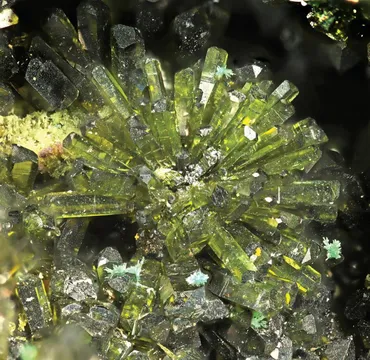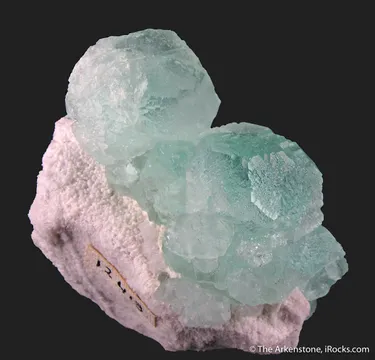
A collector's guide to Utah, USA: its geology, mining history and notable minerals, illustrated with the 198 specimens documented from this locality on EarthWonders.
Key facts
Utah matters to mineral collectors because it is not one locality in the narrow cabinet-label sense, but a whole mineral province: porphyry copper at Bingham Canyon, silver-lead-zinc replacement orebodies at Tintic and Park City, sandstone-hosted copper in Lisbon Valley, iron skarns at Iron Springs, phosphate nodules at Clay Canyon and Lucin, topaz rhyolite in the Thomas and Wah Wah ranges, evaporite and lacustrine gypsum around Great Salt Lake, and countless smaller desert occurrences that have supplied American collections for more than a century. Few U.S. states combine such a deep mining history with such a wide collecting palette: brilliant blue azurite and green malachite from oxidized copper zones; brassy pyrite, dark tetrahedrite, galena and sphalerite from sulfide veins and replacement bodies; classic goethite after pyrite cubes from Pelican Point; polished and specimen-grade variscite nodules from Clay Canyon; magnetite and fluorapatite associations from Iron Springs; and red beryl, topaz, bixbyite-(Mn), pseudobrookite, hematite and opal from the high-fluorine rhyolites of west-central Utah.
The best Utah specimens have a distinctly Western look. Bingham Canyon material often carries the muscular character of a great porphyry system: pyrite, quartz, tetrahedrite-group minerals, galena, turquoise and copper oxides in tough mine matrix rather than dainty alpine perfection. Tintic specimens are oxidized, colorful and chemically adventurous, with azurite, malachite, aurichalcite, cerussite, anglesite, mimetite, jarosite-group minerals and rare tellurates in vugs and mine-dump seams. Lisbon Valley azurites can be strikingly vivid, with rich blue crystals and clusters coming from porous, bleached sandstone rather than carbonate replacement ore. Clay Canyon variscite is prized for saturated apple- to emerald-green nodules, often with yellow to cream crandallite and wardite patterning. Pelican Point goethites are not merely “brown iron”: the finest pieces preserve sharp cubic pyrite architecture, sometimes as crisp floater groups with striations, stepped faces and occasional brassy remnants. Utah rewards the collector who reads old labels carefully, because “Utah” can mean anything from a 19th-century Tintic oxidation-zone rarity to a modern Great Salt Lake selenite plate.
Regional View
Country View
The state’s specimen history is inseparable from mining. The Bingham district moved from 19th-century underground lead-silver-gold workings into one of the world’s great open-pit copper operations; the Tintic district became one of the classic American silver-lead-zinc districts and later one of the richest U.S. localities for secondary tellurium minerals; Clay Canyon was a famous early variscite source whose nodules attracted both lapidaries and academic mineralogists; and Topaz Mountain remains one of the most approachable public collecting areas in the country for well-formed topaz in rhyolite cavities. For serious collectors, Utah is best approached by district and mine, not simply by state name: a “Utah azurite” from Lisbon Valley, Mammoth mine, Bingham Canyon, or Frisco may represent very different geology, habit, age and market desirability.
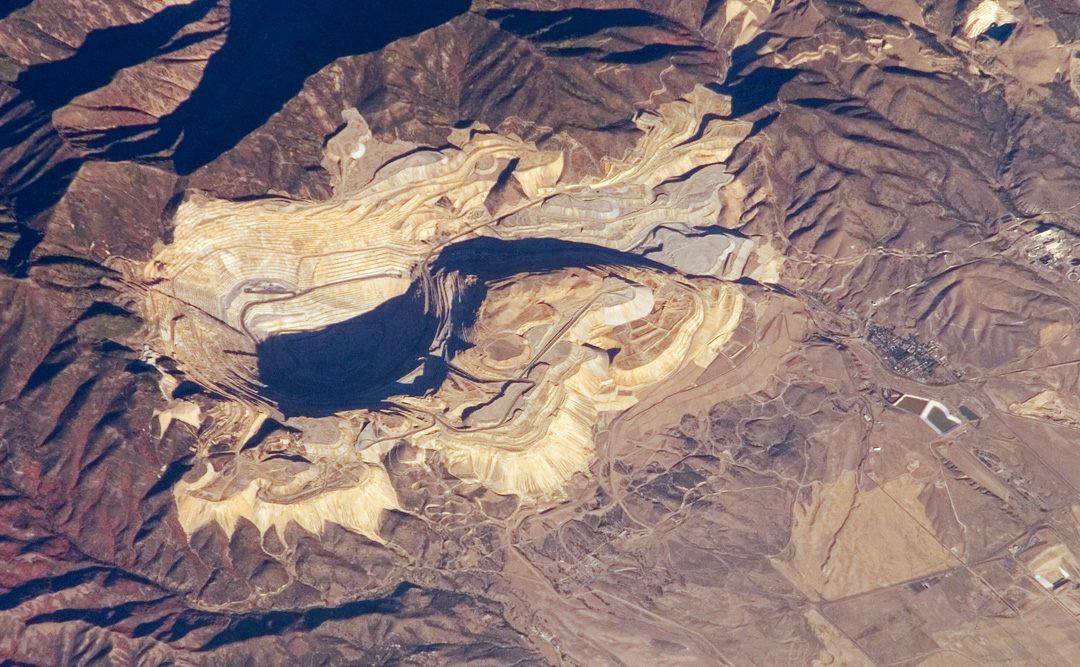
Photo: NASA Earth Observatory
Search for specimens: View all specimens from Utah, USA
Utah’s mineral-specimen record is dominated by several deposit families. In the Oquirrh Mountains southwest of Salt Lake City, Bingham Canyon is a porphyry copper-molybdenum-gold-silver system centered on hydrothermally altered intrusive rocks and surrounding Paleozoic sedimentary rocks. Its collecting interest comes from both primary sulfide assemblages and oxidized zones: pyrite, chalcopyrite, bornite, molybdenite, tetrahedrite-group minerals, galena, sphalerite, quartz, calcite, turquoise, azurite, malachite and a long suite of secondary copper and sulfate species. Historically, high-grade gold, silver and lead ores were mined underground before large-scale open-pit copper mining began in the early 20th century. Today the Kennecott operation is an active Rio Tinto mine complex with surface and underground mines, concentrator, smelter, refinery, rail infrastructure and tailings facilities, so collecting is not a casual field activity; modern specimen availability comes from older collections, historic mine material, permitted recovery, dealer stock and occasional mine-associated dispersals rather than public access to working ground.
The Tintic district in the East Tintic Mountains of Juab and Utah Counties is a different kind of collector’s paradise. Its great ore zones—Gemini, Mammoth, Plutus, Godiva and Iron Blossom among them—are chiefly replacement deposits in carbonate rocks, with fissure veins also important in early mining. Primary ore minerals include enargite, tetrahedrite, galena, sphalerite, pyrite, marcasite, gold, silver and copper. In the oxidation zones, that primary sulfide endowment generated a remarkable secondary suite: smithsonite, hemimorphite, aurichalcite, malachite, azurite, cuprite, cerussite, anglesite, hematite, quartz, calcite, aragonite, dolomite, barite and gypsum, plus rarities such as olivenite, clinoclase, mixite, tyrolite, conichalcite, linarite, scorodite, adamite, mimetite, carminite, cornwallite, jarosite, plumbojarosite and connellite. The Centennial Eureka, Bullion Beck, Grand Central, Mammoth and Northern Spy mines are especially important names on old labels. Tintic is also a type-locality district for a notable group of minerals, and reworking of old Centennial Eureka dumps exposed microcrystalline copper tellurates that became famous among systematic collectors.
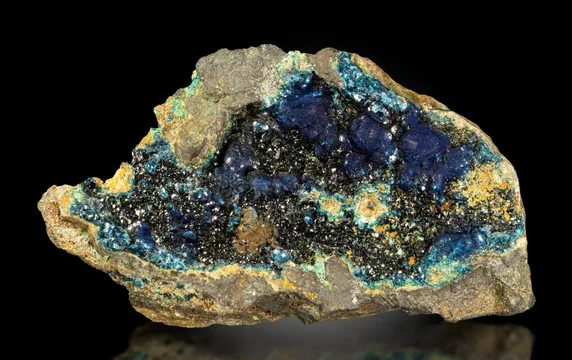
In southeastern Utah, Lisbon Valley is the state’s great sandstone-hosted copper district. The ore bodies follow a northwest-trending anticline cut by a major normal fault that acted as a hydrothermal channel. Copper minerals occur in the pore spaces of bleached Cretaceous Burro Canyon Formation sandstone, with additional mineralization in the Dakota Sandstone. In specimen terms, this gives Lisbon Valley a very different character from Tintic or Bingham: azurite and malachite may sit in pale, porous sandstone, and the best azurite clusters have a brightness and openness that contrast with the heavier sulfide-rich matrices of Utah’s older mining districts. The Big Indian mine area is especially significant in specimen history because beautiful azurite clusters discovered there in 1978 were collected commercially into the late 1980s. Lisbon Valley Mining Company operates the modern open-pit, heap-leach, solvent-extraction/electrowinning copper operation on a large block of ground in San Juan County, so access and collecting are governed by active-mine restrictions and land status.
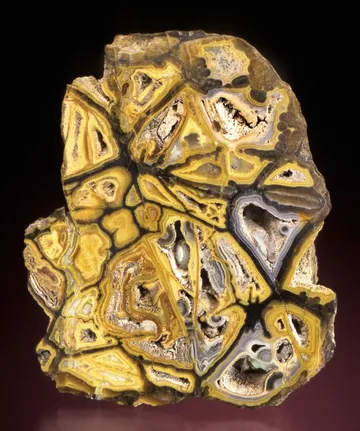
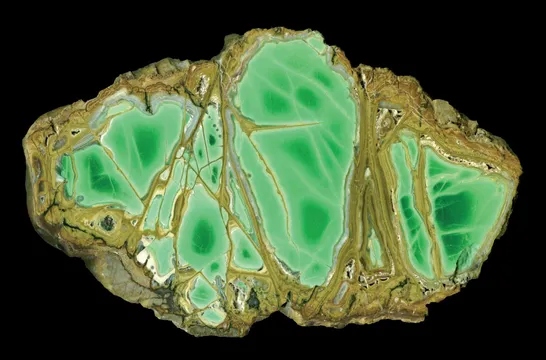
Clay Canyon near Fairfield is one of Utah’s great nonmetallic specimen localities. The Little Green Monster variscite deposit, also labeled historically as the Utahlite mine, Chlorutahlite mine, Clay Canyon mine or simply Fairfield, produced green aluminum phosphate nodules and an extraordinary suite of associated phosphate minerals. Variscite was first recognized there in the 1890s, and the nodules attracted both lapidary use and mineralogical study. Specimen material is typically nodule, seam or vein material rather than free-standing crystals: the best pieces show strong green color, attractive yellow or cream crandallite/wardite contrast, and natural nodular form. The classic mine has been worked and reworked for diminishing returns, and much desirable material now circulates from old collections, estate parcels and lapidary rough rather than fresh field production.
Topaz Mountain and the broader Thomas Range represent Utah’s high-fluorine rhyolite collecting style. Topaz crystals formed in cavities in the Topaz Mountain Rhyolite, an approximately 6–7 million-year-old volcanic rock. Loose colorless topaz crystals are commonly found in washes, while better amber crystals, crystal groups and associated minerals require opening solid rhyolite pockets. The same region is famed for red beryl, bixbyite-(Mn), pseudobrookite, hematite, garnet-group minerals, opal and amethyst. Much of the classic public collecting area is on BLM land, but private claims and leases exist; the correct approach is to confirm current land status, avoid marked claims, and treat the rhyolite with eye protection and restraint.
The Iron Springs district west of Cedar City is a magnetite-dominant iron skarn and replacement district. Its ores are chiefly magnetite with minor hematite, formed by replacement of carbonate rocks near intrusive contacts; associated gangue and specimen minerals include calcite, quartz, dolomite, phlogopite, fluorapatite, siderite, ankerite, diopside, magnesite, gypsum, barite, epidote, andradite, vesuvianite and scapolite. Collectors value sharp magnetite octahedrons, fluorapatite on magnetite, calcite associations and unusual native lead–minium specimens from the Cedar City area, but old mine workings, claims and land status must be treated carefully.
Utah’s evaporite and desert-lacustrine localities round out the specimen picture. The Dugway Geode Beds formed when Miocene rhyolite cavities were later eroded and redeposited by Lake Bonneville processes into collectable geode-bearing sediments; the typical prize is a hollow geode lined with clear, purple or pinkish quartz rather than one of the headline metallic species. Great Salt Lake and nearby saline environments produce gypsum and selenite crystals, including clear plates, stacks and clay-included “dirty diamond” styles. These are fragile, soft, water-sensitive specimens that belong in trays, boxes and stable indoor conditions, not loose in field buckets with harder quartz or sulfides.
Public collecting in Utah is possible, but not everywhere. BLM casual collecting rules allow reasonable personal-use collecting on many federal lands where not otherwise closed, claimed, leased, developed or environmentally restricted. Utah School and Institutional Trust Lands require their own rockhounding permit for state trust parcels. Private land requires permission. Active mines, patented claims, leased gemstone ground, National Parks, most National Monuments, American Indian lands, military reservations, dam sites, wildlife refuges and archaeological sites are not open collecting ground. Old mining districts also present real hazards: open shafts, unstable dumps, contaminated mine waste, steep slopes and lead-arsenic-rich oxidation zones. A good Utah field plan starts with land-status maps, current agency rules, claim checks, local road conditions and a willingness to walk away from any questionable access.
Utah azurite ranges from thin oxidation-zone coatings to serious cabinet specimens, with the strongest collector names including Lisbon Valley, Bingham Canyon, Mammoth and other Tintic mines, and scattered old copper camps such as Frisco. Lisbon Valley material is especially distinctive because blue crystals and clusters formed in bleached sandstone pore spaces in a sediment-hosted copper system; good pieces show vivid royal-blue color, recognizable crystal form, and natural contrast against pale sandstone or associated malachite rather than merely powdery blue stain. Tintic and Bingham azurites tend to be more closely tied to sulfide oxidation and carbonate-rock or mine-matrix settings, commonly associated with malachite, cuprite, cerussite, anglesite, aurichalcite, quartz, calcite and iron oxides. The top Utah azurites have depth of color, unbruised luster, and locality specificity on the label; ordinary examples are massive, rubbed, or simply blue-green mine rock without crystal architecture.
Pyrite is a backbone mineral in Utah’s great sulfide districts, especially Bingham Canyon, Tintic, East Tintic and Park City, where it occurs with quartz, tetrahedrite-group minerals, enargite, galena, sphalerite, chalcopyrite, calcite and silver-bearing ore minerals. Bingham pyrite specimens may show brassy modified cubes or clusters on quartz and sulfide matrix, reflecting the broad pyritic shells and sulfide zoning of a porphyry copper system. Tintic pyrite is important both as an ore-stage mineral and as the parent of later oxidation products; pieces from the Trixie, Eureka Standard, North Lily and other East Tintic mines can be associated with acanthite, hessite, petzite, galena, tetrahedrite and quartz. In collector terms, Utah pyrite is strongest when it has sharp, lustrous crystals and a named mine; massive brassy sulfide without form is common, while well-composed Bingham or Tintic examples with documented associations are much more desirable.
Utah malachite is the green companion and alteration partner of azurite across the state’s copper districts, particularly Bingham Canyon, Lisbon Valley, Tintic, Frisco and smaller oxidized copper prospects. Lisbon Valley malachite commonly reflects copper moving through porous sandstone, producing green coatings, seams, sprays and replacements associated with azurite and tenorite in the upper oxide zone above chalcocite, bornite and chalcopyrite. Tintic malachite belongs to a richer secondary suite, where it may occur with aurichalcite, azurite, cuprite, cerussite, anglesite, smithsonite, hemimorphite and iron oxides. The best Utah malachites are not just green stains: they show velvety botryoidal texture, fibrous sparkle, sharp contrast with azurite or pale matrix, and a reliable mine or district label; weak, powdery coatings are common and far less collectible.
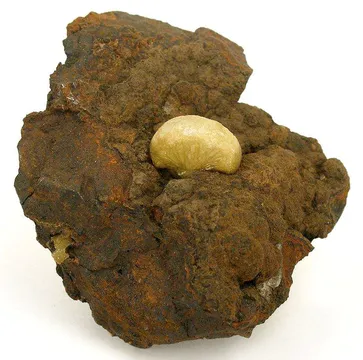
Utah’s most collectible goethite is the Pelican Point material from the Lake Mountains district near Utah Lake, where pyrite crystals were replaced by brown to black iron oxyhydroxide while preserving the original cubic morphology. Fine specimens are pseudomorphs rather than ordinary limonite masses: sharp cubes, modified edges, striated faces, stepped growth and floater groups are the features collectors look for, and some pieces retain tiny brassy pyrite remnants in cracks or cavities. Individual replaced crystals can reach thumbnail to small-cabinet scale, with documented examples showing crystals around 5–25 mm and cabinet pieces several centimeters across. Strong pieces have crisp geometry, stable surfaces and minimal bruising; mediocre pieces are rounded, friable brown aggregates that only hint at their pyrite ancestry.
Utah variscite is one of the state’s signature collector and lapidary minerals, led by Clay Canyon near Fairfield and supplemented by Lucin, Snowville and other northwestern Utah occurrences. Clay Canyon material from the Little Green Monster/Utahlite area occurs as nodules and seams in an altered fault zone, commonly with crandallite, wardite, millisite, gordonite, montgomeryite, overite, sterrettite and related aluminum phosphate minerals. The most desirable pieces show saturated green variscite with attractive yellow, cream or gray-green phosphate patterning, natural nodule form, and enough polish or broken surface to reveal color without sacrificing geological character. Ordinary Utah variscite is pale, chalky, fractured or mostly crandallite-rich matrix; the best specimens balance color, pattern, provenance and integrity.
Calcite is widespread in Utah but most meaningful to collectors when tied to a specific district assemblage: as gangue in Tintic replacement bodies, as vein and vug fill in Park City and Bingham sulfide ores, as a carbonate association in Iron Springs skarn material, and as matrix or late-stage crystal growth in smaller desert prospects. In Tintic, calcite accompanies quartz, aragonite, dolomite, barite, gypsum and oxidized lead-copper-zinc species, so a modest calcite crystal can be more interesting when it carries aurichalcite, minium, cerussite, mimetite or sulfide remnants. Iron Springs calcite may occur with magnetite, fluorapatite and skarn minerals, making association specimens more important than isolated calcite aesthetics. Good Utah calcites have sharp form, luster, association and named-mine context; generic pale rhombs or broken vein calcite are common and usually valued only as matrix.
Tetrahedrite-group minerals are central to Utah’s silver-lead-zinc mining districts, especially Tintic, Bingham and Park City, where they occur with pyrite, quartz, galena, sphalerite, enargite, chalcopyrite and other silver-bearing sulfides and sulfosalts. Park City specimens, including material from the Daly-Judge area, are known for dark metallic tetrahedrite associated with sphalerite and pyrite; Tintic and East Tintic material may be argentiferous and can sit within complex telluride-sulfosalt assemblages. Because tetrahedrite is often visually subdued, quality depends on sharp tetrahedral or modified crystals, contrast against quartz or sulfide matrix, and a label that preserves the mine and district. Massive black sulfosalt ore is historically interesting, but crystallized Utah tetrahedrite with bright pyrite or sphalerite association is far more collectible.
Utah aurichalcite is chiefly a secondary zinc-copper carbonate from oxidized base-metal districts, with Tintic and East Tintic especially important on specimen labels. At the Burgin mine and other Tintic localities, aurichalcite belongs to the lead-zinc-copper oxidation suite with cerussite, smithsonite, hemimorphite, malachite, azurite, anglesite, brochantite, calcite, barite and iron-manganese oxides. It is usually collected as pale blue to blue-green acicular sprays, velvety crusts or fibrous aggregates rather than large crystals. Good Utah aurichalcite needs freshness and delicacy: silky needles, clear blue-green color, bright contrast on calcite or limonite-rich matrix, and no dusting, crushing or bleaching; weak material is chalky, matted or merely an indistinct blue-green coating.
Utah selenite, the transparent crystalline variety of gypsum, is best known from saline-lake and desert evaporite settings such as Great Salt Lake and from Hanksville-area Wayne County material. Great Salt Lake selenite may occur as clear to translucent plates, crystals and clay-included “dirty diamond” forms grown in mud and brine-influenced sediments; Hanksville specimens can appear as transparent stacked sheets or blades. The appeal is clarity, geometry and delicate internal clay or growth features rather than hardness or brilliance, because gypsum is very soft and easily scratched. Fine Utah selenite is clean, complete, naturally lustrous and undried-looking; poor examples are bruised, flaking, etched by moisture or abraded from transport with harder minerals.
Gypsum occurs across Utah in evaporite, lacustrine, sedimentary and mine-oxidation settings, from Great Salt Lake selenite to massive gypsum deposits in central and southern counties and small crystals in metallic districts such as Tintic and Iron Springs. Collector gypsum may appear as clear selenite plates, stacked blades, desert-included crystals, fibrous satin spar, or granular to massive material. In Tintic, gypsum is part of the gangue and oxidation suite accompanying quartz, calcite, aragonite, dolomite and barite, while in Iron Springs it can be a minor gangue mineral in magnetite-skarn assemblages. The best Utah gypsum specimens are undamaged, stable, well-crystallized and locality-specific; ordinary gypsum is abundant, soft and easily reduced to scratched or cleaved fragments if not handled separately.
Utah magnetite is most collectible from the Iron Springs district west of Cedar City, where iron ores are chiefly magnetite with minor hematite formed by skarn and replacement of carbonate rocks. Specimen magnetite may occur as massive ore, sharp octahedrons in vugs, or association pieces with fluorapatite, calcite, quartz, siderite, dolomite, phlogopite, diopside, epidote, andradite, vesuvianite or scapolite. The district is valued because the magnetite can be both geologically significant and aesthetic: black octahedral crystals against calcite or pale-green fluorapatite make far better cabinet specimens than dense ore lumps. Fine pieces show sharp crystal faces, strong luster, magnetic response, and undamaged associated apatite or calcite; mediocre examples are heavy black massive fragments with little form.
Native lead is a rarity in Utah collections, with the Cedar City/Iron County material especially notable because metallic gray lead microcrystals and blebs occur with red to yellowish minium on heavy iron-mine matrix. This is not the galena-rich lead-silver ore familiar from Tintic or Park City, but actual native Pb preserved as tiny metallic crystals, clusters or masses in vugs and surfaces. The best specimens show visible, well-placed lead against contrasting brick-red minium, ideally with crystals large enough to resolve under a hand lens or microscope; some documented examples have lead clusters several millimeters across. Because lead is soft, toxic and prone to dulling, good Utah native lead specimens are handled as protected rarities rather than robust display pieces.
Utah minium is an uncommon secondary lead oxide best known from Cedar City/Iron County native lead specimens and from Tintic occurrences such as the Centennial Eureka and Burgin mines. On the Cedar City material, minium may form solid, heavy, brick-red to orange-red or yellowish-red masses and microcrystalline surfaces hosting scattered native lead; on Tintic pieces it is more typically a microscopic to small-specimen oxidation product within lead-rich mine assemblages. The finest examples are richly colored, dense, and visually contrasted with native lead or calcite, while still carrying trustworthy provenance because red lead minerals and man-made lead oxides can be confusing in old collections. Avoid powdery, anonymous red material unless the identity and locality are supported by a serious label or analysis.
Beyond the species highlighted above, Utah is unusually rich in type-locality and rarity material. Tintic has yielded type-locality minerals including argentojarosite, arsenobismite, billingsleyite, crandallite, tinticite and the Centennial Eureka copper tellurates frankhawthorneite, jensenite, leisingite and utahite. The Thomas Range and adjacent topaz-rhyolite country are essential for red beryl, bixbyite-(Mn), holfertite and other rare high-temperature volcanic minerals; Maynard Bixby’s name is attached to both bixbyite and the older variety name “bixbite” for red beryl, a continuing source of label confusion. Clay Canyon is important for a dense aluminum-phosphate suite including variscite, crandallite, wardite, millisite, gordonite, montgomeryite, overite, sterrettite, lehiite, lewistonite and related species. Utah also produces notable topaz, fluorapatite, turquoise, fluorite, galena, sphalerite, barite, cerussite, smithsonite, hemimorphite, mimetite, red beryl, bixbyite-(Mn), pseudobrookite, opal, amethyst, halite, geodes, petrified wood and uranium-vanadium minerals from the Colorado Plateau.
The main authenticity problem with Utah specimens is not a famous plague of manufactured fakes; it is locality precision. A label reading only “Utah” can hide enormous differences in value and meaning. “Azurite, Utah” should ideally be narrowed to Lisbon Valley, Bingham Canyon, Tintic, Mammoth mine, Frisco or another named district. “Variscite, Utah” may mean Clay Canyon/Fairfield, Lucin, Snowville or another Great Basin occurrence, and older trade names such as utahlite, chlorutahlite and amatrice have been used inconsistently. “Bixbite” on an old label usually means red beryl, not bixbyite-(Mn), even though both names honor Maynard Bixby and both minerals occur in Utah topaz-rhyolite environments. “Lead” should not be assumed to mean galena; true native lead from Utah is rare and should be treated as a distinct species requiring credible provenance.
Condition varies by mineral family. Azurite and malachite from Utah’s oxidized copper zones are commonly rubbed, edge-bruised or partly altered; the difference between a good and ordinary azurite is often the survival of glassy, unworn crystal faces. Aurichalcite needles are easily crushed or matted and should be protected from dust. Goethite after pyrite from Pelican Point should be checked for sharpness, broken cube corners and friable surfaces, but minor “missing” corners may predate the pseudomorphing and are not always later damage. Variscite nodules are often cut or polished; that is normal in lapidary material, but specimen collectors should distinguish natural nodules, sawn faces, polished display surfaces, stabilized cabochon rough and composite jewelry stock. Selenite and gypsum scratch with a fingernail and can cleave, peel or dull if stored loose. Native lead and minium require careful handling: lead-bearing dust should be avoided, hands should be washed after contact, and specimens should be kept away from children, food-preparation areas and excessive humidity.
Fluorescence can add value in specific Utah assemblages. Some Iron Springs fluorapatite associated with magnetite and calcite is reported to fluoresce, with calcite also capable of red responses under appropriate ultraviolet wavelengths. Hyalite opal from topaz-rhyolite settings may fluoresce green, though labels should not be upgraded from “opal” or “hyalite” without evidence. By contrast, many of the classic Tintic tellurates and lead oxides are micromount subjects rather than UV showpieces; their value lies in species rarity, type-locality status and analytical confirmation.
Market availability is uneven. Utah topaz, Dugway geodes, common gypsum and modest malachite remain accessible and relatively affordable. Pelican Point goethite pseudomorphs appear regularly but better sharp floater groups command a premium. Clay Canyon variscite is available as lapidary rough, slabs, polished nodules and old specimen material, but strong green natural nodules with documented provenance are scarcer than casual listings suggest. Lisbon Valley azurite clusters from the 1978–1980s collecting period, well-labeled Tintic oxidation-zone rarities, native lead–minium from Cedar City, and aesthetic Bingham sulfide specimens are all more specialized markets where provenance and old collection history matter.
The scale of Bingham Canyon is the story that even non-collectors remember, but the collector should look past the postcard grandeur and see the mineralogical transition. In the late 1800s, Bingham was an underground camp chasing high-grade gold, silver and lead. The work was done by candlelight and oil lamps, with black-powder smoke, wet workings and mule-powered trams. Then came the audacious idea that the low-grade copper staining in the leached monzonite was not waste but ore if mined on a massive enough scale. Daniel Jackling, Enos Wall, Samuel Newhouse and the Guggenheim-backed financiers turned a canyon of scattered claims into an experiment in mechanized bulk mining. Steam shovels began stripping at Boston Consolidated in June 1906 and at Utah Copper in August 1906; ore shipment from the open pit followed in 1907 and 1908. The collector’s old Bingham specimen—pyrite on quartz, tetrahedrite with galena, turquoise, azurite, malachite—is a small mineralogical witness to the moment when American mining crossed from hand-selected ore into the age of moving mountains.
Lisbon Valley’s best azurite story is more intimate. Copper mining there began at the Big Indian mine in 1903, but the district’s specimen fame came much later, when beautiful azurite clusters were discovered near Big Indian in 1978. For roughly the next decade, collectors and commercial diggers recovered vivid blue clusters from a sandstone-hosted copper system unlike the carbonate replacement camps of Tintic. That difference matters in the hand: Lisbon Valley azurite can look as if the blue has grown out of open pores and pale desert sandstone, a reminder that not all great copper specimens come from limestone caves or porphyry veins. The district later returned to large-scale copper production, but those late-1970s and 1980s azurites retain the aura of a finite specimen event.
Clay Canyon’s variscite history has the charm of a mineralogical relay race. In 1893, green nodules from the north slopes of Clay Canyon west of Fairfield reached F. T. Millis of Lehi, who sent material to George P. Merrill at the U.S. National Museum. Early descriptions called the material “nuggets” in a quartz vein, and the find quickly became one of the most important variscite occurrences in the country. The locality changed hands, but its greatest service to mineralogy came because Arthur Montgomery helped preserve nodules for study rather than letting every attractive piece vanish into cabochons. Those specimens fed the work of Esper S. Larsen, Jr. and E. S. Larsen III, who unraveled a suite of rare phosphate minerals from the nodules. For collectors today, a good Clay Canyon piece is not just green ornament: it is a cutaway into one of the classic American phosphate occurrences.
Topaz Mountain gives Utah its most democratic gem story. The crystals formed in cavities in rhyolite, and the field technique still has the directness of old-fashioned rockhounding: walk washes for loose, sun-bleached colorless crystals, or break fresh white rhyolite in search of amber topaz and associated pocket minerals. The best moments are small and sharp—a transparent topaz sliding out of a cavity, a black bixbyite-(Mn) crystal on pale rhyolite, or, very rarely, a red beryl crystal where most collectors find none. Utah’s red beryl story began with Maynard Bixby in the Thomas Range in 1904, when a raspberry-red beryl unlike the familiar green, blue, yellow or colorless varieties was recognized. The older name “bixbite” later became a labeling headache because bixbyite was already a different mineral named for the same man; in a single Utah tray, the collector can encounter both the beauty and the confusion.
Bingham Canyon’s Manefay landslides in 2013 are a modern mining story with geological force. On April 10, two enormous slides carried about 145 million tons of waste rock into the open pit. The first, at 9:30 p.m., was the larger, nearly 100 million tons; the second followed roughly an hour and a half later. Eleven minutes after the second slide, a shallow magnitude 2.5 earthquake registered beneath the mine, induced by the rapid shift in weight. The slide path dropped about 2,975 feet and ran about 9,840 feet, with a headwall 1,150 feet high, and the rock avalanche reached speeds over 70 mph. The remarkable part is what did not happen: no deaths and no injuries. Monitoring showed instability months in advance, movement accelerated to about 2 inches per day, employees were evacuated at 11 a.m., and a public warning went out that afternoon. The mine still lost shovels, haul trucks and other equipment, but the episode stands as a brutal lesson in the living geology of a pit large enough to change its own landscape.
The Dugway Geode Beds tell a quieter Lake Bonneville story. First, 6–8 million-year-old rhyolite trapped gases in cavities; then groundwater lined those cavities with quartz; then ancient Lake Bonneville eroded the geode-bearing rock and redeposited the geodes in sediments miles away. A modern collector digging in soft unconsolidated material is not working the original rhyolite ledge, but a lake-reworked concentration of hollow stones. Most geodes are only 2–3 inches across, often lined with sugary clear quartz, amethyst or pinkish quartz, but the pleasure is in the uncertainty of each round, lightweight nodule. Utah’s metallic districts impress by scale and chemistry; Dugway impresses by making deep geologic time feel like a shovel’s depth.