Deer Trail Mine, USA — classic Utah locality known for sea-green fluorite on quartz, with a broader mineral suite; prized by collectors for color and history.
Key facts
The Deer Trail Mine is one of the classic Utah localities that straddles two collecting worlds: the hard-rock mining history of the Marysvale–Tushar country, and the refined specimen market for pale green fluorite on sparkling quartz. It lies near Marysvale in Piute County, on the eastern flank of the Tushar Mountains, within the Mount Baldy–Ohio mining district. Geologically, it is a polymetallic carbonate-replacement system: silver-gold-lead-zinc-copper sulfide and oxide ores replaced favorable carbonate beds in the Permian Toroweap Formation, with the better-known specimen-producing fluorite occurring in the same broad hydrothermal environment that made the mine an important metal producer.
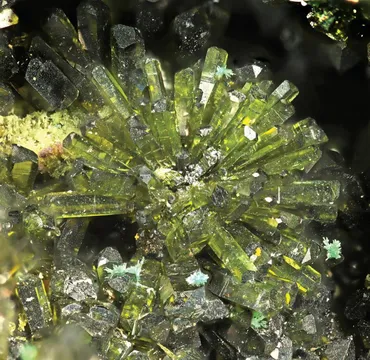
Collectors know Deer Trail first for its fluorite. The best pieces are immediately recognizable: sea-green to mint-green fluorite crystals, commonly dodecahedral to cubo-octahedral rather than simple cubes, perched on or partly cloaked by white drusy quartz. Some specimens are soft and sugary with quartz; others show translucent, backlit fluorite with stepped faces and a pale, icy glow. The mine also produced quartz specimens in their own right, generally as white druse, crusts, and matrix that set off the fluorite rather than as the major display mineral. Below the collector surface, the mineralogy is broader and more complex: galena, sphalerite, pyrite, chalcopyrite, cerussite, anglesite, malachite, jarosite, manganese-bearing calcite, uranium minerals reported historically as pitchblende/uraninite, and a suite of uncommon secondary copper-zinc sulfates and related species have all been documented from the locality.
Historically, Deer Trail matters because it was not merely a specimen pocket locality. It was the principal metal mine of the Marysvale area, discovered in 1878 and mined in several distinct chapters: early high-grade oxide ore, later work from the PTH tunnel and lower mine, and modern exploration aimed at understanding the full carbonate-replacement, skarn, and porphyry system. That gives the specimens a stronger story than many isolated fluorite finds: each good miniature carries the visual delicacy of a collector mineral and the geological context of a major western replacement deposit.
Regional View
Country View
The mine’s setting is part of its appeal. Deer Trail Mountain and the neighboring Alunite Ridge area sit within the Marysvale volcanic field, where volcanic rocks, altered intrusive-related systems, and older sedimentary host rocks meet along a major structural zone. The result is a district with vertical and lateral zonation: alunite-bearing advanced argillic alteration high in the system, epithermal gold-silver veins at intermediate levels, and polymetallic carbonate replacement bodies lower down. Deer Trail’s display minerals come from that lower, carbonate-replacement end of the system, but its fluorite is unusually attractive for Utah and occupies a special niche among American fluorite localities because of its color, form, and quartz association.
Search for specimens: View all specimens from Deer Trail Mine, USA
The Deer Trail Mine is in the Mount Baldy–Ohio mining district near Marysvale, Piute County, Utah, in the Tushar Mountains. Modern locality descriptions place it in the Deer Trail–Alunite Ridge part of the Marysvale volcanic field, along the structural transition between the Basin and Range–Great Basin side of western Utah and the Colorado Plateau side to the east. The mine workings are associated with the eastern side of Deer Trail Mountain, and the historic mine area includes the Upper Deer Trail, Lower Deer Trail, PTH tunnel, and nearby related targets such as Carissa and Lucky Boy within the larger modern exploration package.
The deposit is best described as a polymetallic carbonate replacement deposit, or CRD, with silver, gold, lead, zinc, and copper as the principal metals. The important ore bodies replaced favorable limestone beds in the lower part of the Permian Toroweap Formation. Published geological summaries describe the replacement bodies as semiconcordant to manto-like, flanking feeder structures and localized by folding and faulting. The ore system is not a simple vein: it is a structurally focused replacement system in which hydrothermal fluids moved through faults and permeable beds, reacting with carbonate host rocks and producing sulfide-rich bodies with quartz, carbonate, fluorite, and local barite or adularia as gangue.
The mine’s geology is especially interesting because the exposed Deer Trail orebodies are interpreted as part of a larger magmatic-hydrothermal system. Classic work on the deposit concluded that the sulfide replacement bodies formed in the outer zone of a volcanic hydrothermal system, with lead and sulfur isotopes pointing to an igneous source and fluid-inclusion and stable-isotope data indicating magmatic fluids progressively diluted by meteoric water. More recent exploration models have carried that idea farther, treating Deer Trail as the known high-grade CRD expression of a larger district-scale system that may continue toward skarn and porphyry-style copper-molybdenum mineralization beneath Deer Trail Mountain and the Alunite Ridge area.
Mining began after the discovery of the Deer Trail mineralized body in 1878. Local histories credit Joseph Smith, who was reportedly hunting deer about six miles southwest of Marysvale when he found the outcrop. The early mine exploited high-grade oxide and lead-rich ore near the surface. A small mill installed in 1918 marked the start of a particularly productive early period; historical summaries report that the Upper Deer Trail Mine produced roughly 138,000 tons of predominantly oxide material between 1918 and 1923, with rich gold, silver, and lead values. Mining was interrupted when workings encountered a fault that cut off the known mineralized body, after which production continued more sporadically from stopes and pillars.
A major second chapter began in 1945, when the PTH tunnel was driven to search for the faulted extension of the ore. After about 3,400 feet of drifting, a new mineralized body was encountered, and the PTH tunnel eventually became the key access to lower, unoxidized sulfide ore. Historical accounts describe more than 10,000 feet of tunnel development and later production from the lower mine, including the 8,600 area, where zinc, lead, silver, gold, and copper values were significant. The mine operated intermittently into the late twentieth century, with published modern summaries commonly noting historic production through the early 1980s or closure by the mid-1980s, depending on whether they are referring to the mine as a producing operation or to later intermittent activity and exploration.
Ownership and exploration have changed repeatedly. The property was explored by major companies in the late twentieth century, including Phelps Dodge, Noranda, Battle Mountain Gold, and Cominco American. Unico later controlled the mine and mill infrastructure; Western Pacific Resources entered an acquisition agreement in 2013 and undertook reactivation and underground exploration work in 2014. MAG Silver consolidated the Deer Trail and Alunite Ridge project area beginning in 2018 and announced acquisition of the consolidated project in 2020. In September 2025, Pan American Silver completed its acquisition of MAG Silver, adding MAG’s interest in the Deer Trail exploration project to Pan American’s portfolio. As of this guide, the locality should be regarded as an active exploration and permitted mining property, not an open rockhounding site.
For collectors, the important specimen production is tied less to ore tonnage than to the fluorite-quartz pockets and vugs encountered in the mine, especially material attributed to the PTH tunnel and related Deer Trail workings. The classic specimens came out as pale green fluorite, often with a white quartz coating or sugary quartz druse. Some were naturally attractive as found; others became much more desirable after careful acid preparation removed quartz films that masked the fluorite’s color and form. This preparation history is part of the Deer Trail look: bright sea-green crystals, exposed or partially jacketed in white quartz, with the best examples showing balanced composition, clean faces, and undamaged crystal edges.
Access today is not casual collecting access. The property includes patented and unpatented claims, historic underground workings, surface infrastructure, and ongoing permitting and exploration activity on both private and federal lands associated with the Fishlake National Forest. Permission from the operator and relevant land managers is essential. Old mine openings, timbered workings, unstable ground, sulfide oxidation, and modern exploration activity all make unauthorized entry unsafe as well as legally risky.
Deer Trail fluorite is the locality’s signature collector mineral: pale sea-green to mint-green, translucent to locally quite gemmy when backlit, and most prized where dodecahedral or cubo-octahedral crystals sit aesthetically on white quartz. Crystals on market specimens commonly range from thumbnail scale to about 1–2 cm, with some cabinet pieces carrying clusters of many crystals rather than a single dominant cube; the habit is notably non-cubic for fluorite, with dodecahedral faces and combinations of cube, octahedron, and dodecahedron giving the crystals a rounded, jewel-like architecture. Much of the fluorite was found coated or partly coated by thin white quartz, and acid-prepared specimens can reveal color that was originally hidden under a pale, opaque crust. Strong pieces have open placement, clean green color, sharp enough form to show the unusual habit, and sparkling quartz that enhances rather than buries the fluorite; ordinary pieces tend to be sugary, contacted, dull from microquartz coatings, or visually crowded by matrix.
Quartz from Deer Trail is usually valued as the essential stage on which the fluorite performs: white to colorless druse, crusts, and small crystals coating matrix, lining cavities, or partly sheathing fluorite crystals from the mine’s hydrothermal system. It can be sugary and opaque where it formed as a thin overgrowth, or brighter and more sparkling where fine drusy faces are intact. The best quartz-bearing specimens are those in which the quartz provides contrast without obscuring the green fluorite, especially pieces where white druse frames the fluorite or leaves windows through which the fluorite remains translucent. Quartz is also important in the broader ore mineralogy: it is a common gangue in the Deer Trail replacement and vein system, and cavities in quartz gangue are significant in the nearby Marysvale rare-mineral assemblages; however, as a display species from Deer Trail itself, quartz is usually collected as a locality-defining association rather than as isolated crystals of major size.
Beyond fluorite and quartz, Deer Trail has a substantial ore and secondary-mineral suite. Historic Utah mineral lists record anatase, anglesite, cerussite, galena, native gold, jarosite, limonite, leuchtenbergite, malachite, manganese-bearing calcite, pitchblende or uraninite, plumbojarosite, pyrite, pyrolusite, specularite, sphalerite, and zircon. Mindat’s more recent locality record expands the list with baryte, beudantite, brochantite, calcite, caledonite, campigliaite, chalcanthite, chalcopyrite, clinochlore, covellite, cuprobismutite, dolomite, epidote, gypsum, helvine, hessite, hübnerite, hydrozincite, ktenasite, linarite, mimetite, molybdenite, rhodochrosite, schulenbergite, serpierite, smithsonite, wulfenite, and additional rare or uncertain species. The immediate Marysvale district also has type-locality significance through minerals such as cannonite from the Tunnel Extension mine in the Ohio district, but collectors should keep those labels separate: “Marysvale,” “Ohio district,” “Tunnel Extension,” “Lucky Boy,” and “Deer Trail” are not interchangeable locality names.
The main authenticity issue with Deer Trail specimens is preparation and labeling, not a well-known trade in artificial fakes. A large proportion of desirable fluorite specimens have been cleaned to remove quartz coatings that originally made the crystals appear white and opaque. When disclosed, this is normal for the locality and does not disqualify a specimen; it does, however, affect how one judges luster and surface texture. Over-etched fluorite may look unnaturally matte, pebbly, or softened, while well-prepared pieces retain crisp form and enough quartz to show the original association.
Labels deserve close reading. “Deer Trail,” “Deertrail,” “Deer Tail,” “PTH Tunnel,” “Mount Baldy District,” “Mount Baldy–Ohio District,” “Cottonwood Creek,” and “Marysvale” can all appear on legitimate older or dealer labels, but there are other Deer Trail mines in the western United States, and there is also a Deer Trail Mine name in other Utah contexts. For specimen purposes, the precise collectible locality is Deer Trail Mine, Mount Baldy–Ohio mining district, Piute County, Utah, USA. Material merely labeled “Utah fluorite” or “Marysvale fluorite” should be checked against the habit: Deer Trail’s classic look is pale green dodecahedral to cubo-octahedral fluorite with white quartz, not purple Dugway-type fluorite, Illinois-style cubes, or massive banded lapidary material.
Condition is crucial. Fluorite has perfect octahedral cleavage, and Deer Trail crystals are often exposed on a hard, drusy matrix; bruised edges, contacted rear faces, and small cleaves are common. Because the fluorite is pale, internal cleavage and edge wear can be visually unforgiving under strong light. Quartz coatings can hide damage, but they can also create a desirable frosted contrast. The strongest specimens are those that balance natural association and visual clarity: enough quartz to confirm the locality character, enough exposed fluorite to show color and crystal form.
Fluorescence is part of the locality’s appeal. Natural History Museum of Utah displays Deer Trail fluorite in a long-wave ultraviolet fluorescence context, and collector reports also note fluorescence under both long- and short-wave ultraviolet light on some specimens. Use UV as a supporting observation, not as a sole identification test: fluorescence intensity varies with coatings, preparation, crystal thickness, and lamp wavelength. Handle acid-prepared specimens with the same caution as any fluorite: avoid thermal shock, ultrasonic cleaning, and unnecessary re-cleaning. Do not attempt hydrofluoric acid preparation outside a properly equipped professional setting; HF is exceptionally dangerous.
Market availability is better than for many Utah classics but still finite. Deer Trail fluorite appears regularly enough that serious collectors can be selective, yet fine old pieces with open composition, lustrous green crystals, and attractive quartz matrix are not common. Miniatures and small cabinet specimens are the sweet spot of the market. Large, undamaged, aesthetic cabinet specimens are substantially rarer, and specimens with documented older provenance, PTH Tunnel attribution, or strong museum-quality form can command a premium. Quartz-only pieces are far less sought after unless they are unusually aesthetic or tied to fluorite, sulfide, or rare-species associations.
The name of the mine still carries the moment of discovery. In 1878, Joseph Smith was reportedly trailing a deer in the mountains about six miles southwest of Marysvale when he noticed the mineralized outcrop that became the Deer Trail Mine. Local histories remembered Smith not simply as a prospector but as a figure later associated with the cyanide process in Utah mining. The story has the plain, compressed drama of many western discoveries: a hunter following game at the base of the range, a change of attention from tracks to rock, and a lead-silver-gold orebody emerging from a mountainside that would be worked for generations.
By 1920, Deer Trail was being described in civic language as one of the great mines of the state, with a modern plant and a mill admired for gravity handling and employee safety provisions. The same account reported the mine’s 1919 production in hard numbers: 15,801 tons of ore yielding 4,244 fine ounces of gold, 26,107 fine ounces of silver, 332,092 pounds of lead, and 3,136 pounds of copper. Those figures help explain why the locality has more gravity than a small specimen find. The same hills that later gave collectors pale green fluorite were, in that era, an industrial landscape of ore, mills, roads, teams, and men moving rock out of a district still wrestling with distance, weather, and transportation.
The darker side of Deer Trail’s mining history is also recorded in painful detail. On March 23, 1938, a smoldering fire and carbon monoxide in the mine killed Bert Glen Lund, age 36, and Dale McDonald Dalton, age 21, both of Marysvale. Four other miners were imperiled, and a rescue squad of eleven leasers entered dangerous conditions to bring men out. The trapped miners were about 3,500 feet back in the mine, in a winze 200 feet from the end of a drift. Morris Burr, half-conscious, managed to crawl on hands and knees until he reached fresh air and met Dean Trevort, who helped spread the alarm. Rescuers carried the unconscious men to clearer air about 1,500 feet from the danger zone, while a pulmotor was flown from Salt Lake to Richfield and rushed onward, arriving too late for the two men who died. A coroner’s jury later found carbon monoxide gas to be the cause of death.
Modern exploration added a different kind of field story. In 2014, when Western Pacific Resources was preparing the old mine for renewed underground drilling, contractors began by replacing transformers and substations, bringing buildings and electrical installations up to code, checking ground support, setting up ventilation, removing old powder, building new powder and cap magazines, constructing a refuge chamber, and driving new six-by-nine-foot drift and drill stations. It is an unusually vivid reminder that an old specimen locality is also a working industrial problem: before geology can be tested, air, power, explosives storage, rails, timber, and human refuge all have to be made safe enough to work around.