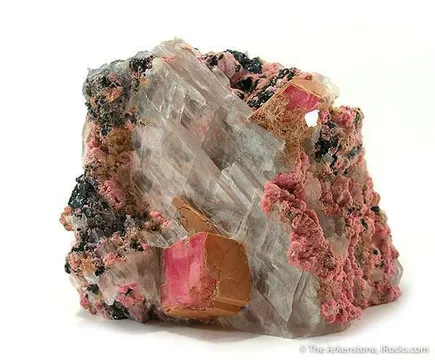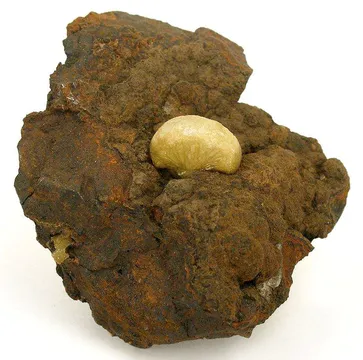
Tintic Mining District, Utah — renowned for dark azurite and malachite, olive olivenite, rare tellurates, and cabinet- and micromount-worthy specimens.
Key facts
Tintic is one of the great names in Utah mineral collecting: a silver-lead-zinc-copper-gold district whose specimen reputation rests not on a single show mineral, but on the oxidation of a large, chemically complicated ore system. The district lies around Eureka, Mammoth, Silver City, Dividend, and the East Tintic workings in the East Tintic Mountains of central Utah, where Paleozoic quartzites, shales, limestones, and dolomites were folded and faulted during Sevier deformation, then intruded and mineralized during Oligocene magmatism. The result is a district of carbonate-replacement bodies, fissure veins, high-sulfidation epithermal veins, and deeply oxidized copper-arsenic-tellurium suites. For collectors, Tintic means dark-blue azurite, velvety malachite, olive-green olivenite, deep blue-green clinoclase, conichalcite, tyrolite, mixite, linarite, carminite, mimetite, jarosite-group minerals, and a remarkable list of rare tellurates and type-locality species.
Regional View
Country View
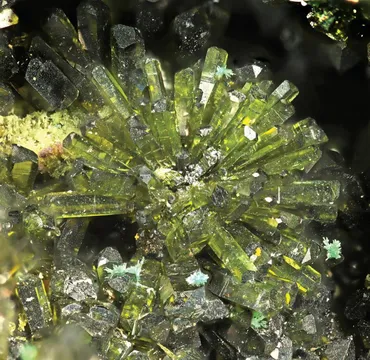
Tintic’s finest cabinet pieces have the look of an old western sulfide camp that has been through intense oxidation: heavy, dark matrices cut by small vugs, with sharply contrasting blue, green, olive, black, brown, and white mineral crusts. Mammoth and Centennial Eureka material can be especially handsome, with clinoclase in dark radial balls and sprays, olivenite lining small cavities, azurite and malachite adding saturated color, and quartz or barite providing sparkle. Many of the most desirable pieces are modest in size but very rich under magnification; the district is as important to the micromount collector as it is to the cabinet collector.

Photo: Wikimedia Commons / Rob Lavinsky, iRocks.com
The locality also matters historically. Tintic was organized after the 1869 discovery of rich silver ore, and by the early twentieth century it stood with Bingham and Park City among Utah’s great mining districts. The “Big Four” mines at Eureka—Bullion Beck, Gemini, Eureka Hill, and Centennial Eureka—gave the skyline its famous headframes, while later blind discoveries in East Tintic, particularly Tintic Standard, Burgin, and Trixie, showed that rich ore continued beneath volcanic cover where surface clues were subtle or absent.

Search for specimens: View all specimens from Tintic Mining District, USA
The Tintic Mining District is centered on the East Tintic Mountains of Juab and Utah Counties, with the classic Main Tintic area around Eureka, Mammoth, and Silver City, and the East Tintic area around Dividend, Homansville, Tintic Standard, Burgin, and Trixie. It is not a single mine locality but a broad, structurally complex mining camp made up of many historically productive mines and prospects. For collectors, old labels may say “Tintic,” “Eureka,” “Mammoth,” “Silver City,” “Centennial Eureka,” “Blue Rock,” “Gold Chain,” “Ajax,” “Grand Central,” “Bullion Beck,” “Northern Spy,” “Tintic Standard,” “Dividend,” “Burgin,” or “Trixie,” and those sublocality names matter: different parts of the district produced very different specimen suites.
The district’s geology begins with a thick Paleozoic sedimentary section, including the Lower Cambrian Tintic Quartzite and carbonate units such as the Ophir Formation, Ajax Dolomite, Bluebell Dolomite, and Deseret Formation. These rocks were folded into the Tintic syncline and East Tintic anticline, sliced by thrust and high-angle faults, and later intruded by Oligocene igneous bodies including the Silver City stock and related monzonitic to quartz monzonitic intrusions. Hydrothermal fluids used the prepared fault architecture, replacing reactive carbonate beds and occupying fractures in the more brittle quartzite.
The Main Tintic ores are chiefly carbonate-replacement deposits and fissure veins. Replacement bodies formed elongate manto-like bodies and steep chimney-like roots, commonly rich in silver, lead, zinc, copper, and gold. Five major Main Tintic ore zones are commonly singled out in district summaries: Gemini, Mammoth, Plutus, Godiva, and Iron Blossom. Fissure veins, some narrow but laterally persistent, were easier early targets because they came close to the surface; the Sunbeam, Tesora, and Showers mines worked this style in the southern part of the district. In East Tintic, concealed carbonate-replacement ores are joined by gold-silver-rich high-sulfidation epithermal fissure veins in Tintic Quartzite, notably at Trixie, Eureka Standard, and deeper portions of North Lily.
The ore mineralogy is correspondingly broad. Primary ore minerals include galena, sphalerite, pyrite, marcasite, enargite, tetrahedrite-tennantite minerals, chalcopyrite, native gold, native silver, and a variety of silver sulfosalts and tellurides. Oxidation above the water table generated the collector minerals: azurite, malachite, cuprite, cerussite, anglesite, smithsonite, hemimorphite, aurichalcite, hematite, goethite, jarosite-group minerals, olivenite, clinoclase, conichalcite, tyrolite, mixite, linarite, scorodite, adamite, mimetite, carminite, cornwallite, connellite, and numerous rarer arsenates, sulfates, phosphates, and tellurates. The Centennial Eureka, Bullion Beck, Grand Central, Mammoth, Gold Chain/Ajax, Northern Spy, and Tintic Standard mines are especially important collector names.
Mining began after George Rust’s 1869 discovery of silver-bearing ore, and the district quickly developed into a major hard-rock camp. From 1869 through 1987, district production has been summarized at about 19.1 million tons of ore, with very large by-product totals in gold, silver, lead, zinc, and copper. Eureka became the financial and service center of the camp, while Mammoth, Silver City, Dividend, and other camps formed around productive mines, mills, rail connections, and smelters. The “Big Four” Eureka mines—Bullion Beck, Gemini, Eureka Hill, and Centennial Eureka—became landmark producers and still define the historic mining landscape visually.
A second chapter opened in East Tintic, where ore bodies were hidden beneath volcanic cover and discovery depended on drilling, drifting, and geologic interpretation rather than obvious gossans. E. J. Raddatz and associates pursued the Tintic Standard ground despite unfavorable surface rocks; after two shafts and thousands of feet of workings, the mine discovered rich ore in 1916 and became one of the world’s notable silver producers during its 1918–1949 production period. Later, Bear Creek Mining Company, the exploration arm of Kennecott, discovered new lead-zinc mineralization that led to the Burgin mine, established in 1963, while the Trixie ore body was developed as another East Tintic producer beginning in the late 1960s.
The modern operating picture is different from the classic specimen era. As of 2026, the Trixie test mine and a large East Tintic land package are controlled by Osisko Development through Tintic Consolidated Metals. Public company filings describe the Tintic Project as including the Trixie test mine and numerous past-producing precious- and base-metal mines; they also note that there was no active exploration program planned for Tintic in 2026 beyond limited test-mining, care-and-maintenance, and possible direct shipping of mineralized material. That corporate status should not be confused with collecting access. Much of the district is patented, privately held, actively claimed, leased, reclaimed, contaminated, or physically hazardous. Permission is required for private lands and active claims, and old mine openings, stopes, shafts, and unstable dumps are serious hazards.
The classic specimen pockets were mostly by-products of oxidized ore mining, dump recovery, and later specialist collecting. The Mammoth mine and adjacent Mammoth-area workings are repeatedly cited for clinoclase, azurite, malachite, olivenite, tyrolite, carminite, conichalcite, and other oxidized arsenates. Centennial Eureka, also known in the specimen world as Blue Rock, produced superb oxidized copper-arsenic material and later became famous among micromounters for rare copper tellurates on small pieces of dump material. Gold Chain/Ajax material is prized for clinoclase with olivenite, azurite, and malachite. Grand Central is an old-time source for malachite-lined vugs, brochantite, and related copper minerals in quartz. Tintic Standard and Dividend labels are important for jarosite-group species, tinticite, and both carbonate-replacement and quartzite-hosted ore suites. Many great specimens are therefore not from a single “Tintic pocket” but from a long sequence of mine-by-mine oxidized zones exposed over more than a century of mining and collecting.
Tintic clinoclase is one of the district’s signature collector minerals, especially from the Mammoth mine and nearby Mammoth-area workings such as Ajax/Gold Chain, where it occurs as dark blue-green to nearly blackish blue radial aggregates, balls, sprays, and crusts in small vugs on oxidized sulfide and quartz-rich matrix. The best pieces show obvious three-dimensional crystal groups rather than dull crust, with saturated color, sparkle under magnification, and contrast against malachite, azurite, olivenite, quartz, or iron oxides; specimens around a few centimeters are typical for good display pieces, while the mineralogical interest often lies in millimeter-scale aggregates. Ordinary Tintic clinoclase can look like dark green-black coatings until it is lit correctly, but fine Mammoth and Ajax examples reveal tight spherical crystal groups, acicular to bladed radiating structure, and a vivid blue-green color that separates them from malachite, conichalcite, or brochantite on old labels.
Tintic malachite is widespread but most collectible when it forms rich, velvety, fibrous, botryoidal, or vug-lining aggregates rather than ordinary green stains. It is documented from Mammoth, Gold Chain, Black Jack, Grand Central, Tintic Standard, Northern Spy, Centennial Eureka, and many other oxidized copper-bearing workings, commonly with azurite, brochantite, chrysocolla-like copper silicates, goethite, calcite, quartz, olivenite, mixite, cuprite, native copper, and galena. The best Tintic malachite specimens are not the large polished-banded style familiar from Africa; they are old western mine specimens where bright green velvet or botryoidal linings accent dark quartz, gossan, or sulfide matrix, sometimes accompanied by sharp azurite or rare copper arsenates. Good pieces have fresh, even color, undamaged nap, and a convincing sublocality label; average examples are simply green-coated dump rock, and uncertain pieces often need close inspection because malachite is easily confused with brochantite, conichalcite, tyrolite, mixite, or chrysocolla in this chemically crowded district.
Beyond clinoclase and malachite, Tintic is unusually rich in type-locality and rare species. The district is the type locality for classic species including argentojarosite, arsenobismite, billingsleyite, crandallite, and tinticite, and the Centennial Eureka mine is a celebrated modern source of rare copper tellurates such as frankhawthorneite, juabite, jensenite, leisingite, utahite, and related tellurium minerals. Tinticite is especially local in origin, described from cave material at Tintic Standard where phosphatic solutions from bat guano interacted with iron derived from oxidized pyrite. Centennial Eureka and Mammoth specimens add old-time arsenates and phosphates—olivenite, tyrolite, conichalcite, mixite, carminite, mimetite, scorodite, and adamite—while East Tintic’s Trixie and related quartzite-hosted veins bring the district into the realm of high-sulfidation epithermal gold-silver-tellurium mineralogy. For the advanced collector, a Tintic suite is as much about exact mine labels and analytical confidence as it is about showy color.
Tintic specimens reward precision. “Tintic District” is a useful locality designation, but better labels should preserve the mine name: Mammoth, Centennial Eureka/Blue Rock, Gold Chain/Ajax, Grand Central, Bullion Beck, Northern Spy, Tintic Standard, Trixie, Burgin, and other sublocalities are not interchangeable. A Mammoth clinoclase, a Grand Central brochantite-malachite-quartz piece, a Centennial Eureka tellurate micromount, and a Tintic Standard tinticite specimen tell very different stories. Old labels may also use older spellings, company names, shaft names, or camp names; retain them with the specimen even if the modern database name differs.
Documented fakery is not a prominent Tintic theme in the way it is for some high-value gem-crystal localities, but misidentification and overconfident labeling are common risks. Green secondary copper minerals from Tintic can be malachite, brochantite, conichalcite, tyrolite, mixite, chrysocolla-like material, or several rare arsenates and tellurates. Dark blue-green clinoclase may be dismissed as malachite or brochantite by casual sellers, while attractive “rare tellurate” labels should be treated skeptically without analytical support. Many of the rare Centennial Eureka and Trixie tellurates are microscopic, visually similar, and mixed with other species; X-ray diffraction, Raman spectroscopy, or other analytical confirmation is appropriate for expensive micromounts.
Condition is a major value factor. The best Tintic specimens often consist of small crystals and fibrous aggregates on crumbly oxidized matrix. Malachite velvet can be rubbed flat, clinoclase sprays can be dulled by dust or handling, and azurite may be bruised on exposed ridges. Iron oxides, jarosite-group minerals, and porous gossan matrix can shed powder. Avoid washing friable pieces unless you are certain of the species and matrix behavior; a soft air bulb and careful trimming are usually safer than water, detergent, or ultrasonic cleaning. Arsenates, lead minerals, and dusty mine material should be handled with ordinary toxic-mineral discipline: wash hands, keep dust out of living areas, and do not let children handle raw dump specimens.
Fluorescence is not the principal reason to collect Tintic material, and UV response should not be used as a broad locality diagnostic. The district’s specimen identity is instead built on oxidation suites, old-mine associations, and sublocality provenance. Collectors should also be aware of environmental context. The Eureka area has had documented lead-contamination concerns from historic mining, and some mine dumps have been reclaimed or reprocessed. Do not assume that an old dump is safe, legal, or open; many mines are private, claimed, unstable, or subject to reclamation.
Market availability is uneven. Malachite, azurite-malachite, and mixed copper-oxide specimens from Tintic appear regularly, especially as older small cabinet pieces and as self-collected material from the broader region. Fine clinoclase from Mammoth or Ajax, richly crystallized olivenite from Centennial Eureka, attractive tyrolite, carminite, and conichalcite, and well-provenanced old Grand Central or Tintic Standard specimens are much less common. Type-locality rare species and tellurate micromounts are specialized and can be genuinely scarce; buy them for documented provenance and analytical confidence, not for size.
Tintic begins with the kind of story western mining camps were built on: a cowboy named George Rust returning from a prospecting trip in 1869 and noticing silver ore in the hills. The reported assay value—$1,500 per ton—was enough to start a rush. Claims multiplied around what became the Sunbeam mine and Silver City, and the district quickly shifted from prospect holes to hard-rock mining. Unlike placer camps where fortune might be washed from a creek, Tintic demanded shafts, adits, hoists, mills, smelters, wagons, rails, and deep capital. Its wealth was locked in rock.
Eureka grew in the odd way mining towns often do: not as a surveyed farming settlement but as a place pulled into shape by ore, canyon bottoms, roads, shafts, and claims. Contemporary historical descriptions emphasize that its main street followed the bottom of a canyon while side streets wandered where terrain, ownership, and necessity allowed. At its height the town had thousands of residents, brick commercial buildings, newspapers, fraternal lodges, a substantial library, and the amenities of a city that believed the mines beneath and around it would keep paying.
Jesse Knight’s 1896 Godiva discovery belongs to the district’s legend because of its audacity and its geological accuracy. Knight drove an adit 450 feet into limestone and hit one of the rich silver-bearing linear ore bodies that made Tintic famous. In 1905 he followed with the Iron Blossom discovery, described in district summaries as a horizontal pipe-like ore zone mined for as much as 5,200 feet. In collector terms, these episodes explain why the district is not merely a scattering of colorful dump minerals: the specimens came from a huge replacement-and-vein system whose ore bodies were long, deep, structurally guided, and chemically zoned.
The Chief Consolidated story is even stranger. In 1909, Walter Fitch, Sr. and J. R. Finley sank a shaft 1,400 feet and found rich ore. Then the geometry of the ore created a social and legal problem: the productive zone extended northward beneath the town of Eureka itself. Mining could not simply proceed under homes and businesses without mineral rights, so the company had to acquire the mineral rights beneath individual building lots. The effort was worthwhile. Chief Consolidated became the most productive mine in Main Tintic, ultimately grossing more than $50 million and producing silver-, lead-, and zinc-rich ore before its closure in 1957 ended the Main Tintic district’s major production era.
East Tintic’s great story is one of hidden ore. The surface was not generous. Volcanic rocks covered much of the ore-bearing ground, and the only early visible mineralization was a small exposure near what became the Eureka Lily shaft. E. J. Raddatz took the chance around 1906 that ore might lie deep in the Ophir limestone despite the unpromising surface. It took two shafts and thousands of feet of underground work, but in 1916 the Tintic Standard deposit was found. During its 1918–1949 producing years it achieved worldwide prominence as a silver mine, and its success changed how geologists thought about the district: Tintic was not exhausted where the gossans stopped; some of its richest targets were blind.
The Centennial Eureka mine adds a darker note. On September 17, 1914, twelve men were caught in a cave-in at the Blue Rock workings, an event remembered as the worst mine disaster in the district’s history. The same mine name later became beloved by mineral collectors for blue, green, and olive secondary minerals, and then by micromounters for rare tellurates discovered on reworked dump material. That dual identity—dangerous industrial mine, historic producer, and world-class micro-mineral locality—is pure Tintic.
A modern collector’s Tintic can still begin with a small broken rock. Reworked Centennial Eureka dump material yielded minute, previously unrecognized copper tellurates, turning what might have looked like minor colored specks into named mineral species. The scale shift is dramatic: the nineteenth-century camp chased ore shoots by the foot, ton, and million dollars; late twentieth-century mineralogists found scientific value in crystals a fraction of a millimeter across. Few districts illustrate the full range of “value” in a mineral locality so well.