Gold Hill, USA - a classic Utah locality famed for oxidized arsenates, vivid limonite gossan, and rare species, with mine labels and connoisseur appeal.
Key facts
Gold Hill, in the northern Deep Creek Mountains of far western Tooele County, Utah, is one of the classic American localities for oxidized arsenate mineralogy. The collecting fame rests chiefly on the old Gold Hill Mine, also known historically as the Western Utah Mine, where Late Jurassic mineralization affected Paleozoic carbonate and clastic rocks near intrusive rocks and left behind a remarkably varied oxidation-zone suite. To economic geologists it was a small but historically important producer of arsenic, copper, gold, lead, silver, tungsten, zinc and barite; to collectors it is a locality of vuggy limonitic gossan, quartz-vein cavities, green copper arsenates, yellow to pale green zinc arsenates, white to colorless austinite sprays, and a roll call of rare species far out of proportion to the size of the camp.
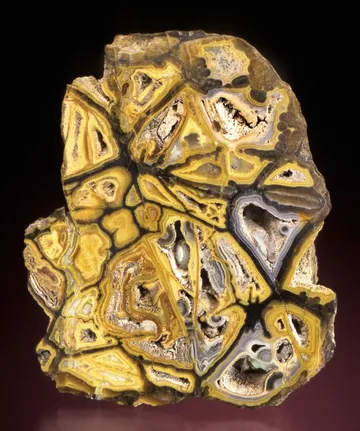
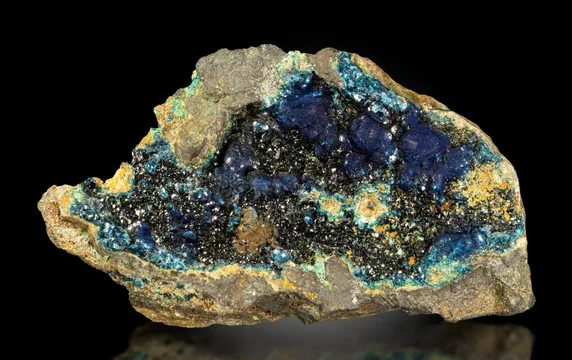
The best Gold Hill specimens have a look all their own: rusty brown to black limonite and goethite matrix, often porous and craggy, carrying sparkling druses, compact botryoidal greens, pale yellow rosettes, white needles, blue-green films, and occasional micromineral fireworks visible only under magnification. Good pieces are rarely large in the showy cabinet-specimen sense. Gold Hill is a connoisseur’s locality: its finest rewards are sharp crystals, strong contrast, old labels with exact level or pit names, and assemblages that can place a specimen in the 30-foot level, 80-foot level, 150-foot level, 300-foot level, Glory Hole, Middle pit, South pit, Red dump, or related Gold Hill workings.
Regional View
Country View
Gold Hill’s arsenate assemblages reflect several overlapping mineralizing environments. Oxidation of sphalerite-arsenopyrite replacement bodies in dolomitic limestone produced the zinc arsenate assemblage for which the mine is famous: adamite, austinite, talmessite, arseniosiderite, hemimorphite, barite, calcite and limonite-lined cavities. Oxidation of copper-bearing quartz veins produced conichalcite, cornwallite, olivenite, mixite, tyrolite, connellite, chrysocolla and native gold associations. Iron- and lead-bearing arsenates add still more depth, including carminite, pharmacosiderite-group minerals, beudantite-group material and later-recognized rarities.

Photo: Kaethe17, Wikimedia Commons

Search for specimens: View all specimens from Gold Hill, USA
Gold Hill lies near the Nevada state line in the northern Deep Creek Mountains, a remote Great Basin range where Paleozoic sedimentary rocks were intruded, metamorphosed and mineralized. The principal collector locality, the Gold Hill Mine or Western Utah Mine, is recorded in section 6, T8S, R17W, Salt Lake Meridian, roughly southwest of Wendover and southeast of the old townsite. Mineralization at the Gold Hill Mine is described as Late Jurassic and hosted chiefly by Ochre Mountain Limestone and rocks of the Manning Canyon Formation, including dark quartzite and black shale. Nearby replacement bodies, skarn-like rocks and quartz veins gave the district its mixed identity: precious-metal camp, copper camp, arsenic producer, tungsten district and arsenate-mineral locality.
The Gold Hill Mine is not a single simple vein locality. Collectors generally understand it as a complex of mine levels, pits, dumps and named collecting areas, each with a different mineral signature. The 30-foot level and its dump are associated with quartz-vein material carrying mixite, conichalcite, native gold, tyrolite, connellite, chrysocolla and the type-mineral juanitaite. The 80-foot level is especially important for adamite and cuprian arsenates, and historic descriptions note abundant yellow rounded adamite aggregates there with hemimorphite. The 150-foot level is important for austinite, including complex crystal forms. The 300-foot level and its dumps yielded scorodite-rich boulders, carminite, arseniosiderite, conichalcite, austinite and material probably derived from higher oxidized zones. The Glory Hole and Middle pit were likely connected historically with the original 80-level workings and are central names on labels for conichalcite, adamite, austinite and later rare species.
The district’s first gold discovery is traditionally placed in 1858, when westbound travelers found gold at Gold Hill. Sustained mining was slow to begin in such a remote desert range, but the Clifton mining district was organized in 1869 and the town of Gold Hill began to develop in the early 1870s. A mill in 1892 boosted production from the Alvarado, Cane Springs and Gold Hill mines. The decisive change for the Gold Hill Mine came in the 1910s, when copper development and wartime demand for arsenic transformed the district. The Deep Creek Railroad reached Gold Hill in 1917, tying the camp to Wendover and to outside smelters and markets. Western Utah Copper Company operated the Gold Hill Mine during its most productive period, and the property later passed to American Smelting and Refining Company interests. Production faded after the mid-1920s as arsenic prices declined, then revived in a smaller strategic-metals role during World War II. The Gold Hill Mine is recorded as closed in January 1945, with ore bodies regarded as exhausted in the old economic sense.
For collectors, the most important “production” began after mining waned. Dumps, shallow workings, pits and oxidized remnants yielded specimens for decades. The famous Mineralogical Record treatment of the locality grouped the mine’s secondary mineralogy into assemblages and tied specific species to specific workings, giving Gold Hill a level of specimen-locality precision unusual for an abandoned western mine. Old labels naming “80 ft level,” “150 ft level,” “Glory Hole,” “Middle Pit,” “South Pit,” “Red dump,” or “300 level” should be preserved with special care; those details can be mineralogically meaningful rather than merely romantic.
Access today must be approached cautiously. Much of the historic Gold Hill Mine area is patented private mining ground within a broader landscape of Bureau of Land Management-administered land, and the old mine workings are abandoned, unstable and hazardous. Nearby public-land status does not make the mine dumps automatically open to collecting. The correct collector’s assumption is that permission is required unless the specific parcel and mineral rights have been verified. The district also contains shafts, adits, stopes, open pits, arsenic-rich oxidation products and fragile historic remains. Collecting should be limited to legal, safe, surface material where permission is clear; entering underground workings is not part of responsible specimen collecting here.
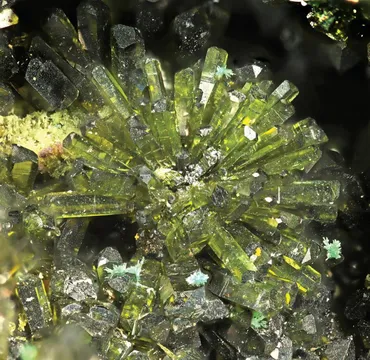
Gold Hill adamite is one of the locality’s signature species, best known from limonitic gossan cavities and especially from the 80-foot level, where yellow rounded crystalline aggregates ranging from small thumbnail patches to multi-centimeter masses were historically abundant with hemimorphite; finer pieces show lustrous pale yellow, yellow-green or cuprian green crystals and rosettes on dark iron oxide, while ordinary pieces are dull crusts or sugary coatings without individual crystal form. The most desirable examples carry sharp, sparkling crystals or spherical aggregates with good separation on rusty matrix, and the best labels place the piece in the 80-foot level, Glory Hole, Red dump or other Gold Hill sublocalities. Associations with austinite, conichalcite, hemimorphite, calcite, quartz, limonite and goethite are typical, and collectors should note that much Gold Hill adamite is small-crystal material where aesthetics depend on luster, coverage, contrast and exact paragenesis rather than size alone.
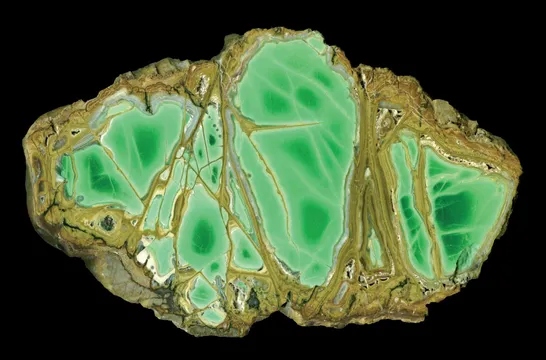
Gold Hill conichalcite is the vivid green copper-arsenate face of the locality, occurring as crusts, botryoidal to mammillary aggregates, sparkling microcrystalline coatings and small crystals on limonite, quartz-vein material and oxidized copper-arsenate assemblages from the 30-foot level, 80-foot level, 150-foot level, 300-foot level, Glory Hole, Middle pit and South pit. It may be apple-green, emerald-green, grass-green or darker velvety green, and the most attractive specimens show rich color against iron oxide or quartz, with associated chrysocolla, cuprian austinite, adamite, cornwallite, mixite, tyrolite, connellite, olivenite or native gold. Superior pieces have saturated green color, botryoidal relief or sparkling surface texture, clear association with white austinite or pale cuprian austinite, and enough matrix contrast to avoid becoming just another green arsenate coating.
Austinite is Gold Hill’s great type-locality mineral: first described from the Gold Hill Mine and later studied repeatedly because its small colorless, white, pale green and cuprian crystals show unusually interesting morphology for such tiny arsenates. The best Gold Hill austinite comes from the southwest side of the Glory Hole and the 150-foot level as colorless to white prismatic, acicular or bladed crystals commonly about 0.5 to 1 mm long, with slightly larger cuprian bladed crystals to about 1.5 mm reported from the 80-foot level and the northwest wall of the Middle pit. It coats fractures in massive limonite and occurs with adamite, conichalcite, chalcophanite, calcite, quartz, arseniosiderite and barite; the most collectible examples show lustrous sprays or “sputnik” tufts standing proud on dark gossan or green conichalcite rather than flattened, chalky films.
Gold Hill’s broader mineral list is exceptional. Austinite, juanitaite and goldhillite are type-locality or type-material-defining species tied to the Gold Hill Mine area, while tooeleite was first described from the nearby U.S. Mine at Gold Hill and should not be confused with Gold Hill Mine arsenates unless the label specifies the correct mine. Juanitaite, named for Juanita Curtis, occurs as olive- to grass-green plates and rosettes associated with mixite, conichalcite, native gold, quartz and other copper arsenates from the 30-foot level, and also with connellite, tyrolite and azurite on the 150-foot level. Goldhillite, a copper-zinc arsenate named for the mine, occurs as green tabular crystals and rosettes from oxidized gossan at the Middle pit with conichalcite, cornwallite, mixite and quartz. Other documented Gold Hill species important to advanced collectors include carminite, scorodite, arseniosiderite, talmessite, barahonaite-(Al), beudantite, cornwallite, cornubite, clinoclase, mixite, olivenite, tyrolite, connellite, pharmacosiderite-group species, philipsburgite- or goldhillite-related material, zálesíite, wulfenite, native gold, native silver, copper minerals and a range of sulfides from the primary ore assemblage.
Gold Hill specimens reward careful labeling and careful mineral identification. Many of the prized species are microcrystalline arsenates in the same color range: conichalcite, cuprian austinite, cuprian adamite, cornwallite, mixite, olivenite, zálesíite and goldhillite can look deceptively alike to the unaided eye. Old “philipsburgite” labels from Gold Hill deserve particular caution because later work showed that at least some material formerly treated as philipsburgite from the mine belongs to goldhillite or related ordered copper-zinc arsenate chemistry. Likewise, “green adamite” should not be accepted automatically without context; conichalcite and cuprian austinite are common visual traps. For valuable pieces, confirmation by Raman spectroscopy, X-ray diffraction, SEM-EDS or a trusted old analytical label is far more meaningful than color alone.
The locality is not known for a tradition of dyed, oiled or fabricated specimens. The more common market problem is misidentification or over-precise labeling. Specimens vaguely labeled “Gold Hill, Utah” may come from the Gold Hill Mine, U.S. Mine, Rube Gold, Cane Springs, Alvarado, Yellow Hammer, Reaper, Lucy L., Wilson Consolidated or another district occurrence, each with different mineralogy. This matters: tooeleite belongs classically to the U.S. Mine dumps, while the best-known adamite-austinite-conichalcite assemblages belong to the Gold Hill Mine. A label that simply says “Gold Hill” is useful, but one naming the mine and level is much better.
Condition is often the limiting factor. Gold Hill gossan is porous, crumbly and iron-stained; arsenate crusts may undercut or detach from limonite; acicular austinite sprays can be crushed by careless wrapping; and soft associated minerals such as mixite, tyrolite or some earthy oxidation products can powder under repeated handling. Avoid soaking complex Gold Hill specimens indiscriminately. Water can loosen clay-rich or limonitic matrix, and acids are inappropriate for arsenate assemblages unless a specimen has been analytically screened and the treatment goal is conservative and professional. Store delicate micros in boxes, not loose flats, and keep labels with the specimen permanently.
Fluorescence adds a useful diagnostic and display dimension. Some Gold Hill adamite shows green fluorescence under shortwave ultraviolet light, and some austinite fluoresces white under shortwave ultraviolet and may show a blue-white to white afterglow. These responses are attractive but not universal enough to identify a specimen by themselves. Because many specimens contain arsenate minerals, handling should be sensible: wash hands after use, avoid grinding or breathing dust, do not clean fragile pieces in household sinks used for food preparation, and keep small crumbly specimens away from children and pets.
On the market, Gold Hill material appears regularly but not abundantly. Modest miniatures and micromounts of adamite, conichalcite and austinite are obtainable, especially from older western U.S. collections, while fine, well-localized specimens with sharp crystals, strong color contrast, type-locality significance or named-level labels are much harder to replace. The best Gold Hill pieces are often not the largest; they are the ones that combine attractive display, confirmed species, intact surface texture and a label that preserves the geography of the mine.
Gold Hill’s collecting history begins with a paradox: one of Utah’s most important mineral localities sits in country that still feels remote even by Great Basin standards. Gold was reported here in 1858 by travelers headed west toward California, but the first excitement did not immediately become a town. Prospectors were pushed out at first, the country was far from supplies, and the early camp developed slowly. By 1869 the Clifton district had been organized, and the settlement around Gold Hill was still primitive enough to be remembered as a place of dugouts and cedar-and-willow shacks rather than brick storefronts and frame hotels. The town gained a firmer shape after a smelter was built and later after the 1892 mill gave the district a more durable industrial center.
The railroad years are the most cinematic. In 1917 the Deep Creek Railroad pushed roughly forty-five to forty-six miles south from Wendover to Gold Hill, a short desert line built to serve mines that suddenly mattered because arsenic had become a wartime commodity. The ore was not glamorous gold-rush treasure by then; much of the traffic was arsenic for insecticide, especially against the boll weevil in southern cotton fields. The line ran two trains a day from March 12, 1917 into the mid-1920s, but weak traffic, grades and a poor roadbed limited what it could do. Its rolling stock was wonderfully modest: two locomotives, a combination passenger car, a box/freight car and a water tank car. By the end, service had dwindled to two trains a week, then one, with the last train running on July 31, 1939.
The Deep Creek Railroad even had the kind of robbery story that sounds invented until the details make it feel more real. The train was robbed only once. The haul was not bullion, high-grade ore or payroll; it was a conductor’s watch, a mail pouch full mostly of catalogs, a bunch of bananas and about three dollars. One account says the watch was found the next day still ticking in the sagebrush. The robbers’ real trouble came not from the value of the loot but from interfering with the mail, and from the fact that a passenger was accidentally shot in the leg. It is a very Gold Hill episode: lonely railroad, high desert, anticlimactic plunder, and a federal mail pouch carrying more mail-order dreams than cash.
The best modern mineral story is the discovery of juanitaite. In September 1971, Juanita and Charles “Bob” Curtis, Wayne Leicht and Fred Croad visited the Gold Hill Mine and worked the dump just west of the 30-foot level adit. They found weathered limonitic gossan fragments with a green mineral they first took for malachite, later determined to be mixite. Juanita noticed native gold in the matrix, and that was enough to send Wayne and Bob through a crawl hole into the shallow inclined adit, where they found similar material still in the walls. They collected about two flats.
The real discovery came later, under the microscope. A couple of weeks after the trip, Juanita Curtis saw dark pepper-like specks scattered on many specimens. Magnification revealed clusters of olive-green plates with bronzy reflections, not matching the familiar Gold Hill suite she knew. Specimens went to William S. Wise for identification, and the “pepper” ultimately became juanitaite, a new copper-calcium-bismuth arsenate named in her honor. The mineral was not a showy cabinet specimen. It was a collector’s mineral in the deepest sense: tiny, overlooked, found because someone experienced looked twice.
Gold Hill’s austinite story is quieter but scientifically elegant. Lloyd W. Staples described austinite from Gold Hill in 1935, and later work returned to the same locality because the crystals, though commonly only fractions of a millimeter long, showed complex low-symmetry forms, right- and left-handed enantiomorphs and, in some cases, twinning. The mine’s white needles and blades are therefore more than pretty oxidation-zone growths. They helped anchor the morphology and chemistry of the austinite-conichalcite relationship, and Gold Hill remains the reference locality against which later austinite finds have been compared.