Clay Canyon, USA - famed variscite nodules and rare hydrous phosphates (wardite, millisite, montgomeryite); a classic, collectible phosphate locality.
Key facts
Clay Canyon, near Fairfield in Utah County, is one of the classic American phosphate localities: a small, shallow, deceptively plain-looking occurrence in the southern Oquirrh Mountains that produced some of the most recognizable variscite nodules ever saved for collectors. The best-known working is the Little Green Monster Variscite Mine, also known on older labels as the Clay Canyon Variscite Mine, Utahlite Mine, or Chlorutahlite Mine. Its importance rests on two linked virtues. First, the locality yielded bold, polishable nodules of green variscite set in yellow to cream crandallite and blue-gray wardite, making slabs and half nodules that are both mineral specimens and natural lapidary pictures. Second, the altered nodules became a remarkably rich micro-environment for rare hydrous phosphates, including valid type-locality species such as wardite, gordonite, millisite, montgomeryite, overite, and englishite.
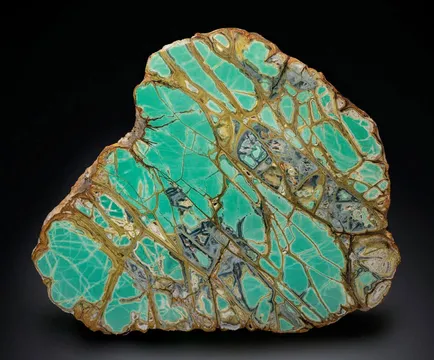
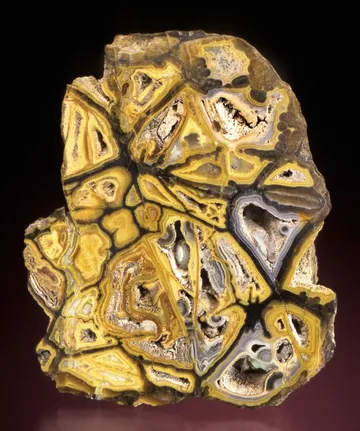
Geologically, the deposit sits in altered and brecciated dark limestone and black shale of the Upper Mississippian Great Blue Limestone, above the Long Trail Shale Member. Variscite formed first, as compact green nodules replacing the limestone along fractures; later alkaline, calcium-, sodium-, magnesium-, and potassium-bearing waters altered and partly dissolved that variscite, producing shells, veinlets, spherules, crusts, and cavity crystals of crandallite, wardite, millisite, gordonite, montgomeryite, overite, englishite, kolbeckite, carbonate-rich fluorapatite, and related species. To a collector’s eye, the deposit is a lesson in paragenesis made visible: emerald to pea-green kernels, yellow crandallite rinds, gray-blue wardite “eyes,” white chalky alteration layers, and occasional tiny open pockets lined with rare phosphate crystals.
Regional View
Country View
The deposit’s fame is inseparable from its preservation history. Much of the great specimen material was not taken as anonymous gem rough; it was mined and deliberately distributed as mineralogical material by Edwin Over and Arthur Montgomery in the late 1930s. That distinction matters. Clay Canyon nodules can be gorgeous when cut, but the finest collector pieces are those that retain mineralogical context: a polished face showing the internal architecture, a natural cavity with visible wardite or montgomeryite, or an old collection label tying the piece to the Little Green Monster work rather than to the broad and frequently confused trade name “Utah variscite.”

Photo: Wikimedia Commons

Photo: Wikimedia Commons
Search for specimens: View all specimens from Clay Canyon, USA
Clay Canyon lies west of Fairfield, in the Sunshine Mining District of Utah County, at the south end of the Oquirrh Mountains. The classic collector locality is the Little Green Monster Variscite Mine, but the Clay Canyon area includes three described variscite occurrences: the Little Green Monster deposit and two unnamed deposits. Labels can be troublesome because “Fairfield,” “Clay Canyon,” “Clay Canyon Mine,” “Clay Canyon Variscite Mine,” “Utahlite,” “Chlor-utahlite,” and “Little Green Monster” have all been used, not always with modern precision. For serious specimens, “Little Green Monster Variscite Mine, Clay Canyon, Fairfield, Utah County, Utah” is the most useful label when the specimen is demonstrably from the classic nodule-producing mine.
The deposit is hosted by dark limestone and black shale of the Upper Mississippian Great Blue Limestone, stratigraphically above the Long Trail Shale Member. The bedding in the area dips northeast, and the deposit lies on the northwestern limb of the Ophir anticline. Earlier studies described the variscite as occurring in a shattered limestone zone; later work emphasized a north-trending vertical fracture zone in which variscite nodules occupy pipe-like bodies plunging north. The mineralized rock is not a simple vein in the gem-trade sense. It is a brecciated and altered carbonate host in which nodules, fracture fillings, and replacements developed together, then were overprinted by later phosphate alteration.
The principal ore and specimen bodies were small. Underground work showed discontinuous phosphate streaks, commonly two and locally three, with a maximum vertical range of about eight feet and a lateral extent of about three feet. Where mineralization was strongest, several streaks lay close together but were separated by barren limestone; the combined mineralized width was generally ten feet or less. Nodules were centered on vertical fractures and bedding fractures, with isolated patches and stringers away from the main fractures. The surrounding limestone was silicified, limonitized, and locally argillized, with chert, alunite, calcite, quartz, and iron-stained earthy material forming much of the matrix around the phosphate nodules.
The paragenesis is unusually well worked out because the nodules themselves preserve the sequence. Variscite formed first as massive, fine-grained green cores. Those cores were then fractured and partly replaced inward by yellow to white crandallite, historically called pseudowavellite in much of the older literature. Wardite and millisite followed in alternating bands, spherules, crusts, and cavity linings. Later generations produced gordonite, montgomeryite, overite, englishite, kolbeckite, and apatite-group minerals in small solution cavities left by the partial removal of variscite. The familiar polished specimen—green center, yellow shell, gray-blue rounded wardite forms—is therefore not merely colorful; it is a cross-section through a replacement history.
The earliest scientific attention came in 1893, when F. T. Millis of Lehi sent a green nodule to George P. Merrill at the U.S. National Museum. The material was soon recognized as variscite, and George F. Kunz promoted the gem name “utahlite,” later modified in the trade to “chlor-utahlite.” Don Maguire acquired and worked the deposit for gem variscite from the 1890s into the early twentieth century. Production was small by mining standards but significant for a new American ornamental stone; the nodules were cut, polished, and marketed as semi-precious material.
The decisive collecting period came in 1936–1939, when Edwin Over and Arthur Montgomery staked the Little Green Monster claim, reopened earlier workings, and extended the mine specifically for mineral specimens as well as variscite. Their work produced thousands of pounds of nodules, many of which went to Harvard, the Smithsonian, other museums, dealers, and private collectors. Those late-1930s lots are the source of many of the finest old-time pieces: polished nodules with strong internal patterning, wardite-rich sections, and rare pockets containing gordonite, montgomeryite, overite, englishite, and kolbeckite.
Clay Canyon later drew industrial attention for scandium rather than gem beauty. Beginning in 1959, the Kawecki Chemical Company investigated the deposits as a possible scandium source. In 1959 and 1960, two shipments of crandallite ore weighing about 330 and 4,000 pounds were produced for evaluation, and analytical work showed significant scandium contents in the Clay Canyon aluminum phosphates. This episode left a useful geochemical legacy: it confirmed that scandium enrichment is especially tied to the altered variscite-crandallite assemblage, with crandallite, wardite, deltaite material, and goyazite all noted as scandium-bearing in the broader analytical literature.
Collecting access today should be treated as restricted. The Little Green Monster is a patented mining claim and private property, and collecting requires permission from the owner. Mindat’s current locality notes also warn that very little of the old mine is visible today: entrances and dumps have been bulldozed to match the surrounding hills, and GPS coordinates for the locality are approximate. Loose, unlabelled “Fairfield variscite” in the market should therefore be understood mainly as old stock, collection material, or material that requires careful provenance before it can be confidently tied to the classic mine.
Clay Canyon variscite is massive and microcrystalline rather than crystallized, occurring as rounded to flattened nodules and residual green kernels within altered nodules; old descriptions give common nodule sizes around one to three inches, with specimens from about a quarter inch to two feet or more across, while early mine descriptions note green variscite thicknesses from about one-quarter inch to over four inches. Its color ranges from vivid emerald green to lighter pea green, commonly mottled, and the best pieces show saturated green cores cut or bordered by dark green healed seams, canary-yellow to cream crandallite, white alteration layers, and blue-gray wardite spherules or bands. Ordinary pieces are simply green-and-yellow lapidary rough; top collector specimens show sharp internal architecture, good polish on at least one face, an old Little Green Monster or Fairfield provenance, and ideally visible wardite or other rare phosphate associations rather than anonymous “Utah variscite” color alone.
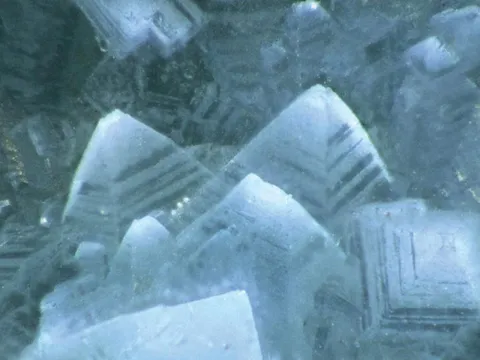
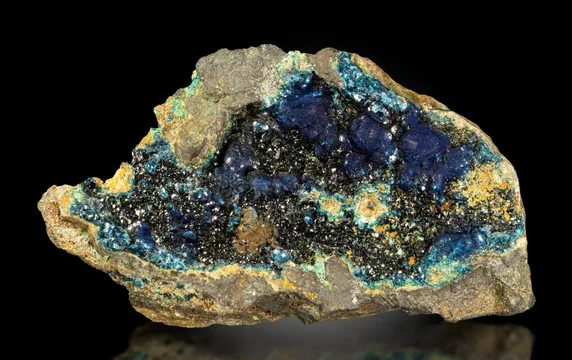
Clay Canyon is the type locality for wardite, and the species here is most familiar as blue-green to bluish-gray spherules, “eyes,” crusts, and vein-like bands intergrown with white to clear millisite and surrounded by crandallite and residual variscite. In the richest nodules, wardite-millisite spherules reach about a centimeter across, alternating layers form scalloped or boxwork patterns along earlier fractures, and later wardite grows as crystals into open spaces left where variscite was dissolved faster than new phosphate could replace it. The best Clay Canyon wardite specimens make the paragenesis visible: gray-blue rounded forms or crystalline linings sharply contrasted against green variscite and yellow crandallite, preferably in old, well-documented nodule slices or cavity pieces; massive gray alteration without pattern or locality documentation is far less desirable.
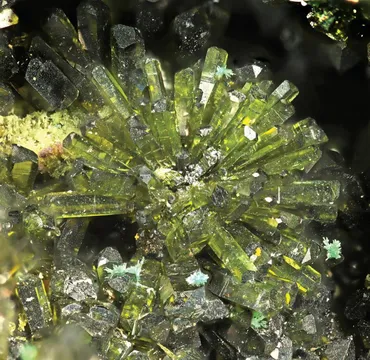
Other Clay Canyon minerals give the locality its disproportionate scientific importance. Crandallite is the dominant yellow to cream alteration mineral and replaced much of the original variscite. Millisite, another valid type-locality species, occurs as white to clear layers interbanded with wardite. Gordonite, also type-locality material, forms colorless to smoky, pale yellow, pale violet, or rarely pale green prismatic crystals in cavities near variscite. Montgomeryite, named for Arthur Montgomery, is a type-locality species here and is prized as bright blue-green bladed crystals in small cavities. Overite, named for Edwin Over, is another type-locality mineral and is rare, occurring as tiny pale yellow to clear crystals or crystalline groups on crandallite near variscite. Englishite is a valid type-locality species from Clay Canyon, recognized as pale gray to colorless platy aggregates with prominent cleavage. Kolbeckite is part of the famous sterrettite-eggonite-kolbeckite nomenclatural story: the Clay Canyon material was first described as sterrettite, later shown to be a scandium phosphate, and is now treated under the valid name kolbeckite. Carbonate-rich fluorapatite, hydroxylapatite, goyazite, alunite, quartz, calcite, kaolinite, halloysite, limonite after pyrite, and other species round out an assemblage that is far richer than the modest size of the workings would suggest.
Clay Canyon specimens are often more difficult to buy intelligently than they appear. The strongest pieces are polished slices, polished half nodules, or trimmed nodules in which the green variscite, yellow crandallite, and gray-blue wardite relationships can be seen at once. Many attractive green phosphate or silica-rich materials from Utah, Nevada, and elsewhere have circulated under broad commercial names, so the main authenticity issue is not usually laboratory fakery but locality inflation: ordinary “Utah variscite” being sold as Clay Canyon, Fairfield, or Little Green Monster material. A convincing piece should show the characteristic Clay Canyon architecture—green variscite with a yellow crandallite rind or vein network, often with gray-green to blue-gray wardite spheres or bands—and should ideally retain an old collection label or a chain of ownership.
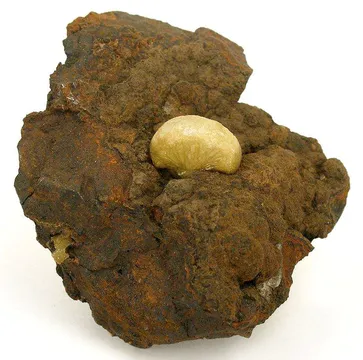
Condition matters. These nodules are replacement bodies, not solid quartz nodules with a uniform polish. White crandallite layers may be chalky or porous, wardite-rich zones may be cavernous, and some rare phosphate crystals occur in small solution cavities that are easy to bruise, abrade, or fill with polishing compound. Highly polished slabs can be excellent specimens, but over-polishing may reduce shallow pocket minerals to color patterns only. Conversely, unpolished pieces can look dull or earthy until cut, because the collector’s appeal is often internal.
Do not assume every gray or pale blue area is wardite, every yellow area is crandallite, or every tiny white crystal is a rare species. Several Clay Canyon phosphates are visually similar at hand-specimen scale, and even the older literature contains discredited or revised names. “Pseudowavellite” in classic papers is now generally understood in this context as crandallite; “deltaite,” “dehrnite,” “lewistonite,” “davisonite,” and “lehiite” require particular caution because several of those historical Clay Canyon names were later discredited, reinterpreted, or folded into other species or mixtures. For rare-species labels—especially kolbeckite, overite, englishite, montgomeryite, and gordonite—analytical confirmation or reliable old museum/dealer provenance carries real value.
Rarity is strongly zoned by species. Variscite-crandallite nodules are obtainable, though fine Little Green Monster examples with dramatic wardite patterning and old provenance can be expensive. True rare-phosphate pocket pieces are much scarcer. The best polished nodules and slices with strong pattern, large size, and documented origin have been reported in the collector market at four figures, and premium pieces tend to stay in long-term collections. Small polished fragments and less vivid nodules remain more accessible, but the gap between decorative variscite and serious Clay Canyon mineral specimens is substantial.
The story begins with a green nodule that did not look like the usual western ore. In December 1893, F. T. Millis of Lehi sent a specimen to George P. Merrill, curator of geology at the U.S. National Museum. Millis described the material as occurring as “nuggets” in a quartz vein near Lewiston, now the Mercur area. Merrill’s examination, reported by Packard in 1894, showed that the green mineral was variscite. The locality soon became famous under a succession of names meant to make the stone marketable: Kunz proposed “utahlite,” and “chlor-utahlite” followed, emphasizing the green color. The name did its work in the gem trade, but the mineralogical story was only beginning.
The early nodules were curiosities with interiors like little geologic diagrams. Packard described a large nodular mass nearly seven inches long, its green variscite portions separated by banded envelopes of yellow material and bordered by a powdery white coating. Ward’s Natural Science Establishment in Rochester received a considerable quantity of the material, and John M. Davison noticed that some nodules contained cavities left by decomposed variscite. Those cavities were encrusted with light green to bluish green crystals of an unknown phosphate. Davison named the new mineral wardite, honoring Henry A. Ward. Clay Canyon had already moved from gem prospect to type locality.
For a time, the mine was more a source of ornamental stone than a specimen locality. Don Maguire acquired the deposit and worked it for the jewelry trade, but the mineralogical richness of the nodules was mostly dormant until academic eyes returned to them. In 1923, Esper S. Larsen and Earl V. Shannon began an intensive study using institutional material and a large collection loaned by George L. English at Ward’s Natural Science Establishment. Larsen visited the site in the summer of 1927 and collected a few pieces from the dump. Their 1930 paper opened the first great taxonomic chapter of the locality, naming or recognizing a suite of phosphates that later generations would test, revise, and partly discredit.
The most important specimen-mining chapter came with two men whose names are now literally written into the mineral list. In the fall of 1936, Arthur Montgomery and Edwin Over visited Clay Canyon after collecting epidote at the Jumbo mine and Green Monster Mountain on Prince of Wales Island, Alaska. They staked the Little Green Monster claim and returned to work it in 1937 and 1939. Their purpose was not merely to dig green stone for cutting; they wanted variscite and the rarer phosphates. They reopened an old horizontal tunnel that had missed the mineralized zone, drove lateral drifts, struck the phosphate area, and followed the mineralization upward toward the surface.
The results were extraordinary for such a small deposit. Montgomery and Over recovered thousands of pounds of nodules, and Montgomery, a geology teacher, saw that much of the material was preserved as specimens rather than destroyed as anonymous lapidary rough. The nodules went to Harvard, the Smithsonian, other major museums, dealers, and private collectors. Those late-1930s pieces included far better wardite and gordonite than earlier workers had seen, plus material that led to the descriptions of overite and montgomeryite. It is hard to overstate how much of Clay Canyon’s modern reputation depends on those few seasons of selective specimen mining.
The locality also generated one of those useful cautionary tales mineralogy supplies from time to time. Larsen and Shannon’s early work described a remarkable set of new names, but later analysis showed that several did not survive as valid species. Deltaite was found to be crandallite plus hydroxylapatite; dehrnite and lewistonite were discredited as carbonate-fluorapatite; davisonite and lehiite were later discredited as well. Sterrettite had an even more tangled fate. It was first described from Clay Canyon as an aluminum phosphate, then linked with eggonite, then shown to be a scandium phosphate, and finally folded into the modern nomenclature under kolbeckite. For collectors, that history is not embarrassment but context: old Clay Canyon labels may preserve names that were correct for their time but no longer valid.