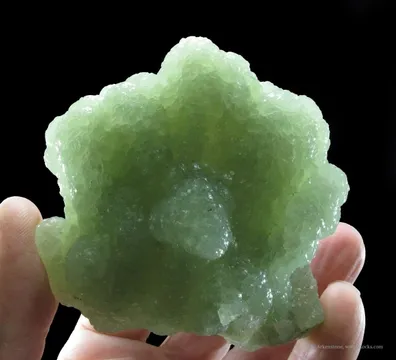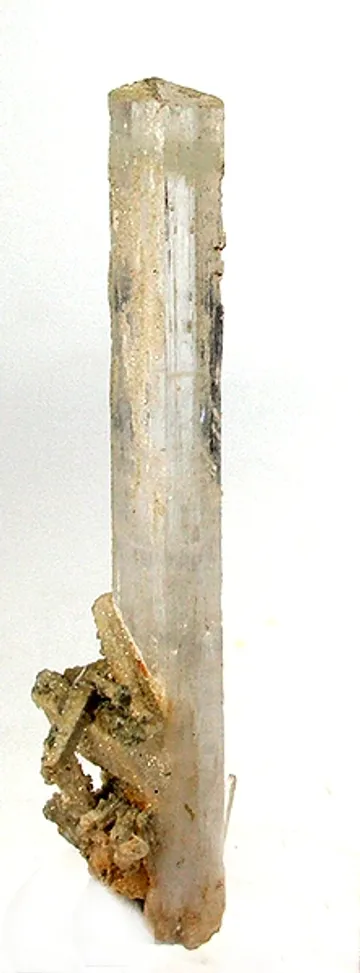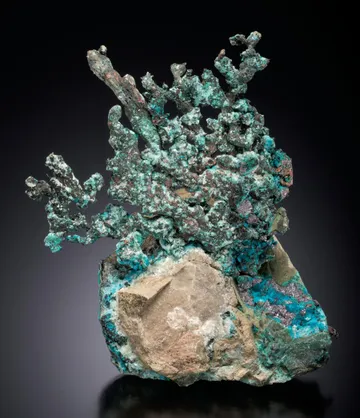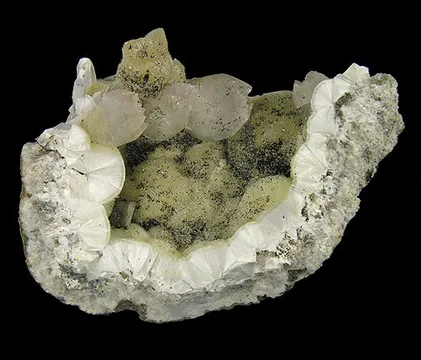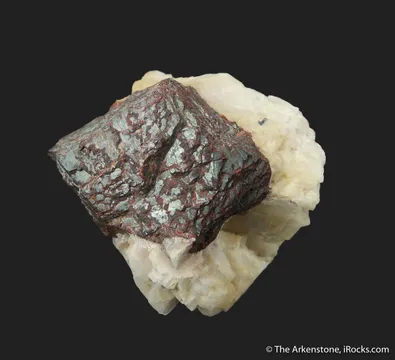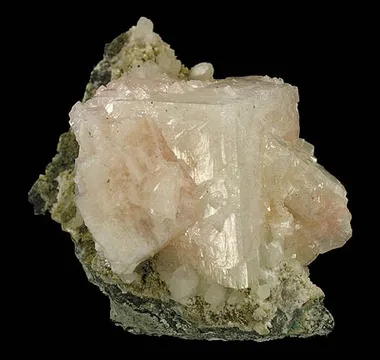
Upper New Street Quarry, USA - classic Paterson trap-rock locality in New Jersey, famed for water-green prehnite and zeolites with sculptural forms.
Key facts
Upper New Street Quarry, historically also known as Burger’s Quarry, is one of the classic Paterson trap-rock localities: a quarry cut into the basalt of the Watchung Mountains at Paterson, Passaic County, New Jersey. Its importance to collectors is not that it was an ore mine, but that quarrying opened cavities in Early Jurassic basalt that had become natural mineral cabinets. The New Street quarries exploited lava that entered a wet, probably lacustrine setting and cooled as pillow basalt; the open interstitial spaces between pillows, plus related vesicles and fractures, later acted as growth chambers for zeolites, prehnite, quartz, calcite, and a distinctly Paterson suite of late secondary minerals.
The locality is especially prized for water-green prehnite, most famously as rounded, fingered, and hollow casts after anhydrite. Good examples have the soft translucency and waxy-to-vitreous luster collectors expect from New Jersey prehnite, but the Upper New Street pieces add sculptural form: “snakehead” and finger-like masses, globular crusts, bladed casts, and aesthetic combinations with white laumontite, calcite, heulandite, chabazite, stilbite, quartz, pectolite, and natrolite. The quarry is also historically important for chabazite, heulandite, stilbite, calcite, apophyllite, and thaumasite; late 19th- and early 20th-century literature already treated West Paterson and Paterson as an extraordinary zeolite district.
Regional View
Country View
The best Upper New Street specimens have a look quite unlike modern Deccan zeolites or Colorado basalts. They are older, tougher, and usually less flamboyant in color, but they reward close looking: salmon rhombohedra of chabazite perched on pearly heulandite; brownish stilbite bow ties across thin basalt plates; clear to amber calcite rhombs over quartz; lustrous mint-green prehnite draped around the ghosts of vanished sulfate crystals. The quarry is now built over in part, and its classic production is finite; much of what appears today comes from old collections, estate dispersals, and material recovered during construction-related work in and around the old Upper–Middle–Lower New Street complex.

Photo: Wikimedia Commons

Photo: Wikimedia Commons
Search for specimens: View all specimens from Upper New Street Quarry, USA
Upper New Street Quarry is a former trap-rock aggregate quarry in Paterson, Passaic County, New Jersey, worked in Watchung basalt and recorded in modern locality databases as a built-over quarry. The old quarry lay in the New Street quarry group, with the Upper and Lower New Street workings on opposite sides of New Street; the Upper quarry is the older of the two, opened in 1893 and worked until 1925. Its historical name, Burger’s Quarry, persists on specimen labels, especially older labels from the first half of the 20th century.
Geologically, the interest is concentrated in the pillow-lava facies of the Orange Mountain Basalt, part of the Newark Basin volcanic sequence of northern New Jersey. At New Street, lava was extruded into water or water-saturated ground, forming rounded pillows, pillow buds, and related subaqueous flow structures. The cavities most desired by collectors are not “ore shoots” in the mining sense, but open spaces formed within and between basalt pillows and along fractures. These voids were later mineralized by low-temperature fluids moving through the basalt, depositing silica, calcite, prehnite, zeolites, pectolite, apophyllite, and late sulfates and carbonates. A useful collector distinction is between larger pillow pockets, which could carry broad crusts and robust groups, and junction pockets between pillows, which often produced more sharply composed plates of quartz, calcite, zeolites, and accessory minerals.
The mineralization is classically secondary and cavity-controlled. Quartz and calcite commonly form early linings or platforms; zeolites such as heulandite, stilbite, chabazite, analcime, laumontite, natrolite, thomsonite, mesolite, and epistilbite occur as later cavity minerals; prehnite forms globular crusts, botryoidal aggregates, and casts; and pectolite, datolite, apophyllite, thaumasite, anhydrite, gypsum, and minor copper and iron species complete the suite. Mindat records 40 valid minerals for the quarry, including native copper, chalcocite, chalcopyrite, pyrite, galena, greenockite, hematite, quartz varieties, calcite, dolomite, azurite, malachite, anhydrite, baryte, gypsum, thaumasite, titanite, datolite, pectolite, babingtonite, pumpellyite-(Mg), prehnite, laumontite, fluorapophyllite-(K), chabazite-Ca, heulandite-Ca, and thomsonite-Ca.
The historical literature gives Upper New Street a long pedigree. A.H. Ehrman’s 1895 account of a “remarkable mineral locality,” Papke’s 1908 visit to Paterson and Great Notch, Penfield and Pratt’s work on thaumasite from West Paterson, B. Mason’s New Jersey Geological Survey bulletin on trap-rock minerals, and the Peters brothers’ later articles on Paterson and New Jersey trap-rock minerals all place the New Street quarries among the foundational American zeolite localities. Papke’s early account is particularly associated with reports of calcite, apophyllite, heulandite, stilbite, and chabazite from the Upper quarry, while the broader New Street complex became known for prehnite, natrolite, pectolite, datolite, and quartz.
Mining was for crushed trap rock, not specimen minerals. The quarrying that exposed the pockets was commercial aggregate work, and later construction reshaping of the old quarry walls became a second collecting chapter. Housing units were eventually built over parts of the old Upper New Street quarry area, but not before blasting and excavation connected with trimming and construction in the late 1980s produced additional fine specimens. Collectors and dealers also use the name “Middle New Street” informally for the productive area between the Upper and Lower quarries during the mid-1980s to early 1990s; many specimens from that interval entered the market labeled simply “Upper New Street Quarry.” That label tradition is important to understand, because it reflects collecting practice in a compact quarry complex rather than a precise surveyed pocket name.
Collecting access today must be treated as private, urban, and restricted. The locality is built over in part, with remaining quarry walls, old levels, and disturbed ground in a densely developed Paterson setting. The classic production is effectively historical, and safe legal access is not something to assume from old field-trip reports or online photographs. Loose old-stock material, specimens from the late-1980s and early-1990s construction period, and pieces from older New Jersey collections are the realistic sources for serious collectors.
The notable finds were cavity finds: pillow-lava vugs with prehnite casts after anhydrite, plates of chabazite and heulandite, stilbite bow ties, quartz and calcite associations, and rarer thaumasite-bearing assemblages with pectolite and datolite. Some of the most desirable prehnites preserve anhydrite morphology as hollow bladed or finger-like casts; the collector value lies in sharpness of the cast, translucency, pale green color, completeness all around, and minimal bruising to the delicate crust. For zeolite plates, the same rules apply as at the best Paterson localities: undamaged terminations, clean basalt matrix, strong contrast between species, and old labels matter greatly.
Prehnite is the signature Upper New Street mineral and occurs as translucent water-green to mint-green globular aggregates, botryoidal crusts, rosetted or finger-like groups, and especially casts after anhydrite; documented specimens range from small thumbnails and micromounts to cabinet pieces around 10 cm, with associations including laumontite, calcite, quartz, natrolite, stilbite-Ca, pectolite, datolite, and thomsonite-Ca. The most locality-specific habit is the hollow or bladed anhydrite cast, sometimes called a “finger” or “snakehead,” collected especially from the Upper–Middle New Street production era and older pockets in the pillow basalt. Good pieces have saturated but delicate green color, translucency, glossy undamaged surfaces, sculptural relief, and recognizable cast geometry; ordinary pieces are more massive, chalky, bruised, or overgrown with dull white laumontite.
Heulandite at Upper New Street is recorded particularly as heulandite-Ca and as heulandite-subgroup material, with pearly curved crystals and plates in white, gray-white, tan, salmon, and reddish tones; it is one of the better zeolites from the locality and is commonly associated with laumontite, calcite, quartz, chabazite-Ca, stilbite-Ca, datolite, and prehnite. The choicest specimens show distinct, lustrous heulandite blades or curved crystals rather than a flat drusy coating, preferably with salmon chabazite rhombohedra or calcite providing contrast. Because laumontite is a frequent companion and alteration product in the Paterson suite, attractive heulandite pieces should be checked for friable white alteration, edge bruising, and confusion between pearly heulandite and lighter stilbite.
Stilbite from Upper New Street, usually represented as stilbite-Ca or stilbite-subgroup material, occurs in sheaf-like crystals, bow ties, radial groups, and drusy plates in white, tan, buff, brown, and occasionally warmer flesh tones, most often on basalt matrix with calcite, quartz, heulandite, chabazite, laumontite, and prehnite. The locality’s best stilbites are not simply coatings; they are three-dimensional bow ties or pronounced sheaves, sometimes several centimeters across, set on contrasting quartz or calcite-lined pockets. Fine pieces are judged by luster, symmetry of the bow tie, clean separation from associated species, and unbroken blade edges, while lesser examples are flattened, iron-stained, or lost in a crowded zeolite crust.
Calcite is abundant in the Upper New Street assemblage and occurs as clear, colorless, white, amber, and pale honey crystals, commonly rhombohedral or complex rhombohedral, on quartz- or basalt-lined cavities with prehnite, stilbite, laumontite, chabazite-Ca, heulandite, hematite, analcime, datolite, and natrolite. It is important both as a display mineral and as a platform for later zeolites: the most appealing pieces show sharp, glassy calcite contrasting with salmon chabazite, pearly heulandite, brown stilbite, or green prehnite. Damage is common because calcite edges and terminations sit proud of the matrix; collector-grade examples should show fresh luster, minimal cleaving, and an association that is unmistakably Paterson rather than a generic trap-rock calcite plate.
Chabazite is one of the great Upper New Street zeolites, recorded both as chabazite-Ca and as chabazite-subgroup material, with rhombohedra and penetration twins reported to several centimeters across; colors range from colorless and white through cream to salmon-pink, peach, and pale orange. It occurs in vugs with calcite, quartz, heulandite, laumontite, prehnite, natrolite, anhydrite, datolite, chalcopyrite, pyrite, and occasional apophyllite, and the finest miniatures show sharp salmon rhombohedra sitting prominently on pearly heulandite or clean quartz. Good chabazite from here is separated from ordinary material by crystal size, sharp rhombohedral form, fresh luster, warm color, and isolation; small beige crystals half-buried in calcite or laumontite are much less compelling.
Quartz at Upper New Street occurs as rock crystal, milky quartz, smoky quartz, chalcedony, agate, and amethyst in the basalt cavities, with amethyst specifically documented from the quarry and associated in photo data with chabazite. Clear to milky quartz commonly forms cavity linings and drusy platforms for calcite, stilbite, chabazite, and prehnite; the rarer amethyst pockets bring a violet accent to an assemblage otherwise dominated by green, white, tan, and salmon tones. Collectors should look for quartz that is integral to the pocket paragenesis rather than merely a drusy lining: lustrous crystals with attached zeolites, calcite, or prehnite give the strongest locality character.
Anhydrite is crucial to Upper New Street not because loose blue or white anhydrite crystals dominate collections, but because vanished or partly preserved anhydrite supplied the forms later copied by prehnite. The famous water-green prehnite “fingers,” “snakeheads,” and hollow bladed casts are the collector-visible record of that sulfate stage, and examples may show sharp external cast form or internal striations that preserve the lost anhydrite crystal morphology. The best anhydrite-related specimens are therefore judged as pseudomorphs and casts: complete, translucent green prehnite shells with crisp form, not merely prehnite masses said to have replaced anhydrite.
Apophyllite from Upper New Street is represented in older reports and modern locality records as apophyllite-group material, including fluorapophyllite-(K), and is associated with the same Paterson cavity suite: stilbite, calcite, heulandite, chabazite, laumontite, pectolite, datolite, prehnite, and pumpellyite-(Mg). Good pieces are typically colorless to pale greenish or white, tabular to blocky, and most valuable when a distinct apophyllite crystal is perched visibly among zeolites rather than hidden as a small accessory. Because Indian apophyllite-stilbite specimens are far more abundant on the market, older labels, basalt matrix, and unmistakable Paterson associations are essential for confident locality attribution.
Beyond the major species, Upper New Street is notable for a long and serious mineral list: analcime, laumontite, natrolite, thomsonite-Ca, mesolite, epistilbite, datolite, pectolite, fluorapophyllite-(K), pumpellyite-(Mg), babingtonite, hedenbergite, titanite, hematite, pyrite, chalcopyrite, chalcocite, native copper, galena, greenockite, baryte, gypsum and selenite, dolomite, siderite, azurite, malachite, opal-AN, and thaumasite. Thaumasite is the locality’s most historically interesting rarity: the West Paterson occurrence was important enough to draw formal American Journal of Science treatment in 1896, and Upper New Street specimens are recorded in association with pectolite, datolite, calcite, quartz, analcime, stilbite, heulandite, anhydrite, and prehnite.
The most important authenticity issue is locality precision. Upper New Street Quarry, Lower New Street Quarry, the informal “Middle New Street” collecting area, Burger’s Quarry, West Paterson, and Paterson have all appeared on labels, and older collections may use the names loosely. Some auction descriptions explicitly note that material collected between the Upper and Lower quarries during the mid-1980s to early 1990s was often labeled Upper New Street even when it did not come from the exact old Upper pit. For a cabinet collector, this does not necessarily make the specimen undesirable, but it should be described honestly as Upper New Street or New Street quarry complex material when provenance is not precise.
No widely documented treatment tradition is attached to this locality. The greater risk is not dyeing or fabrication, but relabeling: common Indian zeolite combinations should never be accepted as Paterson merely because they contain apophyllite, stilbite, heulandite, or chabazite. Upper New Street specimens generally carry dark basalt matrix, older labels, more restrained colors, and associations such as prehnite casts after anhydrite, laumontite, pectolite, datolite, or Paterson-style calcite. Conversely, genuine Upper New Street chabazite-heulandite miniatures can be surprisingly sharp and pastel, so locality should be judged by the whole assemblage and provenance, not by color alone.
Condition matters greatly. Prehnite crusts bruise on high points and can show dull, abraded surfaces if they were recovered from construction rubble. Hollow prehnite casts after anhydrite may be fragile along thin walls or open ends. Laumontite is common and can dehydrate, whiten, powder, or shed, so specimens with abundant laumontite should be stored in stable indoor humidity and handled minimally. Stilbite bow ties chip at blade edges; calcite cleaves readily; chabazite rhombohedra often lose corners; and delicate pectolite or natrolite sprays do not tolerate repeated handling.
Some Paterson-area species are fluorescent, and locality lists and collecting guides record fluorescence for minerals such as chabazite, heulandite, datolite, leonhardite, stevensite, thaumasite, and others in the broader district. For Upper New Street specimens, fluorescence should be treated as a bonus observation rather than an identification shortcut: matrix, associations, crystal habit, and provenance are more reliable than a lamp response.
Market availability is steady but limited. Small prehnite, calcite, stilbite, chabazite, and mixed zeolite pieces appear periodically from old New Jersey collections, online auctions, and estate dispersals. Fine prehnite casts after anhydrite, sharp salmon chabazite on heulandite, well-formed stilbite bow ties, and specimens with old labels or documented collection history are much scarcer. The quarry is no longer a regular commercial source, so exceptional pieces should be regarded as classic, finite American trap-rock specimens rather than currently renewable production.
In October 2012, Michael Streeter’s field-trip party approached New Street from a campground only 37 miles away, a distance that sounds trivial until New York–area weekday traffic enters the story. The first 5 miles to I-80 took about 10 minutes; the remaining 32 miles took another hour and a half, with the group averaging only about 20 miles per hour before reaching Paterson. Their guide for the day, David Bernstein, met them at the upper quarry. Once inside, the urban setting gave way to the old quarry geometry collectors know from labels: an entrance, a view east from the upper quarry, a trail down to a middle level, a pit, and basalt pillows that still had to be worked by hand.
The memorable line from that day is not about a trophy pocket but about effort. By the end of the first day, the party had “moved a ton of rock and dirt” and recovered a bunch of nice specimens. That is exactly the New Street experience in miniature: not glamorous pegmatite pocketing, not a mine level with ore carts, but hard basalt, old quarry benches, pillow structures, and the patient breaking and clearing needed to free small mineralized cavities from trap rock.
The following day the same group worked the lower quarry, where the walls showed prehnite pockets and cavities in the basalt. Streeter wrote that calling the wall work hard “would be an understatement,” but they still managed to liberate a few decent specimens. The field note captures why New Street specimens carry a different romance from polished locality fame: these were urban quarry minerals collected from stubborn rock, often with houses, traffic, and Paterson visible nearby, yet the cavities inside could still hold the soft green prehnite and zeolite assemblages that made the district famous more than a century earlier.
Another modern story is embedded in the labels themselves. During the mid-1980s to early 1990s, collectors worked the zone between the Upper and Lower New Street quarries, a place some called “Middle New Street.” Much of that material entered collections as Upper New Street. The name stuck, not because every specimen was surveyed to an exact quarry wall, but because collectors, dealers, and old labels were trying to describe a compact, productive New Street trap-rock complex in the middle of Paterson. For today’s collector, that history turns a vague label into a clue: “Upper New Street” may mean the old 1893 quarry, or it may mean the productive construction-era New Street ground that yielded some of the locality’s most desirable prehnite casts.