Millington Quarry – New Jersey traprock locality noted for pectolite, prehnite, datolite, calcite, and other Watchung minerals prized by collectors.
Key facts
Millington Quarry is one of the great modern New Jersey traprock localities: a crushed-stone quarry in Bernards Township, Somerset County, cut into the Hook Mountain Basalt of the Third Watchung Mountain. Its collector importance rests not on an ore body in the mining sense, but on amygdaloidal cavities, fractures, and vesicle-rich horizons in Lower Jurassic basalt that were charged by late- and post-igneous mineralizing fluids. Those cavities produced a distinctive Watchung-suite assemblage of pectolite, prehnite, calcite, datolite, fluorapophyllite-(K), natrolite, stilbite, quartz varieties, pyrite, chalcopyrite, sphalerite, and rarer species. The best specimens have the unmistakable Millington look: dark basalt matrix opened into rounded vugs lined by pale green prehnite, porcelain-white to peach-pink mammillary pectolite, glassy datolite, sparkling pyrite, sharp apophyllite, and contrasting calcite.
Regional View
Country View
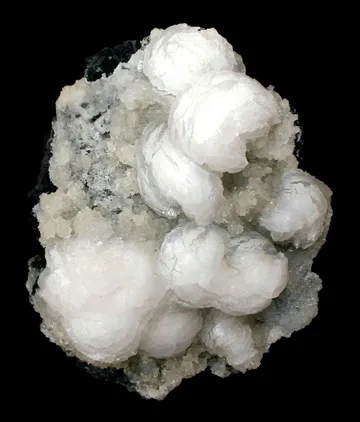
For decades Millington sat in the shadow of older New Jersey zeolite names such as Paterson, Prospect Park, and the Fanwood-Watchung quarries. That changed with the quarry’s late-twentieth-century expansion. From the mid-1980s into the early 2000s, collectors and quarry employees had access to fresh mineralized basalt on a scale that made the locality scientifically important as well as specimen-rich. The pectolites, in particular, lifted Millington from “interesting local traprock quarry” to a world-class pectolite locality: smooth rounded hemispheres and spheres, commonly built of densely packed radiating acicular crystals, in white, cream, pink, peach, salmon, reddish, pale green, and occasionally unusual mixed tones.

Photo: Wikimedia Commons
The quarry also matters because it helped clarify how New Jersey traprock mineralization formed. Work by Warren Cummings and later authors showed that Millington’s secondary minerals were not randomly scattered in a simple stagnant burial-metamorphic setting. They show vertical and lateral zoning related to amygdaloidal horizons, basalt porosity and permeability, glass content, and the movement of mineralizing fluids upward from adjacent sedimentary rocks into the basalt. For collectors, that translates directly into specimen character: some zones favored prehnite and calcite, others pectolite and datolite, others zeolites and apophyllite, with the finest pockets reflecting a balance of open space, fluid chemistry, and late-stage overgrowths.
Search for specimens: View all specimens from Millington Quarry, USA
Millington Quarry lies east of Stone House Road, south and southwest of the New Jersey Transit rail line, west of Pond Hill Road, and north of Overlook Avenue and Keats Road in Bernards Township. The quarry property has been reported at roughly 180 to 190 acres, and its industrial product was primarily traprock: dense basalt crushed for road stone, railroad ballast, and construction aggregate. Quarry reports also record selective working of the immediately underlying hornfels or “red rock,” but the mineral specimens prized by collectors came chiefly from amygdaloidal cavities and related openings in the Hook Mountain Basalt.
Geologically, the quarry is in the Newark Basin, the Mesozoic rift basin that preserves red-bed sedimentary rocks and the Watchung basalt flows of northern New Jersey. The Third Watchung, now formalized as Hook Mountain Basalt, is the uppermost of the three major Watchung extrusive basalt units. At Millington, early geological descriptions recognized successive flow structure in the basalt, including a gray upper layer above darker basalt, separated locally by ferruginous alteration. In specimen terms, the important feature is not simply “basalt,” but vesicular and amygdaloidal basalt: former gas cavities and permeable zones that later became pathways and receptacles for calcium-, sodium-, silica-, boron-, sulfur-, iron-, and copper-bearing fluids.
The mineralization is a classic secondary basalt-cavity assemblage rather than a conventional ore deposit. Pectolite, prehnite, datolite, calcite, natrolite, fluorapophyllite-(K), stilbite, analcime, heulandite-group minerals, and quartz varieties fill or line cavities; pyrite, chalcopyrite, sphalerite, galena, pyrrhotite, and iron oxides occur as sulfide and oxide accessories; gypsum and anhydrite are important both as species and as former crystals that could be dissolved away, leaving casts or guiding later epimorphous growth. Cummings’ interpretation of the quarry emphasized active fluid circulation from sediments into the basalt, and Millington became a key locality for seeing mineral zoning in a real, quarry-scale cross-section rather than only in isolated hand specimens.
Quarrying began in 1895 and continued intermittently into the early 1970s. After a period of inactivity, the quarry restarted in 1979 and was worked much more aggressively, with production exceeding one million tons per year in a number of years. This renewed phase opened the specimen-producing ground. Mineral specimens were found in abundance from about the mid-1980s until early 2007, and many of the Millington pieces now circulating in collections trace to that period. Labels may refer to the locality as Millington Quarry, Tilcon Millington Quarry, Morris County Crushed Stone Company Quarry, Basking Ridge, Bernardsville, Bernards Township, or simply “Millington, New Jersey”; the precise modern locality is Bernards Township, Somerset County.
Operators and ownership changed with time. The property was operated for traprock over more than a century, leased to Tilcon New York in 1999, and publicly associated with Tilcon during the last great period of specimen production. Tilcon announced the closure of the major quarry operation in May 2010 after evaluating market conditions and remaining reserves, while subsequent township records distinguish later, more limited quarry activity and reclamation work under Millington Quarry, Inc. Bernards Township’s 2023 master-plan materials state that active quarry operations ceased in 2016. By the 2010s and 2020s the site had moved from active quarrying toward reclamation, backfilling, lake planning, and residential redevelopment discussions.
Collecting access today should be considered closed. The mineralized zone that supplied the familiar collector specimens has been removed, the pit has been in reclamation, and the property is private land subject to redevelopment and municipal oversight. Modern collecting should not be assumed possible, and trespass into a reclaimed quarry is both unsafe and legally risky. Present-day specimens reach the market almost entirely through old collections: material collected by or associated with New Jersey field collectors, former quarry access, dealer lots from the late 1990s and 2000s, and dispersals of collections assembled while the quarry was still active.
The notable finds span several decades. Early post-reopening specimens include white and pale pectolite pockets, natrolite sprays, calcite-lined vugs, and prehnite on basalt. By the 1990s, collectors such as Kurt Hennig, Richard Mayer, and others were recovering pink pectolite on datolite, prehnite in datolite vugs, and pectolite epimorphs related to anhydrite. The mid-2000s produced some of the most coveted modern material: hematite-stained pink to red pectolite spheres, cream and green pectolite, pectolite with apophyllite and pyrite, datolite-coated pockets, and specimens collected in 2005–2007 that were later figured in dealer updates, The Mineralogical Record, The Tilcon Times, and Lapis.
Pectolite is the signature Millington mineral and the reason the quarry is known well beyond the circle of New Jersey traprock specialists. It occurs as tightly packed radiating acicular crystals forming mammillary crusts, hemispheres, spheres, and pocket linings on basalt, commonly with datolite, pyrite, prehnite, fluorapophyllite-(K), natrolite, calcite, chalcopyrite, and minor heulandite-group minerals. Classic pieces are white to cream, but the collector premium belongs to the pink, peach, salmon, mauve, reddish, and pale green material; published summaries note that most Millington pectolite is white, while the pink to red colors reflect trace iron oxide staining, and mid-2000s specimens broadened the known palette. Individual rounded aggregates are often in the 1–3 cm range, but documented examples reach larger sizes, including spheres and hemispheres several centimeters across and exceptional pectolite forms to about 6 cm. The finest specimens combine undamaged rounded pectolite with open vug aesthetics, dark basalt contrast, datolite or apophyllite association, sparkling pyrite, and visible radial structure at broken or natural edges; ordinary pieces are more massive, bruised, chalky, or lacking the clean three-dimensional pocket form that makes Millington pectolite so distinctive.
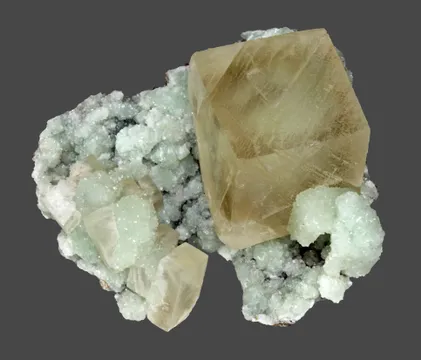
Millington prehnite is typically yellow-green to light green, forming rounded botryoidal clusters, spheres, hemispheres, and vug linings on basalt, commonly associated with calcite, apophyllite, datolite, pectolite, natrolite, and sulfides. Good individual rounded groups are commonly a few centimeters across; documented collector pieces include greenish-yellow spheres to about 2 cm, a 2.7 cm prehnite sphere in a datolite vug, and a 5.1 cm prehnite sphere bearing calcite. Some prehnite shows flat faces or cast-like surfaces produced where earlier thin tabular anhydrite dissolved away, a particularly New Jersey traprock feature that rewards close inspection. The best Millington prehnites are clean, lustrous, translucent to softly glowing green, well separated in an open pocket, and accented by calcite or datolite; lesser examples are drusy coatings without sculptural form, or show contact damage from blasting and extraction.
Calcite from Millington is abundant enough to be a common associate yet varied enough to deserve serious collector attention. It occurs as colorless, white, grayish, and pale yellow crystals, including modified rhombohedrons and scalenohedrons, with published records noting transparent crystals and masses to about 6 cm. More typical specimens show smaller crystals coating prehnite, lining basalt vugs, or growing over datolite; documented pieces include hundreds of small calcite crystals on light green prehnite, elongated colorless scalenohedral crystals to about 15 mm on datolite, and gray double-terminated needle-like scalenohedrons. The desirable Millington calcites are not usually the biggest New Jersey calcites, but the most aesthetic combination pieces: sharp, undamaged calcite perched on green prehnite, pectolite, datolite, or natrolite in an intact basalt cavity, with enough transparency or luster to keep the carbonate from visually flattening the specimen.
Other documented Millington minerals broaden the locality from a pectolite-prehnite-calcite occurrence into a full traprock suite. Datolite is a major supporting species and appears in many of the best pectolite pockets. Natrolite forms white to colorless acicular sprays and radiating groups, with fine examples reaching several centimeters; fluorapophyllite-(K) and apophyllite-group crystals occur as rosettes, prismatic crystals, and pectolite-associated vug crystals; stilbite-Ca and stilbite-subgroup material occur as sheaves, bow ties, and globular aggregates. Quartz varieties include chalcedony, smoky quartz, and amethyst. Sulfides and metallic accessories include pyrite, chalcopyrite, sphalerite, galena, and pyrrhotite, with sphalerite on prehnite especially sought after in East Coast traprock suites. Rarer or less commonly collected species recorded from the quarry include analcime, chabazite, heulandite-subgroup minerals, thomsonite-Ca, babingtonite, ilvaite, riebeckite and crocidolite, aerinite, actinolite, almandine, albite, gypsum, anhydrite, hematite, goethite, bitumen or pyrobitumen, saponite, montmorillonite, sepiolite, marialite, siderite, todorokite, and zoisite.
Millington specimens are generally straightforward, but labels deserve scrutiny. Older pieces may be marked “Morris County Crushed Stone,” “Tilcon Quarry,” “Basking Ridge,” “Bernardsville,” or “Millington,” while the accepted collector locality is Millington Quarry, Bernards Township, Somerset County, New Jersey. The “Morris County” wording on some labels is historical company nomenclature, not the county of occurrence; the quarry is in Somerset County. Good provenance matters because superficially similar New Jersey traprock pectolite, prehnite, calcite, apophyllite, and natrolite also came from Paterson, Prospect Park, Fanwood, Chimney Rock, Upper and Lower New Street, Laurel Hill, and other Watchung or Newark Basin localities.
No well-established trade problem of systematic fake Millington specimens is documented, but misidentification is common enough to watch for. Pale green rounded pectolite may be confused with prehnite, and massive or drusy prehnite can be mistaken for pectolite without a close look at crystal texture. Datolite, calcite, and apophyllite can all appear as pale glassy-to-white vug minerals and should be checked by habit, cleavage, hardness, luster, and association. “Apophyllite after pectolite” or pectolite-associated apophyllite labels occur in the trade, so a specimen with both species should not be reduced to a single-name label unless the habit is clear. Sphalerite on prehnite is a legitimate and prized association but is uncommon enough that the locality and species identification should be treated carefully.
Condition is the central quality issue. The quarry specimens were recovered from blasted basalt, so bruised botryoids, sawed or broken basalt, missing vug edges, dinged calcite tips, and fractured pectolite surfaces are normal hazards. Pectolite’s radiating acicular structure is attractive but vulnerable: broken edges expose fibrous needles, and even smooth mammillary surfaces can show tiny contact marks. Calcite cleaves easily and reacts to acids, so avoid acid cleaning unless a knowledgeable conservator has tested the exact specimen. Gypsum and selenite, where present, are soft and water-sensitive. Riebeckite-variety crocidolite is recorded from the quarry; such material should not be cut, ground, abraded, or handled in ways that generate dust.
Availability is finite. The mineralized ground that produced the classic specimens is gone, the quarry is reclaimed or under redevelopment planning, and collecting access should be treated as closed. Common small pieces still appear from New Jersey collections, but genuinely fine Millington pectolite, prehnite, natrolite, calcite-on-prehnite, sphalerite-prehnite, and complete basalt vugs are much less available than they were during the 1990s and 2000s. For pectolite, pay for undamaged form, strong pink-to-peach or unusual color, good basalt contrast, and a reputable old label. For prehnite, look for distinct spheres or botryoids rather than flat crusts. For calcite, favor sharp crystals in attractive association rather than isolated common-looking carbonate.