Paterson, USA — historic New Jersey trap-rock locality yielding prehnite, datolite, pectolite, calcite and zeolites; a classic destination for collectors.
Key facts
Paterson, in Passaic County, New Jersey, is one of the classic mineral localities of the northeastern United States: a city locality whose best specimens came not from an ore mine but from trap-rock quarries and railroad cuts driven into the Watchung basalt. For collectors, “Paterson” usually means the old New Street quarries and associated exposures in and around Garret Mountain and the Great Falls area, where Mesozoic basalt flows of the Newark Basin were broken open for construction stone and road aggregate. The same quarrying that supplied hard basalt for rail beds, concrete, and asphalt exposed amygdules, fractures, pillow-lava pockets, and mineralized seams lined with prehnite, datolite, pectolite, calcite, quartz, apophyllite, chabazite, stilbite, thomsonite, heulandite, laumontite, and a long tail of rare sulfides, sulfates, carbonates, and zeolites.
The great Paterson pieces have a look that is unmistakably New Jersey trap rock: dark gray to black basalt carrying sharp pockets of pale green prehnite; satiny white pectolite in fibrous sprays and compact fans; glassy datolite plates; tan to brown stilbite bow ties; quartz and amethyst druses; rhombohedral chabazite; and bright calcite crystals that can make an otherwise sombre basalt matrix flash. The locality’s importance is historical as much as aesthetic. It was already known to nineteenth-century New York-area collectors, then became one of the benchmark localities treated in the twentieth-century literature on New Jersey zeolites and trap-rock minerals. Today, because the principal quarries are closed, built over, or otherwise unavailable, fine Paterson specimens are chiefly a matter of old collections, museum holdings, and careful acquisition from the secondary market.
Regional View
Country View
The geological setting is a collector’s gift: basalt flows erupted during the rifting that opened the Atlantic, locally forming hard ledges and cliffs along the Watchung ridges. Where gas cavities, cooling joints, flow contacts, and pillow-lava structures provided open space, later fluids deposited secondary minerals in orderly sequences. In the best pockets the dark trap rock acts like a theatrical backdrop, setting off translucent greens, whites, honey tones, and violet quartz. Many older labels simply read “Paterson,” but serious locality work usually tries to distinguish Upper New Street Quarry, Lower New Street Quarry, Hoxie’s Quarry, the Interstate 80 roadcut, Hinchcliffe Stadium, McKiernan & Bergin Quarry, or adjacent Passaic County trap-rock localities such as Prospect Park and Great Notch.
Search for specimens: View all specimens from Paterson, USA
Paterson’s mineral specimens came from basalt, not from a conventional metallic ore body. The productive rock is part of the Watchung basalt sequence of the Newark Basin, especially the Orange Mountain Basalt, historically called the First Watchung Basalt. These lavas, erupted during early Atlantic rifting, include massive trap rock as well as vesicular, amygdaloidal, jointed, and locally pillow-structured zones. The mineralization is best understood as secondary, low-temperature cavity and fracture filling: open spaces in the basalt were lined or partly filled by quartz, calcite, zeolites, prehnite, datolite, pectolite, apophyllite, and related minerals.
The most famous Paterson collecting ground was the New Street area. The Upper New Street Quarry, also known historically as Burger’s Quarry, lay on the east side of New Street and was worked in the late nineteenth and early twentieth centuries. The Lower New Street Quarry lay along the railroad track and was worked from about 1900 until 1936. These quarries opened countless basalt pockets as the rock was quarried for trap-stone aggregate. Newly blasted faces were especially important because fresh cavities could be recognized before weathering dulled the zeolites or loosened delicate crystals. Other Paterson entries in old labels and literature include Hoxie’s Quarry, McKiernan & Bergin Quarry, the Interstate 80 roadcut, the Passaic Falls area, and later construction sites that cut into the same basaltic ridge.
The “ore bodies,” in collector language, are better described as pocket systems. Some pockets are vesicles or amygdules in basalt, some are fractures, and some are larger cavities related to pillow-lava structure. In the broader Paterson–Great Notch–Prospect Park district, collectors and authors have distinguished larger pillow pockets from narrower junction pockets between pillows. The larger cavities could host richer and more spacious growths; the smaller junction pockets were often lined with quartz and calcite and then overgrown by zeolites and associated minerals. This explains why many Paterson specimens are composites: calcite on quartz, prehnite with datolite, pectolite with prehnite, stilbite on calcite, chabazite with heulandite or laumontite, and late delicate coatings in otherwise compact basalt vugs.
Mining was quarrying for construction material. Paterson’s trap rock was valuable because basalt is tough and suitable for road metal, rail ballast, concrete aggregate, and asphalt. The mineral specimens were incidental byproducts of that industry, saved by quarrymen, local collectors, museum curators, and visiting New York and New Jersey mineralogists. The best period for classic specimen production was the active quarry era, especially from the late nineteenth century through the early twentieth century. By the late twentieth century there were no operating trap-rock quarries within Paterson itself, and serious collecting from the old faces had essentially ended. Today the principal historic localities should be considered closed, private, hazardous, protected, redeveloped, or otherwise unsuitable for casual collecting unless an owner, manager, or public authority has explicitly granted permission.
The collector’s map of Paterson is therefore partly physical and partly historical. Lower New Street is central for prehnite, datolite, pectolite, quartz, calcite, chabazite, analcime, thomsonite, laumontite, and several rare associated species. Upper New Street is especially well represented by calcite, chabazite, stilbite, prehnite, quartz, apophyllite, sulfides, and unusual accessory minerals. Hoxie’s Quarry appears on labels for analcime, calcite, chabazite, datolite, laumontite, malachite, and quartz. The Interstate 80 roadcut is important enough to be separately recorded for quartz, apophyllite, natrolite, gmelinite-group material, thaumasite, and related cavity minerals. Because nineteenth- and early twentieth-century collectors moved by rail and trolley, and because local place names shifted, “Paterson,” “West Paterson,” “Garret Rock,” and nearby Passaic County trap-rock labels require interpretation rather than blind acceptance.
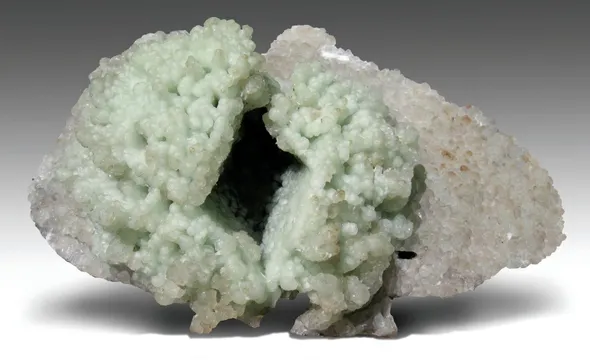
Prehnite is the signature Paterson mineral: pale to medium green, rarely yellowish or white, occurring as botryoidal crusts, hemispherical aggregates, compact plates, and locally terminated crystal groups in basalt cavities and fractures, especially in the New Street quarries. Lower New Street specimens are particularly familiar to collectors, where prehnite appears with calcite, thomsonite-Ca, laumontite, chalcopyrite, sphalerite, pectolite, datolite, quartz, natrolite, and other trap-rock associates. Ordinary pieces are dull, massive green crusts on broken basalt; good Paterson prehnite has lively translucency, intact rounded mounds or sharp terminations, fresh color, and a clean contrast with white calcite, glassy datolite, or dark basalt matrix.
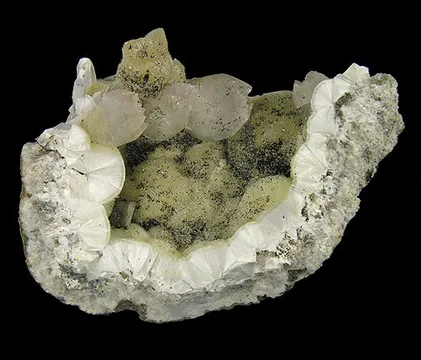
Calcite is one of the great framework minerals of the Paterson pockets, appearing from the New Street quarries, Hoxie’s Quarry, Hinchcliffe Stadium, the Interstate 80 roadcut, and other local exposures as rhombohedra, cleavable masses, druses, and locally sharp crystals associated with quartz, prehnite, stilbite, laumontite, chabazite, heulandite, and datolite. Its collector appeal here is less about rarity than placement: the best calcites are sharp, lustrous, translucent to transparent, and well positioned on basalt or earlier quartz rather than bruised cleavage fragments. Fine Paterson calcite also matters because it establishes the pocket sequence visually, providing the pale or honey-toned stage on which chabazite, stilbite, prehnite, or apophyllite can stand out.
Quartz from Paterson is most familiar as cavity linings, small crystal groups, and varieties including rock crystal, milky quartz, smoky quartz, chalcedony, agate, and amethyst, with both Upper and Lower New Street long recognized for amethyst-bearing trap-rock pieces. In the pocket sequence quartz commonly forms an early drusy lining on basalt before calcite and zeolites, so the best specimens are those in which the quartz is not merely a white crust but a sharp, sparkling interior surface carrying violet amethyst tips, later calcite, chabazite, stilbite, or green prehnite. Good Paterson quartz is judged by freshness, color, undamaged pocket geometry, and honest basalt matrix; ordinary pieces are small broken vug fragments with worn or iron-stained druse.
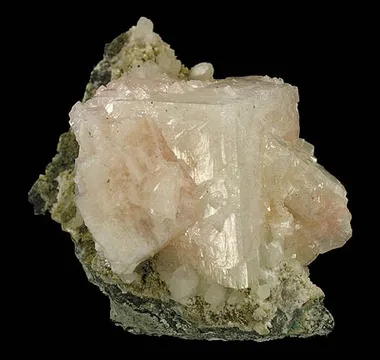
Paterson pectolite is a classic New Jersey trap-rock species, typically white to gray-white and satiny, in compact fibrous masses, divergent sprays, fans, and thick felted aggregates in basalt cavities and seams, especially at Lower New Street and other New Street workings. It is commonly associated with prehnite, datolite, quartz, thomsonite-Ca, natrolite, apophyllite, and calcite, and the best examples show crisp fibrous architecture rather than chalky, weathered, or bruised material. The locality’s better pectolite has real three-dimensional presence: tight silky bundles against black basalt, white fans breaking from green prehnite, or pectolite paired with glassy datolite, all of which distinguish Paterson material from the flat, massive, nondescript pectolite seen from lesser occurrences.
Stilbite-Ca from Paterson is best known from Upper New Street, where it occurs as sheaf-like aggregates, radiating hemispheres, bow ties, and tan to brown crystal groups in basalt cavities with prehnite, calcite, quartz, laumontite, heulandite-Ca, babingtonite, fluorapophyllite-(K), datolite, and chabazite-Ca. The appeal of Paterson stilbite lies in form and setting: clean bow ties perched on earlier calcite or quartz, lustrous brownish sheaves contrasting with pale zeolite crusts, and intact radiating groups on dark basalt are much more desirable than loose, abraded sprays. Because many old labels use broad locality names, pieces with credible Upper New Street provenance and undamaged crystal terminations carry a premium.
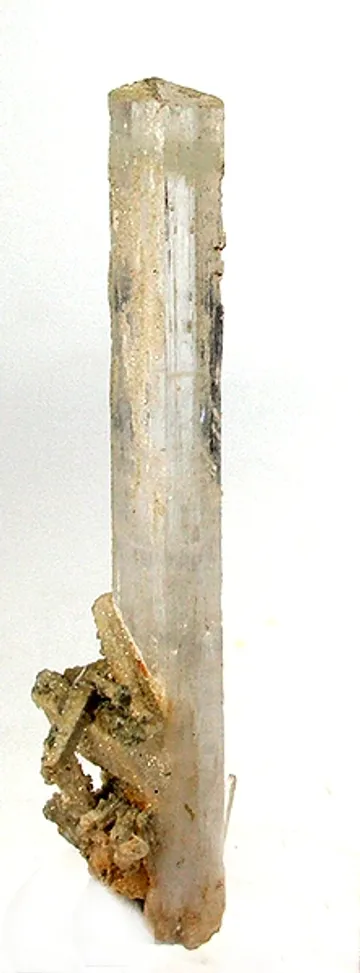
Anhydrite is an uncommon but important sulfate in the Paterson assemblage, recorded from both Lower and Upper New Street and most often encountered by collectors as pale, white, or colorless material in association with the basalt-cavity suite rather than as large showy standalone crystals. Its significance is paragenetic: anhydrite, gypsum, glauberite, and thaumasite point to sulfate-bearing fluids and late-stage cavity chemistry in a locality better known for zeolites, prehnite, datolite, and pectolite. Good Paterson anhydrite specimens are therefore valued for secure provenance, clear association, and preservation of delicate crystal or replacement textures; ordinary pieces can be visually hard to separate from other pale cavity fillings without testing or strong documentation.
Apophyllite-group minerals, including fluorapophyllite-(K), occur in the Paterson trap-rock cavities as square to tabular crystals and lustrous pale coatings or groups, especially in the New Street system and related exposures. The crystals are typically colorless, white, or very pale greenish, and they appear with calcite, prehnite, quartz, stilbite, datolite, pectolite, and other zeolites. The best Paterson apophyllites are bright, sharp, and visibly separated from the matrix or from earlier calcite; the less interesting examples are cloudy, merged into white crusts, or so poorly documented that they cannot be separated confidently from the broader Passaic County trap-rock output.
Chabazite is one of Paterson’s classic zeolites, recorded from Lower New Street, Upper New Street, Hoxie’s Quarry, and the Interstate 80 roadcut, where it forms rhombohedra and penetration twins, locally reaching several centimeters across. It commonly occurs with calcite, heulandite, laumontite, quartz, prehnite, and other zeolitic pocket minerals, and its best specimens show the unmistakable blocky geometry of chabazite standing cleanly on a contrasting pocket lining. Fine Paterson chabazite is judged by crystal sharpness, completeness of twins, luster, and matrix aesthetics; lesser material is often small, opaque, crowded, or partly buried in later coatings.
Datolite from Paterson occurs in the New Street quarries, Hoxie’s Quarry, Hinchcliffe Stadium, McKiernan & Bergin Quarry, and related basalt exposures, typically as glassy white to pale green crystals, plates, or drusy groups in cavities with prehnite, pectolite, calcite, quartz, stilbite, apophyllite, and thomsonite. Lower New Street material is especially familiar in old collections, including pieces where pale green datolite stands on or beside botryoidal prehnite. The best Paterson datolites are transparent to translucent, sharp, and visibly individualized rather than merged into pale crust; collector-grade examples also benefit from a balanced matrix and convincing old provenance, because datolite from nearby Passaic County localities can be visually similar.
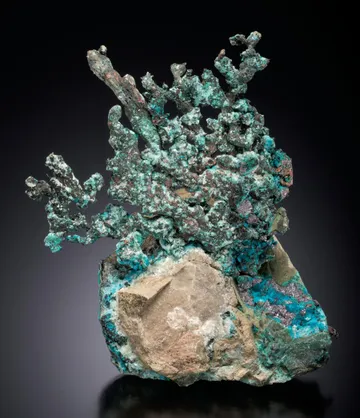
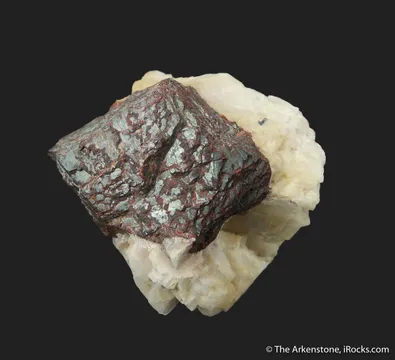
Beyond these headline species, Paterson’s mineral list is notably broad for an urban basalt locality. Analcime, natrolite, mesolite, scolecite, heulandite-Ca, laumontite, thomsonite-Ca, gmelinite-group material, epistilbite, and stilbite-group minerals show the strength of the zeolite suite. Rarer or more specialized entries include babingtonite, greenockite as golden tabular crystals, native copper, chalcocite, chalcopyrite, sphalerite, galena, malachite, azurite, pyrite, hematite, pyrolusite, pumpellyite-(Mg), titanite, opal, dolomite, siderite, baryte, gypsum, glauberite, thaumasite, and several questionable or discredited reports. For serious collectors, these lesser species are often more label-sensitive than visually obvious: a common-looking pale crust or tiny dark crystal may be far more interesting when it is an old, well-documented Paterson specimen with an identifiable quarry source.
Paterson specimens reward locality discipline. Many old pieces are labeled simply “Paterson,” but that name may cover several quarry sites and cuts within the city. Some historically labeled “West Paterson” specimens may actually be from Paterson proper, because collectors using public transportation often referred to the conveniently situated West Paterson stop; West Paterson itself is now Woodland Park. Conversely, some specimens sold as Paterson may be from nearby Prospect Park, Great Notch, Little Falls, Haledon, or other Passaic County trap-rock localities. Those neighboring localities are excellent in their own right, but they are not interchangeable when building a refined locality suite.
The most common authenticity issue is not outright fakery but locality drift. New Jersey trap-rock assemblages can look very similar across Paterson, Prospect Park, Great Notch, Upper Montclair, Bergen Hill, and other Newark Basin localities. A credible old label, a known collection pedigree, quarry-specific notes, or a matching museum/dealer record is often more important than visual comparison alone. Be cautious with specimens carrying overly broad labels such as “New Jersey zeolites,” “West Paterson,” or “Paterson area” if the seller presents them as a specific New Street quarry without evidence.
Condition is a major value factor. Prehnite bruises and chips along botryoidal surfaces and terminations; pectolite splinters, mats, and dulls; calcite cleaves and scratches easily; datolite edges can be nicked; chabazite corners are vulnerable; and stilbite sheaves may lose their tips. Laumontite, when present, is notorious for dehydration and chalking, so specimens containing it should be kept in stable indoor humidity and handled minimally. Avoid acid cleaning on mixed Paterson pieces unless the specimen has been carefully evaluated, because calcite is often part of the aesthetic and paragenetic story, and pectolite, zeolites, datolite, and delicate coatings may be harmed by aggressive treatment.
Fluorescence can be interesting in New Jersey trap-rock minerals, but it should be treated as an auxiliary observation rather than a locality proof. More useful for collecting is a careful look at the matrix and associations: dark basalt, open vug structure, calcite-quartz linings, green prehnite, fibrous pectolite, datolite, and zeolites in the same specimen all strengthen a Paterson attribution when the label history is credible. On the market, ordinary Paterson prehnite and calcite still appear with some regularity from old stock, but top-quality New Street combinations, attractive pectolite, sharp datolite, fine chabazite, and well-provenanced stilbite are much less common than the locality’s historical fame might suggest.
In the nineteenth century, Paterson was close enough to New York City to become a practical mineral excursion rather than a remote expedition. Collectors could ride out by rail, walk the cuts and quarry exposures, and return the same day with trap-rock specimens. Nelson Horatio Darton, still a teenager when he wrote his 1882 Scientific American Supplement account of New York-area mineral localities, treated Paterson as part of that urban collecting world. His description is wonderfully hands-on: he directed readers by railroad, placed the productive ground near the West Paterson stop, and told them where the prehnite-bearing veins lay in the basalt near the surface. The tone is not that of a distant academic—it is the voice of a young collector trying to get other collectors to the right ledge with a hammer.
Darton’s vocabulary also preserves the working-world texture of the locality. Pectolite was “silky spar” to quarrymen and tunnel workers, a practical name for a mineral whose diagnostic feature is its tough, satiny fiber. His field descriptions repeatedly stress how mineral collecting depended on fresh exposures and on the eyes of the workers: specimens appeared on dumps, in veins that looked deceptively like calcite, in soft altered seams, or in cavities that had just been opened. The classic Paterson specimen was not merely “found”; it was recognized, trimmed, and saved from rock being quarried for entirely non-mineralogical reasons.
A later chapter is almost the opposite story. By the time twentieth-century authors and field-trip leaders summarized the district, the great Paterson quarries were no longer the open, specimen-rich workplaces of the earlier collecting era. The very industry that created the mineral supply had moved on or shut down, and quarry faces that once yielded fresh cavities became inaccessible, dangerous, overgrown, or redeveloped. This is why Paterson has the aura of a closed classic: the minerals are not extinct, but the collecting conditions that produced them largely are.
The Paterson Museum keeps the city’s mineral identity alive in a way few urban localities can match. Paterson is better known nationally for silk mills, waterpower, and the Great Falls, yet its basalt is part of the same story of industrial development. The hard trap rock that supported the falls, formed the ridges, and supplied construction aggregate also held the cavities that made the city famous among mineral collectors. In that sense, a fine Paterson prehnite or pectolite is not just a pretty trap-rock specimen; it is a crystallized piece of the same basalt landscape that shaped the city’s factories, quarries, rail lines, and museum collections.