






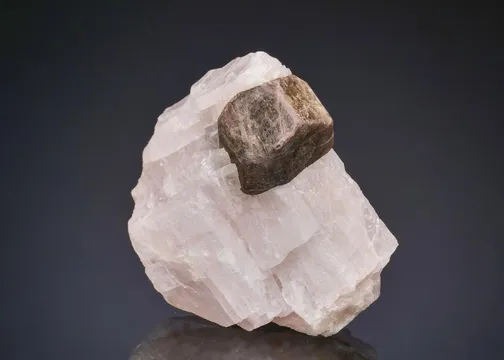
Franklin Mining District, USA — renowned for franklinite, willemite, zincite, and calcite; world-famous fluorescent suite and premier collector locality.
Key facts
Franklin is one of the few mineral localities where the hand specimen, the ore deposit, the mining history, and the collector culture are inseparable. The district in Sussex County, New Jersey, includes the Franklin Mine at Mine Hill in Franklin and the closely related Sterling Hill Mine at Ogdensburg, two intensely metamorphosed zinc-iron-manganese orebodies enclosed in the Franklin Marble of the New Jersey Highlands. Their dominant ore minerals—black franklinite, green to brown willemite, red zincite, and white to gray calcite—are unlike the sulfide assemblages that dominate most zinc camps. Franklin and Sterling Hill instead gave collectors oxide- and silicate-rich zinc ores, hundreds of documented mineral species, a long list of type-locality minerals, and the most celebrated fluorescent-mineral suite in the world.
The best Franklin pieces have a look that is instantly recognizable: sharp black octahedra of franklinite perched in sugary or cleavable calcite; green, brown, yellow, or peach willemite cutting through the marbley matrix; scattered red zincite like sparks in ore; and, under shortwave ultraviolet light, the famous red-orange calcite and electric green willemite. Cabinet specimens from old mine workings can be sculptural and bright even in daylight, while polished slabs and rough ore chunks become dramatic two-world objects—quietly granular in daylight, blazing in the dark.
Regional View
Country View
The district owes its richness to a rare combination of original metal-rich sedimentation, deep Grenville metamorphism, later deformation, pegmatite intrusion, hydrothermal alteration, faulting, weathering, and two centuries of mining exposure. Franklin specimens are therefore not merely “zinc ore”; they are cross-sections through a long geological history. A single thumbnail may contain ore minerals, marble, calcium silicate minerals, secondary alteration products, and several fluorescent responses.

Photo: Rob Lavinsky / Wikimedia Commons

For serious collectors, Franklin is also a label locality. “Franklin, N.J.” may be good enough for a casual fluorescent specimen, but the finest labels preserve whether a piece came from the Franklin Mine, Buckwheat area, Trotter Mine, Parker shaft, Palmer shaft workings, Sterling Hill, the Passaic pit, or a museum collecting pile. That precision matters because Franklin and Sterling Hill share a broad ore system while differing in color tendencies, textures, crystal habits, and rarity profiles.
Search for specimens: View all specimens from Franklin Mining District, USA
The Franklin Mining District lies in the New Jersey Highlands, northwest of New York City, in and around Franklin and Ogdensburg, Sussex County. The zinc deposits are enclosed in Franklin Marble, a Mesoproterozoic carbonate unit that extends along the Wallkill Valley. Modern interpretations treat the Franklin and Sterling Hill ores as metamorphosed stratiform zinc-iron-manganese deposits: metal-rich layers originally formed with carbonate sediments on an ancient seafloor, then were folded, buried, and recrystallized during Grenville-age mountain building. The metamorphic overprint was extreme enough to transform the precursor materials into the strange, durable ore assemblage collectors now prize—franklinite, willemite, zincite, calcite, tephroite, rhodonite, and a remarkable suite of calcium, manganese, zinc, arsenic, boron, lead, and silicate minerals.
At Franklin, the principal orebody was folded into a plunging synclinal form at Mine Hill. Old descriptions divide it into limbs, keels, and named workings rather than neat tabular zones. The Buckwheat open cut exposed the southern synclinal connection of the orebody; the Parker shaft was sunk on the east side of Mine Hill and connected by a crosscut to the ore at depth; the Palmer shaft became the major hoisting route for later operations. The Trotter Mine, Taylor Mine, Hamburg Mine, Buckwheat workings, Parker shaft, and related dumps each developed their own collecting reputations because each intersected different combinations of ore, marble, pegmatite contact zones, veins, and secondary alteration.
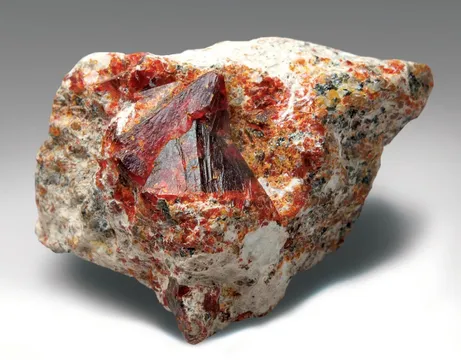
The primary ore was a granular to gneissic mixture dominated by franklinite, willemite, zincite, and calcite. In hand specimens the franklinite appears black and submetallic to metallic, commonly octahedral or granular; willemite ranges from green, brown, tan, yellow, gray, pinkish, red-brown, and gemmy colors to dull massive textures; zincite is typically red to orange-red in grains, scales, or masses; and calcite forms the pale matrix that made the district visually famous under ultraviolet light. Around the orebody and in contact zones, collectors encounter andradite, rhodonite, bustamite, tephroite, hardystonite, clinohedrite, esperite, leucophoenicite, margarosanite, hancockite, hendricksite, nasonite, cahnite, barysilite, axinite-(Mn), barite, sphalerite, fluorite, copper minerals, and many rarities. The Parker and Trotter material is especially important for complex vein and pegmatite-influenced assemblages.
The mining history began in confusion. Early workers mistook parts of the deposit for copper or iron ore because the principal zinc minerals were not yet known to science. Zincite was recognized in the early nineteenth century; franklinite was described in 1819; willemite followed soon after as the mineralogy of the ore became clearer. Dr. Samuel Fowler, physician, politician, mine owner, and mineral enthusiast, was central to bringing the Franklin orebody to scientific attention. The district then passed through decades of competing mineral rights, overlapping claims, iron-versus-zinc disputes, smelting problems, and corporate consolidation before large-scale industrial extraction stabilized under the New Jersey Zinc Company.
Commercial production transformed Franklin from a mineral curiosity into one of America’s great zinc camps. The Buckwheat Mine began in a field once associated with buckwheat farming; the open cut later became one of the most recognizable features of the Franklin mineral landscape. By the late nineteenth and early twentieth centuries, deep shafts, crosscuts, stopes, concentrating plants, and magnetic separation of franklinite had made the district an industrial operation as well as a scientific locality. The Franklin Mine ceased production in 1954 after depletion of its workable ore. Sterling Hill, a few miles away at Ogdensburg, continued much longer and closed in 1986, ending New Jersey’s underground zinc-mining era.
Collecting today is controlled and museum-based. The Franklin Mineral Museum operates the Buckwheat Dump, a 3.5-acre collecting area made of rock originally discarded from New Jersey Zinc Company operations, with an additional accessible collecting area behind the museum. The site remains famous because, even after decades of collecting and the removal of large volumes of rock, it can still yield fluorescent ore, common Franklin species, and occasional surprises. The Sterling Hill Mining Museum offers collecting on its Mine Run Dump, where its Local pile contains high-grade ore derived from Sterling Hill and an ultraviolet checking shed helps collectors evaluate fluorescence before keeping material. Neither site should be treated as open public land; access, rules, fees, age limits, tools, and seasonal schedules must be checked with the museums before visiting.
The most desirable historical Franklin specimens generally came from mine workings and old dumps rather than modern casual surface picking. Classic rhodonite in calcite, sharp franklinite octahedra, gem willemite, zincite-rich ore, hardystonite-clinohedrite-esperite fluorescent combinations, and complex Parker or Trotter assemblages are all label-sensitive. The Parker dump, once a legendary collecting ground, has largely disappeared through development or removal, while the Buckwheat Dump survives in reduced but still meaningful form. Old labels from the New Jersey Zinc Company, Franklin Mineral Museum, Franklin-Ogdensburg Mineralogical Society collectors, or well-documented private collections can substantially increase a specimen’s scientific and market value.
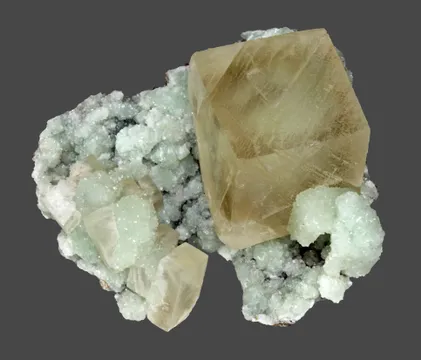
Calcite is the pale stage on which much of Franklin’s mineral theater occurs: white, gray, cream, pinkish, and salmon calcite forms massive ore matrix, cleavable blocks, druses, veins, and coarse carbonate pods enclosing franklinite, willemite, zincite, rhodonite, hardystonite, clinohedrite, sphalerite, and many rarities. Manganese-activated calcite from Franklin and Ogdensburg is the district’s most abundant fluorescent mineral, typically glowing bright orange-red to red under shortwave ultraviolet light and often showing a brief red phosphorescence; under other wavelengths it may be weaker or shift through pink, orange, yellowish, bluish, or mixed responses. Ordinary pieces are simply calcite-rich ore chunks, but good Franklin calcite specimens have strong color in both daylight and ultraviolet, clean contrast with black franklinite or green willemite, crisp crystal form where present, and reliable sublocality information such as Buckwheat, Trotter, Lang shaft, or Sterling Hill.
Franklinite is the emblem mineral of the district and the black backbone of its ore. At Franklin it occurs as massive layers, granular aggregates commonly averaging a few millimeters, rounded to euhedral grains, slickensided masses, and sharp isometric crystals whose dominant habit is octahedral, sometimes modified by dodecahedral, cubic, and trapezohedral faces. The best specimens are not mere black ore; they show lustrous, well-formed crystals standing out from white or pink calcite, or clean octahedra associated with willemite, zincite, and calcium silicate minerals. Franklinite was first described from the district, became New Jersey’s official state mineral, and remains a locality-defining species; exceptional crystals may reach cabinet size, but many large crystals fractured on removal, so complete sharp octahedra with intact faces, minimal bruising, and an old Franklin or Sterling Hill label are especially prized.
Willemite is Franklin’s green fire: a zinc silicate that may look green, brown, tan, peach, gray, yellow, reddish, blackish, or gemmy in daylight but typically fluoresces a strong green under shortwave ultraviolet light. At Franklin it occurs as granular ore with franklinite and zincite, green gneissic layers, massive “gem” material, crystals in calcite, fibrous or radiating habits, coatings, veins, and exsolution intergrowths with minerals such as tephroite, bustamite, petedunnite, and cyprine-bearing vesuvianite. Better specimens show clear daylight identity as well as ultraviolet performance: sharp or gemmy crystals, radiating sprays, saturated green fluorescence, attractive contrast with red-orange calcite and black franklinite, or unusual associations from Parker, Trotter, Buckwheat, and other Franklin workings. Common dump pieces are still satisfying under a lamp, but the collector-grade examples combine strong fluorescence, visible texture, and provenance.
Rhodonite from Franklin is among the district’s great daylight minerals, valued for pink to bright pinkish-red crystals and masses in a locality otherwise dominated visually by black, white, green, and red ore minerals. It occurs abundantly in and around calcium silicate assemblages, at orebody-marble contacts, in veins, near pegmatite-influenced zones, and in the Trotter and Parker mine assemblages. The premier Franklin rhodonite specimens are bright pink euhedral crystals in white calcite with franklinite and minor willemite, commonly 1–7 cm and exceptionally much larger; other habits include grayish-pink pseudoprismatic composite crystals, bladed seam crystals, vein “ribbons,” and intergrowths with andradite, bustamite, marsturite, manganaxinite, ganophyllite, hedyphane, tephroite, and willemite. Quality depends heavily on preparation: lustrous crystals mechanically freed from calcite are far superior to acid-burned pieces, and good labels, unweathered color, sharp form, and clean calcite contrast distinguish serious specimens from ordinary pink bands in ore.
Beyond these four headline minerals, Franklin is famous for a roster that can overwhelm even experienced collectors. Zincite is the red type-locality zinc oxide and one of the district’s essential ore minerals; hardystonite, clinohedrite, esperite, margarosanite, wollastonite, leucophoenicite, nasonite, and fluorapatite help produce many of the classic multicolor fluorescent assemblages. Type-locality and district-defining rarities include species such as axinite-(Mn), bannisterite, bementite, bustamite, cahnite, chalcophanite, fluor-uvite, hendricksite, hetaerolite, turneaureite, wawayandaite, yeatmanite, zincite, and many others depending on how strictly one treats Franklin versus Ogdensburg sublocalities. The Franklin-Ogdensburg mineral list is maintained with unusual care precisely because sight identifications, old labels, and financial incentives have historically muddied the record.
The first authenticity issue is locality precision. “Franklin, New Jersey” is often used loosely for material from either Franklin Mine or Sterling Hill, and older labels may read simply “Franklin” even when the specimen came from Ogdensburg or from a mixed collecting pile. That may be acceptable for decorative fluorescent material, but it is not acceptable for a serious systematic suite. Franklin Mine, Buckwheat Dump, Trotter Mine, Parker shaft, Palmer shaft, Sterling Hill, Passaic pit, and modern museum dump labels should be kept distinct whenever the evidence allows.
Modern self-collected material needs special care in labeling. The Buckwheat Dump is a museum collecting site made of mine waste and displaced material, not an in situ exposure where every rock can be assigned to a precise underground pocket. Sterling Hill’s collecting area includes a Local pile and an International pile, so a specimen from that site should be marked accordingly. If a collector buys or trades a piece represented as “self-collected at Sterling Hill” or “from Franklin Mineral Museum,” the label should specify the pile or dump if known.
Fluorescence is important but not diagnostic by itself. Franklin calcite commonly fluoresces red-orange to red under shortwave ultraviolet, willemite green, hardystonite violet-blue, clinohedrite orange, esperite yellow, and many other species have distinctive responses; however, intensity varies, coatings can mask fluorescence, and some minerals respond differently under shortwave, midwave, and longwave lamps. For meaningful comparison, note lamp wavelength and whether the photograph shows daylight, SW UV, LW UV, phosphorescence, or blended illumination. Serious Franklin fluorescent collectors should use a filtered shortwave lamp and should not rely on purple consumer “blacklight” flashlights for identification.
Condition matters more than beginners expect. Franklinite is tough, but octahedral faces can be chipped, rounded, or dulled; zincite can be granular, cleaved, friable, or altered; willemite may be massive but can be bruised or etched; calcite cleaves readily; and rhodonite can weather dark or lose surface quality. Many specimens from dumps are battered because they were waste rock, not carefully mined cabinet pieces. A “good” Franklin specimen often means clean contrast, stable matrix, undamaged crystal faces, and honest preparation rather than mere rarity of species.
Preparation is a major issue, especially with rhodonite and calcite-hosted crystals. Historical and modern sources warn that acid removal of calcite can damage rhodonite, dull surfaces, reduce color, or leave telltale etched remnants. Mechanically exposed rhodonite crystals, painstakingly worked out of calcite, are far more desirable. Acid work is also risky with complex Franklin assemblages because one may improve the exposure of one species while destroying calcite fluorescence, altering willemite surfaces, loosening fragile material, or damaging species that were not recognized in the matrix.
The synthetic-zincite problem is real in the broader market, though usually easy to avoid if one knows Franklin material. Natural Franklin and Sterling Hill zincite typically occurs as red to orange-red grains, scales, masses, or rare crude crystals with franklinite, willemite, and calcite. Bright, gemmy, furnace-grown zincite crystals from industrial sources—often orange, red, yellow, or green and sold as loose crystals or cut stones—are a completely different material. A natural Franklin zincite label should be supported by matrix, mineral association, and credible provenance.
Rarity at Franklin is layered. Common fluorescent ore is widely available from museum dumps, shows, estate collections, and online dealers. Fine franklinite crystals, strong willemite-calcite fluorescent plates, good zincite-rich ore, and attractive rhodonite are also available but increasingly dependent on old collections. Truly rare species, type-locality specimens, and old mine pieces with precise sublocality labels are finite and often trade privately among Franklin specialists. Condition, documentation, and sublocality can outweigh size.
The Franklin story begins with misidentification. Early miners saw red material in the hills of Sussex County and interpreted it through the mineral vocabulary they already knew. Red looked like cuprite, and cuprite meant copper. The supposed copper yielded none. The “iron ore” behaved badly in furnaces. The black mineral was not ordinary magnetite. What had been exposed on Mine Hill and at Sterling Hill was a deposit so chemically unusual that practical miners had found it before mineralogy had names for its principal minerals.
Samuel Fowler recognized that the Franklin ores were not a routine local iron deposit. A physician by training and a man of wide public life, Fowler bought into Mine Hill in the early nineteenth century and became the figure most associated with bringing the locality to science. Specimens moved from rural New Jersey to mineralogists in New York and Europe. Zincite was recognized as a zinc oxide; Berthier described franklinite in 1819; willemite entered the Franklin vocabulary soon afterward. In one of the most memorable early industrial episodes, zinc oxide prepared from zincite was ground in oil and used as paint on Fowler’s house—an American demonstration of zinc white before that pigment became widely established.
The naming of franklinite carried an unusually literary flourish. The mineral was named from Franklin, itself tied to Benjamin Franklin, and the early wording emphasized that the name should recall a place associated with “a great man” revered by friends of science and humanity on both sides of the Atlantic. It is hard to imagine a more fitting mineral for New Jersey: black, heavy, stubborn in the mill, scientifically troublesome, and beautiful when crystallized. More than two centuries later, the state made that symbolism official by designating franklinite as New Jersey’s state mineral.
For collectors, the old dump names became almost as evocative as the mine names. The Parker dump was once spoken of as a premier Franklin collecting ground, rich in material that had come through a shaft connected to a broad underground area. The Trotter dump was associated with complex vein and pegmatite-influenced specimens, including sphalerite, fluorite, niccolite-group minerals, secondary veins, and recrystallized ore minerals. The Buckwheat Dump survived as the public collecting heart of Franklin, a place where generations of collectors screened ordinary-looking rock by day, then carried it to ultraviolet light to see whether a dull gray chunk would become red, green, yellow, or blue.
The last day of the Franklin Mine has the stark simplicity of a mining-town ending. On September 30, 1954, the last skip of zinc ore came to the surface. Shafts were sealed, gates were locked, and buildings that had dominated the town’s working life began passing into memory. Yet Franklin did not disappear into the usual silence of a closed mining camp. The mineral museum, collecting dumps, annual shows, specialist societies, and the continuing fascination of fluorescent minerals turned the town’s orebody into a living collecting culture.
Sterling Hill extended the story for another three decades. When it closed in 1986, New Jersey lost its last underground zinc mine, but the site was not simply abandoned. It became the Sterling Hill Mining Museum, preserving mine workings, equipment, galleries, and the fluorescent Rainbow Tunnel. The result is unusual: collectors can study Franklin and Sterling Hill as both mineral localities and museum landscapes, seeing ore in the ground, ore in cases, ore on dumps, and ore under ultraviolet light.

_1_(32403279061).jpg)