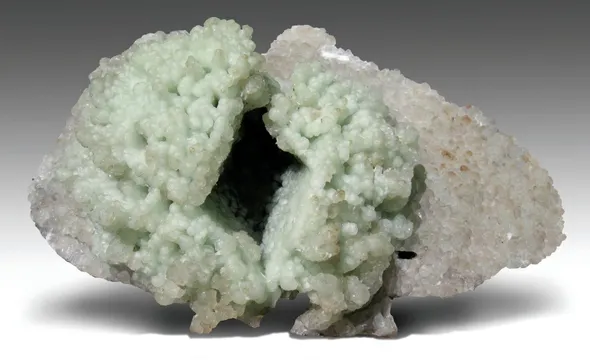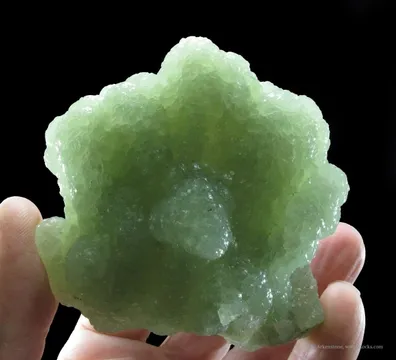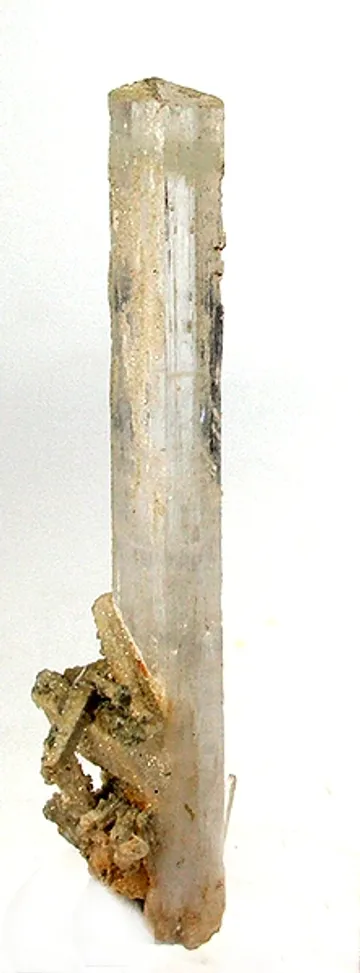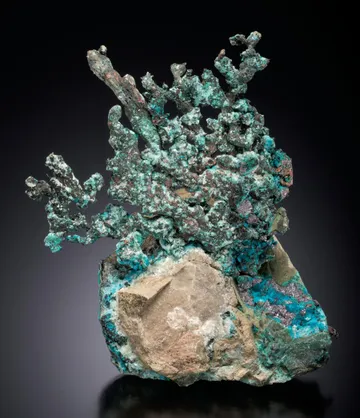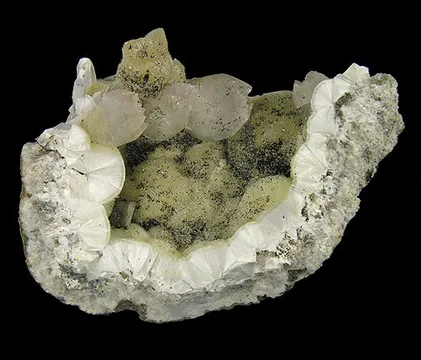
Chabazite from Upper New Street Quarry, New Jersey — a Paterson classic zeolite with pearly rhombs on basalt, peach-to-salmon color, and collecting appeal.
Key facts
Upper New Street Quarry is one of the classic names in the Paterson trap-rock district, and its chabazite belongs to that unmistakable New Jersey zeolite tradition: blocky, pearly rhombs and penetration twins perched on dark basalt, glittering quartz, calcite, heulandite, albite, and other low-temperature cavity minerals. The best pieces have a quiet but refined look—cream, peach, salmon-pink, tan, orange, and, rarely, saturated brick-red chabazite set against the darker, rugged matrix of the Watchung basalt.

Photo: Wikimedia Commons
What makes the locality special is the rock fabric that created the collecting opportunity. Upper New Street worked pillow basalt—lava that advanced into a shallow wet environment and broke into rounded lobes. The spaces between those pillows became the mineral collector’s treasure chambers. Later circulating fluids deposited zeolites, quartz, calcite, prehnite, and related species in open cavities, giving Upper New Street specimens their vuggy, architectural character.
Chabazite here is documented both as “chabazite” in the older locality sense and as Chabazite-Ca in modern usage. The distinction matters: chabazite is now treated as a subgroup name, and chemical work is required to assign an individual specimen confidently to Chabazite-Ca, Chabazite-K, Chabazite-Na, and so on. In the Paterson collecting world, however, the shorthand “chabazite from Upper New Street” still carries a strong visual and historical meaning.

Photo: Wikimedia Commons
The most desirable examples are not necessarily the largest plates. Collectors prize sharpness, luster, intact rhombohedral edges, a pleasing peach-to-salmon color, and associations that say “Paterson” at a glance: chabazite on sparkling quartz, chabazite with pearly heulandite, chabazite with calcite rhombs, and chabazite among the white forms of albite after anhydrite. The finest miniatures can have a sculptural balance that belies their modest scale.
Search for specimens: View all chabazite specimens from Upper New Street Quarry, New Jersey, USA
Upper New Street Quarry, also known historically as Burger’s Quarry, is in Paterson, Passaic County, New Jersey. It was a trap-rock quarry in the Watchung basalt, and the documented working period runs from 1893 to 1925. The quarry is now built over, which is an important fact for collectors: modern production from the original quarry should not be expected.
The deposit is a basalt-hosted zeolite and cavity-mineral occurrence. Upper New Street and the neighboring New Street workings exploited basalt that had formed pillow structures when lava entered or advanced over a probable shallow wetland or lake. Between the pillows were large irregular spaces, and those interstitial zones became exceptionally productive mineral pockets. In regional terms, the quarry belongs to the famous Paterson basalt mineral district, a group of localities long admired for zeolites, prehnite, quartz, calcite, datolite, and other cavity minerals.
Upper New Street’s mineral list is broad. Chabazite occurs with calcite, quartz, amethyst, heulandite, laumontite, prehnite, natrolite, anhydrite, chalcopyrite, datolite, apophyllite, pyrite, albite, babingtonite, aragonite, analcime, and pectolite in documented photo associations. The larger locality list also includes important Paterson trap-rock species such as fluorapophyllite-(K), stilbite-Ca, scolecite, thomsonite-Ca, greenockite, baryte, gypsum, hematite, and others.
The quarrying history has a second chapter that matters greatly to specimen provenance. Although the principal quarrying period ended in the early twentieth century, later construction activity exposed collectible material again. Blasting and excavation to trim the old quarry walls for housing development in the late 1980s yielded additional specimens. Collectors also recognize material from the area between the Upper and Lower New Street quarries, commonly called “Middle New Street” in the collecting community; many such pieces have long circulated under Upper New Street labels.
Today, access is essentially historical rather than practical. The original Upper New Street Quarry is built over, and collecting opportunities belong to the past, old collections, estate dispersals, museum holdings, and the occasional piece that surfaces from the 1980s–1990s construction-era finds or older Paterson collections. Any specimen said to be recently self-collected from the original Upper New Street Quarry should be treated cautiously unless its circumstances are very clearly explained.
Upper New Street chabazite is best known as rhombohedra and penetration twins, with documented crystals reaching as much as 45 mm across. Most collector pieces seen on the market are smaller: many miniatures and small-cabinet specimens carry individual rhombs from a few millimeters to around 1.5–2 cm, while larger historic crystals are scarcer and command more attention.
The color range is a major part of the locality’s appeal. White and cream chabazite with a faint peach or pink blush is common in better-looking specimens. Stronger orange, salmon-pink, tan, and peach-orange crystals are especially attractive when they sit on white quartz or pearly heulandite. Rare brick-red chabazite from Upper New Street is highly distinctive and is far less common than the usual cream-to-peach material.
Crystal surfaces can be vitreous to pearly, and good pieces have crisp rhombohedral faces with a blocky geometry that photographs well. The better crystals are not just present; they stand clear of the matrix, show clean terminations and edges, and avoid being buried in later coatings. Penetration twins can give a more complex form and are part of the locality’s classic look.
Associations are central to quality. Chabazite on sparkling quartz-lined basalt is a standard and attractive Upper New Street combination. Chabazite with colorless to pearly heulandite is especially evocative of the Paterson zeolite suite. Chabazite with calcite rhombs can be very aesthetic, particularly where the calcite is glassy and the chabazite has warm color. Albite pseudomorphs after anhydrite add another layer of locality character, producing white sculptural forms that contrast with orange chabazite and pearly zeolite coatings.
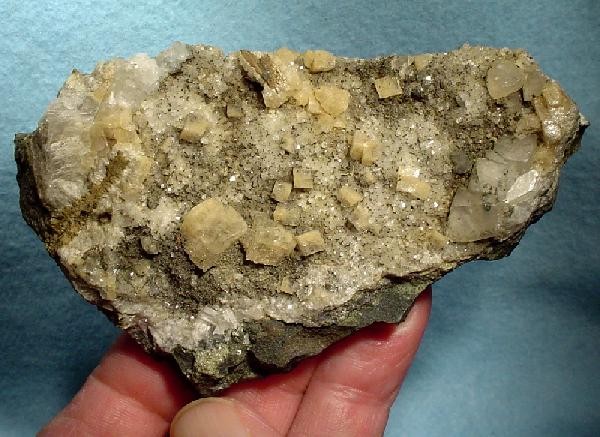
Photo: Wikimedia Commons
A strong Upper New Street chabazite specimen should have several of the following: sharp rhombs or twins, warm peach/salmon/orange color, bright luster, good contrast against basalt or quartz, an attractive zeolite association, and old collection provenance. Size alone is not enough. A small, crisp, peach-colored miniature on pearly heulandite may be more desirable than a larger dull plate with bruised rhombs.
For Upper New Street chabazite, the chief authenticity issue is locality precision rather than artificial treatment. Old labels may say “Paterson,” “West Paterson,” “New Street,” “New Street Quarry,” or “Burger’s Quarry” without specifying Upper or Lower New Street. “West Paterson” is especially problematic because the New Street quarries are in Paterson; the phrase often reflects older collecting shorthand rather than a precise municipal locality. When a label does not distinguish Upper from Lower, “New Street Quarry, Paterson” may be the more conservative locality description.
The “Middle New Street” problem is also real. Material collected in the area between Upper and Lower New Street during the mid-1980s to early 1990s commonly entered collections as Upper New Street material. That does not make it undesirable—much of it is excellent Paterson trap-rock material—but it does mean that careful collectors should keep old labels, dealer notes, and provenance history with the specimen rather than silently upgrading the locality.
No treatment is normally required to sell this material; the usual concerns are mechanical condition and cleaning. Chabazite rhombs bruise along exposed edges, and a specimen can look fine at arm’s length while having chipped corners under magnification. Quartz-lined plates may hide small broken chabazite rhombs among sparkling microcrystals. Calcite associations can be vulnerable to acid cleaning, so etched or dulled calcite should be noted. Heulandite and laumontite associations can be delicate; laumontite, in particular, is a dehydration-prone zeolite, and any friable, powdery, or chalky white material on old Paterson specimens deserves careful handling.
Rarity is relative. Chabazite from Upper New Street is not unknown, and specimens appear regularly enough that a patient New Jersey collector can acquire one. Fine examples, however—sharp, lustrous, warm-colored crystals over 1 cm with good associations and old provenance—are much less common. Large crystals approaching the documented upper size range are genuinely scarce. Red or strongly brick-colored pieces are uncommon and should be evaluated carefully for both provenance and condition.
Market availability is strongest through old collections, online dealer inventories, auction archives, and New Jersey-focused specimen dispersals. The quarry is built over, so new supply from the original workings is not a meaningful factor. Prices vary widely: small but representative pieces may remain approachable, while richly colored, sharp, old-collection miniatures and small cabinets with strong visual balance can attract more specialized competition.
The story of Upper New Street is partly the story of a quarry that kept producing after it was supposed to be finished. The working quarry belonged to an earlier industrial Paterson: a trap-rock operation opened in 1893, cutting into basalt for stone, not for collectors. Yet the same rock that made good aggregate also held cavities. Where the lava had cooled in pillows, the spaces between those pillows became lined with zeolites, quartz, calcite, and prehnite. The quarrymen were not opening “geodes” in the popular sense, but collectors knew what those vugs meant.
Then came the late-twentieth-century afterlife. Long after regular quarrying had ended, the old ground was being reshaped for housing. Blasting and excavation trimmed the quarry walls, and fresh pockets were exposed before the site disappeared beneath development. A drill rig photographed around 1988, quarry walls with townhouses, and a collector digging a pillow-lava vug capture the strange transitional moment: classic mineral ground being both reopened and erased. For a brief window, the same pillow basalt that had made Upper New Street famous yielded more specimens, just before access vanished.
Among collectors, the geography became more complicated than a map would suggest. Between the Upper and Lower New Street quarries lay a productive area affectionately called “Middle New Street.” Specimens from that zone were commonly labeled Upper New Street, even when they were not taken from the original upper quarry itself. Today those labels carry a small historical puzzle. A specimen may be authentically “New Street” in every mineralogical sense and still require a cautious description if the old tag is vague.
The specimens themselves preserve the human trail. A 4.2 x 3.6 x 2.7 cm chabazite miniature from the Richard Kosnar Collection shows sharp, pearly rhombohedra up to 2.0 cm on edge, mostly white with a faint peach-pink color. Another old piece, ex Walter E. Kuenstler Collection, carries pastel salmon-pink chabazite on pearly heulandite and is described as likely from the 1940s–1960s era. A later auctioned specimen from the Rich Kosnar Collection showed brick-red chabazite to 1.2 cm, an unusually saturated color for the species from this locality, and sold in 2024 for $30 after a short run of bids. The modest price is telling: Upper New Street chabazite is not always expensive, but a collector who understands the district sees more than the hammer result. The specimen is a small survivor from a built-over quarry, a vanished basalt face, and a collecting culture that prized Paterson pockets long before online locality databases existed.
Mindat locality page: Upper New Street Quarry, Paterson, Passaic County, New Jersey, USA — Core modern locality record, with coordinates, historical name Burger’s Quarry, quarry status, working dates, geological setting, mineral list, and references.
Mindat occurrence page: Chabazite from Upper New Street Quarry — Species-level occurrence record documenting chabazite habit, associated minerals based on photo data, and the reference list for chabazite at the locality.
Ehrman, A. H. (1895). “Mineral Collector,” 2:138–139. — One of the early published references cited for chabazite and several associated minerals at Upper New Street Quarry.
Papke, H. (1908). “Mineral Collector,” 15:113–118. — Early twentieth-century reference cited for Upper New Street chabazite and other Paterson trap-rock minerals.
Peters, Thomas A., and Peters, Joseph J. (1978). “Famous Mineral Localities: Paterson, New Jersey.” The Mineralogical Record, 9(3), 157–179. — Major locality article on the Paterson mineral district, cited for Upper New Street chabazite.
Peters, Joseph J. (1984). “Triassic Traprock Minerals of New Jersey.” Rocks & Minerals, 59(4), 157–183. DOI: 10.1080/00357529.1984.11764472 — Important statewide treatment of New Jersey trap-rock minerals, repeatedly cited for Upper New Street and related Paterson species.
Mason, Brian H. (1960). Trap Rock Minerals of New Jersey. Bulletin 64, New Jersey Geological Survey. — Classic New Jersey Geological Survey reference on trap-rock mineralogy, cited for multiple species in the Paterson district.
Tschernich, Rudy W. (1992). Zeolites of the World. Geoscience Press, 567 pp. — Standard zeolite reference cited for chabazite at Upper New Street Quarry.
Wikimedia Commons: Category: Upper New Street Quarry — Open image repository containing multiple Upper New Street specimen photographs, including chabazite-Ca combinations with heulandite, albite, quartz, calcite, and prehnite.
File: Chabazite-Ca-185410.jpg — Rob Lavinsky photograph of a 4.2 x 3.6 x 2.7 cm Upper New Street specimen with pearly chabazite rhombohedra to 2.0 cm on edge, ex Richard Kosnar Collection.
File: Chabazite-Ca-Heulandite-Albite-120390.jpg — Rob Lavinsky photograph of a 6.4 x 4.5 x 3.2 cm combination specimen with orange chabazite, pearly heulandite, and albite pseudomorphs after anhydrite, ex George Feist Collection.
File: Chabazite-Ca-Heulandite-Ca-225190.jpg — Rob Lavinsky photograph of a 4.1 x 3.4 x 2.4 cm old miniature with salmon-pink chabazite to 1.3 cm on pearly heulandite, ex Walter E. Kuenstler Collection.
File: Chabazite-Ca-Quartz-Calcite-174568.jpg — Rob Lavinsky photograph of a 10.5 x 6.5 x 2.5 cm plate with tan chabazite rhombs to 9 mm on micro-quartz and calcite, collected in 2007.
Mindat — Upper New Street Quarry, Paterson, Passaic County, New Jersey, USA — Best single reference for locality status, coordinates, historical names, working dates, geology, mineral list, and cited literature.
Mindat — Chabazite from Upper New Street Quarry — Focused occurrence page for chabazite, including habit, associated minerals, and chabazite-specific references.
Wikimedia Commons — Upper New Street Quarry category — Useful visual archive of Upper New Street specimens, including several chabazite-Ca associations.
Wikimedia Commons — Chabazite-Ca-185410.jpg — Detailed image record for a sharp, pearly chabazite specimen with collection provenance.
Wikimedia Commons — Chabazite-Ca-Heulandite-Albite-120390.jpg — Image record showing the classic Upper New Street association of orange chabazite, heulandite, and albite after anhydrite.
Wikimedia Commons — Chabazite-Ca-Heulandite-Ca-225190.jpg — Image record for an old salmon-pink chabazite miniature on heulandite.
Wikimedia Commons — Chabazite-Ca-Quartz-Calcite-174568.jpg — Image record for a chabazite plate on quartz and calcite, useful for recognizing common matrix style.
Mineral Auctions — Chabazite, rare red color, Upper New Street Quarry — Auction archive documenting a brick-red Upper New Street chabazite miniature, its size, condition note, provenance, and 2024 sale result.
Mineral Auctions — Chabazite, ex Brian Kosnar Collection, Upper New Street Quarry — Auction archive with useful notes on “Middle New Street,” 1980s–1990s collecting, and common Upper New Street labeling practice.
John Betts Fine Minerals — Mineral Blog journal entry on New Street labels — Practical discussion of old New Street, Paterson, West Paterson, Upper New Street, and Lower New Street labeling issues.
National Park Service — Paterson’s Geology: A Step Back in Time — Accessible background on Paterson basalt, the Watchung Mountains, quarrying, and regional geologic history.
Paterson Museum — Rocks and Minerals — Museum overview emphasizing Paterson’s importance as a mineralized basalt area and its local mineral display.
New Jersey Geological Survey — Bedrock Geologic Map of the Paterson Quadrangle — Regional geologic map source for the Paterson quadrangle and the basalt units that host zeolite-lined pillow and vesicle cavities.