






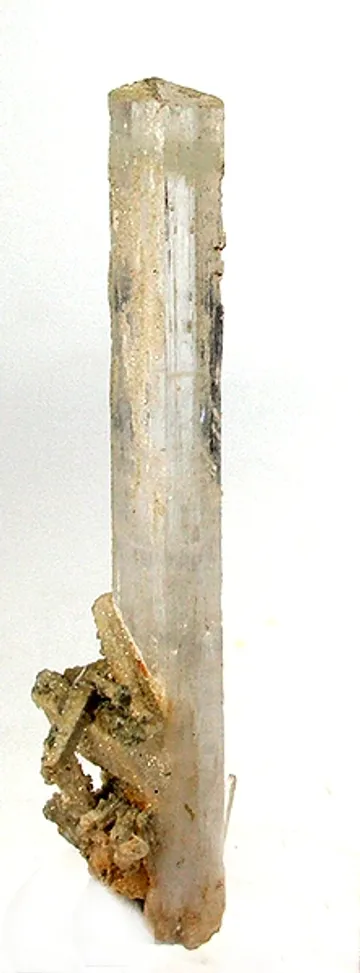
Chimney Rock Quarry, USA - premier collector locality in the southern Watchung belt, yielding native copper, chalcocite, natrolite and zeolite-calcite suites.
Key facts
Chimney Rock Quarry is the great collector locality of the southern Watchung trap-rock belt: a working basalt quarry in Bridgewater Township, Somerset County, New Jersey, cut into the Orange Mountain Basalt of the Newark Basin and sitting directly over, and beside, old copper workings long known as the Chimney Rock Copper Mine, Bound Brook Quarry, Houdaille Industries Quarry, and Stavola Industries Quarry. Its importance is not merely that it produced “good New Jersey trap-rock minerals,” but that it gave collectors two very different-looking suites from one hydrothermal story: copper mineralization concentrated in Passaic Formation red beds and fracture systems at the basalt contact, and a zeolite-prehnite-datolite-calcite assemblage in fissures, cavities, and exceptional open fractures within the basalt itself.
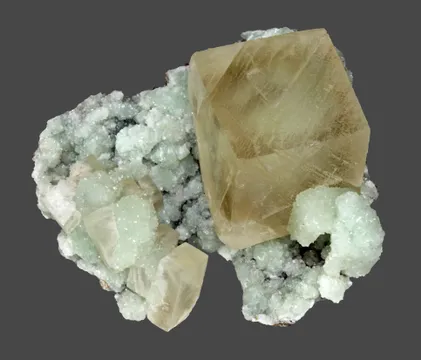
The locality is famous above all for native copper, chalcocite, natrolite, chalcopyrite, chrysocolla, calcite, analcime, and prehnite. The best pieces are instantly recognizable: heavy red-brown and metallic copper plates with blue to blue-green chrysocolla in red mudstone; dark, steely chalcocite crystals on matrix; lustrous “blister” chalcopyrite with rounded botryoidal surfaces; honey, white, or colorless calcite; and tall, glassy, white to colorless natrolite prisms that rank among the finest North American examples of the species. At its best Chimney Rock is not a pretty zeolite locality with a little copper attached—it is a locality where red-bed copper, basalt vesicles, brine movement, late-stage zeolites, and quarry exposure all converged to make specimens with strong geological identity.
Regional View
Country View
The quarry exposes dark greenish-gray to greenish-black basalt of the Orange Mountain, or First Watchung, basalt. The rock is fine grained, dominated by calcic plagioclase and clinopyroxene, and includes multiple lava flows separated locally by weathered zones, red siltstone, or volcaniclastic material. Vesicular tops and bottoms, columnar jointing, pillow structures in the lower part of the upper flow, and pahoehoe structures in the uppermost flow are all part of the setting that made the quarry such a useful window into early Mesozoic volcanism in the Newark Basin. For collectors, the important point is that those structural openings—joints, fissures, vesicles, amygdules, and larger tensional openings—became the plumbing through which mineralizing fluids moved.
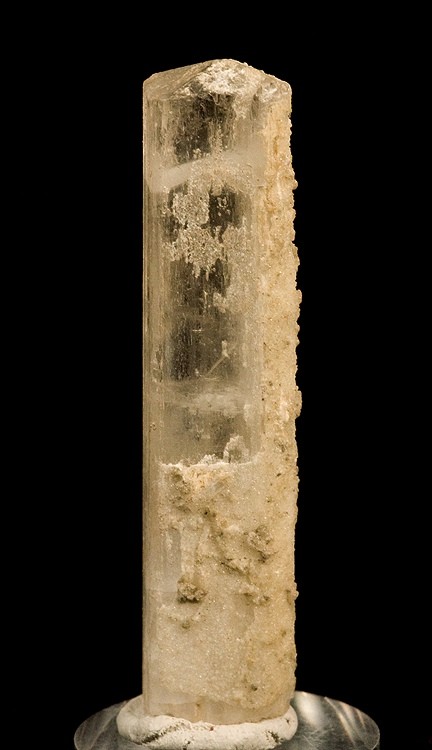
The best natrolites from Chimney Rock have a presence quite unlike the common acicular zeolite sprays of many basalt quarries. They are stout, single, orthorhombic prisms: glassy, pale, upright crystals that can look almost carved from ice. Fine examples may be colorless to faintly white and transparent enough to show internal veils and growth zoning. In contrast, the copper specimens are dense, earthy, and strongly colored—coppery metal, red sediment, blue-green chrysocolla, green malachite, and dark sulfide surfaces—making Chimney Rock one of the few American localities where a single name can legitimately excite both zeolite specialists and copper-suite collectors.

Photo: Wikimedia Commons
Search for specimens: View all specimens from Chimney Rock Quarry, USA
Chimney Rock Quarry lies in Bridgewater Township, Somerset County, New Jersey, roughly northeast of the US Route 22 and I-287 interchange, south-southwest of Martinsville and northwest of Bound Brook. In the mineral literature, older labels may read Bound Brook Quarry, Houdaille Industries Quarry, Stavola Industries Quarry, Stavola Construction Materials, or simply “Bound Brook, New Jersey.” The locality is a trap-rock quarry in Orange Mountain Basalt, but it overlaps historically and spatially with the Chimney Rock copper occurrence, so old labels may also refer to the Washington Mine or Chimney Rock Copper Mine area.
The deposit is best understood as a basalt-contact copper and secondary-mineral system in the Newark Basin. The quarry is cut into the Orange Mountain Basalt above Passaic Formation mudstones and siltstones. Most of the copper was not in large ore shoots in the basalt itself, but in red-bed sediment immediately beneath the basalt contact and in fractures cutting both sediment and basalt. The Passaic Formation beds include mudstones ranging from thick-bedded to laminated, with cavities after earlier evaporite minerals such as gypsum and glauberite. Near the basalt contact, a darkened zone roughly within the upper 1.5 feet of the sediment is associated with copper deposition; specimens from this zone often show reduced, bleached halos around native copper replacements, recording the redox chemistry that made the copper drop out of solution.
The copper mineralization is a distinctive red-bed style. Native copper and minor native silver occur in narrow veinlets and replacements, including veinlets only a few millimeters wide that cut downward from the basalt-sediment contact and form polygonal networks interpreted as dewatering or shrinkage-related structures. Chalcocite came later and is subordinate to copper in the darkened sediment zone, occurring in thin crosscutting veins. Chrysocolla, malachite, cuprite, brochantite, and other secondary copper species formed by alteration, producing colorful coatings, replacements, and cavity fillings. Chimney Rock differs from many textbook red-bed copper deposits because the reducing agent is interpreted as ferrous iron in the basalt rather than black shale, pyrite, organic matter, or bacterial sulfate reduction.
The zeolite-prehnite-datolite suite belongs to the same larger hydrothermal system, even though the copper assemblage and zeolite assemblage have often been treated separately in the literature. Basin brines appear to have moved upward from the sedimentary section into the basalt, depositing early soluble salts, quartz, native copper and silver, prehnite, datolite, copper sulfides, natrolite and associated zeolites, calcite, and finally weathering products of copper carbonates and iron oxides. In the basalt, amygdules and pipe vugs may contain chalcedony, jasper, quartz, calcite, hematite, and goethite; the more important specimen pockets formed in larger extensional openings and fractures.
The quarry’s industrial history is long. Local copper mining at Chimney Rock is associated with Revolutionary War tradition, including the oft-repeated story that copper from the area helped supply brass artillery and produced a cannon later used at Yorktown. By the nineteenth century, copper mining had become economically marginal, but the basalt itself proved far more valuable. William Haelig leased land from copper interests in the 1880s and established the Chimney Rock Quarry; before rail access, stone was hauled to Bound Brook by horse-drawn wagons, and a later rail spur made large-scale trap-rock quarrying practical. Modern operations have continued under Stavola, with the Bound Brook facility producing aggregate, asphalt-related materials, and recycled construction materials.
For collectors, the important specimen period is not a single mining “era,” but a series of quarry exposures. The natrolite discovery, opened in the early 1970s and extended in 1978, is the legendary one: an open fracture or pocket system on a bench surface yielded white translucent to transparent crystals to 22 cm, with associated analcime, calcite, and other zeolites. The pocket had to be worked by underhanding, and water removal was necessary. The lower extension exposed in 1978 produced additional material, but the classic crystals remained finite, heavily collected, and today are much scarcer on the market than the phrase “thousands of crystals” might imply.
A later high point came from the copper-rich exposures of the late 1990s into about 2001, when a fault-bounded mass of red sediment was progressively exposed in the active quarry. Collectors came to know it informally as “The Great Red Wall.” Copper minerals occurred in veins and replacements, especially along the sheared outer margins of the sediment mass. This wall produced notable native copper, chalcocite, and chrysocolla specimens, including crystallized native copper and large chalcocite plates. It was eventually quarried away to the floor, making specimens from that exposure a closed chapter rather than an ongoing supply.
Collecting access today should be regarded as closed without explicit permission. Chimney Rock is an active industrial quarry, and trespassing is not tolerated. Modern specimens appear chiefly from old collections, dealer inventories, mineral auctions, and the occasional deaccession. Labels need to be read carefully: “Bound Brook,” “Houdaille,” “Stavola,” “Chimney Rock,” and “Bridgewater” may all be correct depending on period and label habit, but they are not interchangeable with every Watchung quarry or every Somerset County zeolite occurrence.
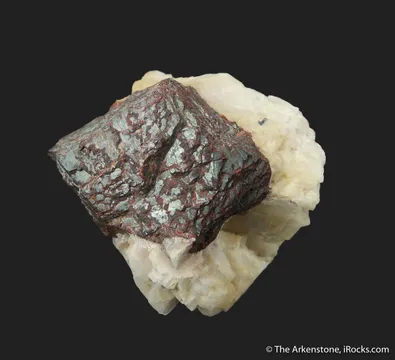
Native copper from Chimney Rock is most prized when it is recognizably crystallized rather than merely massive or smeared through red sediment: the best late-1990s pieces show complex crystals to about 4 cm, arborescent or platy growths, crude feathery spinel-twin textures, and strong color contrast with blue to blue-green chrysocolla, red mudstone, occasional amethyst, cuprite, or malachite. Large copper masses weighing hundreds of pounds have been recorded from the quarry, and at least one very large mass was preserved for display, but collector-grade copper is judged on form, exposed crystal faces, sculptural open texture, and clean association rather than sheer weight. The finest pieces came from the copper-rich sediment and fault-related zones exposed during active quarrying, especially the late “Great Red Wall” period, and they stand apart from ordinary Chimney Rock copper by showing distinct crystals, attractive patina, and colorful secondary copper minerals rather than dull, massive replacement copper locked in rock.
Chrysocolla at Chimney Rock is a vivid secondary copper mineral of the copper zone, forming blue to bluish-green alteration material after and around native copper and chalcocite, and it is most often seen as coatings, replacements, seams, and included color in calcite rather than as isolated freestanding crystals. Its best collector role here is as a color-maker: it turns red sediment-hosted copper specimens into dramatic blue-green and copper-red display pieces, accents dark chalcocite plates, and may occur with calcite, cuprite, malachite, and native copper. Ordinary examples are thin, dull coatings or ambiguous green-blue stains, while better specimens show rich, saturated color, clear genetic association with copper or chalcocite, and enough three-dimensional surface coverage to be visually dominant without obscuring the metallic mineral beneath.
Natrolite is Chimney Rock’s aristocratic zeolite, and the classic material came from the early-1970s pocket and its 1978 lower extension: white to colorless, translucent to transparent orthorhombic prisms, commonly single rather than spray-like, with crystals reported to 22 cm and many fine examples in the cabinet to large-cabinet range. The pocket also contained large white analcime crystals, some larger than golf balls, along with calcite and other late-stage minerals in a fracture opening in the basalt. Good Chimney Rock natrolite is separated from ordinary New Jersey zeolite material by scale, stoutness, clarity, sharp termination, and freedom from bruising; the finest examples have a glassy, almost gem-crystal quality, and some recovered material was clean enough to cut flawless stones of more than 10 carats.
Other documented minerals from Chimney Rock include analcime, anhydrite, albite, anorthite, augite, bornite, brochantite, calcite, chalcocite, chalcopyrite including the “blistered copper” habit, cuprite including chalcotrichite, datolite, epidote, galena, glauberite, goethite, gypsum, hematite including specularite, heulandite-group minerals, malachite, native silver, opal, pectolite, pigeonite, prehnite, pyrolusite, quartz varieties including agate, amethyst, chalcedony, rock crystal, and smoky quartz, and stilbite-group minerals. The most important rarities for collectors are not type-locality minerals—Chimney Rock is not known as a type locality—but unusual quality expressions: North American-class natrolite, New Jersey-class crystallized chalcocite, botryoidal chalcopyrite masses to unusually large size, crystallized copper from a limited late find, and the large analcimes associated with the natrolite fracture system.
Chimney Rock specimens should be bought with label literacy. Older pieces may legitimately be labeled “Bound Brook,” “Houdaille,” “Stavola,” “Bridgewater,” or “Chimney Rock,” but vague “New Jersey trap rock” labels should not be upgraded to Chimney Rock without supporting provenance. Conversely, not every “Bound Brook” zeolite is automatically from the famous natrolite pocket; Somerset County has multiple trap-rock and basalt-related localities, and old collection labels can be imprecise.
The principal authenticity issue is not a flood of known fabricated fakes, but misidentification and enhancement. Chalcopyrite from the locality may occur as rounded botryoidal “blister” masses and is sometimes polished to reveal a golden metallic interior beneath tarnish; such polishing is part of the collecting history of the material, but it should be disclosed and not confused with naturally lustrous crystal faces. Copper-bearing pieces can also be mis-sold when dull massive copper is presented as crystallized copper, or when blue-green coatings are assigned to chrysocolla without analysis even though color alone is not proof. Greenish inclusions in calcite from copper-zone material deserve particular caution, as celadonite-like green minerals and chrysocolla can be visually confused without context or testing.
Condition matters greatly. Natrolite is brittle and shows damage at terminations, along prism edges, and at the base where crystals were detached from pocket breccia or matrix. Single crystals are especially vulnerable to repaired bases and small bruises that only become obvious under strong side light. Chalcocite from Chimney Rock may be naturally dull or slightly etched, and many fine pieces were etched from calcite; this is part of the locality style, but excessive cleaning can leave surfaces granular or undercut. Native copper may be darkly patinated, partly altered, or embedded in soft red sediment; aggressive cleaning can destroy chrysocolla, cuprite, malachite, and sediment contrast that make a specimen desirable.
Calcite from Chimney Rock is worth checking under shortwave ultraviolet light. Rhombic honey-yellow calcite has been reported with golden-yellow fluorescence, while white scalenohedral calcite may fluoresce pink under shortwave. These responses can add interest, but fluorescence should not be used as a stand-alone proof of locality because comparable trap-rock calcites occur elsewhere in New Jersey.
Market availability is uneven. Small copper-chrysocolla and calcite pieces still appear from older collections, and massive copper-bearing pieces are not impossible to find. Fine crystallized native copper, large chalcocite crystals, and sharp glassy natrolite are much scarcer, especially with old labels, clean condition, and credible pocket-era provenance. The very best Chimney Rock specimens are now essentially collection-circulation minerals: they move when an old New Jersey collection, a specialized zeolite suite, or a regional copper collection is dispersed.
The oldest story attached to Chimney Rock is the cannon story, and like many good New Jersey mining stories it lives half in documentation and half in local memory. The copper workings at Chimney Rock are tied to Revolutionary War tradition: copper from the area was said to have supported the Continental war effort, and the proceeds or metal are associated in local accounts with a brass cannon later used at the Siege of Yorktown. Whether every detail of that tradition can be pinned down to a modern archival standard or not, the story explains why this quarry is more than an aggregate pit to collectors. A piece of copper from Chimney Rock carries the unusual aura of a mineral specimen connected to colonial industry, early American metallurgy, and the military geography of the Middlebrook and Watchung region.
The quarrying story begins with a more practical turn. In 1886, William Haelig leased land from copper interests and established the Chimney Rock Quarry. Before the rail spur, stone went out the hard way: horse-drawn wagons carried trap rock down toward the railroad at Bound Brook. Haelig then persuaded the Central Railroad of New Jersey to put in a spur to the stone pit. That decision tells the economic story of the locality in miniature. Copper had romance and history, but trap rock paid the bills; once the quarry could ship stone efficiently, basalt became the enduring commodity.
The great natrolite pocket of the 1970s is one of the classic New Jersey collecting episodes. The opening was exposed on the top surface of a bench, and collectors worked downward into it by underhanding rather than simply prying loose a wall pocket at chest height. Water was enough of a problem that a pump was needed. From that wet, awkward opening came white to transparent natrolite crystals to 22 cm long, associated with large analcime crystals and later calcite. In 1978, the lower extension of the same structure was exposed and worked, producing another smaller but important recovery. The pocket had once been described as “pipe-like” and attributed to a steam-explosion origin, but later quarry exposures showed it to be an exceptional tensional opening in a fracture rather than a true steam explosion breccia. That distinction matters: it turns the find from a picturesque accident into evidence for how the basalt opened and how mineralizing brines moved through it.
The late copper finds have their own quarry-floor drama. Beginning around 1989 and continuing until about 2001, active quarrying exposed a fault-bounded mass of red sediment that stood for years as a conspicuous monolith. Collectors called it “The Great Red Wall.” Its heavily sheared margins carried veins and replacements of copper minerals, and the mineralization sat above the basalt in a way that made the exposure especially memorable to collectors who understood the usual contact relationships. From this wall came some of the locality’s defining modern specimens: copper, chalcocite, chrysocolla, and related minerals in red sediment, including pieces that showed the same red-bed chemistry as the older copper occurrence but in a fresh, collectible quarry exposure. Then, as working quarries do, the wall disappeared—progressively cut down until it was leveled to the quarry floor.
A more recent collector memory preserves how Chimney Rock still holds the attention of New Jersey specialists even when access is closed. In an October 2020 presentation to the Mineralogical Society of the District of Columbia, collector Dan Teich described the quarry as “like taking a walk through the Triassic era,” a compact phrase that captures what makes the locality special. It is a quarry where a person can read lava flows, sediment caught at contacts, hydrothermal fractures, old copper mining, and modern aggregate extraction in one place. His audience was not being shown just pretty minerals; they were being walked through a slice of the Newark Basin, with copper and zeolites as the bright punctuation marks.


.png)