New Jersey, USA — renowned Franklin–Sterling Hill zinc district with franklinite, willemite, zincite; famed for UV-fluorescent minerals and cabinet collections.
Key facts
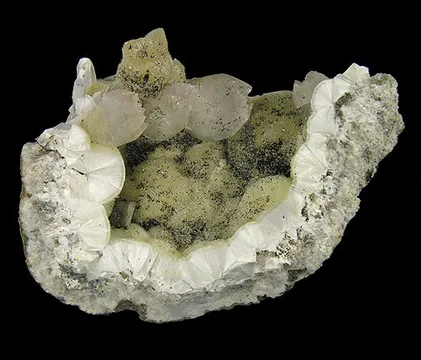
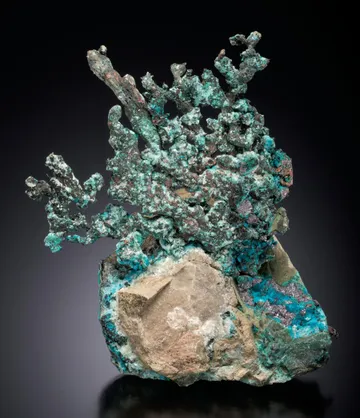
New Jersey is one of the great compact mineral states: small on a map, but outsized in the history of mineralogy. For serious collectors it is really two classic provinces sharing one label. In the northwest, the Franklin–Sterling Hill zinc district of Sussex County produced a zinc-iron-manganese assemblage unlike any other known deposit: franklinite, willemite, zincite, manganiferous calcite, hardystonite, esperite, clinohedrite, hodgkinsonite, margarosanite, and a long tail of rare arsenates, silicates, borates, oxides, and phosphates. In the Piedmont and Meadowlands, the Newark Basin traprocks — Watchung basalts and related diabase bodies — furnished the old New Jersey zeolite suite: natrolite, analcime, heulandite, stilbite, chabazite, prehnite, datolite, apophyllite, pectolite, calcite, quartz, native copper, and rare secondary copper minerals.
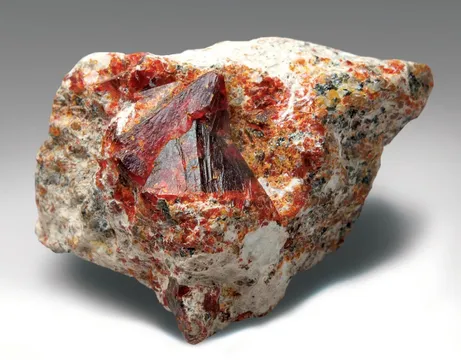
The northwest zinc district is the scientific centerpiece. The ore bodies at Franklin and Sterling Hill are enclosed in the Franklin Marble, a Mesoproterozoic carbonate unit that records ancient shallow-marine deposition, zinc-rich metalliferous layers, deep Grenville metamorphism, folding, faulting, later hydrothermal alteration, and Pleistocene glaciation. The principal ore minerals — black franklinite, reddish zincite, brown to greenish willemite, and pale calcite — are visually blunt in daylight but spectacular under shortwave ultraviolet light: calcite glows red to orange-red, willemite green, hardystonite violet-blue, clinohedrite orange, and other species add yellow, cream, blue, and phosphorescent afterglow. New Jersey’s best fluorescent slabs are not merely “pretty UV rocks”; they are cabinet-scale records of one of the most mineralogically dense ore environments on Earth.
Regional View
Country View
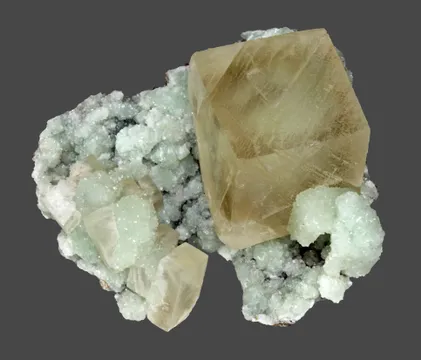
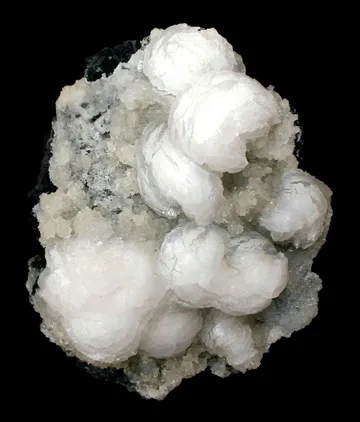
The traprock side of New Jersey has a different beauty: basalt cavities, seams, and fractures lined with pale zeolites, lustrous prehnite, glassy datolite, quartz, amethyst, calcite, and occasional native copper or silver. The famous Paterson-area quarries, Prospect Park, Upper and Lower New Street, Great Notch, Chimney Rock near Bound Brook, Millington, Summit/Houdaille, and Laurel Hill/Snake Hill are remembered by collectors for discrete quarry labels and very specific habits. The best natrolite from Chimney Rock is not a mass of hairlike needles but a large, transparent to translucent, sharply terminated orthorhombic prism — a New Jersey style that can stand beside much better-known zeolite localities.

Photo: Wikimedia Commons

Photo: Wikimedia Commons
Search for specimens: View all specimens from New Jersey, USA
New Jersey’s most important mineral specimens come from two geological settings. The Franklin–Sterling Hill district is a metamorphosed zinc-iron-manganese ore system in the Franklin Marble of the New Jersey Highlands. The accepted modern interpretation treats the orebodies as syngenetic, originally deposited as zinc-rich metalliferous sediments or exhalative chemical layers in a carbonate basin roughly 1.3 billion years ago, then metamorphosed during the Grenville orogenic cycle. The result is not a normal skarn, not a normal Mississippi Valley deposit, and not a common sulfide orebody. Its ore minerals are franklinite, willemite, and zincite, with calcite, tephroite, rhodonite, bustamite, pyroxenes, amphiboles, mica-group minerals, arsenates, borates, and complex manganese-zinc silicates distributed through ore, marble, skarn-like reaction zones, pegmatitic seams, late fractures, and weathered surfaces.
The two great zinc mines sit close together but are not interchangeable. Franklin, historically Mine Hill and Franklin Furnace, was the chief early producer and the source of many of the district’s classic daylight and fluorescent specimens. Sterling Hill, at Ogdensburg about 2.5 miles to the south, continued as the later producer after Franklin’s reserves were exhausted. The New Jersey Zinc Company consolidated major holdings in 1897 and developed the district at industrial scale. Franklin closed in 1954 after more than a century of operation; Sterling Hill continued until 1986, first as open pit workings and later as a deep underground mine with workings descending to 2,675 feet and about 35 miles of tunnels. Sterling Hill closed because of economics, not because collectors had exhausted its mineralogical possibilities.
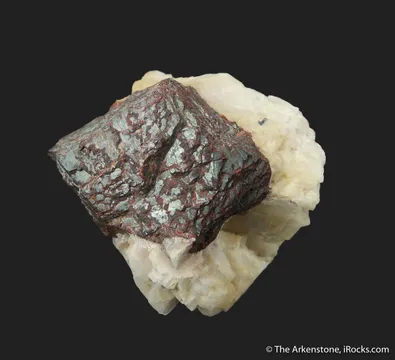
The ore was never easy to understand industrially. Early workers mistook the unusual black, red, and brown minerals for iron or copper ores, and smelting attempts failed before the material was recognized as zinc-rich. Once understood, the deposits became central to the American zinc industry, yet for collectors the value lies in the minerals that mining exposed incidentally: sharp black franklinite octahedra on calcite and zincite; massive and crystalline zincite; willemite crystals and fluorescent ore; hardystonite-calcite-willemite fluorescent combinations; margarosanite, clinohedrite, esperite, and other brilliantly fluorescent species; and micromount rarities that have made Franklin–Sterling Hill a lifelong specialty for many collectors.
The second New Jersey collecting province is the traprock belt of the Newark Basin. Here, early Mesozoic basalt flows and diabase intrusions developed amygdules, cooling joints, contact zones, and later mineralized fractures. These cavities became receptacles for zeolites and associated secondary minerals. Paterson and Prospect Park quarries are the legendary names, but good labels can include Upper New Street Quarry, Lower New Street Quarry, Warren Brothers/Prospect Park, Great Notch, Chimney Rock or Bound Brook, Millington, Summit/Houdaille, Laurel Hill/Snake Hill, and smaller Watchung and Palisades localities. The suite is classically low-temperature: analcime, natrolite, heulandite, stilbite, chabazite, laumontite, prehnite, datolite, apophyllite, pectolite, calcite, quartz, chalcedony, amethyst, native copper, silver, and copper alteration minerals.
Chimney Rock Quarry in Bridgewater Township is essential for natrolite collectors. A major fracture pocket exposed in the early 1970s, with later work in the same mineralized system, produced the large natrolites that made Bound Brook a name beyond local collecting circles. The paragenesis described for Chimney Rock moves from early soluble salts through quartz and native metals, then prehnite-datolite-copper sulfide mineralization, then the natrolite-zeolite stage, followed by calcite and late weathering products. That sequence is why Chimney Rock specimens can carry natrolite with heulandite, analcime, calcite, prehnite, datolite, or other basalt-cavity minerals rather than appearing as isolated crystals in a vacuum.
Collecting access today is sharply divided between legal, museum-managed sites and closed or restricted industrial and urban localities. Sterling Hill Mining Museum maintains fee collecting on its Mine Run Dump, including local zinc ore from Sterling Hill and a shortwave ultraviolet inspection shed; current rules should be checked before visiting, as age limits, tools, hours, fees, and weather closures can change. Franklin Mineral Museum maintains collecting at the Buckwheat Dump, a 3.5-acre field of mine rock behind the museum, plus an accessible collecting area near the building. The old Franklin and Sterling underground workings are not open collecting ground, and many traprock quarries that produced classic zeolites are closed, reclaimed, developed, or active industrial sites. A specimen with an old Paterson, Lower New Street, Prospect Park, Chimney Rock, or Millington label often represents access that no longer exists.
New Jersey natrolite is chiefly a traprock mineral, and the finest examples are from basalt cavities and fracture pockets rather than from the Franklin zinc ores. Chimney Rock Quarry at Bound Brook produced the state’s most celebrated crystals: colorless to white, glassy to satiny orthorhombic prisms, locally stout and singly or doubly terminated, with exceptional individual crystals reaching around 9 cm in documented specimens and associated with analcime, heulandite, calcite, prehnite, datolite, and other Watchung-basalt secondary minerals. Paterson-area localities such as Upper and Lower New Street and Prospect Park yielded more typical sprays, needles, and radiating aggregates in cavities with prehnite, laumontite, stilbite, heulandite, apophyllite, calcite, and quartz. For collectors, a good New Jersey natrolite is sharply terminated, glassy, undamaged at the tips, and tied to a precise quarry label; ordinary pieces are merely white fibrous zeolite on basalt, while the best Chimney Rock crystals have the presence, clarity, and architectural termination expected of a first-rank North American zeolite specimen.
Beyond natrolite, New Jersey’s mineral roll call is extraordinary. Franklin and Sterling Hill are the type or classic locality for many species, including zincite, franklinite, willemite, tephroite, sussexite, chalcophanite, hardystonite, clinohedrite, hodgkinsonite, margarosanite, cahnite, larsenite, esperite, hendricksite, kolicite, hauckite, johnbaumite, sterlinghillite, ogdensburgite, retzian-(Nd), and many others in the Franklin–Sterling Hill literature. Laurel Hill/Snake Hill adds the type locality of petersite-(Y), a minute emerald-green rare-earth copper phosphate occurring as sprays on fracture surfaces in altered hornfels and sandstone near diabase. Summit/Houdaille is famous for New Jersey greenockite, often on prehnite or datolite in basaltic traprock. Paterson and Prospect Park are classic for prehnite, datolite, apophyllite, stilbite, heulandite, analcime, chabazite, calcite, quartz, amethyst, pectolite, and native copper. In collector terms, “New Jersey” on a label is never enough: a Franklin fluorescent slab, a Sterling Hill franklinite crystal, a Chimney Rock natrolite, and a Prospect Park prehnite are different collecting worlds.
New Jersey specimens demand good labels. “Franklin, N.J.” and “Sterling Hill, N.J.” are often used loosely, and older collection labels may confuse Franklin Mine, Buckwheat Dump, Parker shaft material, Trotter Mine material, Taylor Road, Sterling Mine, Passaic Mine, and later museum dump finds. That distinction matters because many rarities are locality-sensitive, and some species accepted from one part of the district are not automatically credible from another. Traprock material has the same problem: “Paterson” may hide Prospect Park, Upper New Street, Lower New Street, Great Notch, or another Passaic County quarry, and “Bound Brook” is often used for Chimney Rock Quarry.
The best-known authenticity issue in New Jersey cabinet specimens concerns franklinite crystals in matrix. Large black octahedra commonly crack, break from calcite-willemite-zincite matrix, or have battered edges. Old-time repairs, glue fills, artificial rebuilding, and blackening with shoe polish or similar coatings are documented collector concerns. Inspect large franklinite crystals under strong light and magnification: look for filled cracks, unnatural gloss in recesses, mismatched contact lines between crystal and matrix, glue halos, and discontinuity between the underside of the crystal and the host rock. A clean old franklinite on original matrix is much more desirable than a dramatic but reconstructed piece.
Zincite requires particular caution. Natural Franklin–Sterling zincite is a classic locality mineral, but synthetic zincite from zinc-smelting environments exists in vivid red, orange, yellow, and green crystals and is widely seen in the mineral trade. It should not be accepted as Franklin or Sterling Hill without a strong old label, credible collection history, or diagnostic context in franklinite-willemite-calcite ore. Natural New Jersey zincite commonly occurs massive, granular, cleavable, or as embedded crystals associated with franklinite, willemite, calcite, tephroite, or other ore minerals; loose bright gemmy crystals with no matrix deserve skepticism.
Fluorescence is both the joy and the trap of New Jersey collecting. Shortwave UV, not just longwave, is essential for evaluating Franklin–Sterling material. Calcite commonly fluoresces red to orange-red; willemite is green and may phosphoresce; hardystonite can give violet-blue; clinohedrite can fluoresce orange; esperite, margarosanite, cuspidine, wollastonite, and many others add complications. Fluorescence alone is not an identification. A handsome red-and-green slab may be simply calcite and willemite with franklinite; a dull-looking rock may carry a rare fluorescent species visible only under the right wavelength. Serious collectors label photographs by wavelength and avoid overnaming mixed fluorescent patches unless the species has been confirmed.
Condition standards differ by group. For traprock zeolites, intact terminations and unabraded sprays matter. Natrolite tips break easily, and old quarry pieces often have bruised terminations from blasting or trimming. Laumontite can dehydrate and crumble; delicate heulandite, stilbite, and apophyllite crystals chip along cavity edges; prehnite surfaces can be scuffed or artificially oiled to appear fresher. For Franklin–Sterling fluorescent slabs, sawed and polished faces are accepted when the specimen is meant to display UV pattern, but rare species, crystallized franklinite, crystallized zincite, or micromount associations are generally more desirable in minimally altered matrix with clear provenance.
Market availability remains good for common New Jersey material and thin for the finest pieces. Buckwheat Dump and Sterling Hill Mine Run Dump still supply educational fluorescent ore, but top-quality old Franklin or Sterling specimens, large undamaged franklinite crystals, classic zincite, rare type-locality species, and major Chimney Rock natrolites are finite old-collection material. Traprock zeolites from closed quarries surface through estates and regional dealers; pieces with quarry-specific labels and old New York–New Jersey collection provenance command a premium.
One of the strangest early chapters in the Franklin–Sterling Hill story is that the ore did not initially behave like an ore at all. Early Dutch and colonial workers were seeking iron and copper, and the black and red minerals of Sussex County seemed to promise both. In 1772, rock from Sterling Hill and Franklin was sent all the way to Wales for smelting. The verdict was embarrassing and important: neither iron nor copper could be extracted. Only later did mineralogists and metallurgists understand that the district’s essential value lay in zinc, locked in unfamiliar minerals that had not yet been described.
In 1810, Dr. Archibald Bruce, a New York physician and mineralogist, published a description of Franklin zincite. The timing is worth pausing over. The United States was barely three decades old, professional mineralogy in the country was just beginning, and Franklin already had a mineral new to science. That 1810 paper opened more than two centuries of study. The Franklin Mineral Museum now describes the district as having more than 1,100 publications tied to its minerals and geology — an astonishing number for two neighboring ore bodies in rural New Jersey.
The Chimney Rock natrolite story belongs to the age of active traprock quarry collecting. In the early 1970s, blasting and quarry work exposed a remarkable fracture pocket at the Chimney Rock Quarry near Bound Brook. The pocket produced large analcime crystals — some described as larger than golf balls — together with the natrolites that gave the find its reputation. The best crystals were not the ordinary cottony white zeolite tufts collectors expect from basalt; they were stout, glassy prisms, some singly or doubly terminated, large enough to become individual display specimens. A later generation of collectors still recognizes those old Bound Brook pieces immediately: pale basalt or cavity matrix, heulandite or analcime association, and a natrolite crystal that looks almost too large for New Jersey until the label confirms it.
Laurel Hill, better known to many older collectors as Snake Hill, produced one of New Jersey’s more surprising type-locality stories. In early 1981, Nicholas Facciolla found tiny green crystals there and brought the material to the Paterson Museum. The species became petersite-(Y), a rare-earth copper phosphate later named for the brothers Thomas A. Peters and Joseph Peters, one a mineral curator at the Paterson Museum and the other on the mineralogical curatorial staff of the American Museum of Natural History. The type material consisted of minute sprays, around a tenth of a millimeter, from secondary mineralization in altered hornfels near diabase — the opposite of a big cabinet trophy, but exactly the kind of small mineralogical clue that keeps New Jersey in the type-locality literature.
Sterling Hill’s working life also survived in an unusually human form. John Kolic began work as a New Jersey Zinc Company miner in 1972, continued until the mine closed in 1986, then returned in 1989 to work for the Sterling Hill Mining Museum. He kept meticulous work diaries for decades. Their dates run through the final years of the operating mine, the closure, the transformation into a museum, and the early preservation era. For collectors, that matters because Sterling Hill is not only a source of fluorescent specimens; it is one of the rare American mines where the daily rhythm of late underground zinc mining, and then the conversion of a mine into a teaching collection, is preserved in the words of someone who drilled, maintained, guided, and remembered the place.
The modern visitor’s initiation is usually the Rainbow Tunnel. In daylight it is an underground passage with rock panels and mining infrastructure; when the shortwave ultraviolet lamps take over, the walls turn into a red, green, blue, yellow, and purple mineral garden. That demonstration has become almost ritual: ordinary gray-white ore suddenly reveals calcite, willemite, hardystonite, and other fluorescent species as a luminous map of the deposit. It is not a collecting pocket, but it explains in one minute why so many collectors buy a shortwave lamp after their first trip to Ogdensburg.
Schaller, Waldemar T. (1932). The Crystal Cavities of the New Jersey Zeolite Region. U.S. Geological Survey Bulletin 832, 90 pp. — The classic federal study of New Jersey traprock cavities, the essential background for Paterson-area and Watchung zeolite specimens.
Palache, Charles (1935). The Minerals of Franklin and Sterling Hill, Sussex County, New Jersey. U.S. Geological Survey Professional Paper 180, 135 pp. — A foundational monograph on the Franklin–Sterling Hill mineral suite and its early systematic treatment.
Mason, Brian H. (1960). Trap Rock Minerals of New Jersey. New Jersey Geological Survey Bulletin 64, 51 pp. — The key state bulletin on Watchung and related traprock minerals, including zeolites, prehnite, datolite, native copper, and quarry localities.
Wilkerson, Albert S. (1962). The Minerals of Franklin and Sterling Hill, New Jersey. New Jersey Geological Survey Bulletin 65, 80 pp. — A concise state-survey reference for the Franklin–Sterling Hill district.
Sassen, Roger (1978). “Natrolite and Associated Secondary Minerals at the Chimney Rock Quarry, Bound Brook, New Jersey.” The Mineralogical Record, 9(1), 25–31. — The important publication for Chimney Rock natrolite and the associated secondary-mineral sequence.
Peacor, Donald R., and Dunn, Pete J. (1982). “Petersite, a REE and phosphate analog of mixite.” American Mineralogist, 67(9–10), 1039–1042. — The type description of petersite-(Y) from Laurel Hill, Secaucus.
Dunn, Pete J. (1995). Franklin and Sterling Hill, New Jersey: The World’s Most Magnificent Mineral Deposits. Franklin-Ogdensburg Mineralogical Society, five parts, xxiv + 755 pp. — The modern collector and researcher’s landmark monograph, with 420 photographs and 300 maps, sections, and line drawings.
Franklin-Ogdensburg Mineralogical Society. Mineral Species Found at Franklin and Sterling Hill, NJ. — A compact checklist documenting the breadth of the Franklin–Sterling Hill species list and minerals unique to the area.
Sterlinghillite entry and references in American Mineralogist, 66, 182–184. — A useful example of the late-stage rare manganese arsenate mineralogy from Sterling Hill.
Buried Riches: Unearthing New Jersey’s Mining Legacy — Drive By History, NJ PBS / PBS — A 26-minute program on New Jersey mining history, including Sterling Hill Mining Museum and the Rainbow Tunnel.
Buried Riches: Unearthing New Jersey’s Mining Legacy — PBS transcript and episode page — Alternate PBS page with transcript excerpts useful for the Sterling Hill fluorescence demonstration.
Mindat: New Jersey, USA — Natrolite occurrence list — Useful for checking which New Jersey localities have documented natrolite.
Mindat: Chimney Rock Quarry, Bridgewater Township, Somerset County, New Jersey — The key online locality page for Bound Brook/Chimney Rock traprock minerals and natrolite associations.
Mindat: Prospect Park Quarry, Prospect Park, Passaic County, New Jersey — A major Paterson-area traprock locality page for zeolites, prehnite, datolite, and associated species.
Mindat: Laurel Hill, Secaucus, Hudson County, New Jersey — The type-locality page for petersite-(Y) and an important traprock/hornfels locality.
Sterling Hill Mining Museum: Origin of the Sterling and Franklin Zinc Deposits — Clear current explanation of the zinc deposit model, Franklin Marble setting, metamorphism, production figures, and mineral diversity.
Sterling Hill Mining Museum: Origin of the Mine — Concise history of early smelting attempts, New Jersey Zinc Company consolidation, mine depth, tunnels, closure, and museum formation.
Sterling Hill Mining Museum: Mineral Collecting — Current starting point for rules, fees, age limits, and access to the Mine Run Dump.
Franklin Mineral Museum: Mineral Science — Strong overview of Franklin–Sterling Hill research history, museum holdings, and fluorescent mineral context.
Franklin Mineral Museum: Activities and Buckwheat Dump collecting — Current visitor information for museum-managed collecting areas, including the Buckwheat Dump.
Franklin-Ogdensburg Mineralogical Society mineral search page — Collector-oriented database for Franklin–Sterling Hill species, fluorescence, and locality-filtered mineral information.
FOMS: Franklin Mineral Show Booklets — Historical show programs documenting the evolution of the Franklin–Sterling Hill collecting community and mineral lists.
National Park Service: Paterson’s Geology — Background on Paterson basalt, Watchung traprock quarrying, glaciation, and the local geological landscape.
New Jersey Geological and Water Survey: Technical Reports — State index for Bulletin 64, Bulletin 65, and other New Jersey geological reports.
Mineral Record citation: Roger Sassen, Chimney Rock natrolite article — Bibliographic record for the principal Chimney Rock Quarry natrolite publication.
Petersite-(Y) mineral page — Type-locality, type-material, associated-mineral, and naming information for petersite-(Y) from Laurel Hill.