






A collector's guide to Tourmaline Queen Mine, USA: its geology, mining history and notable minerals, illustrated with the 144 specimens documented from this locality on EarthWonders.
Key facts
The Tourmaline Queen Mine is one of the defining American gem-pegmatite localities: a Queen Mountain LCT pegmatite in the Pala Mining District of northern San Diego County, California, opened at the height of the early-twentieth-century tourmaline boom and made immortal by the blue-cap elbaites recovered in 1972. The mine sits in the western, tourmaline-rich part of the Pala district, where gently west-dipping pegmatite dikes cut gabbroic country rock of the Peninsular Ranges batholithic complex. In collector language, “Tourmaline Queen” means far more than a dot on a map: it means thick rubellite-to-pink elbaite prisms with abrupt indigo-blue caps, smoky or milky quartz, bladed white cleavelandite, lilac lepidolite, pocket clay, and, on the rarest specimens, peach morganite perched directly with blue-capped tourmaline.
Regional View
Country View
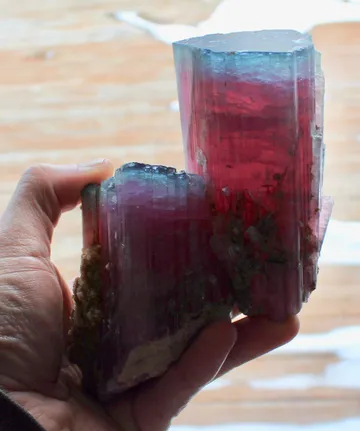
The best Tourmaline Queen specimens are instantly recognizable even across a room. The classic 1972 pieces show a saturated pink to cranberry-red elbaite body, commonly stout rather than pencil-thin, capped by a sharply bounded dark blue to electric blue termination. Matrix specimens add the locality’s full vocabulary: pearly albite blades, pale quartz, lilac lepidolite, and occasionally gemmy morganite. Fine singles can be cabinet-size jewels in their own right, but the great matrix pieces—the “Candelabra,” “Rabbit Ears,” and the Morganite-on-Tourmaline combinations—belong to the short list of American mineral specimens that have entered collecting folklore.

Photo: Wikimedia Commons
The mine’s history divides neatly into two great collecting eras. The first began in 1903, when Frank A. Salmons and associates located the pegmatite, then worked it heavily during the 1904–1914 period when Pala tourmaline fed both specimen collectors and the gem trade. The second began when Ed Swoboda, Bill Larson, John McLean, José Montes, Buzz Gray, and Pala Properties International reopened the mine in 1971. Within months they had turned an old, mud-choked set of workings into the source of the “Blue Cap Pocket,” a discovery still regarded as one of the greatest tourmaline finds in North America.
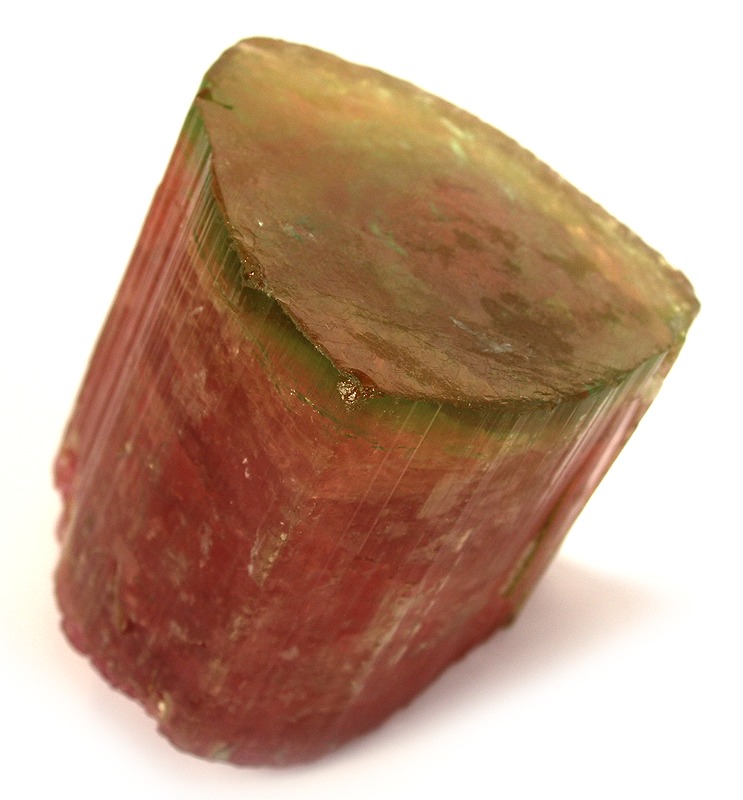
Photo: Wikimedia Commons
The Queen is also important because it is not merely a tourmaline locality with one famous pocket. Its pegmatite records the same mineralogical processes that made the Pala district a textbook complex pegmatite province: albitization, fracture-controlled replacement, pocket clay, late-stage lithium enrichment, and the repeated association of elbaite, lepidolite, cleavelandite, quartz, feldspar, and beryl. The blue-cap crystals are the icons, but the mine’s broader production—pink, green, blue, and multicolored tourmalines, morganite, quartz, lepidolite, albite, muscovite, feldspars, and accessory rare-element minerals—makes it a locality worth studying as well as admiring.
Search for specimens: View all specimens from Tourmaline Queen Mine, USA
The Tourmaline Queen Mine is on the east slope of Tourmaline Queen Mountain—often shortened by collectors to Queen Mountain—near Pala, in San Diego County, California. The workings are high on the mountain at roughly 1,600 feet elevation, east-southeast of the Tourmaline King Mine and north of the Stewart workings. The mine exploits the northern part of a pegmatite dike traced for at least 3,000 feet. The dike trends roughly north and dips gently to moderately west, about 10° to 30°, through coarse-grained gabbro with local quartzite and quartz-mica schist inclusions.
Geologically, the Queen belongs to the Pala district’s gem- and lithium-bearing granitic pegmatites: complex, zoned LCT pegmatites developed within the southern California Peninsular Ranges province. The broader district covers about 13 square miles and contains hundreds of pegmatite dikes, but Queen Mountain is the classic western tourmaline-and-lepidolite hill. In the old geological literature, Queen Mountain pegmatites were noted for lithium minerals, gem tourmaline, and quartz crystals; the Tourmaline Queen was singled out as the district’s leading source of pink, green, and blue tourmaline.
The pegmatite is not a uniform “vein” in the casual prospector’s sense. Like the best Pala dikes, it contains zones of graphic granite, coarse feldspar, massive quartz, fracture fillings, replacement bodies, albite-rich portions, lepidolite-rich pockets, and clay-filled vugs. In the Tourmaline Queen main cut, replacement bodies composed mainly of quartz and muscovite locally contain albite, tourmaline, and lepidolite. Comb structures occur in some tabular fracture fillings, with small terminated crystals of quartz, cleavelandite, muscovite, lepidolite, and tourmaline oriented toward open space. The best gem crystals came from pocket pegmatite—those clay-rich cavities where the last volatile-rich fluids had room to finish crystals cleanly.
The early workings included two benchlike open cuts and extensive underground workings driven from the upper cut: inclines, irregular drifts, and low rooms extending through an area roughly 150 feet along strike and 80 to 100 feet wide. By the mid-twentieth century, some of those workings were inaccessible, backfilled, caved, or sealed by slumped blocks and storm-washed debris. The mine’s later success was therefore not a simple matter of “digging where the old miners stopped”; it required reopening dangerous old ground, reading the pegmatite’s mineralogical signals, and following subtle enrichments down-dip.
The property was first located in 1903 by Frank A. Salmons and associates after the northern part of the dike, marked by milky quartz at the outcrop, had initially attracted attention as a quartz claim. Early exploratory work reportedly produced about 80 pounds of gem tourmaline, and the mine quickly became one of the leading Pala tourmaline producers. Its main early production period ran from about 1904 through 1914, the years when the Pala district’s pink tourmaline was strongly tied to the Chinese carving and gem market. When that market collapsed after the fall of the Qing imperial government in 1911 and prices weakened, many Pala mines became uneconomic; the Queen was then worked only intermittently by high-graders and small operators for decades.
Modern specimen fame arrived when Pala Properties International, led by Ed Swoboda and Bill Larson, shifted attention from the Stewart Mine to the Queen in late 1971. John McLean began drilling and blasting in September of that year, initially under rough conditions: old mud-coated workings, primitive equipment, hand-loaded water in drill holes, wheelbarrow mucking, and a winch to haul material up the dipping adit. The first encouraging pocket was a clay-filled cavity about 2 x 2 x 1 feet, yielding dark-blue exterior tourmalines with deep rubellite interiors and quartz crystals with distinctive white-to-pink opaque coatings from montmorillonite inclusions. That pocket proved the Queen was not finished.
The great 1972 Blue Cap Pocket followed after a frustrating barren stretch and a fault-like structure. A small rubellite-on-quartz specimen led to a larger clay pocket, and then to the first deep rubellite crystal with a bright blue indicolite termination. From that pocket system came the pieces that made the locality legendary: superb blue-cap singles, quartz-matrix groups, the “Candelabra” specimen now associated with the Smithsonian story, the “Rabbit Ears” specimen later in the Houston Museum of Natural Science, a Canadian Museum of Nature matrix piece with blue-cap crystals on quartz, and astonishing combinations of peach morganite on blue-cap elbaite.
The mine did not stop with the 1972 find. Pala International developed roughly 1,500 feet of underground workings at the Tourmaline Queen in a little over three years after reopening, and later collecting literature records additional pockets, including the 1988 Green Cap Pocket. Green-cap Queen material is a distinct collectible subset: stout elbaite crystals with pink bodies and sharply defined green caps, generally much rarer in fine large singles than the term “green cap” might suggest when applied loosely to other Pala or Himalaya material.
Collecting access today should be regarded as closed unless explicit permission is obtained from the owners or operators. Pala International’s own public information states that it does not offer mine tours or buckets of mine gravel. Public fee-digging in the Pala area is associated with separate operations such as the Oceanview Mine and commercial tailings experiences, not open access to the historic Tourmaline Queen workings. Serious collectors should assume that legitimate specimens will enter collections through old collections, reputable dealers, museum deaccessions where applicable, and well-documented modern estate material—not through casual collecting at the mine.
Tourmaline is the identity mineral of the Tourmaline Queen Mine, occurring as schorl and, most famously, lithium-rich colored tourmaline in the pocket pegmatite. The great collector pieces are thick prismatic crystals rather than fragile needles: rubellite to pink bodies, dark blue or blue-green caps, occasional green-capped crystals, and multicolored zoning both lengthwise and concentrically. The 1972 Blue Cap Pocket yielded the locality’s defining style—cranberry-pink elbaite crystals with abrupt blue terminations, commonly associated with quartz, albite/cleavelandite, and lepidolite; some singles and matrix pieces reach cabinet scale, while many smaller crystals came out of clay washing. Good Queen tourmaline is judged less by size alone than by cap definition, luster, transparency at the termination, undamaged trigonal terminations, vivid body color, and, for matrix specimens, an aesthetic placement on quartz, albite, or lepidolite that proves the crystal has not merely been stuck onto a base.
Elbaite from the Tourmaline Queen is the species-level name behind the mine’s pink, red, green, blue, and multicolored gem tourmalines, and the finest examples are among the most coveted elbaites from the United States. The 1972 pocket produced stout bicolored elbaites with rubellite bodies and indicolite-blue caps, including unrepaired singles, repaired but historically important matrix specimens, and combinations with quartz, cleavelandite, lepidolite, and rare morganite; the 1988 Green Cap Pocket added short, fat, intensely zoned elbaites with green caps and pink bodies. Ordinary Queen elbaites may be attractive fragments or opaque altered prisms, but top pieces show saturated color zoning with a crisp transition, lustrous natural faces, minimal bruising, and trustworthy documentation to a specific pocket or old collection.
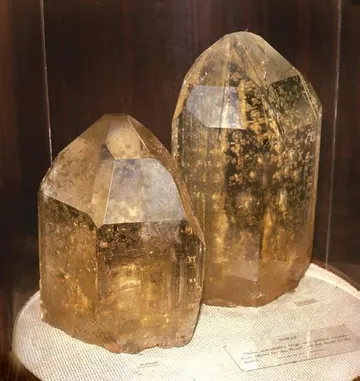
Quartz at the Tourmaline Queen is both a pegmatite-forming mineral and a specimen-making matrix mineral. In the district it ranges from massive milky quartz and coarse anhedral pegmatitic quartz to well-formed pocket crystals, some clear, some smoky, and some coated or internally clouded by clay minerals such as montmorillonite; in the Queen’s 1971–1972 workings, quartz crystals were repeatedly recovered from red pocket clay alongside the tourmaline. The best Queen quartz specimens are not usually collected as isolated quartz display pieces but as architecture for tourmaline: a pale quartz crystal carrying a pink-blue elbaite at a dramatic angle, quartz with cleavelandite and lepidolite giving color contrast, or the rare historical specimen where tourmaline and morganite are locked into the quartz matrix in a way that preserves the original pocket geometry.
Morganite from the Tourmaline Queen is a rare, high-prestige associate rather than a volume species, most memorable from the 1972 blue-cap pocket system where peach-pink beryl crystals occurred directly with blue-capped elbaite. Pala district pocket beryl is typically white to colorless goshenite or pale rose to peach morganite, in equant to tabular crystals with sharp basal and prism faces, associated with cleavelandite, muscovite, lepidolite, quartz, and locally tourmaline; at the Queen, the finest morganites are valued above all when they remain on original tourmaline-bearing matrix. A loose pale morganite from Pala can be hard to assign confidently, but a documented Queen morganite on blue-cap elbaite—especially one from the Swoboda/Larson era or a named collection—is a classic American combination.
Lepidolite at the Tourmaline Queen occurs in the lithium-rich pocket and replacement assemblage, usually as lilac to pink mica aggregates, plates, coatings, or masses associated with tourmaline, quartz, muscovite, and albite. In the broader Pala pegmatites, coarse lepidolite plates and compact fine-grained purple aggregates are characteristic of pocket pegmatite; at the Queen, increasing lepidolite crystal size was one of the signs miners read as the reopened adit approached richer ground. The best lepidolite on Queen specimens is not the massive ore-like material prized at the Stewart, but crisp lilac accenting on elbaite, especially when it frames a blue cap or sits naturally on quartz and cleavelandite without obscuring the tourmaline’s termination.
Albite, particularly the bladed variety cleavelandite, is one of the essential matrix minerals of Tourmaline Queen specimens. In the Pala pegmatites it occurs as fine sugary albite and as white, curved, twinned cleavelandite blades lining cavities or fringing quartz, feldspar, muscovite, and tourmaline; Queen pocket specimens commonly show albite as pearly white sprays or swirls around the base of elbaite crystals. Collector-quality albite from this mine is valued for texture and contrast rather than as a standalone species: clean white cleavelandite blades give a blue-cap or green-cap elbaite a bright stage, while massive or crumbly albite can look dull unless it preserves obvious pocket relationships.
Indicolite at the Tourmaline Queen is best understood as the blue elbaite component that turns an attractive Pala rubellite into a blue-cap icon. Early in the 1971 reopening, miners hit a pocket of dark-blue exterior tourmalines with rubellite interiors; the later 1972 pocket yielded the famous rubellite bodies with vivid blue terminations, the color boundary sharp enough to define the pocket’s name. Fine indicolite expression here is not merely “blue tourmaline”: it is a lustrous, saturated cap, ideally glassy and visibly blue rather than black in transmitted or edge light, sharply set against the pink-red elbaite body and preferably documented to the 1972 core pocket or closely associated pockets.
Other documented minerals from the Tourmaline Queen and its immediate Queen Mountain pegmatite context include schorl, muscovite, orthoclase, microcline, perthite, beryl varieties including goshenite and morganite, spessartine garnet, cassiterite, columbite-tantalite minerals, lithiophilite, triphylite, triplite, purpurite, cookeite, halloysite, kaolinite, montmorillonite, and other clay minerals. The mine is not chiefly celebrated as a type-locality mine; the valid type-locality phosphate fame on Tourmaline Queen Mountain is more strongly tied to the neighboring Stewart Mine. For the Queen itself, the rarities that matter most to specimen collectors are not tiny type species but aesthetically exceptional pocket combinations—morganite on blue-cap elbaite, large unrepaired blue-cap singles, and matrix specimens where quartz, albite, lepidolite, and tourmaline preserve the original pocket scene.
The first rule for Tourmaline Queen specimens is documentation. A true 1972 blue-cap elbaite should not be accepted merely because it is pink with a dark end. Many Pala, Himalaya, Stewart, and other San Diego County tourmalines show multicolor zoning, and later “cap” finds from other localities can be visually confusing in photographs. The best labels cite Tourmaline Queen Mine, Pala District, San Diego County, California, and, when possible, a pocket, year, collector, dealer, or collection history: 1972 Blue Cap Pocket, Ed Swoboda, Bill Larson/Pala International, John McLean, Chuck Houser, the Barlow collection, the Proctor collection, or institutional comparables.
Repairs are a normal and important part of the Queen story. The source pockets were clay-filled, but many crystals had detached naturally from the pocket roof or walls long before discovery; others were broken by pocket collapse, ancient earth movement, or the unavoidable hazards of underground extraction. The famous “Candelabra” itself involved a detached third tourmaline that was recovered and fit back into place. A well-disclosed repair on a historically important Queen piece is not automatically a defect in the way it might be for a more common locality; undisclosed assembly, wrong-matrix mounting, or vague “Pala blue cap” labeling is the real problem.
Condition issues are predictable for the locality. Look for bruised or cleaved terminations, edge chipping on the cap, contact damage where crystals detached from the pocket, clay or iron staining in crevices, lepidolite coatings that may hide repairs or abrasions, and unstable crumbly albite matrix. Some crystals are naturally darker and more opaque than photographs suggest; blue caps can appear nearly black unless lit from the correct angle. The most desirable pieces balance saturation with translucency, so a thick, inky crystal may be impressive but less lively than a smaller one with light passing through the cap and body.
Matrix authenticity matters. Blue-cap singles are relatively more common than top matrix pieces, and genuine elbaite-on-quartz or elbaite-on-morganite specimens from the 1972 find command a premium because so few survived with attractive, original relationships. Inspect contact points carefully under magnification. Natural attachment should show coherent pocket crust, albite/lepidolite continuity, compatible clay residue, and no suspicious glue meniscus or mismatched break surface. That said, historically repaired pocket specimens may show old adhesive or restored contacts; the issue is whether the repair restores a real broken specimen or creates a fantasy association.
Market availability is thin and uneven. Lesser Pala-labeled tourmaline fragments are common enough, but true Tourmaline Queen blue-cap specimens of consequence appear only occasionally. Major 1972 matrix pieces are largely locked in museums or long-held private collections. Green-cap Queen material is also scarce in large, well-documented singles. When a significant example reaches the market, provenance, pocket attribution, repair disclosure, and comparison with published specimens often matter as much as dimensions.
When Pala Properties moved from the Stewart Mine up toward the Tourmaline Queen, the operation began with the kind of optimism that looks, in hindsight, almost reckless. The old adits were in poor condition, the face had slumped during heavy rains, and the upper workings were so full of silt that men had to crawl on hands and knees. The lower workings had been flooded, leaving the walls slick with mud. John McLean and José Montes reopened ground with pick, shovel, wheelbarrow, compressor, jack leg, rubber hose, and generator—barely more than the minimum needed to drill, blast, and breathe underground.
The first real sign came in September 1971. After two weeks of hard drilling and blasting, McLean had advanced about 20 feet down-dip when a pocket of dark-blue tourmaline appeared. Bill Larson and Buzz Gray were in Seattle at the National Gem and Mineral Show when Karla Larson called with the news. The pocket was only about 2 x 2 x 1 feet, filled with sticky red clay, but it produced four fine tourmalines. One was a doubly terminated single about 3 x 2 inches; three others were matrix pieces, each with a tourmaline crystal attached to quartz. The blue was exciting enough, but the surprise was inside: dark-blue exteriors over deep rubellite interiors. For a mine many locals had believed was exhausted, that was proof of life.
Then came the barren stretch—the kind of ground that tests a miner’s faith. For roughly 40 feet the tunnel showed little encouragement: no lepidolite, fine-grained quartz, feldspar, and muscovite, and a fault-like structure that looked barren on both sides. McLean wanted to try a little to the right and down where the rock seemed softer. One shot exposed a little lepidolite. A week and two more shots later, a small pocket appeared with a quartz crystal about 5 x 4 inches and a rubellite tourmaline flaring from its center. The crystal came out in three pieces, but it was enough. The Queen was beginning to speak in the language of real pocket pegmatite.
The pivotal pocket started modestly. McLean came down to the shop and told Larson there was a new pocket with a tourmaline exposed, about 2 x 2 inches. Larson, Buzz Gray, and Rocky Willis followed him up the mountain. The pocket sat about two feet above the floor at the back of a short right-hand jog, an oval opening only about 1.5 by 1 foot. In the beam of their light, the red crystal glowed from a mass of brown wet clay. Larson pushed a 10-inch screwdriver into the clay and buried it to the handle. The cavity was deeper than it looked.
For an hour they worked with fingers and small tools, pulling out globs of sticky clay and quartz crystals until they had four or five powder boxes full. Finally Larson removed the crystal McLean had first exposed. It came out as a single, and when he rubbed the clay away with his thumb he felt a smooth glassy termination. The color appeared: bright indicolite blue on a deep rubellite body. That was the first clear signal that this was not just another Pala pocket. It was the beginning of the blue-cap legend.
The next day Ed Swoboda and his wife Kumja came down from Los Angeles. Swoboda dug for hours, covered in red mud, removing six or seven powder boxes of clay without finding another tourmaline. The pocket had grown to more than 3 x 2 x 2 feet, but it seemed to contain only the one crystal. The men kept mistaking clay-covered screwdriver handles for gems. By 3 p.m. they gave up, disappointed. Swoboda began the two-and-a-half-hour drive home.
Then McLean walked in later, muddy and grinning. He asked Larson whether he remembered the small tourmaline left in the pocket. Larson dismissed it as a one-inch scrap. McLean answered with the line every field collector wants to hear: “Well, it grew.” Out came a perfect 3 x 1 inch crystal, then another, until five beautiful bicolored tourmalines lay in front of them. Larson called Swoboda and caught him just as he arrived home. The message was simple: “We quit too soon.” Swoboda’s answer was immediate: “See you at 9:30!” Not the next morning—9:30 that night.
That night’s return to the Queen reads like mineral-collecting theatre. Ed, Buzz, Karla, Bryant Harris, Carl Larson, and Bill Larson assembled after a quick brandy, then drove in the dark to the Stewart and piled into the yellow truck for the rough two-mile road up to the Queen. Headlights swung into “outer space” as the truck bounced over boulders. At one point the front left tire dropped into a ditch, jolting the passengers in the back. Someone complained about shaken beer. They kept going.
At the mine, the generator broke the silence above old Salmon City, the abandoned early mining camp below. They hurried down the adit to the pocket. For ten minutes, nothing. Then Swoboda felt a big crystal—at least four inches—and another alongside it. For a while they hoped the pair would be a matrix specimen, but they proved to be singles. Even so, they were the finest so far: the same strong red bodies and blue caps. Karla cleaned them with a little beer. By 4 a.m., the pocket had retreated so far back that the person digging had to crawl partly into it. They called it a night, waking Karla, who had curled up around the two crystals.
Dean Luxton understood that something rare was happening not just mineralogically but historically. An advanced collector and photographer, he rented a camper, packed it with photographic equipment, and parked at the Stewart Mine for several weeks. He lived with the miners’ rhythm, photographing the Tourmaline Queen work as it unfolded. His goal was to document a gem pocket from beginning to end. He took more than a thousand photographs, and the resulting slide program was scheduled for display at the American Museum of Natural History beginning in February 1973. In an era when many great pockets were remembered only by labels and dealer stories, the Blue Cap Pocket became one of the first major gem-pocket discoveries to be visually documented in real time.
The “Candelabra” came out on a Wednesday night, under a failing generator and one large flashlight. Larson had exposed a promising single earlier and asked his father, Carl, to help remove it. The generator refused every pull, adjustment, curse, and “good luck kick.” They entered anyway. The crystal was tightly attached, possibly the matrix specimen they had been waiting for. Larson worked with double jack and chisel in cramped position for the better part of an hour, then began removing clay around the tourmaline. A quartz crystal appeared behind it; then, as the specimen took shape, a second tourmaline emerged at the rear. He applied gentle pressure with a small bar and felt the whole mass move. Out came the specimen later known as the “Candelabra”: more than a foot long, with tourmalines on either end and a place where a third had once been attached. They dug another 40 minutes and found that third crystal. It fit.
The next major episode began with two pockets about 18 inches apart, each roughly two feet across. Josie Scripps agreed to accompany the group only until dark. Ed and Bill each got into a pocket, working on foam pads, joking and drinking beer and Pepsi around the seriousness of the work. As they dug, they realized the two pockets connected. They removed the bridge between them and suddenly had a single working face. Singles came steadily. After each man had removed three or four superb blue caps, Swoboda leaned over and said, “You know, I can die happily now!”
Later that same night, after dinner at the Stewart around 9 p.m., the men went back up in fog while Josie and Karla went home to wash the first batch of crystals. The pocket was so promising that no one wanted to leave it. Working only with fingers, because the pieces were too perfect to risk with tools, they exposed one crystal after another until ten were visible in the clay. Near the end, Larson touched what he thought was quartz and saw salmon pink. “Morganite,” he shouted. Then another appeared—a cluster. The matrix was tourmaline. Morganite on tourmaline was so unexpected that the men could hardly believe the association while it sat in their hands.
At home, the kitchen table was already covered with newspapers and ten clean tourmalines from earlier in the evening. The men arrived with five dynamite boxes full of mud, crystal, and broken pocket material, then proceeded to clog the drains while washing it all. Many pieces needed repair; some became “jigsaw nightmares.” During the cleaning, Larson found a second tourmaline that fit onto the morganite cluster specimen. Another quartz crystal, first dismissed as merely perfect quartz, proved to have places where two tourmalines fit. The repaired result took everyone’s breath away. By the end of the night they knew they had three great pieces: the Candelabra and two newly assembled masterpieces from the same pocket system.
The celebration came on Monday, February 7, 1972. More than one hundred people gathered at the Stewart before going underground and then back to the Collector Shop for the unveiling. The guest list reads like a mineralogical roll call: Dr. Pierre Bariand from the University of Paris, Dr. Peter Embrey from the British Museum, Paul Desautels and John White from the Smithsonian, Louis Moyd from the Canadian National Museum, Prosper Williams, Josie Scripps, and others. Several cases of champagne and beer disappeared. Larson later remembered walking into the back of the shop and seeing the Candelabra with Embrey and Bariand on either side of Paul Desautels, who was down on his knees examining the piece that would go to the Smithsonian. Two weeks later, after the Tucson show, Dr. Vincent Manson of the American Museum of Natural History visited and gave the find its enduring verdict: “In terms of color and degree of perfection, This is the find of the Century.”

Photo: Wikimedia Commons
Swoboda, Ed, and Larson, William F. “History of the Tourmaline Queen mine, San Diego County, California.” The Mineralogical Record, vol. 33, no. 5, 2002, pp. 409–425. The central published account of the mine’s history and the 1972 blue-cap discovery, cited in the Journal of Gemmology bibliography and widely referenced in later collector literature.
Fisher, Jesse. “Gem and Rare-Element Pegmatites of Southern California.” The Mineralogical Record, vol. 33, no. 5, 2002, pp. 363–407. The broader California pegmatite article in the same special issue, placing the Tourmaline Queen in context with Stewart, Tourmaline King, Pala Chief, Himalaya, and other San Diego County mines.
Jahns, Richard H., and Wright, Lauren A. “Gem- and Lithium-Bearing Pegmatites of the Pala District, San Diego County, California.” California Division of Mines Special Report 7-A, 1951. The foundational geological study of the Pala pegmatites, including district structure, mineral assemblages, zoning, replacement bodies, pocket clays, and detailed treatment of Queen Mountain pegmatites.
Jahns, Richard H., and Wright, Lauren A. “Gem- and Lithium-Bearing Pegmatites of the Pala District, San Diego County, California,” Tourmaline Queen Mine section. The specific locality description for the Tourmaline Queen Mine, including position, workings, dike geometry, host rock, early ownership, and production history.
Sterrett, Douglas B. “The Production of Precious Stones” for 1907, quoted in Pala International’s historical reprint. Early federal-era description of the Tourmaline Queen’s position, main ledge thickness, early workings, and production of pink, green, and black tourmaline with feldspars and lepidolite.
“Tourmaline (‘Blue-cap’),” The Mineralogical Record Ikons supplement, vol. 38, no. 1.12, 2007. Published discussion of the Smale Blue-cap and other named masterworks from the 1972 Tourmaline Queen discovery, including museum-held specimens.
AMNH Research Library Digital Special Collections: “Elbaite tourmaline, variety Bicolor, cluster of four intergrown ‘blue-cap’ crystals, 10.5 x 7.0 cm, Tourmaline Queen Mine, California.” Museum photographic record of a blue-cap cluster, catalog number 46288, tied to the Harry Frank Guggenheim Hall of Minerals.
Wikimedia Commons: “Elbaite-Beryl-165259.jpg.” Freely licensed image record of a rare Tourmaline Queen combination specimen: a blue-cap elbaite crystal set into peach-pink morganite, from the Ed Swoboda material.

Photo: Wikimedia Commons
Mindat: Tourmaline Queen Mine, Pala Mining District, San Diego County, California — Mineral list, locality hierarchy, references, maps, and specimen photographs for the mine.
PalaMinerals: “The Queen Reigns Again,” by Bill Larson — First-person narrative of reopening the mine and discovering the 1972 Blue Cap Pocket, reprinted from Lapidary Journal.
Pala International: History of Pala Mining — Company history of Pala International’s work at the Stewart, Tourmaline Queen, Pala Chief, Himalaya, and related gem mines, including access notes.
PalaMinerals: Pegmatites of the Pala District, Part 2 — Detailed geological and mineralogical treatment of the Pala district’s pegmatite structure, mineral assemblages, and pocket minerals.
PalaMinerals: Pegmatites of the Pala District, Tourmaline Queen Mine section — Focused description of the Tourmaline Queen workings, dike geometry, history, host rock, and early production.
GIA: Historical Reading List, Tourmaline and Other Gem Minerals from Southern California — Bibliographic guide to classic and modern publications on southern California tourmaline and related gem minerals.
Wikimedia Commons: Blue Cap Tourmaline, Tourmaline Queen Mine — Freely licensed photograph of a classic blue-cap elbaite on quartz and cleavelandite.
Wikimedia Commons: Elbaite-ch37c.jpg — Freely licensed photograph of an unrepaired 1972 blue-cap elbaite from the Tourmaline Queen Mine.
Wikimedia Commons: Elbaite-palasd-58b.jpg — Freely licensed photograph of a 1988 Green Cap Pocket elbaite from the Tourmaline Queen Mine.
AMNH Digital Special Collections: Blue-cap elbaite cluster — American Museum of Natural History photographic record of a 10.5 x 7.0 cm blue-cap elbaite cluster from the mine.
.jpg)


