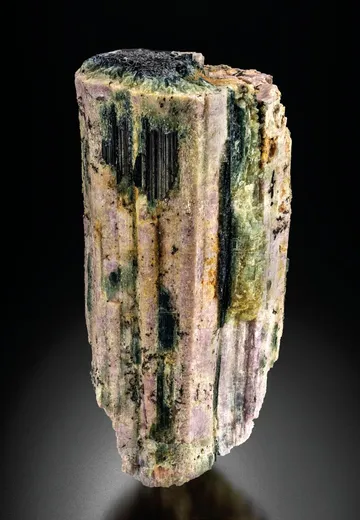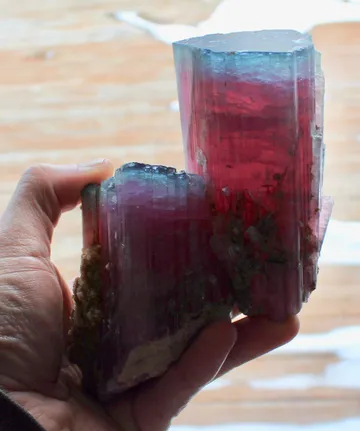
Pala Mining District, USA — premier gem pegmatite locality in California, known for pink-to-cranberry tourmaline, blue-capped elbaite, morganite, and kunzite.
Key facts
The Pala Mining District is one of the defining American localities for gem pegmatites: a compact field of lithium-rich, boron-bearing granitic pegmatite dikes in northern San Diego County, California, set into the crystalline rocks of the Peninsular Ranges. For collectors, Pala is not just a name on a label; it is a visual language—pink to cranberry tourmaline in lilac lepidolite, blue-capped elbaite on cleavelandite and quartz, pale rose morganite, etched lilac kunzite, straw-yellow triphane, smoky-to-citrine quartz, and old-time phosphate suites from the Stewart mine. The district’s best specimens carry the unmistakable character of pocket pegmatite: sharply colored crystals rescued from clay-filled seams, quartz-rich cores, cleavelandite rosettes, and fine-grained purple mica matrix.
Historically, Pala stands at the center of southern California’s great gem-pegmatite era. The Stewart mine introduced the world to purple lepidolite with sprays of rubellite; the Pala Chief made kunzite famous; the Tourmaline Queen produced the legendary blue-cap tourmalines; and the later Oceanview and Elizabeth R workings proved that Chief Mountain still had major pockets to give. The district’s geology is equally important. Jahns and Wright’s classic 1951 study of the Pala pegmatites remains a foundational work because the district shows pegmatite zoning, replacement textures, “line rock,” pocket pegmatite, lithium mineralization, and late hydrothermal alteration in unusually instructive exposures.
Regional View
Country View
The collector’s image of Pala is built around contrast: hot-pink rubellite in cool lavender mica; black schorl grading into gem elbaite; white albite and milky quartz setting off colored crystals; and spodumene blades whose apparent color changes dramatically with viewing direction and lighting. Many old Pala pieces are not large by Brazilian or Afghan standards, but fine ones have exceptional pedigree, early California history, and a mineralogical context that rewards close study.

Photo: James St. John / Wikimedia Commons
Search for specimens: View all specimens from Pala Mining District, USA
The Pala district lies north to northeast of the village of Pala in northwestern San Diego County, within the Peninsular Ranges province. Its famous mines are grouped principally on three low gabbroic hills: Hiriart Mountain or Hiriart Hill to the east, Chief Mountain in the middle, and Tourmaline Queen Mountain to the west. The important historic names include the Stewart, Tourmaline Queen, Tourmaline King, Pala Chief, Katerina, White Queen, El Molino, Gem Star, San Pedro, Mission, Vanderburg-Naylor, and the more recent Oceanview and Elizabeth R workings on Chief Mountain.
Geologically, the district is an LCT-style gem pegmatite field hosted largely by mafic rocks of the southern California batholith, with older quartzite, schist, and gneiss preserved as screens and pendants. The lithium pegmatites are tabular dikes, most commonly only a few to about ten feet thick, though the Stewart dike swells dramatically in places. They generally strike northwest and dip southwest; near surface some of the productive dikes flatten to low angles, then steepen at depth. That geometry mattered to miners. At the Pala Chief, the gently dipping gem-bearing part of the dike gave rise to the old description of a “blanket” deposit, because erosion exposed a broad, benchlike pegmatite face along the hillside.
The internal structure is classic but highly variable. Many dikes have thin border zones and thick wall zones of graphic granite, inner zones or cores rich in quartz, perthite, or quartz-spodumene aggregates, and later fracture-filling or replacement bodies of albite, quartz, muscovite, lepidolite, and tourmaline. The collector-grade material came from “pocket pegmatite,” not from simple open cavities in the Alpine sense. Pala pockets commonly were clay-filled or partly clay-filled zones in the inner portions of the dikes, especially near quartz-spodumene cores and footwall-side replacement units. In these zones, crystals of elbaite, beryl, spodumene, quartz, cleavelandite, lepidolite, and phosphates developed as euhedral or partly etched individuals, then were protected—sometimes imperfectly—by clay.
The early mining history begins with the Stewart deposit. Purple lepidolite and pink tourmaline were known before systematic mining, and the colors were striking enough that early prospectors mistook or hoped for metallic ores before the material was recognized as gem and lithium mineralization. The Stewart became the district’s great lepidolite mine, with important production beginning in the 1890s, major output from about 1900 to 1907, a renewed wartime and postwar period around World War I, peak production around 1920, and decline before shutdown of large-scale operations by 1928. Its production was mostly industrial lepidolite, but the Stewart’s specimen legacy—rubellite sprays in lilac mica, beryl, phosphate nodules, and altered lithium phosphates—is far more important to collectors today.
The Pala Chief was located in May 1903 by John Giddens, Frank A. Salmons, Bernardo Hiriart, and Pedro Peiletch, though the first recognized lilac spodumene of the district had been found the previous year on Hiriart Mountain. The Pala Chief became the mine that made kunzite famous because it supplied large, attractive, gem-quality crystals in quantity. Its pockets contained spodumene, tourmaline, beryl, quartz, lepidolite, albite, and clay; gem tourmaline was especially abundant in the central and northwestern parts of the mine area, while the southeastern portion was richer in spodumene. Much of the Pala Chief quartz has a distinctive milky outer rind or enameled look, and some spodumene occurs as unaltered remnants of much larger lath-shaped crystals enclosed by quartz.
The Tourmaline Queen, first located in 1903 as a quartz claim by F. A. Salmons and associates, became the district’s leading early producer of gem tourmaline. Its dike, at least 3,000 feet long, carried pocket material with lepidolite, pink, blue, and green tourmaline, quartz, albite, schorl, and associated minerals. Mining was most active from 1904 to 1914, when Pala pink tourmaline fed both the American gem trade and the export market. The mine returned to legend in the early 1970s when Pala International’s work at the Tourmaline Queen produced the blue-cap pocket, including the Smithsonian “Candelabra” elbaite specimen: hot-pink crystals with blue caps rising from quartz and albite like candles.
The later history of the district is not merely nostalgic. Pala International reopened and explored the Stewart, Tourmaline Queen, and Pala Chief beginning in the late 1960s and early 1970s, developing underground workings and recovering high-quality pink tourmaline and specimen material. On Chief Mountain, the Elizabeth R and Oceanview mines extended the modern chapter. The Oceanview’s 49er Pocket, discovered in September 2007, produced outstanding aquamarine and morganite on cleavelandite, smoky-to-citrine quartz, and dark tourmaline. The Big Kahuna and Big Kahuna II zones, discovered in 2010, produced important kunzite, bicolored tourmaline, cranberry-red elbaite-schorl crystals, purple lepidolite, smoky quartz, and beryl. These finds re-established Pala as an active modern specimen source rather than merely an old label.
Collecting access today is limited and controlled. Historic workings are private, patented, claimed, unsafe, or otherwise closed unless access is specifically arranged. The Pala Chief is owned by Oceanview Mines, LLC and has offered special fee digs in cooler seasons rather than unrestricted public collecting. The Oceanview operation has offered fee-dig screening of mine material by reservation. Collectors should treat any casual “Pala” label as incomplete: the difference between Stewart, Tourmaline Queen, Pala Chief, Oceanview, Elizabeth R, Katerina, and White Queen is often mineralogically meaningful and can be economically significant.
Elbaite is the mineral that gives Pala its most recognizable color: rubellite-pink to cranberry-red prisms, green and blue zones, watermelon-style sections, and the coveted blue-cap habit where pink crystals terminate in blue to blue-green growth. The finest Pala elbaites are from the Stewart, Tourmaline Queen, Pala Chief, Oceanview, and related Chief Mountain workings, typically in association with albite var. cleavelandite, quartz, lepidolite, cookeite, schorl, and clay pocket material. Stewart pieces are prized for pink rubellite sprays and crystals set in lilac lepidolite; Tourmaline Queen specimens command a premium when they show sharp blue caps on pink crystals, especially on matrix; and Oceanview/Big Kahuna material is admired for small but intensely colored bicolored pencils and cranberry-red crystals on purple lepidolite and albite. Good pieces here are defined by natural terminations, strong color zoning, clean contrast with matrix, and old-mine or pocket-specific provenance; ordinary fragments are common, but intact, aesthetic matrix specimens are not.
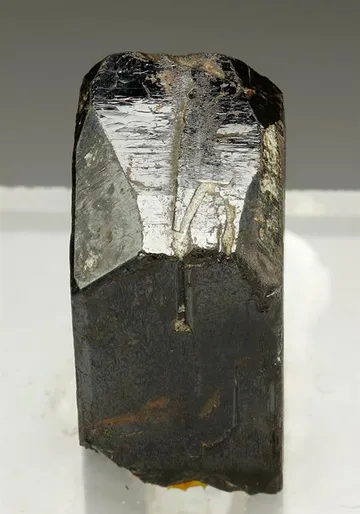
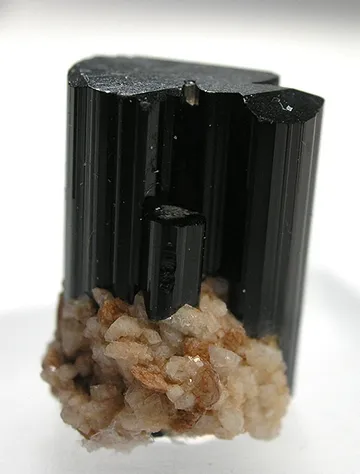
“Tourmaline” on Pala labels often covers several realities: true gem elbaite, black schorl, schorl-elbaite transitional crystals, foitite-rich dark purple material, and historic rubellite trade material. In the district, schorl is widespread in graphic granite, line rock, albite-rich units, and pocket zones, while colored tourmaline is concentrated in gem pockets and replacement bodies, especially on Tourmaline Queen Mountain and parts of Chief Mountain. The best collector pieces show more than just color—they show the pegmatite story: black cores passing into red or pink rims, blue-capped elbaite set on albite, rubellite pencils rising from lepidolite, or gemmy bicolored fragments with enough surface and termination to show growth history. Ordinary Pala tourmaline is often broken, opaque, or dark until backlit; superior specimens are translucent to gemmy, cleanly terminated, and accompanied by cleavelandite, quartz, lepidolite, or pocket clay that confirms the district’s characteristic assemblage.
Spodumene at Pala ranges from altered chalky laths and clay pseudomorphs to transparent lilac kunzite, straw-yellow triphane, pale greenish blades, and colorless gem material. It is most important in the Pala Chief, Katerina-White Queen area, Stewart dike, Oceanview, Elizabeth R, and other Chief Mountain and Hiriart Mountain pegmatites, where it occurs in quartz-spodumene cores and adjacent pocket pegmatite with quartz, albite, lepidolite, tourmaline, beryl, cookeite, and lithium phosphates. The Pala Chief produced historic gem spodumene in clay pockets, while the Oceanview Big Kahuna zones and the 2011 Pala Chief Triphane Pocket produced modern highly regarded crystals and cuttable material. The best specimens preserve form despite Pala’s notorious cleavage and etching: lustrous blade faces, visible pleochroic color, intact terminations when present, and matrix relationships that place the crystal in a real pocket rather than a loose shard.
Beryl is widespread but selective at Pala, occurring as pale green beryl, aquamarine, goshenite, pink beryl and morganite, and less attractive gray to white masses in outer or intermediate pegmatite zones. In pocket settings it appears with albite, quartz, lepidolite, tourmaline, and spodumene; Jahns and Wright noted pinkish beryl in the Katerina, El Molino, Pala Chief, and San Pedro mines, and the modern Oceanview–Elizabeth R area added important aquamarine and morganite specimens, especially from the 49er Pocket. Pala beryl is seldom abundant as perfect large prisms; many crystals are etched, tabular, or partly included. The best pieces are valued for color contrast—blue-to-pink zoning, morganite on cleavelandite, or aquamarine with quartz and schorl—as well as provenance to a named pocket such as the Oceanview 49er Pocket or to the older Chief Mountain workings.
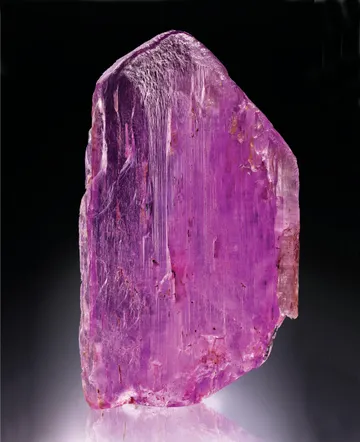
Kunzite is the lilac to pink gem variety of spodumene that made Pala internationally famous after the first recognized material from Hiriart Mountain in 1902 and the spectacular early production from the Pala Chief in 1903 and after. Pala kunzite typically occurs as flattened, strongly cleavable blades or etched laths in clay-rich pocket pegmatite with quartz, albite, lepidolite, tourmaline, beryl, and cookeite; the finest historic pieces from Pala Chief have a delicate lilac transparency and an old California pedigree, while modern Oceanview Big Kahuna and Big Kahuna II pieces can show deep purple to bluish pleochroic tones before lighting shifts their appearance. Size can range from thumbnail shards and small blades to major crystals, including very large modern Oceanview specimens, but collector quality depends less on sheer mass than on preservation: clean color down the correct viewing direction, minimal bruising along cleavage, attractive etching rather than corrosion, and a label tied to Pala Chief, White Queen/Katerina, Oceanview, or a named pocket.
Quartz is the structural backbone of Pala’s gem pockets, forming massive core material, milky crystals, smoky crystals, citrine-smoky gems, and the white enameled outer zones that are especially characteristic of some Pala Chief specimens. In the Pala Chief, quartz commonly encloses or partly encloses spodumene, and isolated spodumene crystals may project into clay-filled pockets alongside abundant quartz crystals and scaly lepidolite. The Oceanview 49er Pocket produced notable gem-quality citrine to smoky quartz, including large clusters, and Big Kahuna II specimens show smoky quartz with albite, lepidolite, and cranberry-red tourmaline. The best Pala quartz is not just clear or smoky; it is contextual—quartz carrying tourmaline, beryl, lepidolite, or spodumene, or quartz that records the pocket environment through clay inclusions, zoning, attachments, and undamaged terminations.
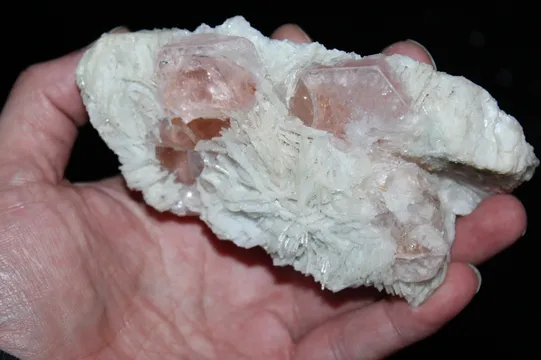
Morganite from Pala is a pale rose to peach-pink beryl that became especially important in the modern Chief Mountain chapter, though pink beryl was known from the district much earlier. The Elizabeth R mine produced some of southern California’s finest morganite specimens during Roland Reed’s mining, and the Oceanview 49er Pocket yielded intergrown and bicolored morganite-aquamarine crystals on cleavelandite, including specimens whose color zoning gives them far more personality than isolated cuttable fragments. Pala Chief has also yielded pink beryl, including large crystals in the southeastern part of the deposit and morganite associated with the 2011 Triphane Pocket area. Good Pala morganite is typically judged by delicacy of color, glassy luster, sharp hexagonal form, association with cleavelandite or quartz, and whether the specimen preserves the Pala pocket context rather than presenting as a loose pale beryl chip.
Lepidolite is the matrix mineral that makes many Pala specimens immediately recognizable and was the basis of major commercial mining at the Stewart. It occurs as fine-grained lilac, pink, bluish, gray-purple, and deep-purple mica aggregates, commonly with quartz, albite, tourmaline, muscovite, spodumene, and phosphates in pocket pegmatite. The Stewart’s south ore body was famous for pinkish to lilac lepidolite, while its north ore body produced lilac to bluish lepidolite with abundant pink tourmaline; small quantities also came from Pala Chief, Tourmaline Queen, Tourmaline King, and Vanderburg-Katerina. Collector-grade lepidolite is best when it serves as an aesthetic stage for rubellite sprays or elbaite crystals, or when its color is unusually rich and fine-grained; massive ore chunks are historically interesting, but specimens with sharp tourmaline, beryl, quartz, or phosphate associations are far more desirable.
Beyond the headline gems, Pala is a serious rare-mineral district. The Stewart mine is especially important for lithium phosphates and their alteration products, including lithiophilite, triphylite, hureaulite, palaite, salmonsite, stewartite, strengite, purpurite, heterosite, and sicklerite-like material. Several names are historically tied to the district or to Stewart material, and old phosphate specimens with original labels are highly collectible even when visually modest. Bismuth minerals are another recurring theme, with native bismuth, bismuthinite, bismite, bismutite, pucherite, beyerite, and later clinobisvanite/eulytite assemblages documented from parts of the district, especially Stewart, Pala Chief, Elizabeth R, and Oceanview contexts. Other notable species include amblygonite-montebrasite, columbite-group minerals, microlite-group minerals, cassiterite, topaz, phenakite, bertrandite, bavenite, helvite, cookeite, zinnwaldite, monazite, apatite, pyrite, molybdenite, zeolites, garnet, and the unusual blue luinaite-(OH) reported from Elizabeth R and Oceanview material.
Pala specimens demand disciplined locality work. Old labels may say only “Pala,” “Pala District,” “San Diego Co.,” “Pala Mountain,” “Queen Mountain,” “Chief Mountain,” or even use obsolete mine names. Tourmaline Queen Mountain has also been confused historically with “Pala Mountain,” and specimens from Stewart, Tourmaline Queen, Pala Chief, Elizabeth R, Oceanview, Katerina, and White Queen can be casually mixed under one district name in collections and dealer stock. For high-value pieces—blue-cap tourmaline, Pala Chief kunzite, Oceanview Big Kahuna material, Elizabeth R morganite, Stewart phosphates—the specific mine or pocket label matters.
Condition is the central issue. Pala spodumene has excellent cleavage and is commonly etched, bruised, repaired, or reduced to shards; a complete-looking kunzite crystal should be examined carefully under strong light for cleavage cracks, glued breaks, and cleaved backs. Tourmaline can be naturally fractured, repaired, or dark enough that color is visible only with transmitted light; backlighting is useful, but it should not substitute for face-up color when assessing display quality. Beryl and quartz are commonly chipped from pocket extraction, and lepidolite matrices can shed or crumble if handled roughly. Purple mica matrix is attractive but fragile, especially where it is fine-grained and clay-contaminated.
Color deserves special caution. Kunzite and related spodumene from Pala can be strongly pleochroic, so a crystal may look lilac, pink, greenish, yellowish, or nearly colorless depending on viewing direction and light source. Modern Chief Mountain spodumene has been reported to shift toward pink under ultraviolet exposure, including some LED lighting, while other Pala material may appear much paler in daylight than in carefully chosen photographic lighting. Store kunzite away from prolonged strong sunlight, not because every Pala crystal will fade dramatically, but because good practice with spodumene is conservative and the value of fine Pala color is high.
There is also a practical authenticity issue with modern fee-dig material. Specimens recovered by visitors may be genuine mine material, but they are generally not in situ pocket extractions and should be labeled honestly as screened mine dump or dig-pile material unless the circumstances are documented otherwise. Conversely, old Pala specimens without exact mine labels should not be “upgraded” to Tourmaline Queen, Stewart, Pala Chief, or Oceanview based only on color. The assemblage can help—Stewart lepidolite-rubellite-phosphate associations differ from Oceanview beryl-spodumene-cleavelandite suites—but confident attribution requires provenance, comparison material, and restraint.
Rarity is uneven. Small tourmaline fragments, bits of lepidolite, quartz, and minor kunzite chips remain available from modern digs and old collections. Fine matrix elbaite, blue-cap tourmaline, well-formed Pala Chief kunzite, named-pocket Oceanview spodumene, Elizabeth R morganite, and old Stewart phosphate specimens are much scarcer. The market rewards pieces with three things at once: a specific label, an undamaged crystal, and a matrix or association that makes the specimen unmistakably Pala.
The Stewart story begins with color in the wrong mental category. The purple lepidolite and pink tourmaline on Queen Mountain were so startling that early observers did not immediately understand them as gem pegmatite minerals. One prospector, Magee, reportedly took the red color as a possible sign of cinnabar and staked a claim in hope of mercury ore. When that failed, the ground was tried as a marble quarry, another mismatch between expectation and geology. Only later did the Stewart become what it really was: a lithium and gem-mineral deposit whose lilac mica and rubellite sprays would circulate through mineral collections for more than a century.
The discovery of kunzite has the texture of a field anecdote that became a gemological milestone. On Hiriart Mountain in 1902, M. M. Sickler and his son Frederick were working a lepidolite claim when they uncovered a chalky mass with large quartz crystals. In the clay were transparent crystals—some lilac, some straw-colored, some colorless—that local jewelers and collectors could not identify. Specimens were sent to Tiffany & Co. in New York, where George F. Kunz recognized the material as spodumene. The variety would soon carry his name, but the human story around that name was never simple: Hiriart Mountain supplied the first recognition, while the nearby Pala Chief supplied the crystals that made kunzite famous.
The Pala Chief’s early photographs are among the most evocative images in American gem mining. In one circa-1903 view, Frank A. Salmons, Bernardo Hiriart, and Pedro Peiletch work directly on a pocket in the pegmatite face. Another photograph from 1903 or 1904 shows M. S. McLure, Hiriart, Peiletch, and Salmons at the open face where the first Pala Chief kunzite was found. George F. Kunz himself was photographed with a large Pala Chief crystal and a cut stone, a neat tableau of the new gem’s path from clay pocket to Tiffany-era gem cabinet. The most famous early Pala Chief pocket carried a suitably theatrical name: the “Bridal Chamber.”
Pala’s gems quickly entered the showman’s world. For the 1915 Panama-California Exposition in San Diego, Frank Salmons built a “Pala Chief Mine” exhibit faced with tons of purple lepidolite, quartz, feldspar, kunzite, and tourmaline. The point was not merely to show gems in cases; it was to recreate the underground fantasy of the mine itself for fairgoers, with Pala’s colors turned into architecture. Few mineral districts have supplied both the specimens and the stage set for their own legend.
The Tourmaline Queen’s blue-cap story belongs to the modern revival of the district. In the early 1970s, Pala International reopened old ground with a patient, specimen-minded approach: explosives were the enemy of value, and progress was measured less in footage than in whether crystals survived. The breakthrough was the Blue Cap Pocket, later celebrated as one of the great American tourmaline finds. The Smithsonian “Candelabra” specimen, mined at the Tourmaline Queen in 1972, became the visual emblem: three hot-pink elbaite crystals tipped in blue, rising from quartz and albite like candles.
A 1974 National Geographic account captured the intimacy of that kind of mining underground at the Tourmaline Queen. Bill Larson and John McLean were working not like quarrymen but like surgeons, teasing crystals from soft pocket mud with an old screwdriver. Then “out of the brown muck” came a bright red glint, and within minutes they had freed a tourmaline crystal six inches long and as thick as a Christmas candle. That sentence remains one of the best descriptions of why Pala mining is so addictive: a clay seam, a hand tool, and a sudden jewel-colored object where blank rock had been.
The Oceanview 49er Pocket gave the district a new twenty-first-century chapter. It was discovered on September 22, 2007, Jeff Swanger’s 49th birthday, and the name nodded both to the date and to California’s older treasure-hunting myth. The pocket was not a quick one-day haul. It took months to excavate, and it produced morganite, aquamarine, bicolored beryl, smoky and citrine quartz, dark purple tourmaline, and matrix specimens that rivaled older southern California finds. One especially memorable beryl specimen carried pink and blue in the same crystal, with a bubble visible through a glassy termination.
Then came the Big Kahuna zones. In spring 2010, the Oceanview’s Big Kahuna Zone produced the mine’s largest kunzite find to that date, along with gem-quality bicolored tourmaline pencils. In December 2010, Big Kahuna II was hit down dip, yielding deep-purple kunzite and cranberry-red tourmalines on albite-lepidolite matrix. One enormous kunzite crystal from Big Kahuna II measured 28 x 15.6 x 2 cm and weighed 2.2 kg, a specimen described by the mine as perhaps the largest extant U.S.-origin kunzite crystal. For a district often remembered through 1900s labels, that crystal was a modern reminder that Pala’s pegmatites were not finished speaking.