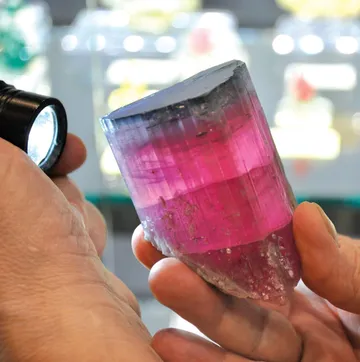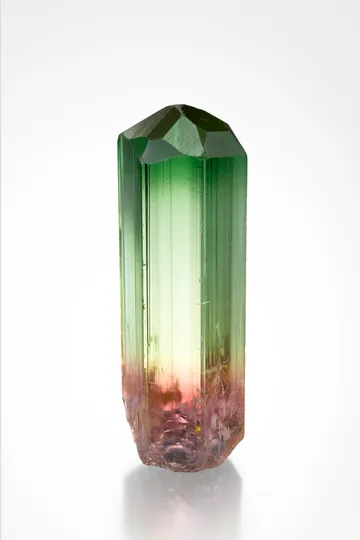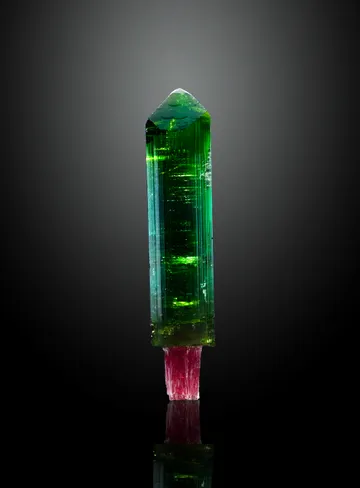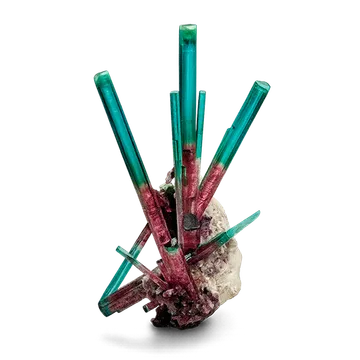
Tourmaline from Tourmaline Queen Mine: thick, lustrous crystals; rubellite-red to indicolite-blue interiors; iconic blue-cap varieties and collecting appeal.
Key facts
Tourmaline from the Tourmaline Queen Mine is the benchmark by which North American elbaite specimens are judged. The mine sits on Tourmaline Queen Mountain in the Pala district of northern San Diego County, California, within the classic gem-pegmatite belt that made Pala a household name among collectors of tourmaline, lepidolite, beryl, and spodumene. Its finest specimens combine exactly the qualities collectors prize but rarely see together: thick, lustrous, sharply terminated crystals; saturated cranberry-red to rubellite-pink interiors; abrupt blue indicolite caps; and, in the greatest pieces, matrix of quartz, cleavelandite, lepidolite, and peach-pink morganite.

Photo: Wikimedia Commons
The celebrated “Blue Cap” specimens are not merely tourmalines with blue tips. In strict collecting usage, the term refers to the 1972 Tourmaline Queen Mine discovery: rubellite elbaite crystals with vivid blue terminations, often dark indigo to sapphire blue at the cap and rich pink-red below. That find produced some of the most famous American mineral specimens ever recovered, including, “The Candelabra,” now associated with the Smithsonian, and the, “Rabbit Ears,” long recognized as one of the iconic blue-cap specimens in the Houston Museum of Natural Science orbit of great collections.
The geological setting is a complex lithium- and rare-element-bearing granitic pegmatite emplaced in the crystalline rocks of the southern California batholith. At Pala, gem tourmaline occurs in late-stage, “pocket pegmatite,” where albite, quartz, muscovite, lepidolite, and tourmaline developed in pockets and clay-filled cavities along enriched parts of the dike. At the Tourmaline Queen Mine, the productive pegmatite was historically described as a continuous dike at least 3,000 feet long, trending roughly northward and dipping westward on the east slope of Queen Mountain.

Photo: Wikimedia Commons
The mine’s reputation rests on two eras. The first began with its 1903 location by Frank A. Salmons and associates, followed by important production from 1904 to 1914, when Pala tourmaline fed a strong gem and carving market. The second began when Pala Properties International, led by Ed Swoboda, Bill Larson, John McLean, and their crew, reopened and reinterpreted the old workings in 1971–1972. Their success transformed the mine from a famous old California locality into a modern legend.
Collectors look first for provenance. A true 1972 Blue Cap specimen should have old, specific documentation, not just a blue termination. Beyond provenance, the hierarchy is familiar but severe: undamaged natural termination, intense cap color, strong pink-to-red body color, luster, size, matrix aesthetics, and disclosure of any repairs. Small singles and repaired crystals can still be important historical specimens; unrepaired matrix pieces are in an entirely different class of rarity.
Search for specimens: View all tourmaline specimens from Tourmaline Queen Mine, USA
The Tourmaline Queen Mine is on the east slope of Tourmaline Queen Mountain, also known historically as Pala Mountain or Queen Mountain, in the Pala Mining District of San Diego County, California. The workings lie north of Pala and above the San Luis Rey River drainage, in the same celebrated district as the Stewart, Tourmaline King, Pala Chief, and other gem pegmatite mines. Mindat lists the locality as Tourmaline Queen Mine, Tourmaline Queen Mountain, Pala, Pala Mining District, San Diego County, California, USA.
The deposit is a lithium- and rare-element-bearing granitic pegmatite. Jahns and Wright described the Tourmaline Queen workings as high on the east slope of Queen Mountain, about 1,500 feet east-southeast of the Tourmaline King Mine, at about 1,600 feet elevation. The mine is in the northern part of a pegmatite dike at least 3,000 feet long. In the main cut, the dike trends north and dips 10° to 30° west in coarse-grained gabbro, with nearby septa and inclusions of quartzite and quartz-mica schist. The regional pegmatites are part of the Pala district’s broader swarm of north-trending, generally west-dipping dikes, many of which formed pocket-bearing zones rich in quartz, albite, muscovite, lepidolite, and tourmaline.
The mine was first located in 1903 as a quartz claim by Frank A. Salmons and associates of Pala after milky quartz was seen at the outcrop. Exploratory work quickly revealed lepidolite and colored tourmaline—pink, blue, and green—and the property became the leading gem-tourmaline producer in the Pala district during the 1904–1914 boom. Early work included open cuts, inclines, drifts, and low rooms following enriched parts of the pegmatite. The 1951 Jahns and Wright report noted that gem material had been recovered from many parts of the workings and recorded one year of tourmaline sales amounting to $48,000, much of it marketed to eastern buyers including Tiffany and Company and the American Gem and Pearl Company of New York.
A major early market for Pala tourmaline was China, where pink and red material was valued for carving and ornament. The collapse of the imperial Chinese market after the 1911 overthrow of the Qing dynasty sharply reduced demand, and the Tourmaline Queen, like other Pala gem mines, became uneconomic for sustained production. From roughly 1914 to the late 1960s and early 1970s, work was intermittent and generally small-scale.
The modern chapter began when Ed Swoboda acquired the Stewart Lithia, Tourmaline Queen, and Pala Chief mines through his company Swoboda Inc. (which still owns the Tourmaline Queen Mine to this day). As President of the newly-formed Pala Properties International (PPI), Ed joined forces with Bill Larson and they started working the properties that Swoboda leased to PPI for $1/year. After learning modern gem mining at the Stewart Mine, the crew moved up to the Tourmaline Queen in late 1971. Old workings were reopened, roads and pads were improved, and new underground exploration began under the practical direction of John McLean and miners including José Montes. Pala International’s summary of its mining history records about 1,500 feet of underground workings developed at the Tourmaline Queen in a little over three years.
The great 1972 Blue Cap discovery followed barren drifting and a sequence of smaller pockets. The key pocket system produced single crystals, quartz-matrix pieces, tourmaline with cleavelandite, and the extraordinary tourmaline-morganite combinations that made the find famous beyond California. The large pocket system was celebrated by Pala Properties before the Tucson show in February 1972, with museum curators and prominent collectors invited to view the specimens.
Collecting access should be treated as closed unless explicit permission is obtained from the owner or authorized operator. The locality is a historic patented mine area with old underground workings, caved ground, and private-property considerations. Old Pala pegmatite workings are not casual collecting sites; serious collectors should acquire specimens through reputable dealers, documented old collections, museum deaccessions, or legitimate marketplace channels rather than attempting unauthorized field access.
The defining Tourmaline Queen species is elbaite, the lithium-rich tourmaline most associated with gem pegmatites. Mindat also records schorl and named color varieties including rubellite, indicolite, and verdelite from the locality. The classic crystals are stout, vertically striated prisms with triangular to rounded-trigonal cross sections and flat to slightly modified terminations. Many of the famous crystals are thick enough that collectors describe some as “beer can” style: broad, substantial prisms rather than thin pencils.
Color is the locality’s signature. Early production included yellow, green, light pink, ruby-red, and blue tourmaline, but the great collector standard is the 1972 rubellite-blue bicolor. In the best blue-cap specimens, the lower portion is red to cranberry pink, commonly with a darker outer skin and a glowing red interior when backlit, while the termination is abruptly blue to indigo. Some pieces show intermediate zones, smoky or purplish bands, or dark outer surfaces over red interiors. Post-1972 and adjacent-pocket pieces may have paler, grayer, or less lustrous caps; these can still be authentic Tourmaline Queen tourmalines but should not be automatically equated with core Blue Cap Pocket material.
The mine produced both singles and matrix specimens. Matrix pieces are especially prized when the tourmaline rises from white cleavelandite blades, clear to milky quartz, lavender lepidolite, or peach-pink morganite. The most famous combinations include blue-capped tourmaline with morganite, a pairing so visually improbable that it remains one of the great aesthetics in American mineral collecting. Quartz matrix pieces can be particularly sculptural, with tourmaline crystals standing like candles or columns from the quartz.
Typical sizes vary enormously by pocket and quality. Small fragments and thumbnail crystals exist, and the early workings produced abundant cutting and carving material. Collectible singles from the 1972 style commonly fall in the miniature to small-cabinet range, with crystals of several centimeters; exceptional crystals and matrix pieces reach cabinet scale. Published descriptions and sales records document crystals around 10 cm, large pairs and groups, and major matrix specimens over a foot across in the case of the “Candelabra” style material.
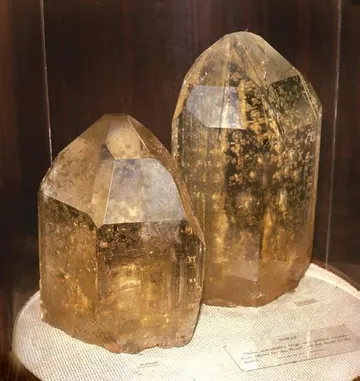
Associated minerals documented from the mine include albite and cleavelandite, quartz, smoky quartz, citrine, lepidolite, muscovite, microcline, orthoclase, beryl including morganite, spodumene, schorl, spessartine, lithiophilite, triphylite, montmorillonite and other clay minerals, cookeite, and minor rare-element or alteration minerals. In collector specimens, the most important associations are cleavelandite, quartz, lepidolite, and morganite.
Quality depends on much more than color. The best Tourmaline Queen tourmalines have a natural glassy termination, strong vertical luster, and minimal bruising along the termination edge. Because many crystals broke naturally in the pocket or detached from pocket walls before discovery, repairs are common even among important pieces. A repaired specimen can still be a major classic if the repair is disclosed and stable, but unrepaired examples command a strong premium. Matrix pieces are judged by the orientation of the crystal, the proportion between tourmaline and matrix, the visibility of the blue cap, and whether the specimen has the unmistakable “Pala” contrast of red tourmaline against white feldspar, lavender lepidolite, clear quartz, or pink beryl.
The first authenticity issue is terminology. “Blue cap” is now used loosely in the mineral trade for any tourmaline with a blue termination, including specimens from Brazil, Afghanistan, Namibia, Pakistan, and other localities. A true Tourmaline Queen Blue Cap is a locality-and-pocket concept: it should trace to the 1972 Tourmaline Queen Mine discovery or to a clearly documented related Queen Mine pocket. Serious buyers should ask for old labels, collection history, publication history, dealer provenance, or photographic documentation. A blue termination alone is not proof.
The second issue is repair. The Blue Cap Pocket produced crystals and matrix pieces that often broke naturally during pocket evolution or during removal. Published and dealer descriptions repeatedly note repaired specimens, reattached crystals, and restored matrix pieces. This is not surprising for large pocket tourmalines, especially those recovered from sticky clay with quartz, feldspar, and morganite. Repairs are acceptable in the classic-mineral market when disclosed, but they affect price sharply. Look for glue seams at the base, mismatched striations across breaks, unusual glossy films in crevices, and unnatural contact points between tourmaline and matrix. Longwave ultraviolet light, magnification, and side lighting are useful.
Polished terminations are another concern. Natural Tourmaline Queen terminations may be lustrous and flat, but they should show natural growth features, slight irregularities, or authentic contact relationships. A perfectly mirror-like termination lacking growth texture may have been polished after damage. Polishing should always be disclosed and lowers desirability, especially on a locality where original terminations are central to value.
To complicate matters a bit, the pocket of Blue Cap Tourmalines from the 1970s feature glossy terminations on the blue caps. This is a well-known feature of these crystals. However, there also exist blue cap tourmaline specimens from the Tourmaline Queen Mine that have matte a termination. One excellent example of this is in the collection of the A.E. Seaman Museum in Detroit. These are, "real" Blue Cap Tourmalines from the Tourmaline Queen Mine however these are from a 1920's find. While still beautiful and desired, these 1920 specimens do not match the desirability of the 1970s specimens.
Outright synthetic tourmaline crystals are not a major problem in the specimen market, but assembled composites and misleading labels are real concerns. The high value of true 1972 blue-cap material creates incentive for over-optimistic naming: later Pala blue-tipped tourmalines, non-Queen blue caps, repaired fragments, or unrelated bicolor tourmalines may be marketed with language that implies the famous pocket. Buy the specimen, but also buy the paperwork.
Condition issues are common. Edge wear on the blue termination, bruising on prism edges, cleaved or contacted backs, and repaired bases are all seen. Some crystals are naturally contacted where they grew against matrix or pocket walls; this can be acceptable if the display face is strong. Clay residues, lepidolite coatings, and albite encrustations can be original and attractive, but heavy coatings may hide repairs or damage. Avoid aggressive cleaning, as lepidolite books, cleavelandite blades, and clay-pocket associations can be fragile.
Rarity is tiered. Ordinary Pala tourmaline fragments and small single crystals appear with some regularity. Tourmaline Queen specimens with old labels are less common. True 1972 Blue Cap specimens are rare, and major unrepaired matrix pieces are among the elite trophies of American mineral collecting. Recent auction and dealer descriptions emphasize that only a small number of significant Blue Cap specimens are known or available, and that many major pieces are in museums or locked in long-term private collections. When fine examples appear publicly, they attract attention far beyond tourmaline specialists.
Current availability is therefore uneven. Small or repaired singles occasionally enter the market through established dealers, auctions, and old-collection dispersals. Good matrix specimens are scarce. Top-tier Blue Cap pieces should be expected to trade in a high-end, provenance-driven market where condition, documentation, and publication history can matter as much as size.
The most vivid story begins not in the Tourmaline Queen itself but just before the move up the mountain. Pala Properties had been working the Stewart Mine with limited success and planned to shift operations to the Queen. A bulldozer needed to repair the Queen road was delayed for a week. With time to kill, John McLean placed one last blast in the Stewart between two adits where lepidolite showed. When the fumes cleared, a tourmaline crystal “a full 10 inches by 4 inches” was lying in the rubble. McLean took it to José Montes, who at first thought it was quartz; when he saw the red, he began jumping and celebrating. After three-and-a-half years, the Stewart had given them its crowning crystal—but the delay was over, and the crew moved on to the Queen.
At the Tourmaline Queen, the first problem was simply getting back in. The old adits were in terrible condition after heavy rains. The upper adits were so full of silt that they could be traversed only on hands and knees; lower workings had filled with water and left mud on the walls. John McLean and José Montes dug by pick and shovel until they intersected one of the old adits and enlarged the trench enough for ventilation. The “poor-boy” operation used the most basic gear: compressor, jack leg, drill, rubber hose, and generator. Blasted waste was backfilled into old tunnels deemed unnecessary.
By September 1971, McLean was driving downdip. Water had to be poured manually into drill holes to keep dust down. After two weeks of hard work, only 20 feet of new tunnel had been carved out. Then a call came while Bill Larson and Buzz Gray were at the National Gem and Mineral Show in Seattle: Karla Larson reported that a pocket of dark-blue tourmaline had been hit. When Larson returned, the pocket was found to have been about 2 by 2 by 1 feet, filled with sticky red clay. It produced four fine tourmalines, including a doubly terminated single about 3 by 2 inches and three matrix pieces with 3-by-2-inch tourmalines on quartz. The most important clue was internal: the tourmalines were dark blue outside but deep rubellite within.
That pocket convinced the crew the mine had passed its test. The operation became more serious. The pads were made permanent, concrete replaced dirt, and the old main adit was reopened by hand. A winch was needed to haul a wheelbarrow up the adit because the passage followed the 12° to 15° dip of the pegmatite. Pick, shovel, wheelbarrow—then more blasting, and the cycle again. After two months, the crew could finally walk upright down the 180-foot downdip instead of crawling.
The first unmistakable blue-cap moment came after 40 discouraging feet of barren pegmatite. Larson was in the shop with Rocky Willis, a jewelry designer from Bar Harbor, Maine, when John McLean came down to say he had hit a new pocket: “I can’t tell how big it is, but there is one tourmaline exposed measuring 2 x 2 inches.” That was enough. Larson, Buzz Gray, Rocky Willis, and McLean went up the long road to the Queen.
The pocket was at the back of a short adit, two feet above the floor, an elliptical opening about 1½ by 1 foot. To Rocky Willis, who had never seen a gem pocket, it must have looked impossible: solid feldspar, quartz, and mica, and inside it a brown, wet, sticky mass of red clay. The 2-by-2-inch tourmaline glowed red under the light. Larson pushed a 10-inch screwdriver into the clay and buried it to the handle. The pocket was deeper than the screwdriver. He removed four or five powder boxes of clay and quartz crystals and finally plucked the exposed tourmaline. When he rubbed it clean with his thumb, he felt a smooth glassy termination. The color appeared: deep rubellite below, vivid blue at the termination.
The next day Ed Swoboda and his wife Kumja came down from Los Angeles. Ed got into the pocket and removed glob after glob of red clay with his fingers. The tools were so coated they were difficult to pick up; gloves were useless because they destroyed the touch needed to avoid breaking crystals and quickly became heavy with clay. For hours, six or seven powder boxes of clay came out with no additional tourmalines. The pocket had grown to over 3 by 2 by 2 feet but seemed nearly barren. Sometimes a mud-covered plastic screwdriver handle looked like a fine gem crystal for a moment. By 3 p.m., disappointed, they gave up.
They had quit too soon. Later, John McLean returned, muddy and grinning, and asked whether Larson remembered the “small” tourmaline left in the pocket. Larson imagined a 1-inch scrap. McLean said, “Well, it grew,” and handed him a perfect 3-by-1-inch crystal. Then he pulled out another, and another, until five beautiful bicolor tourmalines lay in front of them. Larson phoned Ed just as he was coming through the door in Los Angeles after his 2½-hour drive: “We quit too soon.” Ed’s answer was immediate enough that Karla asked whether he meant 9:30 the next morning. No—9:30 that night.
That night the group assembled: Ed, Buzz, Karla, Bryant Harris, Carl Larson, and Bill. Fortified with brandy, they drove through darkness in the yellow truck. The two-mile road was rough enough by day and treacherous at night. The headlights shot into open space as the truck bounced over boulders; once the front left tire dropped into a small ditch, bouncing the passengers in the back. Someone cursed because his beer had been shaken up.
At the mine, they looked out over Salmon City, the deserted early-1900s mining camp below. Then the generator coughed to life and the old atmosphere of carbide lamps and highgraders vanished. In the pocket, Ed worked by feel. For ten minutes nothing appeared, and the fear of another dry run returned. Then his fingers found a crystal at least 4 inches long. Beside it was another of similar proportions. For an hour they hoped the two might form a matrix piece; they proved to be singles, but magnificent ones. Karla cleaned them with a little beer. The large crystals had slight termination damage because they had once been attached to the pocket roof and had broken free long before human hands reached them. By 4 a.m., the pocket was so deep that whoever worked it had to crawl inside. They woke Karla, who had curled up around the two crystals, and called it a night.
Over the following week, John McLean carefully cleared the pocket area using half and quarter sticks of dynamite. Two new pockets joined the original one. Dean Luxton, an advanced collector and amateur photographer, decided the discovery had to be documented properly. He moved into a camper at the Stewart Mine with a load of photographic equipment and spent weeks with John and José in the Queen. He took more than a thousand photographs, creating a slide presentation that was later shown at the American Museum of Natural History. Barbara Lowe of the Los Angeles County Museum came with a photographer, and specimens were removed while cameras clicked—an unusually early example of a gem pocket being documented as it was mined.
Then came the “Candelabra.” One Wednesday night, the generator failed. No pulling, tinkering, cursing, or even a good-luck kick would start it. Carl Larson had brought a large flashlight, so they entered anyway. The exposed tourmaline glowed red. It seemed tightly attached—possibly their first matrix piece. Larson worked slowly with double jack and chisel in a cramped position, resisting the urge to pry it out. A quartz crystal took shape behind the tourmaline. Then a second tourmaline appeared at the rear. With gentle pressure from a small bar, the whole mass moved. Larson reached in with both hands and pulled out the specimen that became “The Candelabra”: over a foot long, with two tourmalines on either end and a central spot where a third had been attached. They dug for another 40 minutes and found the third tourmaline, a perfect fit.
On a later Friday night, two connecting pockets were exposed about 18 inches apart, each about 2 feet across. Josie Scripps went up only until dark. Ed and Bill each got into a pocket, then realized the two connected. They removed the bridge between them, creating one working face. Singles came steadily. After each man had removed three or four superb crystals, Ed leaned over and said, “You know, I can die happily now!”
That night the fog came in as they drove back up after dinner. The men worked with fingers only; the pieces were too perfect to risk with tools. One crystal lay under another until ten were exposed at once. Then Larson wiped what he thought was quartz and saw deep salmon pink. “Morganite,” he shouted. Another morganite appeared. The pieces came out as morganite on tourmaline—an association so unexpected that the group could barely believe it. Later, at the house, the kitchen table was covered with newspapers and ten cleaned tourmalines from earlier in the evening. Five dynamite boxes of mud and “goodies” were brought in, clogging drains as they washed the contents. Repairs became jigsaw puzzles. A second tourmaline fit onto the morganite cluster. A perfect quartz crystal, initially set aside as almost ordinary, proved to have attachment points for two tourmalines. They found the matching crystals and assembled another breathtaking matrix piece. A brandy toast followed, and everyone stumbled to sleep.
The celebration came on Monday, February 7, 1972. More than 100 people gathered at the Stewart. Champagne and beer were consumed at the mine, questions were answered, and the specimens were later unveiled at the Collector Shop. Dr. Peter Embrey, Dr. Pierre Bariand, and Paul Desautels examined the “Candelabra,” with Desautels down on his knees studying the Smithsonian-bound piece. Two weeks later, after Tucson, Dr. Vincent Manson of the American Museum of Natural History gave the line that has followed the pocket ever since: “In terms of color and degree of perfection, This is the find of the Century.”