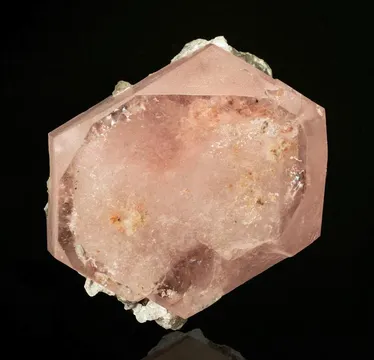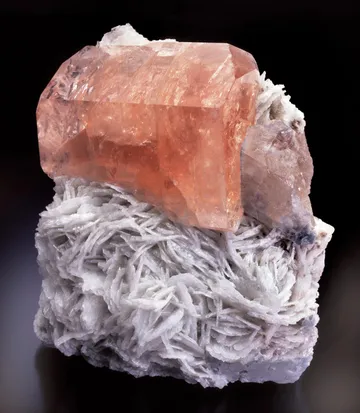
Hiriart Mountain, USA - historic pegmatite locality and birthplace of kunzite; prized for pastel pink-to-lilac spodumene crystals and rare-element pockets.
Key facts
Hiriart Mountain rises just east of Pala in northern San Diego County, California, in the classic Pala Mining District of the Peninsular Ranges pegmatite province. For collectors, its importance rests on two linked reputations: it is one of the birthplaces of kunzite as a named gem variety, and it is a compact mountain crowded with historically important rare-element pegmatite workings—White Queen, Katerina, Vanderberg, San Pedro, Anita, El Molino, Sempe, and associated prospects. The deposits are lithium-rich granitic pegmatite dikes emplaced mainly in gabbroic country rock, with the best gem material concentrated in inner quartz-spodumene cores and pocket zones rather than evenly distributed through the dikes.
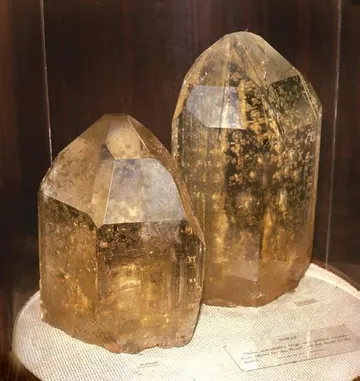
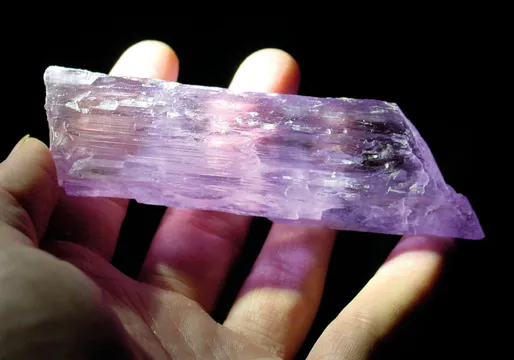
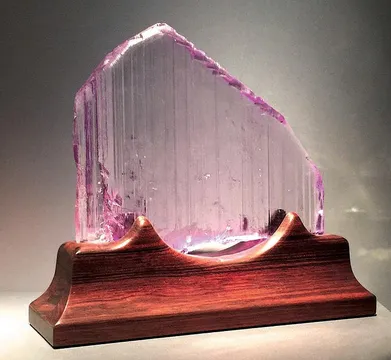
The mountain’s signature specimens are spodumene and its pink-to-lilac variety, kunzite. The best Hiriart Mountain pieces are glassy, striated, usually bladed to prismatic crystals in delicate pink, lilac, pale violet, colorless, yellowish, or pale green shades. Many were recovered loose from clay-rich pockets or as remnants in altered spodumene masses; matrix specimens are much scarcer and more coveted, especially when kunzite sits naturally in quartz, cleavelandite, lepidolite, or feldspar. The classic look is old California pegmatite: pastel color, strong vertical striation, occasional etching, and a softness of hue that is unmistakably different from many later Afghan or Brazilian kunzites.
Regional View
Country View
Hiriart Mountain also matters because the early history is unusually tangled and human. Fred M. Sickler, Marion M. Sickler, Bernardo Hiriart, Pedro Peiletch, Frank Salmons, and George F. Kunz all enter the story, as do the White Queen, Katerina, Pala Chief, and Vanderberg claims. The exact “first” locality for kunzite has been argued for more than a century, but Hiriart Mountain—very likely the Katerina-White Queen ground—is central to the discovery narrative. Later finds at San Pedro and Vanderberg added another layer: twentieth-century pockets that produced large quantities of colorless, pink, green, and blue-toned gem spodumene, including crystals and rough that fed both cabinet collections and gem cutting.

Photo: Wikimedia Commons
Search for specimens: View all specimens from Hiriart Mountain, USA
Hiriart Mountain is one of the eastern hills of the Pala district, north to northeast of the San Luis Rey River near Pala, San Diego County, California. The mountain appears in older literature under several spellings—Heriart, Heriot, Hiriat Hill, and Hiriart Hill—but the collector locality is the same historic pegmatite cluster. It is named for Bernardo Hiriart, one of the Basque prospectors closely associated with the early gem discoveries in the district.
Geologically, the locality belongs to the rare-element lithium pegmatites of the Peninsular Ranges batholith. Jahns and Wright described the Pala pegmatites as dikes emplaced along fracture systems in crystalline country rock, chiefly gabbro, tonalite, granodiorite, and related batholithic rocks, with older metamorphic remnants nearby. At Hiriart Mountain, the pegmatites are not a single simple vein but a swarm and set of composite dikes. Individual bodies may split, rejoin, roll, thin, or thicken into bulges, and the valuable zones commonly occupy the central or lower-middle parts of the dike rather than the hanging-wall graphic granite alone.
The productive Hiriart pegmatites show the familiar Pala architecture: graphic granite in the hanging-wall part, finer albite-quartz-muscovite “line rock” toward the footwall, and discontinuous inner zones or cores of massive quartz, perthite, cleavelandite, lepidolite, and spodumene. The great collector minerals were most often found in pockets or altered pocket pegmatite along the edges of quartz-spodumene cores. Where the system was favorable, spodumene grew in coarse jackstraw-like aggregates in massive quartz; later alteration left only select unaltered gem remnants, which became the kunzite, colorless spodumene, yellowish triphane, and pale green spodumene prized by collectors and lapidaries.
The Katerina mine, also spelled Catherina or Katrina and at one time known as the Ashley mine, lies low on the southwestern slope of Hiriart Mountain. It was first opened by M. M. Sickler and worked by the Sickler family; George Ashley of Pala purchased it in 1947 and resumed small-scale work. Jahns and Wright recorded a complex group of juxtaposed dikes traceable from the Katerina area toward the summit and around the mountain. The important part of the Katerina deposit was a bulge in the middle dike, with a quartz-spodumene discoidal core roughly 8 feet thick at maximum, about 70 feet wide, and at least 85 feet long. The best gem material occurred in fractured and brecciated pocket aggregates near the outer parts of the quartz-spodumene core, associated with lepidolite, cleavelandite, quartz, blue tourmaline aggregates, and white to pink gem beryl.
A short distance west of the Katerina main drift is the historically resonant ground where Jahns and Wright were shown small cuts and shallow underground rooms said to mark the first discovery of kunzite. Mauthner’s later synthesis of the competing accounts concluded that, if one wants a practical type locality for kunzite, the strongest case is Frederick Marcellus Sickler and Hiriart Mountain, most probably the Katerina mine area. The early material was not necessarily the sharpest or most dramatic by modern specimen standards, but it was the material that forced recognition of lilac gem spodumene as a distinctive American gem.
The Vanderberg mine occupies the Vanderberg-Katerina pegmatite system and has been a major Hiriart Mountain name for spodumene, beryl, quartz, tourmaline, and rare pegmatite species. The main Vanderberg dike was reported as striking northward and dipping westward, with exposure for more than 3,000 feet along the crest area of Hiriart Mountain. Marion M. Sickler located the Vanderberg claim in 1902 as part of the Sickler group. George Ashley later acquired the mine and, in the early 1950s, uncovered famous kunzite-bearing pockets. Norman E. Dawson later worked the deposit and recovered additional high-quality kunzite, morganite, and smoky quartz. The Vanderberg is also important to collectors of tourmaline chemistry, because later pocket finds included elbaite-foitite crystals on cleavelandite, microcline, and quartz.
The San Pedro mine is a small but very important Hiriart Mountain source for kunzite. It lies in the northern part of the Vanderberg pegmatite system, close to White Queen, Vanderberg, and Anita. Older descriptions note shallow cuts in a dike up to about 20 feet thick, and Kunz described it as traversed by the same dike or vein system as the Katerina and Vanderberg. Its great claim to collector attention is the Reynolds find of about 1950–1951, when Charles Reynolds encountered a large spodumene pocket yielding nearly 300 pounds of colorless, pink, and pale green gem spodumene. Documented San Pedro pieces from that find are highly desirable, especially when they retain old California provenance such as Reynolds, Josephine Scripps, Bill Larson, or other San Diego County pegmatite collections.
The White Queen mine is indispensable to the history of kunzite and to rare tourmaline mineralogy. The claim was filed by Fred M. Sickler in June 1901 and has long been linked to the first Hiriart Mountain lilac spodumene sent to George F. Kunz at Tiffany & Company. It is also one of the most important Pala localities for foitite-bearing elbaite-foitite tourmaline, studied from pocket material in a lepidolite-subtype pegmatite. The White Queen pegmatite is described as an asymmetrically zoned dike emplaced in gabbro, with pockets near albite and lepidolite units and accessories including garnet, spodumene, lithiophilite, beryl, and manganocolumbite.
Other Hiriart Mountain workings round out the district picture. The El Molino mine, opened about 1903 and worked intermittently by Fred M. Sickler, is better known for beryl—especially pale-yellow, golden, and pink beryl—than for kunzite. It occupies a group of juxtaposed pegmatite dikes on the southeastern slope of the mountain, where pockets in central quartz-feldspar units produced radiating and tabular beryl crystals rather than the lithium-rich tourmaline-lepidolite-spodumene assemblage seen in other Pala pockets. The Anita mine produced kunzite crystals prized by collectors, including striated crystals with strong pleochroic contrast down the c-axis. Sempe, Hiriart, Fargo, Naylor/Vanderberg, and smaller prospects record how thoroughly the mountain was tested during the early gem rush and later revivals.
Mining history on Hiriart Mountain begins in the same boom that made Pala internationally famous. Lepidolite, tourmaline, quartz, beryl, and then spodumene drew prospectors into the hills from the 1890s through the early 1900s. The most vigorous district-wide gem prospecting ran from roughly 1908 to 1914, after which prices, market demand, and easily found pockets declined. Activity revived after 1940 as domestic gem material became scarcer and more valuable. George Ashley’s 1947 acquisition of Hiriart Mountain claims and the work of Norman Dawson, Charles Reynolds, and other operators brought a second wave of important finds, particularly at Katerina, San Pedro, and Vanderberg.
Collecting access today should be treated as restricted unless explicit permission has been obtained from the land and mineral-rights holders. Historic Hiriart Mountain workings include caved stopes, old adits, inclines, open cuts, backfilled rooms, and unstable pocket zones, and some land in this part of the Pala area is managed for the benefit of the Pala Band of Mission Indians. Hiriart specimens on the market therefore mostly come from old collections, documented historic finds, and occasional material dispersed from dealer or museum holdings—not casual modern field collecting.
Hiriart Mountain kunzite is the locality’s central collector mineral: pale rose, lilac, pale purple, and occasionally bluish-lavender spodumene, typically as deeply striated blades or prismatic crystals, many of them etched, cleaved, or recovered loose from clay-rich pocket material. Katerina, White Queen, Vanderberg, San Pedro, and Anita are the essential mine names, with Katerina-White Queen ground tied to the original recognition of kunzite and San Pedro and Vanderberg producing later twentieth-century crystals and gem rough. Good pieces here are not judged only by size; the premium goes to color saturation for California material, transparency, sharp or doubly terminated form, old provenance, and especially natural matrix, which is far rarer than loose crystals because the pocket clay and altered feldspar commonly fail before the spodumene does.
Non-varietal spodumene from Hiriart Mountain includes colorless, straw-yellow, pale green, and altered white-to-gray material as well as kunzite, and it occurs most characteristically in quartz-spodumene cores where large laths and bladed crystals formed in massive quartz before later alteration broke them down into gem remnants. Jahns and Wright described Pala gem spodumene as mostly blade-, lath-, or rod-shaped, deeply striated, grooved, and etched; most crystals are under 2 inches, but the district produced crystals at least 15 inches long, and Hiriart Mountain was specifically noted for short, thick crystals capable of yielding large cut stones over 200 carats. Ordinary pieces are pale cleaves or altered laths; the best Hiriart spodumene shows gem zones, attractive color or pleochroism, a convincing mine attribution, and association with quartz, cleavelandite, lepidolite, beryl, or tourmaline from a specific Hiriart working.
Beyond spodumene, Hiriart Mountain is a serious rare-element pegmatite locality. Documented species include albite and cleavelandite, quartz including smoky quartz, microcline and perthite, orthoclase, muscovite, lepidolite, elbaite including rubellite and indicolite, schorl, foitite, beryl varieties including morganite and goshenite, hambergite, phenakite, topaz, amblygonite-montebrasite minerals, lithiophilite and sicklerite, triplite, vivianite, columbite-(Fe), columbite-(Mn), tantalite-(Mn), stibiotantalite, pucherite, beyerite, clinobisvanite, namibite, todorokite, spessartine, almandine, and bismuth minerals at El Molino. Foitite is the standout mineralogical rarity: the original foitite type material was labeled only “southern California,” but later work identifies the White Queen mine on Hiriart Mountain as the probable source of material matching the type-locality problem.
Hiriart Mountain kunzite is a provenance-sensitive field. Labels may use Hiriart, Heriart, Heriot, or Hiriat Hill, and mine names are often confused: Katerina appears as Catherina, Catarina, Katrina, or Ashley; Vanderberg appears as Vanderburg, Vandenberg, or Naylor-Vanderberg; and early kunzite literature sometimes blurs White Queen, Katerina, Vanderberg, San Pedro, and Pala Chief. For a serious specimen, the label chain matters. A loose lilac spodumene labeled only “Pala” is much less precise than a piece tied to San Pedro, Katerina, Vanderberg, White Queen, or Anita with old collection history.
Condition is the first practical issue. Spodumene has two excellent cleavages, and many Hiriart crystals show cleavage faces, edge bruising, striation wear, etching, or broken terminations. A cleavage face is not automatically fatal—indeed, it is common on old California kunzite—but pricing should reflect whether the crystal reads as a complete natural form or as a pretty cleave. Long bladed crystals are especially vulnerable to transverse breaks, and short thick Hiriart crystals, when transparent and well colored, can be more desirable than larger but watery blades.
Matrix Hiriart kunzite should be examined carefully. Some late twentieth-century Vanderberg matrix specimens were reportedly stabilized with glue because the pocket rock was crumbly; that does not make every such specimen undesirable, but it must be disclosed. Natural hard-rock matrix specimens from Hiriart Mountain are genuinely scarce and command a premium because much of the original pocket material was clay-rich, altered, and mechanically weak. Check whether spodumene crystals are actually embedded, whether the contact is natural, and whether any pocket clay, albite, lepidolite, or quartz has been consolidated.
Color is another concern. Kunzite can fade with prolonged sunlight exposure, especially paler lavender and bluish material. Hiriart Mountain pieces should be displayed away from direct sun and intense UV-rich lighting. Strong pleochroism is normal; crystals may look pale from one direction and richer down the c-axis. Do not judge a Hiriart crystal from a single viewing angle, and do not assume a pale broad face means the crystal lacks color.
Irradiation and artificial color modification are known issues for spodumene generally, but documented Hiriart Mountain collecting concerns are more often about fading, poor attribution, cleavage, repair, and matrix stabilization than about systematic locality-specific fakery. For old San Pedro, Katerina, Vanderberg, White Queen, and Anita material, look for consistent style: pastel California color, vertical striation, etched or grooved faces, old labels, and associations appropriate to the mine.
Market availability is limited and uneven. Loose crystals appear occasionally, especially from San Pedro and Anita-type material, but top old pieces with specific mine names and strong provenance are scarce. Katerina and White Queen pieces have special historical cachet; Vanderberg material can be highly attractive and sometimes better colored; San Pedro specimens are prized for the Reynolds-era pocket story. Matrix specimens from any of these mines are significantly rarer than loose crystals.
The first Hiriart Mountain kunzite story begins not with a glittering jewel case, but with confusion. Around 1902, M. M. Sickler and his son Frederick were doing assessment work in the Katerina pegmatite when they broke into a concentration of large quartz crystals in unusual pinkish clay. Mixed into that clay were clear, straw-yellow, colorless, and pale-lilac splinters and blade-like fragments of a mineral they did not recognize. The Sicklers showed the material locally, but miners at Mesa Grande and jewelers in San Diego and Los Angeles could not name it. Finally, in December 1902, Fred Sickler sent specimens to George F. Kunz at Tiffany & Company in New York. Kunz recognized the mineral as spodumene, and the lilac gem variety soon carried his name.
The discovery credit became a small California drama. Fred Sickler’s own account has him noticing a “‘rotten’ quartz” streak on the left side of a cut, changing the direction of the working, driving in six feet, breaking through a wall of amblygonite, and finding red clay packed with quartz crystals and pink or lilac spodumene. But H. C. Gordon’s 1903 letter to Kunz put Bernardo Hiriart and Pedro Peiletch in the foreground, naming them as Frenchmen who had first found the mineral in Section 24, T9S, R2W, on a mine located by themselves and Fred Sickler, nine months before finding it on another claim. The language barrier mattered: Hiriart and Peiletch could “talk but very little English,” and the wording of who found what, and exactly where, became slippery almost immediately.
Even the claims resist neat telling. Fred M. Sickler filed the White Queen claim on June 10, 1901. M. M. Sickler and Bernardo Hiriart filed the Katerina claim on March 15, 1902. Later writers tried to pin the original kunzite to White Queen, Katerina, or a precise set of shallow cuts west of Katerina’s main drift. Jahns and Wright were apparently shown the place and described a group of small cuts and shallow rooms west of the Katerina main drift where kunzite was first discovered. Mark Mauthner, after laying out the conflicting versions, concluded that if a discoverer and type locality must be named, they should be Frederick Marcellus Sickler and Hiriart Mountain, most probably the Katerina mine.
The postwar revival brought a second Hiriart Mountain chapter. George Ashley bought claims on Hiriart Mountain from Fred Sickler in July 1947 and reopened the Katerina mine. At Katerina he recovered small quantities of excellent kunzite from the inner parts of the pegmatite. The image is a very Pala one: old workings, unstable ground, altered clay, quartz-spodumene core material, and small pockets yielding a few pounds at a time of transparent pastel crystals that could still stop a collector in his tracks half a century after the original discovery.
The San Pedro mine produced one of the mountain’s most memorable pockets. Charles Reynolds acquired the claim in 1948 and, about 1950 or 1951, hit a large spodumene pocket that yielded almost 300 pounds of colorless to pink to pale green spodumene. The largest crystal weighed nearly 2.25 kilograms and measured about 30 × 10 × 2.5 cm; roughly three-quarters of it was reported to be faceting grade. Sixteen pieces weighed more than 0.45 kilogram, and the most gemmy material averaged about 85 grams. Contemporary estimates placed the find’s value at $20,000 to $30,000, an astonishing sum for a small Pala pegmatite pocket of that period.
Vanderberg then gave Ashley an even more dramatic triumph. In July and October of 1951, pockets at the Vanderberg mine produced roughly 59 to 68 kilograms of pink, green, and blue gem-quality spodumene. John Sinkankas later praised these crystals in nearly breathless terms, calling them “the most spectacularly beautiful kunzites ever known,” and wrote that the finest Madagascar and Brazil spodumenes could not compare in size, clarity, or color. About 10 percent of the production was said to be exceptionally flawless gem rough. Among the stones cut from it were a dark amethystine 177-carat gem, a 215-carat gem, and another of 107 carats.
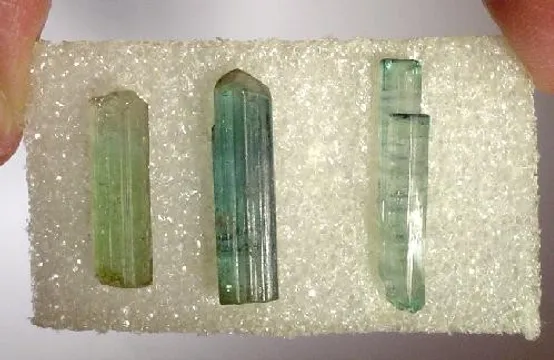
The mountain kept yielding specialized collector material long after the first kunzite fame. In 1983, Phil Osborn of Hemet found pockets of elbaite-foitite tourmaline on the Vanderberg dike below the road southeast of the main workings, near the old “Naylor Rock” ground. Several kilograms of small, loose, gem-quality tourmaline crystals were recovered, commonly grading from dark purple to greenish blue at the basal pyramid, with some specimens on cleavelandite and microcline with quartz. Those little crystals tied Hiriart Mountain not only to gem history but to the modern mineralogical story of foitite and late-stage tourmaline evolution in complex pegmatites.
Richard H. Jahns and Lauren A. Wright, “Gem- and Lithium-Bearing Pegmatites of the Pala District, San Diego County, California,” California Division of Mines Special Report 7-A, 1951 — The foundational technical report on the district, with geology, zoning, production figures, and mine descriptions for Katerina, El Molino, and other Hiriart Mountain workings.
George F. Kunz, “Gems, Jewelers’ Materials, and Ornamental Stones of California,” California State Mining Bureau Bulletin 37, 1905 — Early primary source for California gem materials, including the first public-era discussion of Pala spodumene and kunzite.
Lawrence H. Conklin, “On Kunz & Kunzite,” Mineralogical Record 18, 1987, reprinted by Pala International — A key historical treatment of the naming and discovery controversy surrounding kunzite and the White Queen/Hiriart Mountain connection.
Mark Mauthner, “The History of Kunzite and the California Connection,” Rocks & Minerals 86(2):112–131, 2011 — The most detailed modern synthesis of kunzite discovery claims, Hiriart Mountain evidence, major California finds, and collection history.
Milan Novák and Matthew C. Taylor, “Foitite: Formation during late stages of evolution of complex granitic pegmatites at Dobrá Voda, Czech Republic, and Pala, California, U.S.A.,” The Canadian Mineralogist 38:1399–1408, 2000 — Important analytical study of elbaite-foitite pocket tourmalines from the White Queen mine and Dobrá Voda, documenting the late Fe-enrichment trend.
MacDonald, Hawthorne, and Grice, “Foitite, [Fe2(Al,Fe)]Al6Si6O18(BO3)3(OH)4, a new alkali-deficient tourmaline: Description and crystal structure,” American Mineralogist 78:1299–1303, 1993 — Original foitite description; later work places the likely source of the southern California type material at or near the White Queen mine on Hiriart Mountain.
Jesse Fisher, “Gem and Rare-Element Pegmatites of Southern California,” Mineralogical Record 33(5):361–407, 2002 — Widely cited collector and mineralogical overview of the southern California pegmatite province, including Hiriart Mountain localities.
Jesse Fisher, “Mines and Minerals of the Southern California Pegmatite Province,” Rocks & Minerals 86:14–34, 2011 — Modern collector-oriented survey of the province and its important gem and rare-mineral mines.
Jesse Fisher, “A recent find of kunzite at the historic Katerina mine, Pala district, San Diego County, California,” Mineral News 15(1):1, 6–7, 1999 — Cited in Mauthner’s bibliography and relevant to late twentieth-century Katerina kunzite production.
Mindat: Hiriart Mountain, Pala Mining District, San Diego County, California — Central locality database page aggregating Hiriart Mountain sublocalities, mineral lists, references, and photographs.
Mindat: San Pedro Mine, Hiriart Mountain — Specific locality page for the San Pedro mine, an important source of documented kunzite, especially the Reynolds-era find.
Mindat: Vanderberg Mine, Vanderberg-Katerina pegmatites, Hiriart Mountain — Detailed locality page for the Vanderberg mine, including history, mineral list, land-status notes, and production anecdotes.
Mindat: White Queen Mine, Hiriart Mountain — Important locality page for the White Queen mine, central to both early kunzite history and foitite-bearing tourmaline research.
CaltechAUTHORS: Jahns and Wright, “Gem- and Lithium-Bearing Pegmatites of the Pala District” — Best single technical source for the geology, mine descriptions, production, and pegmatite zoning of the Pala district.
Pala International: “Gem- and Lithium-Bearing Pegmatites of the Pala District,” online edition — Accessible web version of the Jahns and Wright material, useful for browsing the district history and geology.
Pala International: Pala pegmatites, economic minerals and mining — Contains the classic discussion of Pala spodumene, kunzite colors, habits, cutting issues, and production figures.
Pala International: Selected mine descriptions, including Katerina and El Molino — Essential for Hiriart Mountain mine-by-mine geology and pocket descriptions.
Pala International: “On Kunz & Kunzite” by Lawrence H. Conklin — Concise historical essay on the kunzite naming and discovery dispute.
Mark Mauthner, “The History of Kunzite and the California Connection” — Deepest narrative source for the competing kunzite discovery claims and later California finds.
Mindat: Hiriart Mountain locality page — Best database hub for mineral species, sublocalities, photos, and references.
Mindat: Katerina Mine kunzite occurrence — Focused occurrence page for Katerina kunzite, with photo and association data.
Mindat: San Pedro Mine kunzite occurrence — Useful photo and locality reference page for San Pedro kunzite.
Wikimedia Commons: San Pedro Mine kunzite photograph — Freely licensed image of a large San Pedro Mine kunzite crystal from Hiriart Mountain.
Novák and Taylor, foitite-elbaite study, The Canadian Mineralogist — Technical mineralogical source for White Queen elbaite-foitite tourmalines and late-stage pegmatite evolution.
San Diego County FEIR mineral resources appendix — Modern county-level context for gem and specimen mineral mines, including the Katerina entry.