A collector's guide to Touissit, Morocco: its geology, mining history and notable minerals, illustrated with the 630 specimens documented from this locality on EarthWonders.
Key facts
Touissit is one of the essential Moroccan names in a serious systematic or display collection: not a single mine famous for one mineral, but the collector’s face of a major carbonate-hosted lead-zinc district straddling far eastern Morocco near the Algerian border. The Touissit-Bou Beker district is a classic Mississippi Valley-type system, with galena and sphalerite mineralization emplaced in dolomitized Jurassic platform carbonates and later transformed by deep oxidation into an unusually rich suite of secondary lead, zinc, and copper minerals. That oxidation is the reason collectors care so much: anglesite, cerussite, azurite, malachite, smithsonite, vanadinite, wulfenite, phosgenite, nadorite, paralaurionite, and related species all belong to the locality’s identity.
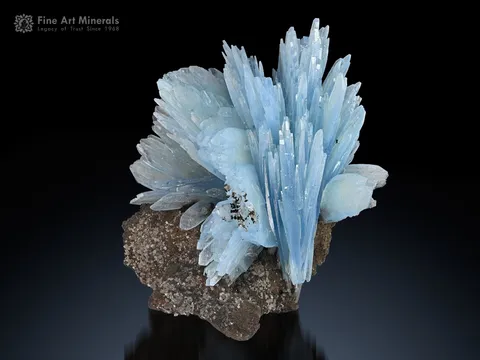
The best Touissit specimens have a particular look. Azurite forms deep electric-blue, lustrous blades and spear-point clusters, sometimes partly altered to velvety malachite. Anglesite appears as transparent to canary-yellow crystals on heavy galena, among the most recognizable examples of the species. Cerussite is famous as glassy smoky V-twins and cyclic twins, often looking far more elegant than its dense lead-carbonate chemistry suggests. Wulfenite, vanadinite, phosgenite, gypsum, smithsonite, dolomite, and aragonite add a second layer of character: this is a locality where matrix and association matter almost as much as the headline crystal.
Regional View
Country View
Historically, the district bridges industrial mining and modern specimen collecting. Its ore bodies were mined for lead, zinc, copper, and silver, but the most celebrated collector material entered international circulation especially from the late 1970s through the 1990s, with older Touissit labels now prized in their own right. Since the principal industrial mines closed in 2002, top specimens have increasingly come from old collections, dealer stock, and occasional small-scale recovery rather than from a steady mining stream.

Photo: Wikimedia Commons

Photo:
Search for specimens: View all specimens from Touissit, Morocco
Touissit lies in the Touissit-Bou Beker mining district of northeastern Morocco, close to the Algerian frontier and roughly south of Oujda. In geological literature the district is normally treated as a broader Moroccan-Algerian MVT province that includes, from west to east, deposits such as Mekta, Beddiane, Touissit, Bou Beker, and the Algerian El Abed deposit. The Moroccan part includes the localities most familiar to collectors: Touissit itself, Bou Beker or Bou Bekker, the Zellidja mine, Beddiane, and numbered pits or shafts such as Puits IX and XI.
The host rocks are a relatively thin Aalenian-Bajocian dolomitic carbonate platform sequence resting above Paleozoic basement and associated with the structural setting of the Horsts Chain and the Missouine graben. The primary ore consists chiefly of galena and sphalerite, with minor pyrite, marcasite, chalcopyrite, tetrahedrite-group minerals, and related sulfides, accompanied by multiple generations of dolomite. Mineralization occurs both as replacement of dolostone and as open-space fillings in fractures, breccias, karst cavities, and vugs. The district’s ore bodies are strongly controlled by stratigraphy, dolomitization, dissolution, faults, fractures, and the position of the Touissit shoal.
The orebodies are not uniform. Galena is especially important in the western deposits such as Mekta and Beddiane, whereas sphalerite becomes more abundant toward Touissit, Bou Beker, and farther east. Published geological descriptions emphasize stratoid bodies, collapse breccias, hydrothermal karsts, zebra textures, “snow-on-roof” textures, and insoluble-residue “trash zones,” all classic features in the district’s MVT architecture. In the Beddiane area, ore was worked through underground access and shafts reaching roughly 180 m depth, and parts of the deposit were noted for very high local lead grades.
The secondary mineralization is the collector’s treasure. Oxidation penetrated deeply and converted much of the original sulfide mineralization into lead carbonates and sulfates, zinc carbonates, copper carbonates, vanadates, molybdates, phosphates, chlorides, and iron-manganese oxyhydroxides. Cerussite and anglesite formed from galena; smithsonite from sphalerite; malachite and azurite from copper-bearing sulfides and sulfosalts; wulfenite and vanadinite formed in suitable oxidized lead-bearing microenvironments. Scientific studies distinguish red, gossanous calamine ore from later gray-white calamine, with smithsonite, hydrozincite, cerussite, anglesite, malachite, azurite, calcite, aragonite, gypsum, and quartz participating in the late low-temperature assemblages.
Mining began from surface showings recognized early in the twentieth century. Industrial exploitation was continuous for much of the twentieth century, with major involvement by the Société des Mines de Zellidja and the Compagnie Royale Asturienne des Mines. The Compagnie Minière de Touissit later became central to district operations; Mekta and Beddiane were re-evaluated and brought into production in the late 1970s and around 1980, and production reached its strongest period in the 1980s and 1990s. The principal mines closed in 2002 after reserve depletion and deteriorating economics, although small-scale and irregular hand-sorted lead production continued in parts of the district.
For collectors today, Touissit is effectively a closed classic locality rather than an active collecting destination. Main underground workings are exhausted, closed, unsafe, or controlled, and casual underground access should not be assumed. Modern supply consists largely of old collection material, older dealer holdings, specimens recovered during residual or artisanal activity, and pieces attributed to nearby district sublocalities under simplified labels. “Touissit” on a label may mean the town/deposit proper, the Touissit-Bou Beker district, Bou Beker, Zellidja, Beddiane, or one of the shafts, so serious buyers should value precise provenance.
The important specimen-producing moments are tied to the great oxidized pockets and vugs of the mining era: late 1970s and early 1980s yellow anglesites, 1970s-1990s azurite and cerussite, classic Shaft IX azurites, tabular wulfenite groups from shafts such as Puits XI, and later malachite-cerussite-azurite combinations from the broader Bou Beker-Touissit district. Many top pieces are miniatures and small cabinets rather than enormous museum specimens, but their color, transparency, and association make them disproportionately important.
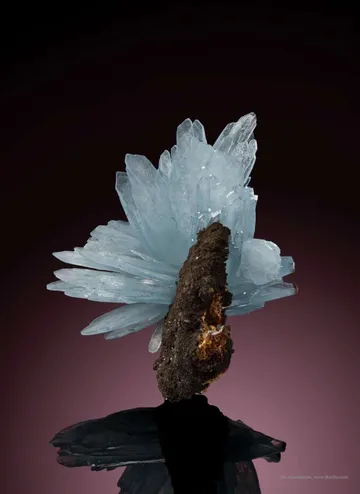
Touissit azurite is one of the locality’s signature display minerals: lustrous deep-blue to electric-blue prismatic and bladed crystals, commonly in parallel growths, spear-point groups, sprays, rosettes, or partly doubly terminated clusters on dolomite, gossan, malachite, cerussite, and locally wulfenite-bearing matrix. The best documented older pieces include Shaft IX material from the late 1970s through the 1990s, with individual crystals commonly in the 2-5 cm range and exceptional crystals reported larger; collectors prize sharp termination, translucency in strong light, saturated blue color rather than blackish overgrowth, and minimal conversion to malachite unless the green replacement adds clean aesthetics. Ordinary Touissit azurite may be bruised, dark, incomplete, or crowded on unattractive gossan; fine pieces have open composition, bright luster, and a recognizable Moroccan combination of blue azurite with white dolomite, green malachite, and pale cerussite.
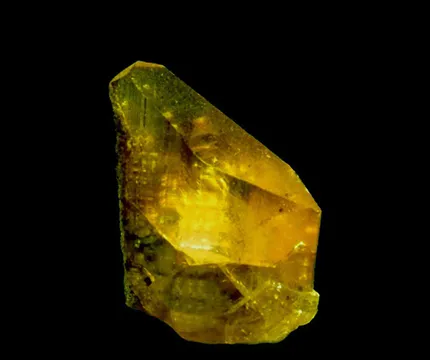
Touissit anglesite is among the world’s classic expressions of PbSO4, typically forming transparent to translucent tabular, spear-point, prismatic, or flattened crystals on dark massive galena, with colors from water-clear and pale straw to rich canary yellow. Many admired specimens trace to the late 1970s and early 1980s, and fine examples may show major crystals from thumbnail scale to several centimeters, including cabinet pieces where gemmy yellow crystals line a galena vug. Associations with galena are fundamental, with cerussite common on or near the same matrix and occasional links to the district’s azurite-malachite assemblage. The finest pieces balance strong yellow internal color, glassy luster, sharp edges, transparency, and undamaged terminations; because artificially lightened or otherwise suspect yellow anglesites have been discussed in the trade, color that penetrates the crystal rather than sitting as a surface effect is especially important.
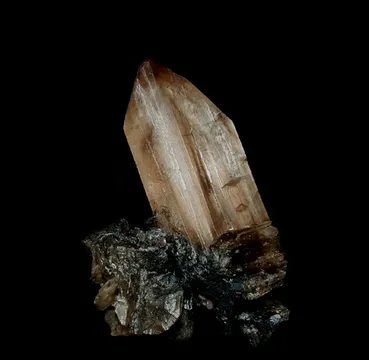
Touissit cerussite is famous for glassy V-twins, cyclic twins, bladed-prismatic crystals, and complex twinned clusters in colorless, gray, smoky, honey, and amber tones, most often derived from oxidized galena bodies and found with galena, anglesite, dolomite, smithsonite, iron oxides, azurite, and malachite. Scientific work records euhedral cerussite crystals filling cavities, fractures, and remnant porosity in massive galena down to substantial underground depths, while the collector market knows the best pieces as free-standing or matrix-mounted twins from the 1970s-1990s era. A good Touissit cerussite should have crisp twin geometry, strong adamantine to resinous luster, clean striated faces, transparency, and little edge wear; ordinary examples are often chipped, incomplete, cloudy, or visually confused by heavy iron oxide.
Malachite from Touissit occurs both as a direct copper-oxidation mineral and as partial to complete replacement of azurite, with habits ranging from botryoidal and velvety crusts to sharp pseudomorphs after azurite blades, prismatic forms, and sprays. The most attractive collector pieces are intensely green malachite after azurite, sometimes retaining the azurite crystal architecture, and combinations where malachite contrasts with blue azurite, white dolomite, pale cerussite, or yellow wulfenite. Scientific descriptions tie malachite and azurite to replacement of copper-bearing minerals, especially chalcopyrite and silver-rich tetrahedrite, and to associations with cerussite and anglesite. Top Touissit malachite is judged on sharp retained form, velvet or silky surface texture, rich color, and lack of rubbed high points; lesser pieces are massive, dull, earthy, or too altered to preserve the original azurite shape.
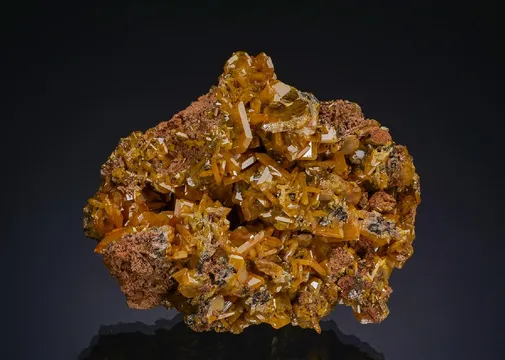
Touissit wulfenite is less abundant on the market than azurite, anglesite, or cerussite, but it is one of the district’s distinctive oxidized-zone minerals, occurring as yellow to orange-yellow tabular, lamellar, and locally hemihedral crystals lining geodes and cavities. Published geological guide material illustrates centimeter-sized lamellar wulfenite crystals as geode fillings, and specimen records include sharp, lustrous yellow tabular groups from shafts such as Puits XI around 1980, sometimes with the broader azurite-malachite-cerussite suite. The best pieces have bright lemon to golden color, thin but undamaged plates, strong luster, and open spacing rather than crowded plates buried in matrix; ordinary examples are often edge-worn, dull, brownish, or too fragile to display well without trimming or support.
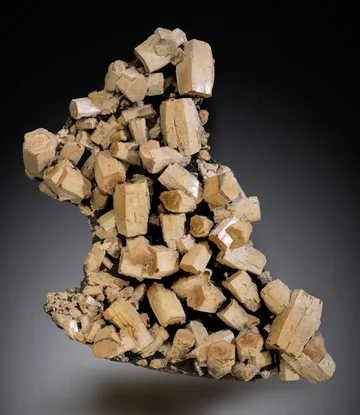
Dolomite is the structural and visual backbone of Touissit rather than merely a background mineral: the ore is hosted by dolomitized Jurassic carbonate, and hydrothermal dolomite occurs as open-space filling, breccia cement, matrix, and saddle-dolomite gangue around galena, sphalerite, azurite, cerussite, anglesite, and malachite. Collector specimens commonly show white, cream, tan, or locally pinkish rhombohedral dolomite crystals under or around more colorful species, especially azurite and malachite. Fine dolomite-only pieces are less central to the locality’s fame, but as matrix it is crucial: clean white dolomite can make blue azurite or smoky cerussite read beautifully, while coarse, broken, iron-stained, or crumbly dolomite lowers the visual quality and stability of a specimen.
Galena is the principal lead ore mineral and the parent of much of Touissit’s great secondary suite, occurring as massive ore, cubic remnants, coarse crystalline masses, and dark matrix for anglesite, cerussite, phosgenite, wulfenite, and related lead minerals. In the Mekta and Beddiane parts of the district, galena is especially important economically, while scientific descriptions document massive galena in hydrothermal karst cavities and galena blocks embedded in residual reddish-brown to yellow-brown clayey matrices in collapse zones. As a collector mineral by itself, Touissit galena is usually valued when it provides strong contrast, weight, and provenance for transparent anglesite or cerussite; clean crystals are scarcer as display specimens than the massive galena matrices, and tarnish, contacts, cleavage bruising, and lead-mineral alteration should be expected.
Smithsonite at Touissit belongs to the district’s calamine story and formed by oxidation of sphalerite in the carbonate host environment, appearing as disseminations replacing sphalerite and carbonate groundmass, open-space infills, concretionary crusts, botryoidal brownish-red aggregates in red calamine, and later grayish to whitish translucent or rice-shaped cavity fillings in microkarsts, veins, and fracture networks. Collector specimens are generally subtler than the locality’s azurite or anglesite, but attractive examples show botryoidal, crusty, or sparkling smithsonite on dolomite, galena, or gossan, sometimes with cerussite or malachite. Good Touissit smithsonite is cleanly textured, lustrous, and well associated; ordinary material can be massive calamine ore with little crystallographic expression.
Vanadinite from Touissit is a secondary lead vanadate of the oxidized zone and is much less common as a headline specimen than the locality’s anglesite, azurite, or cerussite. It typically occurs as small hexagonal crystals or crusts in lead-rich oxidized assemblages, associated in district records with other secondary lead minerals such as cerussite, anglesite, wulfenite, pyromorphite, and iron oxides, and locally reported as arsenic-bearing vanadinite. The best pieces are those where the crystals are bright, distinct, and not overwhelmed by gossan or massive matrix; unlike Mibladen vanadinite, Touissit material is collected more for locality depth and association than for large, brilliant red crystals.
Phosgenite is one of Touissit’s rarer and more sophisticated lead minerals, occurring in the oxidized lead assemblage with cerussite, anglesite, galena, and chloride-bearing secondary species. Collector examples are typically small, pale, colorless to grayish or tan, and valued for rarity, sharpness, and locality rather than showy size; they may appear as prismatic to tabular crystals or small groups in cavities related to altered galena. The best Touissit phosgenites have identifiable crystal form, transparency or bright luster, and convincing provenance, because the species is easily overshadowed visually by associated cerussite or anglesite and is not a common market item from the district.
Gypsum from the Touissit-Bou Beker district occurs as part of the sulfate-bearing oxidation sequence, with scientific descriptions noting transparent to translucent euhedral and tabular gypsum intimately associated with primary sulfides such as sphalerite and galena, as well as later fibrous, crusted, stalactitic, or “wired” gypsum lining cave walls and replacement surfaces. Collector specimens are generally secondary players, often accompanying dolomite, malachite, galena, or calamine material, and should be distinguished carefully from pale baryte or other bladed minerals on Moroccan labels. Good pieces show clean, glassy crystals or delicate fibrous habit without crushing; ordinary examples are friable, dusty, or visually subordinate to matrix.
Aragonite from Touissit is a late carbonate gangue and oxidation-zone mineral, including radiating aggregates and cements around fragments of galena partly altered to cerussite. The collector material can include white to tan sprays, crusts, and locally lead-bearing aragonite historically known as tarnowitzite from the Zellidja/Bou Beker-Touissit area. Fine examples are chosen for sharp radiating form, clean color, and association with lead minerals rather than for great size; massive or chalky aragonite is commoner and less desirable unless it provides context for cerussite, galena, or other secondary lead species.
Calcite is a late-stage carbonate in the Touissit-Bou Beker oxidation environment, documented as encrusting galena and occurring with the district’s non-sulfide assemblage alongside aragonite, gypsum, quartz, smithsonite, cerussite, anglesite, malachite, and azurite. As a collector mineral it is usually a matrix or association species rather than the principal attraction, appearing as pale crusts, late overgrowths, or small crystals in cavities and fractures. Good Touissit calcite adds sparkle and paragenetic interest without hiding the lead and copper minerals; poor calcite coats or dulls more important crystals and can make cleaning decisions difficult.
Other documented Touissit and Touissit-Bou Beker minerals give the district real systematic depth. Mindat and publication records list adamite, baryte, beaverite-(Cu), bindheimite, brochantite, chalcopyrite, covellite, cuprite, descloizite-mottramite series minerals, dundasite, duftite, goethite, hemimorphite, mimetite, mottramite, nadorite, native sulfur, olivenite, paralaurionite, pyrite, pyromorphite, quartz, rosasite, siderite, sphalerite, tetrahedrite-group minerals, and other secondary phases. Nadorite, a lead antimony oxychloride, is especially notable in modern locality lists for Touissit, while paralaurionite from Touissit is a classic rarity for lead-chloride collectors even though its type locality is Laurion, Greece. These minor species rarely drive the locality’s public reputation, but they are precisely why Touissit remains important to systematic collectors long after the great azurite and anglesite pockets became history.
The first caution with Touissit specimens is locality precision. Dealer labels often use “Touissit” broadly for the entire Touissit-Bou Beker district, and older labels may alternatively read Touissit, Bou Beker, Bou Bekker, Bou Becker, Zellidja, Beddiane, Puit IX, Shaft IX, Puit XI, or simply Oujda. That shorthand is normal in the trade, but it matters: a specimen specifically documented from Shaft IX, Beddiane Pit No. 9, Bou Beker, or Zellidja has a stronger story than a generic Moroccan label. When a specimen is expensive, insist on any old labels, collection numbers, dealer tags, or photographs that preserve the chain of attribution.
Anglesite requires special scrutiny. Natural Touissit anglesite can be beautifully yellow, but the trade has long discussed bleached or otherwise suspect anglesites associated with the early 1980s market. A naturally colored crystal should show color through the body of the crystal, not merely a surface stain or inconsistent outer skin. Check edges, fractures, and chips under magnification; if a crystal is intensely yellow only at the surface or oddly pale along internal damage, be cautious.
Cerussite is soft, dense, brittle, and easily bruised. Touissit V-twins are often damaged at the twin edges, terminations, and thin projecting arms. Minor edge wear is common and sometimes acceptable on older classics, but repairs, glued arms, and concealed contacts are not rare in the broader cerussite market. Always inspect with side lighting and magnification. Avoid acid cleaning, ultrasonics, and heat; cerussite can be damaged by acids and by careless handling.
Azurite and malachite raise different issues. Touissit azurite is prized for luster, transparency, and deep blue color, but some specimens are very dark unless strongly lit. Partial alteration to malachite is normal and can be attractive, especially where a pseudomorph preserves sharp azurite form. Heavily rubbed malachite pseudomorphs, repainted-looking surfaces, loose crumbly gossan, or artificially enhanced contrast should be viewed critically. True top azurite should not need oil, dye, or artificial shine to carry the piece.
Wulfenite, vanadinite, phosgenite, gypsum, and aragonite from Touissit are all more condition-sensitive than their hardness alone suggests because many sit on crumbly oxidized matrix. Wulfenite plates chip along thin edges; gypsum is easily crushed or mistaken for other pale bladed species; phosgenite is uncommon enough that analysis may be warranted on high-value pieces. Heavy galena matrix should be checked for stability, oxidation, and old repairs hidden beneath secondary minerals.
Fluorescence is not the main reason collectors buy Touissit specimens, but some anglesite has been reported with minor short-wave ultraviolet response. In practical handling terms, weight and toxicity matter more: galena, cerussite, anglesite, wulfenite, vanadinite, phosgenite, and several rarities are lead-bearing minerals. They are safe as display specimens when handled sensibly, but wash hands after handling, keep dust out of the air, and do not cut, grind, or acid-clean them in a casual workspace.
Market availability is uneven. Modest azurite-malachite pieces, small cerussites, and district-labeled material still appear regularly. Excellent old Touissit anglesite, pristine smoky cerussite V-twins, sharp Shaft IX azurite, and matrix pieces with strong multi-species associations are much less common and command premiums. For serious collectors, the strongest value lies in pieces that combine condition, aesthetics, old provenance, and precise sublocality—not merely the word “Touissit.”
One of the most revealing field-trade snapshots comes not from an underground mining report but from the specimen market. At Sainte-Marie-aux-Mines, a collector-dealer account described searching through more than 2,000 Moroccan specimens and finding only a small number that were not damaged in some way. That is exactly the reality behind many beautiful Touissit minerals: the district made superb crystals, but soft anglesite, brittle cerussite, thin wulfenite, and projecting azurite blades do not survive mining, trimming, packing, and market travel casually. A clean Touissit piece is not just a product of geology; it is a survivor.
Jordi Fabre’s notes on older Moroccan material preserve another side of the district’s specimen history: the role of Morocco’s “basaristes,” the market intermediaries who helped move minerals from mining districts into the international collecting world. Touissit’s fame was built through that network as much as through formal mining channels. Fine specimens passed from miners to local buyers, from local buyers to European dealers, and then into labeled collections that now carry much of the locality’s authority. That is why an old handwritten tag from the 1980s can matter as much as a modern photograph.
Several surviving dealer records read like small time capsules. A superb azurite from Shaft IX was described as obtained just before the closing of the Touissit mines, standing free on white dolomite with the sharp form, luster, color, and perfection that make the locality so recognizable. Other records preserve dates around 1975, 1981, 1982, 1990, 1993, and 1994—an informal chronology of the classic collecting years. These are not just sales details. They map the shift from an active mining district producing fresh pockets to a closed classic locality whose best specimens now reappear one at a time from old collections.