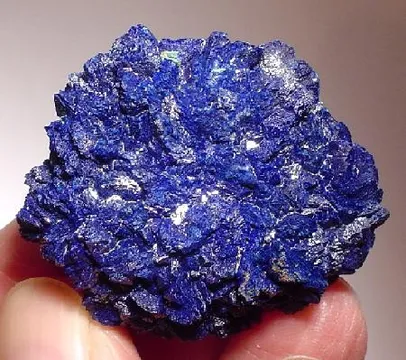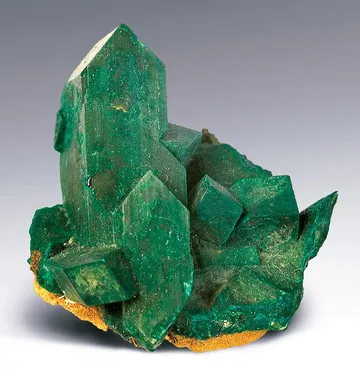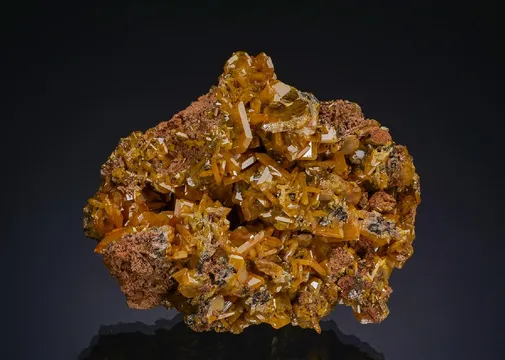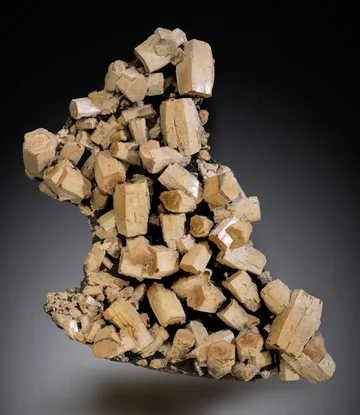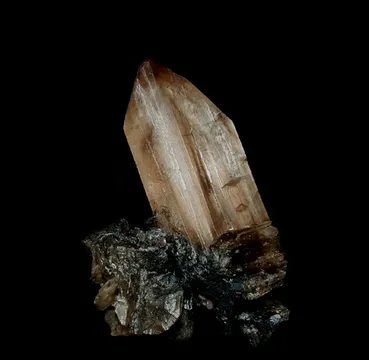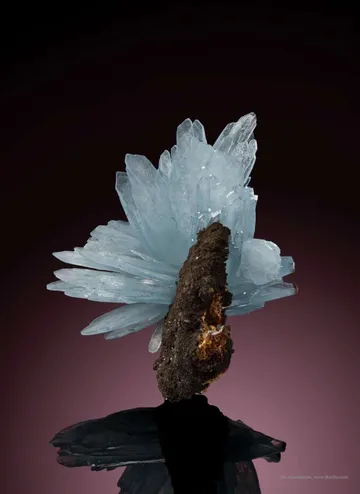
Jebel Ouichane, Morocco — famous for blue barite crystals from open-space sulfates in a late iron-skarn system; crisp blades, large size, prized by collectors.
Key facts
Jebel Ouichane is one of the modern Moroccan localities that changed the way collectors think about barite. The mountain lies near Nador in the Eastern Rif, within the Beni Bou Ifrour–Ouixane iron district, a Neogene skarn system developed where Miocene quartz-diorite porphyry and related dikes interacted with Jurassic to Lower Cretaceous carbonate, turbiditic, and volcaniclastic rocks. For most of its working life the district was an iron producer, not a specimen mine: magnetite, hematite, limonite, pyrite, pyrrhotite, siderite, and ankerite were the economic story. Then, from old quarry walls and iron-oxide cavities, the blue barite appeared in quantity and quality sufficient to make Ouichane a fixture in serious collections.
The specimens are immediately recognizable. Thin, bladed, tabular crystals of pale to intense sky-blue barite stand in parallel sheaves, radiating fans, and flower-like sprays on dark limonite-hematite gossan, commonly with white to grey calcite. The best pieces have a striking three-part aesthetic: glassy blue blades, black-brown iron-oxide matrix, and occasional pale calcite contrast. The finest crystals are transparent to translucent, bright, sharp, and unusually large for such delicate blades, with documented crystal sizes commonly in the 3–4 cm range and locally reaching about 10 cm in scientific descriptions, while field and dealer accounts record exceptional flower-like groups considerably larger as composite specimens.
Regional View
Country View
What separates Jebel Ouichane from many other blue-barite localities is the geological setting. These are not simply vein barites from a routine low-temperature fissure system; they are late, open-space sulfate crystals tied to an iron-rich skarn and porphyry-epithermal evolution. Modern analytical work on the blue barites shows a late, low-temperature stage after iron-oxide and calcite deposition, with barite precipitating from dilute fluids influenced by both meteoric water and magmatic-hydrothermal activity. For the collector, that origin is written directly into the specimen: the airy blue blades occupy vugs and fractures in a heavy, oxidized iron matrix, as though the final delicate mineralizing pulse grew out of the ruins of an iron mine.
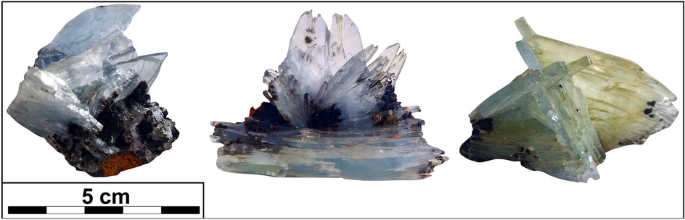
Photo: Dumańska-Słowik et al., Scientific Reports, 2021
Search for specimens: View all specimens from Jebel Ouichane, Morocco
Jebel Ouichane, also encountered in the literature and specimen trade as Ouixane, Wiksane, Uixan, Mount Ouichane, or sometimes under the problematic label “Sidi Lahcen,” is part of the Beni Bou Ifrour–Ouixane iron district southwest of Nador. The principal district deposits are Ouichane, Axara-Imnassen, and Bokoya-Setolazar, distributed over a rugged iron-mining terrain of roughly 36 km². Ouichane and Axara were worked as open pits, whereas Setolazar is described in modern environmental literature as an underground mine.
The district is a Neogene iron-skarn system. Mineralization is genetically linked to Miocene quartz-diorite porphyry and related dike swarms emplaced into a thick Upper Jurassic–Lower Cretaceous sedimentary succession. Published geochronology gives an age of about 7.58 ± 0.03 Ma for the Ouichane quartz-diorite porphyry and about 7.04 ± 0.47 Ma for the mineralization, a close match that supports a magmatic-hydrothermal source for the ore-forming system. The iron was introduced mainly as replacement mineralization in carbonate rocks and as fracture and banded mineralization in associated schists, tuffs, and volcaniclastic units.
At the mountain scale, the setting is more complex than a simple limestone contact. Jurassic limestone near Ouichane dips northward toward the exploited iron deposit and forms large beds, locally up to about 250 m thick, with partial recrystallization to marble. Toward the northwestern mine area, the purer limestone passes into clay-rich rocks, and the whole package is broken by faults, hollows, cracks, and tectonic disruption. North of the deposit, Jurassic–Cretaceous carbonates are overlain by early Tertiary sandy clays, marls, and conglomerates, and the broader area includes tuffs and biotite andesites related to the Gourougou volcanic center west of Melilla, along with granitic to dioritic rocks, aplites, microdiorites, and porphyritic micromonzonites.
The principal ore minerals of the old iron operation were magnetite and hematite, with limonite in oxidized zones and pyrite, pyrrhotite, and chalcopyrite as sulfide components. Carbonates including siderite and ankerite also occur. Scientific petrography of the barite-bearing rock shows hematite, goethite, and magnetite as dominant iron oxides and hydroxides, subordinate calcite and siderite, and accessory manganese oxides, chalcopyrite, and pyrite. The hematite commonly records martitization of magnetite, while calcite occurs as rhombohedral crystals, twinned calcite, and vein fillings associated with siderite.
Mining history begins in the early twentieth century. The iron deposits were discovered during the 1905–1907 prospecting period by the Spanish geologist A. Dell Vall, and exploitation began in 1914 under Spanish companies, chiefly the Compagnie Espagnole des Mines du Rif and the Société Anonyme Minière de Sétolazar. Early work was artisanal, then became mechanized around 1930. Until about 1950, mining was focused mainly on the superficial oxidized ore, especially high-grade red hematite. As workings deepened, pyrite-rich material became more important relative to magnetite, increasing desulfurization costs and reducing profitability.
Production figures vary slightly by author and by whether the entire district or particular operating periods are considered, but the broad picture is clear: this was a major Moroccan iron district. One cited summary gives about 24 million tonnes of ore from 1915 to 1951, including roughly 19 million tonnes of oxidized ore and 5 million tonnes of pyritic ore. Later environmental and mining studies describe total district output of more than 60–65 million tonnes of iron ore, commonly with iron contents above 50% or in the 45–60% range. In 1959 the Bureau de Recherches et de Participations Minières took a 26.66% stake in the Rif mines; in 1967 the Moroccan government took control and assigned exploitation to the Société d’Exploitation de Fer du Rif, usually abbreviated SEFERIF. Pellet production began in the 1970s and ceased by the end of 1978 in one historical account, while other sources summarize active exploitation of the district from 1914 to 1976.
For collectors, the crucial second history begins long after the mine’s first iron glory. Blue barite had been collected in the area by François Lietard in the mid-1970s, but the great specimen wave was the 2012 rediscovery and exploitation of pockets in old quarry walls. The material first appeared strongly on the European show circuit at Sainte-Marie-aux-Mines in 2012 and quickly spread through international mineral fairs. From 2012 through 2015, quarry walls were intensively worked for barite, and the locality became one of the defining blue-barite sources of the decade.
The barite occurs in pockets and open fractures in Jurassic–Cretaceous metasediments and iron-bearing skarn rock. Field accounts describe large pockets in brecciated rock coated with black iron oxides, sometimes with calcite. Some cavities were barren; others were lined or filled with barite. This explains the uneven quality seen in the market: from dull, pale, contacted blades to superb, airy blue flowers on dark matrix. The best pockets produced transparent to translucent, lustrous, flattened crystals in parallel or divergent bundles, and occasionally doubly terminated blades. The dark limonite matrix that makes specimens beautiful also makes extraction unforgiving, because blades penetrate and intersect the gossan rather than sitting cleanly on an easy parting surface.
Collecting access should be treated as restricted. The barite workings are in old quarry and mine ground, and field accounts from the active specimen period describe the quarry as closed or illegally worked, with visiting and photography forbidden. Modern environmental studies also emphasize abandoned mine features, tailings, acidic pit lakes in parts of the district, and unreclaimed waste rock. Serious collectors should obtain specimens through established Moroccan suppliers, dealers, or documented old collections rather than assuming the locality is safely or legally field-collectible.
Barite is the signature mineral of Jebel Ouichane, occurring as light-blue to sky-blue bladed tabular crystals in pockets and open fractures in iron-rich skarn and Jurassic–Cretaceous metasedimentary host rock. Scientific descriptions give average crystal sizes of about 3–4 cm, locally to about 10 cm, with blades commonly arranged in parallel aggregates, sheaves, radiating bundles, and vug-lining groups; collector and dealer accounts from the 2012–2015 production describe the best specimens as blue barite “flowers” on black gossanous matrix, with some dramatic cabinet pieces. Good specimens are transparent to translucent, glassy, sharp, and richly colored, with intact blade tips and strong contrast against limonite, hematite, or calcite; ordinary pieces are paler, contacted, broken, or visually confused by iron staining and matrix damage. Calcite is the most important companion, commonly white to grey, while limonite, goethite, hematite, psilomelane-like manganese oxides, and minor quartz provide the dark matrix and inclusions that give Ouichane barites their unmistakable look.
Other minerals documented from Jebel Ouichane and the Ouichane Mines reflect its iron-skarn origin rather than a broad suite of display species. Hematite, magnetite, goethite, limonite, pyrite, pyrrhotite, chalcopyrite, siderite, ankerite, calcite, dolomite, quartz, psilomelane-group manganese oxides, chalcophanite inclusions in calcite, and minor bornite are all part of the recorded assemblage or closely associated district mineralization. The skarn and alteration assemblages also include amphibole, biotite, chlorite, epidote, phlogopite, quartz, calcite, barite, and sulfides in published geological work. No accepted type-locality mineral is known from Jebel Ouichane in the sources consulted; its mineralogical fame rests instead on the exceptional quality and abundance of one late-stage species, barite, in a setting that is otherwise fundamentally an iron-ore district.
The most important authentication issue is locality labeling. Jebel Ouichane barite is often mislabelled “Sidi Lahcen,” and older or simplified labels may read only “Nador,” “Ségangane,” “Ouichane,” “Uixan,” or “Beni Bou Ifrour.” A label reading Sidi Lahcen is not automatically wrong in the commercial sense—many early market specimens circulated that way—but serious collection records should preserve the connection to Jebel Ouichane/Ouichane Mines, Nador Province, Oriental Region, Morocco, when the specimen matches the characteristic blue bladed barite on iron-oxide matrix. Conversely, the well-known bladed hematite specimens sold as “Nador” are often from a separate hematite occurrence near the road to Melilla, not from Jebel Ouichane, and should not be casually folded into the Ouichane locality without evidence.
No widespread, well-documented fake-treatment problem is established for Ouichane barite, but the specimens invite ordinary market confusion. Blue barite from Bou Nahas/Oumjrane is a different Moroccan occurrence and tends to form sharper, thicker, more diamond-shaped yellowish to blue crystals with sulfides rather than the classic Ouichane sheaves on hematite-limonite gossan. Moroccan barites from Mibladen, Aouli, and other districts also appear in the trade, so the diagnostic features matter: thin flattened blades, sky-blue color, dark gossanous iron matrix, and common calcite.
Condition is the central collecting issue. Contemporary show reports and dealer descriptions repeatedly note how hard it is to find undamaged Ouichane barite. The blades commonly grow into or through limonitic gossan, so extraction tends to break tips, edges, and attached sprays. Look carefully along every blade termination under a loupe. Fresh breaks may show as bright, glassy chips or pale white scars interrupting the blue edge. Repaired matrix is possible on larger specimens, but the more common concern is simple mechanical damage: missing tips, contacted rear crystals, and bruised edges hidden against the iron matrix.
The best specimens have several qualities at once: intense but natural-looking sky-blue color, high luster, transparency or strong translucency, sculptural spacing, crisp terminations, minimal iron smearing on the blades, and a stable dark matrix. A small undamaged miniature can be more desirable than a larger cabinet piece with sheaves trimmed on all sides. White or grey calcite can improve contrast, but too much calcite may obscure the barite. Limonite and goethite matrix should be checked for crumbling, shedding, or old glue stabilization.
Minor fluorescence under longwave and shortwave ultraviolet light is reported on some Fabre Minerals specimens, but Ouichane barite should not be bought primarily as a fluorescent mineral. Handle it as a delicate sulfate on friable iron-oxide matrix: keep it dry, avoid ultrasonic cleaning, avoid acids, and do not soak limonitic matrix. Barite itself is relatively heavy for its size and has perfect cleavage, so thin blades can snap easily if a specimen shifts in a display case or is handled by the crystal sprays.
Market availability is better than for many one-pocket modern classics, but truly fine pieces are selective. The 2012–2015 production put a large number of specimens into circulation, from inexpensive damaged examples to first-rate cabinet pieces. A 2014 Mineralogical Record market report noted Fabre Minerals specimens in the roughly $200 to nearly $700 range, while a later auction description recorded a small-cabinet example purchased fresh for $3,500. Later reports suggested the main occurrence had been exhausted, though a documented November 2022 find produced additional good specimens from ground previously thought to be finished. As of the mid-2020s, the market is therefore not empty, but top undamaged, lustrous, saturated blue, well-composed specimens have become increasingly collection-controlled.
The modern Ouichane story entered the collector world with the suddenness of a show-floor rumor made visible. At Sainte-Marie-aux-Mines in 2012, hundreds of attractive Moroccan barites appeared from a locality that had not produced serious quantities for many years. The name was still unsettled—Ouichane, Mount Ouichane, or Sidi Lahcen—but the geography was clear enough: the Ségangane/Nador region. Jordi Fabre wrote that most of what he saw was low quality or poor color, but that in the first moments of the show, and discreetly afterwards, exceptional pieces changed hands. That is exactly how a locality becomes famous: not first by a paper, but by experienced dealers quietly disappearing the best specimens before the public fully understands what has arrived.
A Spirifer Minerals field account by Tomasz Praszkier gives the most vivid glimpse of the quarry during the fever. After crossing Morocco from the Anti-Atlas to Midelt and then to Nador, he described Ouichane as a huge quarry on the highest mountain in the area, the source of superb blue barites. The discovery, according to local telling, began almost accidentally when barite crystals were found in an old quarry wall. At first only three people worked the occurrence. Soon the number of diggers had grown to about 100, working day and night.
The same account describes a vertical wall transformed into something like Swiss cheese, riddled with tens of holes, each hole occupied by miners digging for specimens. The operation was illegal; visiting the quarry and taking photos were forbidden. When Praszkier’s group managed to visit through good relationships with miners, they were even shown a freshly opened pocket with numerous barite crystals. But photography remained nearly impossible: when a camera came out, everyone hid back in the holes.
The pockets themselves were capricious. They opened in brecciated rock, usually coated with black iron oxides and sometimes carrying calcite crystals. Some large pockets contained no barite at all; others were filled with specimens. Color, luster, size, and form changed cavity by cavity. The best were large blue barite flowers with strong form, good luster, and dramatic contrast on black matrix. The cruel part was extraction. Many pieces were heavily broken, not because the barite lacked quality underground, but because delicate blades had to be removed from tough iron-oxide rock by hurried, non-professional digging.
The 2012 Munich show confirmed that the find was no local curiosity. John Veevaert of Trinity Mineral Company wrote that many Moroccan and European dealers had the new blue barite, first seen at the 2012 Sainte-Marie show. He noted that the blue color was as good as any he had seen from any locality, but he also could not find a single specimen without some kind of damage. The reason was structural: the crystals grew into limonite matrix, making missing tips almost inevitable. That observation still guides connoisseurship today. An undamaged Ouichane barite is not merely “nice condition”; it is a survival.
Magdalena Dumańska-Słowik, Beata Naglik, Tomasz Toboła, Tomasz Powolny, Miłosz Huber, Stanislava Milovská, Natalia Dobosz, Kamil Guzik & Aleksandra Wesełucha-Birczyńska, “Origin and occurrence of gem-quality, skarn-hosted barite from Jebel Ouichane near Nador in Morocco,” Scientific Reports 11, article 10307, 2021. The key modern scientific paper on the blue barite, with petrography, fluid inclusions, Raman spectroscopy, EMPA, XRF, and isotope data.
Mohammed Bouabdellah, Raouf Jabrane, Daoud Margoum & Mohammed Sadequi, “Skarn to Porphyry-Epithermal Transition in the Ouixane Fe District, Northeast Morocco: Interplay of Meteoric Water and Magmatic-Hydrothermal Fluids,” in Mineral Deposits of North Africa, Springer, 2016, pp. 201–225. The major geological treatment of the Ouixane iron district and its skarn-to-porphyry/epithermal evolution.
Mohammed Bouabdellah, Noëmie Lebret, Éric Marcoux & Mohamed Sadequi, “Les mines des Beni Bou Ifrour-Ouixane (Rif Oriental): un district ferrugineux néogène de type skarns / The Beni Bou Ifrour-Ouixane mines (Eastern Rif), Neogene Skarn Type Iron Deposits,” Nouveaux Guides Géologiques et Miniers du Maroc, Notes et Mémoires du Service Géologique du Maroc, no. 564, pp. 357–362, 2012/2013. A concise geological and historical guide to the Beni Bou Ifrour–Ouixane iron mines.
N. H. Rhoden, “Géologie du gisement de fer d’Quichane (Rif nord oriental),” Mines et Géologie 4, pp. 63–70, 1961. An early geological reference on the iron deposit, cited in the modern Scientific Reports study.
Tomasz Praszkier, “Baryt – vielfältige Vorkommen in Marokko,” extraLapis 48, pp. 32–43, 2015. A collector-oriented article on Moroccan barite occurrences, including the Nador/Ouichane material.
Wendell E. Wilson & Tomasz Praszkier, “The Ouichane Mines, Nador Province, Morocco,” The Mineralogical Record 57(1), pp. 13–37, 2026. A dedicated Mineralogical Record article on the Ouichane Mines, announced by Spirifer Minerals with issue and page details.
Thomas P. Moore, “What’s New in the Mineral World? Report #38,” The Mineralogical Record online report, July 19, 2014. Useful market-context notes distinguishing Ouichane blue barite from Bou Nahas barite and documenting the 2012–2014 show presence.
Thomas P. Moore, “What’s New in the Mineral World? Report #42,” The Mineralogical Record online report. Includes the period report that the Ouichane blue-barite occurrence had been exhausted and that no new large lots were expected at that time.
Mindat: Jebel Ouichane, Guelaia Cercle, Nador Province, Oriental Region, Morocco — The main locality page, with species list, photos, alternate names, and collector notes on mislabelling.
Mindat: Ouichane Mines, Jebel Ouichane — The mine-zone entry covering the Ouichane/Uixan mines and associated sublocalities.
Mindat: Barite from Jebel Ouichane — Photo-rich barite-specific entry, useful for comparing habits, color, and associations.
Scientific Reports: Origin and occurrence of gem-quality, skarn-hosted barite from Jebel Ouichane — The strongest scientific source for the barite’s petrography, chemistry, inclusions, and fluid origin.
Springer DOI: Skarn to Porphyry-Epithermal Transition in the Ouixane Fe District — Essential geological background on the iron district and its magmatic-hydrothermal evolution.
Spirifer Minerals Morocco travel report — Firsthand field narrative with details on the quarry, pocket occurrence, illegal digging, and specimen quality.
Fabre Minerals: November 2022 Jebel Ouichane barite update — Dealer documentation of later-production Ouichane barites, including specimen sizes, fluorescence notes, and condition commentary.
Trinity Mineral Co.: 2012 Munich Show Report — Contemporary show report noting the 2012 arrival of Ouichane blue barite and its common condition problems.
Mineralogical Record: What’s New in the Mineral World? Report #38 — Market reporting from 2014 with comparisons between Ouichane and Bou Nahas Moroccan barites.
Mineral Auctions: Jebel Ouichane barite auction archive — Useful archived example of a high-end small-cabinet Ouichane barite and market language around the 2012–2014 finds.