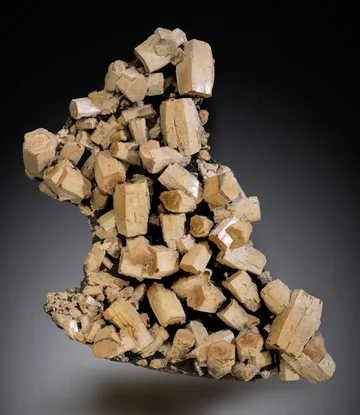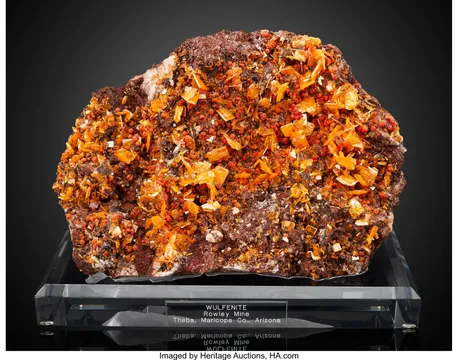
Touissit wulfenite has a look of its own: warm yellow to butterscotch-orange tabular crystals, commonly with sharp beveled edges, spread over dark gossan, pale dolomite, or mixed oxidized lead-zinc matrix. The best pieces have a distinctly Moroccan brightness—less brick-red than many Red Cloud examples, less sugary and isolated than much Mibladen material, and often arranged as dense “windowpane” sprays or intergrown plates that catch light from several directions at once.
Key facts
Touissit wulfenite has a look of its own: warm yellow to butterscotch-orange tabular crystals, commonly with sharp beveled edges, spread over dark gossan, pale dolomite, or mixed oxidized lead-zinc matrix. The best pieces have a distinctly Moroccan brightness—less brick-red than many Red Cloud examples, less sugary and isolated than much Mibladen material, and often arranged as dense “windowpane” sprays or intergrown plates that catch light from several directions at once.
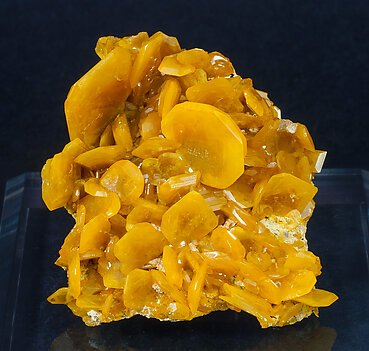
Photo: Fabre Minerals
The locality belongs to the Touissit-Bou Beker mining district of northeastern Morocco, a classic carbonate-hosted lead-zinc district near the Algerian border. Its primary ores are chiefly galena and sphalerite in dolomitized Jurassic carbonate rocks, later deeply oxidized to produce the district’s famous secondary suite: anglesite, cerussite, azurite, vanadinite, phosgenite, nadorite, paralaurionite, leadhillite, and wulfenite among them. For collectors, Touissit is not a one-mineral locality; it is a whole mineralogical province, and wulfenite is one of the bright yellow signatures of its oxidized zones.
Historically, the district had been mined for decades before specimen collecting fully caught up with its potential. The late 1970s and 1980s brought Touissit into the front rank of Moroccan collector localities. Wulfenite from Shaft XI and related workings, often dated by dealers and collections to about 1979–1980 or to broader 1980s finds, became a modern classic. Good examples are no longer routine mine-run material; they now appear mostly as older collection pieces, show stock, and estate material.
For serious collectors, the desirable Touissit wulfenite specimen has several traits at once: saturated yellow to butterscotch color, glassy luster, enough translucency to glow at the edges, complete beveled crystal margins, and a sculptural arrangement rather than an indistinct crust of overlapping plates. Small cabinets and miniatures can be especially successful because the crystals usually stay around the centimeter scale, making balanced specimens more common than huge individual crystals. Large, intact, freestanding crystals from Touissit are much less typical and command attention when they are genuine and undamaged.
Search for specimens: View all wulfenite specimens from Touissit, Oriental Region, Morocco
Touissit is one of the principal deposits within the Touissit-Bou Beker mining district in Jerada Province, Oriental Region, northeastern Morocco. The district trends ENE-WSW near the Algerian frontier and includes, from west to east, deposits and sectors such as Mekta, Beddiane, Touissit, Bou Beker, and the Algerian continuation at El Abed. In collector usage, “Touissit” may mean the Touissit deposit proper, a named shaft such as Shaft XI, or sometimes the broader Touissit-Bou Beker district, so careful locality wording matters.
Geologically, the district is a Mississippi Valley-type lead-zinc system hosted by dolomitized Jurassic carbonate rocks. The ores occur as epigenetic, strata-bound replacements and open-space fillings in dolostone, with breccias playing a major role in the ore structure. The principal primary ore minerals are galena and sphalerite, with pyrite or marcasite and lesser copper and silver-bearing phases. Oxidation converted parts of the system into an unusually rich secondary mineral environment, producing the bright lead, copper, zinc, molybdate, vanadate, sulfate, carbonate, and chloride minerals that made the district famous among collectors.
The mining history is industrial before it is collectible. French-era mining began after World War I, and the district later became one of North Africa’s important Pb-Zn-Ag producers. Reported total production for the Touissit-Bou Beker-El Abed group between 1926 and 2002 is about 70 million tonnes grading roughly 4% Pb, 3.5% Zn, less than 1% Cu, and 120 g/t Ag. The main mines operated by Compagnie Minière de Touissit closed in 2002; after that, production has been described as small-scale artisanal work rather than large modern mine output.
The great specimen era is later than the beginning of mining. Although ore extraction had long been established, Touissit’s reputation among specimen collectors accelerated in the late 1970s, when fine azurite, anglesite, cerussite, vanadinite, wulfenite, and rare lead minerals began reaching the international market. Wulfenite specimens from Shaft XI are repeatedly represented in collector and dealer records with dates around 1979–1980, and many classic Touissit wulfenites circulating today are described as 1980s material.
Collecting access should be regarded as historical and controlled, not as an open rockhounding opportunity. The old mines are industrial workings in a known mining district, and modern pieces generally come through Moroccan dealers, older European and American collections, show stock, or estate dispersals. For collectors, provenance is therefore part of the locality information: “Touissit,” “Shaft XI,” “Oued Mekta,” “Sidi Amer,” and “Oued El Heimer” labels may all appear on specimens, but they do not all say exactly the same thing.
Notable finds include yellow to butterscotch wulfenite plates on dolomite, dense small-cabinet “windowpane” groups from Shaft XI, and less common mixed associations with cerussite, galena, dolomite, and very rarely azurite. Large plates covered with innumerable small crystals are known, as are balanced miniatures with one or two dominant tabular crystals. The locality’s best wulfenites are not simply “Moroccan wulfenite”; they are distinctive classics from a district whose oxidized lead-zinc mineralogy is among the most admired in Africa.
Touissit wulfenite is usually tabular to platy, commonly forming square to rectangular plates with beveled edges. Many crystals show a “windowpane” habit: broad, flat faces with slightly thickened, sloping margins. On the best examples the bevels are crisp and reflective, giving even small crystals a lively, faceted sparkle. Some specimens show hemihedral-looking asymmetry and a wealth of small lateral faces, a trait frequently emphasized on high-quality Shaft XI pieces.
Color is central to the locality’s appeal. Typical tones range from lemon yellow and honey-yellow to mustard, butterscotch, caramel-orange, and occasionally deeper orange-yellow. The better crystals are translucent at the edges and lustrous on the faces; more crowded groups may look satiny where countless intergrown plates scatter the light. Touissit’s best color is saturated without being muddy, and the yellow-to-butterscotch palette is one of the easiest visual clues separating much of this material from redder American and Mexican classics.
Crystal size varies, but many attractive specimens carry crystals in the 2–10 mm range. Fine miniatures and small cabinets may have principal crystals around 1–2 cm on edge. Verified examples include specimens with main crystals of about 1.5 x 1.1 cm, 1.7 x 1.5 cm, 2.0 cm, 2.1 cm, 2.4 cm, and, more unusually, platy crystals reported to 3.0 cm. A very large individual crystal from Touissit is exceptional rather than normal; the locality’s strength is more often the combination of many sharp plates, rich color, and lively architecture.
The common matrix is oxidized lead-zinc gangue: gossanous, iron-stained, porous, or spongy material, often with dolomite. Dolomite is one of the most characteristic and attractive companions, especially where pale crystals or crusts contrast with yellow wulfenite. Other documented associations include galena, cerussite, malachite, mimetite, mottramite, vanadinite, baryte, gypsum, smithsonite, azurite, and the broader Touissit suite of oxidized lead and copper minerals. Wulfenite on azurite is highly unusual for the locality and should be evaluated carefully, but at least one documented specimen with that association exists.
The finest Touissit wulfenites have four interlocking quality factors. First is color: saturated yellow-orange or butterscotch tones beat pale straw or brownish plates. Second is luster: glassy faces and sparkling bevels are much more desirable than dull, etched surfaces. Third is condition: the broad tabular crystals chip easily at corners and edges, so undamaged margins are a premium feature. Fourth is composition: a specimen with dimensional growth, freestanding plates, and visible individual crystals is generally more collectible than a flat crust of indistinct overlapping blades.
Touissit pieces also reward close inspection. Look for crystal thickness, bevel geometry, color zoning from lemon to caramel, and whether the crystal faces are truly lustrous or merely waxy. On good specimens, the plates stand slightly proud of the matrix, allowing the edges to transmit light. On lesser pieces, the crystals may be crowded, broken, stained, or flattened into a mass that reads more as locality representation than as a top wulfenite.
The chief collecting issue with Touissit wulfenite is not identification—good examples are visually persuasive—but condition. Wulfenite is soft, brittle, and prone to edge bruising. Touissit crystals commonly project as thin tabs from an irregular matrix, so chipped corners, cleaved plates, missing tips, and contact marks are common. Dense clusters can look rich at first glance while hiding many broken crystal margins. Use angled light and a loupe; rotate the piece until the bevels flash, then check whether the flash is interrupted by chips.
Repairs are possible and should be considered on more valuable pieces, particularly where a large dominant crystal rises from matrix. A clean break at the base of a tabular crystal can be difficult to notice if the crystal was reattached neatly. Ask specifically about repairs, restorations, and stabilization of friable matrix. Old collection labels from recognized sources—Fabre, Arkenstone, Crystal Classics, noted private collections, or older European labels—can materially improve confidence, but labels are not a substitute for close physical inspection.
No Touissit-specific fake or treatment category is notorious in the standard collector literature in the way that some other minerals have well-known artificial enhancements. The practical authenticity concerns are instead locality precision, repaired crystals, damaged crystals described too optimistically, and specimens labelled simply “Touissit” when they may represent the broader Touissit-Bou Beker district. For higher-end pieces, a more specific label such as Shaft XI, Oued Mekta, Oued El Heimer, or Sidi Amer is valuable when it is credible and accompanied by older provenance.
Be cautious with unusual associations. Wulfenite with dolomite is expected; wulfenite with galena and cerussite is plausible; wulfenite with azurite is rare enough to deserve extra scrutiny. Likewise, any surprising lead oxide identification from the district should be treated carefully, because modern paragenetic work emphasizes goethite-rich early oxidation and standard lead sulfate/carbonate alteration products rather than a robust suite of lead oxides. When in doubt, analytical confirmation is inexpensive compared with the price of a top specimen.
Rarity is tiered. Small, somewhat chipped Touissit wulfenites are obtainable and continue to appear online and at shows. Good miniatures and small cabinets with rich color and limited damage are much scarcer. Highly aesthetic older Shaft XI specimens, especially with intact centimeter-scale crystals, strong luster, and documented provenance, are genuinely desirable locality classics. Large plates and cabinets exist, but they should be judged by crystal condition rather than sheer coverage.
Current market availability is episodic rather than steady mine supply. Recent auction and dealer records show Touissit wulfenites ranging from inexpensive thumbnails and damaged small cabinets to four-figure small cabinets with old collection provenance. In 2026, examples appeared at auction with winning bids from modest sums for small or damaged pieces to over $1,000 for a strong small-cabinet example from the Dr. Erika Pohl-Ströher collection. That spread is typical: Touissit wulfenite rewards a buyer who can distinguish a merely yellow Moroccan specimen from a crisp, old, well-provenanced classic.