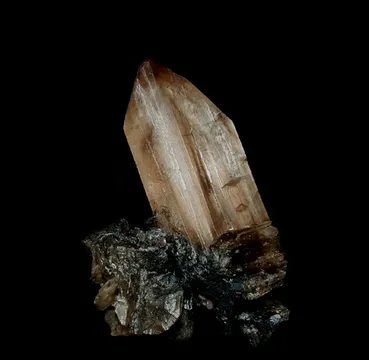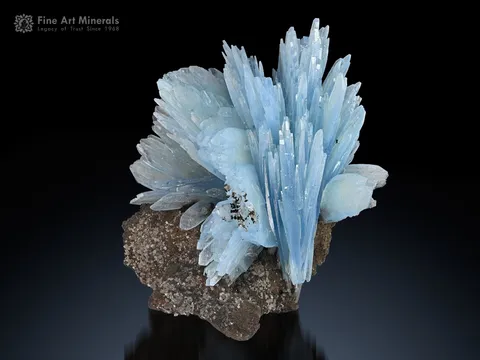
Nador, Morocco — a historic iron district famed for ice-blue barite from Jebel Ouichane and rare mirror-bright hematite blades, prized by collectors.
Key facts
For mineral collectors, “Nador” is not a single pocket or a single mine name so much as a compact, historically important iron district on Morocco’s northeastern Mediterranean margin, centered on Jebel Ouichane and the Beni Bou Ifrour massif southwest of Nador city. Its fame rests on two very different specimen traditions. The first is the modern flood of transparent to translucent, ice-blue barite from Jebel Ouichane: long, bladed to tabular crystals, commonly in parallel sprays or stacked sheaves, set against rusty hematite-limonite-goethite matrix or pale calcite. The second is the older and much more elusive suite of mirror-bright hematite and specularite blades from a small rhyolite quarry near Nador on the road to Melilla, often mislabelled over the years as Ouichane or Segangan.
Geologically, the district is a late Neogene iron-skarn system formed where Miocene dioritic to quartz-dioritic porphyry intrusions invaded Jurassic-Cretaceous carbonate and clastic rocks. The old mines worked magnetite-hematite iron ore, locally with pyrite, pyrrhotite, chalcopyrite, siderite, ankerite, and calc-silicate skarn minerals. Much later, low-temperature hydrothermal fluids exploited open fractures and vugs in this iron-rich environment and grew the blue barite that made Nador a modern marketplace name. The finest barites have a cold, watery blue color, glassy luster, open display, and unbruised blade tips—qualities that are unusually difficult to preserve in these thin crystals.
Regional View
Country View
The collecting story has a pleasing reversal: an industrial iron district that once fed European steelmaking later became important for delicate, gemmy, display-quality sulphate specimens. The barite pockets were not large cavernous chambers in the classic Alpine-cleft sense; they were open fractures, vugs, and pockets in altered, iron-rich skarn and metasedimentary rock. That explains the characteristic contrast of the best pieces: blue, light-filled blades growing from dark gossanous iron oxides, with calcite locally adding a pale architectural base.
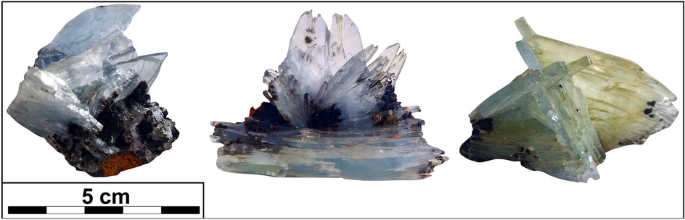
Photo: Scientific Reports
Search for specimens: View all specimens from Nador, Morocco
The Nador collector locality is best understood as two adjacent specimen sources that have been blurred on labels: the Jebel Ouichane / Beni Bou Ifrour iron-skarn district, source of the celebrated blue barite, and a separate small rhyolite quarry close to Nador city, source of the famous bladed hematite and specularite. The Ouichane district lies roughly ten kilometers south-southwest of the port of Nador in the Beni Bou Ifrour massif, with the principal historic iron deposits at Ouichane, Axara-Imnassen, and Bokoya-Setolazar. Older names and spellings include Ouixane, Wixane, Wiksane, Uixán, Segangan, and Sidi Lahcen, a label tangle that still matters when evaluating specimen provenance.
The deposit type at Ouichane is a Neogene iron skarn. The host sequence belongs chiefly to the Ouichane unit of the Beni Bou Ifrour massif and includes Upper Jurassic to Cretaceous carbonate, schistose, sandstone, shale, and tuffaceous rocks. Dioritic and quartz-dioritic porphyry intrusions, dated around 7.58 Ma in published work, cut these rocks and generated contact-metasomatic mineralization; ore formation has been dated at about 7.04 Ma, close enough to the intrusion age to support a genetic link between the magmatism and the iron ores. The primary industrial mineralization is magnetite and hematite, with limonite/goethite from oxidation and variable pyrite, pyrrhotite, marcasite, chalcopyrite, bornite, sphalerite, galena, siderite, and ankerite. Calc-silicate skarn assemblages include andraditic garnet, clinopyroxene, amphibole, epidote, phlogopite, chlorite, and scapolite-group minerals.
The barite is a late, open-space mineral rather than the main ore. It occurs in pockets and fractures in the iron-bearing skarn and Jurassic-Cretaceous metasediments of the Jebel Ouichane quarries. Petrographic study shows the barite-bearing rock to be dominated by iron oxides and hydroxides—especially hematite, goethite, and magnetite—with subordinate calcite and siderite. Calcite commonly predates the barite, and some specimens show the blue blades perched on or partly intergrown with white to gray calcite. Research on fluid inclusions and stable isotopes indicates low-temperature barite growth, below about 100 °C, from low-salinity fluids involving diluted meteoric water mixed with magmatic-hydrothermal components in a near-surface, steam-heated setting. In collector language: the district’s rugged iron-skarn plumbing made the dark matrix, but the prized barite is a later and cooler episode.
Mining at Ouichane began as iron mining, not specimen mining. The iron deposits were prospected between 1905 and 1907 and then brought into production in 1914 by the Compañía Española de Minas del Rif. Published geological guides describe a district of about 36 km2, with Ouichane, Axara-Imnassen, and Bokoya-Setolazar as the most productive deposits. From 1915 to 1951 the district produced roughly 24 million tonnes of iron ore, mostly oxidized ore but also pyritic ore. Moroccan state involvement followed in the later 20th century through SEFERIF and BRPM, the predecessor of ONHYM, after earlier Spanish estimates suggested very large reserves. Later reassessment reduced the reserve picture, and compiled production to the 1976 closure is given as more than 60 million tonnes of ore with average iron contents commonly in the 45–60% range.
The individual ore bodies differed. Ouichane was the richest, noted for very high-grade ore and worked by open pits, room-and-pillar methods, and glory-hole style extraction in two main eastern and western quarries separated by the Ouichane fault. Axara-Imnassen included a roughly 300 m diameter, 100 m deep quarry worked on benches and showed stratiform, banded ore in ferruginized and barren layers. Bokoya-Setolazar had lower-grade, more sulphur- and silica-rich ore, with open-pit and underground components. These distinctions matter for field labels: “Nador,” “Ouichane,” “Beni Bou Ifrour,” and “Segangan” can describe the same broad mining landscape, but they are not interchangeable with the small rhyolite quarry that produced the best bladed hematite.
The specimen-producing barite event is much younger in collecting history. Blue barite had been collected from the mining zone in the 1970s, but the modern collector market was transformed by finds beginning in 2012. The material appeared conspicuously at the Sainte-Marie-aux-Mines show in spring 2012, and from 2012 through 2015 the quarry walls were worked intensively for pockets. Later material, including a noted November 2022 find, showed that high-quality pieces could still appear after many collectors believed the productive zones were exhausted. The best of these later finds preserved the classic look: transparent blue, flattened blades with slight curvature, commonly doubly terminated, on limonite or goethite-rich matrix.
Collecting access today should be approached conservatively. The iron mines are abandoned industrial sites with open pits, old underground workings, unstable benches, waste dumps, and locally acidic pit lakes or mine-drainage problems documented in environmental studies. The barite pockets were mostly extracted from quarry walls, not from a publicly managed collecting area, and the district has a long history of mining concessions and state resource oversight. Serious collectors are usually better served by carefully vetted dealer specimens with accurate labels than by casual field collecting. If a specimen is labelled “Nador,” the next question should be: blue barite from Jebel Ouichane / Beni Bou Ifrour, or bladed hematite from the separate rhyolite hematite occurrence near Nador city?
Nador barite, properly the blue barite of Jebel Ouichane in the Beni Bou Ifrour district, is famous for light-blue to sky-blue, bladed-tabular crystals that average about 3–4 cm and can reach around 10 cm; the crystals are commonly arranged as parallel growths, sheaves, or divergent sprays, less commonly as isolated tabular crystals projecting into vugs. The classic matrix is dark, iron-rich hematite-limonite-goethite skarn, sometimes with white to gray calcite, and the strongest cabinet pieces depend on contrast: transparent blue blades standing free against rusty or blackened matrix. The best examples have glassy luster, uniform color, sharp terminations, minimal edge bruising, and an airy, three-dimensional spray; ordinary examples are crowded, iron-stained, contacted, or chipped along the knife-like edges. Finds from 2012–2015 made the locality famous internationally, while a later November 2022 recovery showed that choice, undamaged pieces could still emerge from a deposit many considered depleted.
Nador hematite is a separate collector classic from the blue barite, coming from a small rhyolite quarry near Nador on the road to Melilla rather than from the Jebel Ouichane barite pockets; it occurs as brilliant black to gunmetal-gray specularite and hematite blades, lamellae, skeletal clusters, and pseudohexagonal plates on pale rhyolite or, more rarely, as sharp floaters or groups with calcite, quartz, or barite. Fine pieces are mirror-bright, extremely thin, sharply edged, and often show skeletal or growth-line textures across the faces; crystals of a few millimeters are common on matrix, while larger loose or matrix specimens to many centimeters are much more desirable. The best specimens are valued for pristine faces and edges, strong metallic luster, and sculptural branching or parallel growth; the most common problems are bent-looking contacts, edge nicks, abrasion, and confusing old labels that place the hematite at Ouichane or Jebel Ouichane.
Other minerals documented from the Nador specimen field reflect the district’s iron-skarn roots more than its display-specimen fame. Jebel Ouichane records include ankerite, calcite, chalcopyrite, bornite, chlorite-group minerals, clinopyroxene-subgroup minerals, epidote, galena, goethite, magnetite, marcasite, phlogopite, pyrite, pyrrhotite, quartz, scapolite-group minerals, siderite, sphalerite, and “psilomelane”-type manganese oxides; Raman work on the barite-calcite assemblage has also identified chalcophanite and goethite inclusions in calcite. The separate hematite quarry near Nador is a much leaner locality mineralogically, with hematite/specularite, quartz, and tridymite documented. Collectors should not confuse this Moroccan Nador with the Algerian Djebel Nador / Nador N’Bails locality that gave its name to nadorite; nadorite is not a type-locality mineral of Nador, Morocco.
The most important authenticity issue is not artificial treatment but label accuracy. Nador blue barite is often sold as “Sidi Lahcen,” “Ouichane,” “Jebel Ouichane,” “Beni Bou Ifrour,” “Segangan,” or simply “Nador,” and those labels may all point toward the same collector market for blue barite, though “Sidi Lahcen” is commonly treated as an erroneous or imprecise label for the Jebel Ouichane material. By contrast, the famous bladed hematite/specularite should not be assumed to be from Ouichane just because older labels say so; the best-known Nador hematites are from the separate rhyolite quarry near Nador city.
No persistent, well-documented fake industry is associated with Nador barite in the way one sees for some Moroccan vanadinite, fossil, or dyed agate material. The routine problems are misidentification and overbroad labelling: pale gypsum-like blades sold as barite without testing, barite from other Moroccan districts folded into “Nador,” and blue barite from Jebel Ouichane confused with superficially similar barites from Bou Nahas / Afrou in the Oumjrane-Alnif area. Ouichane barite is usually recognizable by its flattened blue blades in parallel bundles on hematite-limonite-goethite matrix; Bou Nahas material tends toward thicker, diamond-shaped yellow-brown crystals with sulphides.
Condition is decisive. Nador barite crystals are broad and thin, with exposed blade edges and tips, so even attractive specimens often carry small bruises. Dealer phrases such as “in very good condition, which in these barites is like a small miracle” are not just sales language; the habit really is unforgiving. Examine terminations, the front edges of the blades, and the highest crystals under side lighting. A minor nick on a rear blade may be acceptable; repeated edge chipping across the display face strongly reduces value.
Cleaning should be restrained. Iron oxide staining is part of the look of many Ouichane specimens, and aggressive attempts to brighten the matrix can remove contrast or damage associated calcite. Acid will attack calcite and may undercut the display architecture. Strong reducing cleaners used carelessly on iron oxides can dull or alter limonite/goethite coatings. For most specimens, dust removal with air, a soft brush, and minimal water is safer than chemical cleaning.
Fluorescence is not a principal reason to buy Nador material, though some dealer-documented barites show minor fluorescence under longwave or shortwave ultraviolet light. The visual value remains daylight color, transparency, luster, and contrast. Store larger barites so that no blade bears weight; many are best handled by the matrix only. Hematite from the rhyolite quarry is tougher chemically but still mechanically vulnerable because the crystals are thin plates. Avoid rubbing mirror faces, as fingerprints and micro-scratches show quickly on the metallic luster.
Market availability has changed since the 2012–2015 rush. Ordinary to good Nador barites remain available because the early finds were productive, but top pieces with large, undamaged, transparent blue blades on dramatic matrix are no longer casually abundant. Later finds, including 2022 material, refreshed the market but did not make great specimens common. Fine hematite is scarcer in day-to-day dealer stock than barite; the best pieces tend to circulate through older collections, auction lots, and specialist dealers.
The Nador story begins with iron, contracts, and conflict rather than with delicate cabinet specimens. In 1905, Spanish interest fixed on the Beni Bou Ifrour massif after major iron mineralization was recognized near Ouichane. Clemente Fernández González, one of the founders of the future Compañía Española de Minas del Rif, learned of the Guelaia iron deposits during a 1907 stay in Melilla. The negotiations that followed were as much political as geological: the concession was made through Rogui Bou Hmara, the local strongman who challenged the authority of the Sultan and styled himself as connected to the ruling dynasty. Contemporary summaries give the first payment as 160,000 pesetas in silver coins on December 16, 1907, followed by a second payment of 250,000 pesetas in January 1908. By March 14, 1908, the Sindicato Español de Minas del Rif had been created and the railway project contracted; on June 21, 1908, the Compañía Española de Minas del Rif was formed with capital of 6 million pesetas.
The railway became part of the wider drama. The plan was to move ore from the mines toward Melilla, about 28 km away, but construction unfolded amid rising resistance. Mohamed Améziane, whose territory included the land in question, first opposed Bou Hmara and then turned against the Spanish presence. In 1908, attacks on European workers forced them to take refuge in Melilla. In 1909, the railway construction site itself was attacked, setting in motion the Spanish military response that led to the Battle of Barranco del Lobo on July 27, 1909. The mineral district that collectors now associate with blue barite and brilliant hematite thus sits in a landscape tied directly to the prelude of the Rif War.
The industrial remains still give scale to the old iron enterprise. The San Daniel processing plant, built in 1932 on Jbel Ouichane about ten kilometers southwest of Nador, rose through a 94 m vertical drop on the mountainside. What remains today is not a tidy ruin but a severe geometry of buttresses, staircases, walls, and ore-processing terraces stained by iron oxides. One modern description compares its mass to “a half-buried Mayan pyramid,” an apt image for a site whose concrete has taken on the ochre tones of the ore it processed. Around it are the remnants of furnaces, workers’ buildings, quarries, and a landscape reshaped by decades of iron extraction.
The collector chapter arrived much later and much more quietly. Blue barite had been known from the Ouichane mining zone before the market eruption—François Liétard collected blue barite there in the mid-1970s—but for many collectors the locality became real at the 2012 Sainte-Marie-aux-Mines show. By 2014, mineral writers were cautioning buyers not to confuse the pale blue Ouichane/Sidi Lahcen barite from Nador Province with the different barite from Bou Nahas/Afrou in the Oumjrane-Alnif district. The distinction was visual and immediate: Ouichane produced subparallel bundles of blue blades on hematite-limonite matrix; Bou Nahas produced sharper, thicker, yellow-brown, diamond-shaped crystals with sulphides.
The exhaustion narrative came quickly. By late 2015, specialist reporting relayed word from Tomasz Praszkier of Spirifer Minerals that the lovely blue barite occurrence at Ouichane had been exhausted and that no further large lots should be expected. Dealers were still offering miniature and small-cabinet specimens, many already marked sold, and collectors who had hesitated were told, in effect, not to wait. Then came the sort of twist that keeps locality stories alive: a November 2022 find produced new blue barites of enough quality that Fabre Minerals described one group as coming from “a locality that was believed to no longer yield more quality specimens.” For collectors, that sentence captures the charm of Nador—apparently finished, then suddenly alive again.
The hematite locality had its own detective story. For years, many of the dazzling black blades were sold as “Ouichane” or “Segangan.” Field collectors later traced the real source to a small quarry in Nador itself, where pale volcanic rock is cut by joints coated with black hematite. Spirifer’s Morocco field report shows the progression in plain visual terms: the big iron quarry at Mount Ouichane for barite, then the “mysterious” hematite locality inside Nador, white volcanic rock with black hematite on the joints, small crystals lining fracture walls, and larger blades in situ. One pictured specimen is described as among the biggest known, a 12 cm Nador hematite crystal in the Spirifer collection.
Dumańska-Słowik, M., Naglik, B., Toboła, T., Powolny, T., Huber, M., Milovska, S., Dobosz, N., Guzik, K., & Wesełucha-Birczyńska, A. “Origin and occurrence of gem-quality, skarn-hosted barite from Jebel Ouichane near Nador in Morocco.” Scientific Reports 11, Article 10307, 2021. The key modern scientific paper on Nador blue barite, including petrography, EMPA, XRF, Raman spectroscopy, fluid inclusions, stable isotopes, and genetic interpretation.
PubMed record for “Origin and occurrence of gem-quality, skarn-hosted barite from Jebel Ouichane near Nador in Morocco.” Useful bibliographic record for the Scientific Reports article, with abstract and indexing data.
Bouabdellah, M., Lebret, N., Marcoux, E., & Sadequi, M. “Les mines des Beni Bou Ifrour-Ouixane (Rif Oriental): un district ferrugineux néogène de type skarns / The Beni Bou Ifrour-Ouixane mines (Eastern Rif), Neogene Skarn Type Iron Deposits.” Nouveaux Guides Géologiques et Miniers du Maroc, vol. 9, pp. 357–362, 2012. Field-guide style treatment of the iron-skarn district, ore bodies, mining history, production, and regional geology.
Praszkier, T. “Baryt—vielfältige Vorkommen in Marokko.” extraLapis 48, pp. 32–43, 2015. Morocco barite article cited in locality records for Jebel Ouichane and the modern collecting history of the Nador barite finds.
Moore, T. P. “What’s New in the Mineral World? Report #38.” The Mineralogical Record online report, July 19, 2014. Contemporary dealer-market note distinguishing Nador/Ouichane blue barite from Bou Nahas barite and documenting the post-2012 marketplace presence.
Moore, T. P. “What’s New in the Mineral World? Report #42.” The Mineralogical Record online report. Includes the 2015 report that the Ouichane blue barite occurrence was thought exhausted and notes the quality of remaining dealer specimens.
El Rhazi, M., & Hayashi, K. “Mineralogy, Geochemistry, and age constraints on the Beni Bou Ifrour skarn type magnetite deposit, Northeastern Morocco.” Resource Geology 52(1), pp. 25–39, 2002. Frequently cited technical work on the Beni Bou Ifrour skarn-type magnetite system; listed in the references of the modern Scientific Reports barite study.
Heim, A. “The iron mines del Rif, Morocco.” Economic Geology 29, pp. 294–300, 1934. Historic geological publication on the Rif iron mines, cited in the Beni Bou Ifrour-Ouichane guide bibliography.
Rhoden, N. H., & Ereno, I. “Magnetite ores of Northern Morocco.” Transactions of the Institution of Mining and Metallurgy 71, pp. 629–661, 1961. Classic technical reference on northern Moroccan magnetite ores, cited in the Ouichane district guide and mining-document appendix.
Mindat locality record: Hematite occurrence, Nador Pachalik, Nador Province, Oriental Region, Morocco. Locality record for the small rhyolite-quarry hematite occurrence near Nador, including the important warning that these hematites are often mislabelled as Ouichane.
Mindat locality record: Jebel Ouichane, Guelaia Cercle, Nador Province, Oriental Region, Morocco. Principal locality record for the Jebel Ouichane barite and iron-skarn mineral assemblage.
Mindat locality record: Ouichane Mines, Jebel Ouichane, Guelaia Cercle, Nador Province, Oriental Region, Morocco. Sub-locality record listing the documented mineral assemblage and rock types for the Ouichane mining area.
“Baryte from Jebel Ouichane Mines, Beni Bou Ifrour, Morocco” — Fabre Minerals, Vimeo. Rotating specimen video of a 14.3 × 10.7 × 6.3 cm blue barite on limonite matrix from the November 2022 find.
“Baryte from Jebel Ouichane Mines, Morocco” — Fabre Minerals, Vimeo. Video of a 2014 Jebel Ouichane barite with parallel growths and bundles of light-blue crystals on matrix.
“Baryte with Goethite from Jebel Ouichane mines, Beni Bou Ifrour, Morocco” — Fabre Minerals, Vimeo. Specimen video showing transparent blue barite with goethite matrix from the November 2022 recovery.
Scientific Reports: Origin and occurrence of gem-quality, skarn-hosted barite from Jebel Ouichane near Nador in Morocco — The best single scientific source for the blue barite’s geology, chemistry, inclusions, and hydrothermal origin.
Nouveaux Guides Géologiques et Miniers du Maroc, vol. 9 PDF — Includes the Beni Bou Ifrour-Ouichane iron-skarn district guide with mining history, ore-body descriptions, production figures, and bibliography.
Mindat: Jebel Ouichane, Guelaia Cercle, Nador Province, Oriental Region, Morocco — Core locality page for the Nador blue barite occurrence and associated iron-skarn minerals.
Mindat: Ouichane Mines, Jebel Ouichane — Useful sub-locality page with a detailed mineral list and rock-type entries for the Ouichane mining area.
Mindat: Hematite occurrence, Nador Pachalik — Essential for separating the rhyolite-quarry hematite locality from the Jebel Ouichane barite locality.
Mindat: Barite from Jebel Ouichane — Species occurrence page documenting the world-class quality designation and common associated minerals for Jebel Ouichane barite.
Mindat: Specularite from the Nador hematite occurrence — Species occurrence page for confirmed specularite from the small Nador rhyolite quarry.
Spirifer Minerals Morocco field report, September 2012 — Field photographs and notes showing the Ouichane barite workings and the separate Nador hematite quarry.
Fabre Minerals reference specimens: Morocco — High-quality archived examples of Jebel Ouichane barite, including 2012, 2014–2015, and 2022 material.
Fabre Minerals specimen MFG16AP8 — A documented November 2022 Jebel Ouichane barite specimen with dimensions, crystal size, and descriptive notes.
The Mineralogical Record: What’s New in the Mineral World? Report #38 — Market-context note on the 2012–2014 Moroccan barite influx and how to distinguish Ouichane from Bou Nahas material.
The Mineralogical Record: What’s New in the Mineral World? Report #42 — Collector-market note reporting the then-believed exhaustion of the Ouichane blue barite occurrence.
TelQuel: Ouichane, a Legacy of Stone and Iron — Vivid modern account of the San Daniel processing plant, mining heritage, and historical setting.
Dialnet: La formación de la Compañía Española de Minas del Rif, Abril 1907–junio 1908 — Historical summary of the formation of the Compañía Española de Minas del Rif and the early concession history.
ONHYM Mining: Presentation and History — Official Moroccan mining-history page listing the Wixane iron mine and estimated reserves.