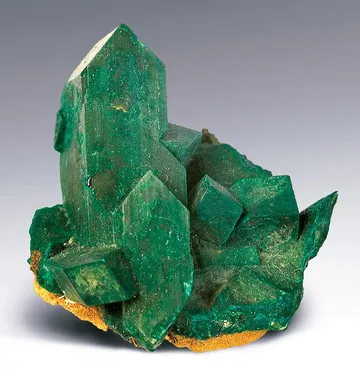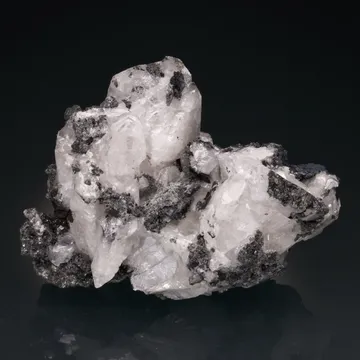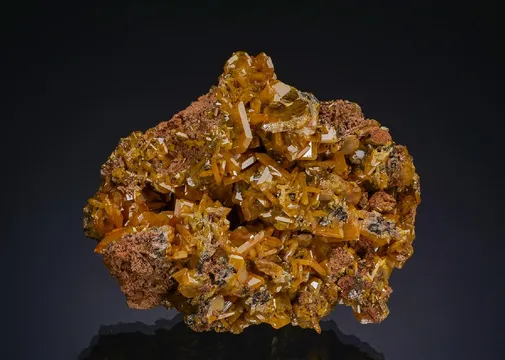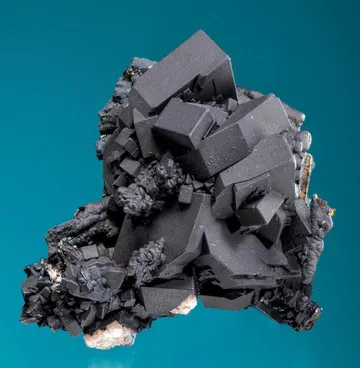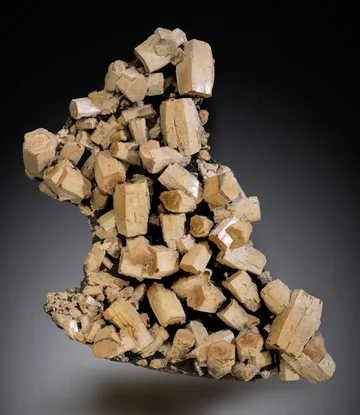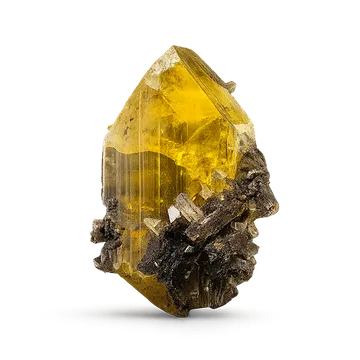
Anglesite from Touissit, Morocco: vivid yellow, glassy crystals on galena; a classic locality piece prized for its color, luster, and cabinet appeal.
Key facts
Touissit anglesite is the yellow glass of the lead-mineral world: heavy, brilliantly lustrous, and often so transparent that a well-lit crystal seems to glow from within. The best pieces are immediately recognizable—lemon to canary-yellow crystals perched on dark galena, sometimes with pale cerussite or carbonate gangue, giving a high-contrast look that made Touissit one of the classic specimen localities of the late twentieth century.

Photo: Rob Lavinsky / iRocks.com via Wikimedia Commons
The reason these specimens have such authority is geological as much as aesthetic. Touissit lies in the Touissit-Bou Beker district of eastern Morocco, a carbonate-hosted Mississippi Valley-Type lead-zinc district in which galena and sphalerite were emplaced in dolomitized Jurassic carbonate rocks. Later oxidation transformed portions of the primary sulfide ore into a spectacular suite of secondary lead, zinc, and copper minerals. For anglesite, the essential reaction was the oxidation of galena, PbS, to lead sulfate, PbSO4, in carbonate-poor or sulfate-rich microenvironments. Where the chemistry favored carbonate instead, cerussite formed; where copper entered the oxidizing system, azurite and malachite joined the assemblage.
Collectors value Touissit anglesite for a combination that is rare in the species: saturated natural yellow color, glassy luster, transparency, and sharp morphology in crystals large enough to stand as fine miniatures or cabinet specimens. Many classic examples are not just isolated crystals but complete compositions—anglesite rising from metallic-gray galena, framed by pale secondary minerals, with enough matrix to tell the story of its origin.

Photo: Didier Descouens via Wikimedia Commons
Historically, Touissit became famous among mineral collectors after major specimen production in the late 1970s and early 1980s. The district had been mined long before that, but the collector-market identity of “Touissit anglesite” was shaped by those classic yellow crystals, many of which passed quickly into advanced private collections and museum displays. Today the best pieces are usually old-stock specimens with older collection pedigrees rather than fresh mine production.
Search for specimens: View all anglesite specimens from Touissit, Morocco
Touissit is one of the main deposits of the Touissit-Bou Beker mining district in Jerada Province, Oriental Region, eastern Morocco. The district trends ENE-WSW for roughly 16 km, with a variable width of about 100 to 1,200 m, and lies near the Algerian border, south of Oujda. In specimen labels, “Touissit” is often used broadly, and older labels may not distinguish cleanly between the Touissit deposit proper, Shaft IX, Shaft XI, Beddiane, Bou Beker, Zellidja, or other workings in the wider Touissit-Bou Beker system.
Geologically the deposit is a carbonate-hosted MVT lead-zinc system. The primary ore is chiefly galena and sphalerite, with pyrite or marcasite and lesser chalcopyrite, bornite, tetrahedrite, Pb-Sb sulfosalts, and silver-bearing species. The ore occurs in dolostone as replacement bodies and open-space fillings, with breccia textures playing a major role. Crackle, mosaic, rubble, and rock-matrix breccias provided the porosity and pathways that later allowed oxidizing meteoric water to move through the ore.
The secondary mineralogy that made Touissit famous developed after oxidation of those primary sulfides. Galena provided the lead for anglesite and cerussite; sphalerite fed zinc minerals such as smithsonite and hemimorphite; chalcopyrite contributed to copper carbonates such as azurite and malachite. The carbonate host rocks buffered acidic fluids and controlled whether lead was fixed as sulfate or carbonate. Anglesite is especially tied to oxidation conditions in which sulfate remained important and carbonate activity was not high enough to convert all lead into cerussite.
Mining history and specimen history are not identical. French mining followed World War I and continued for decades, but the collector fame of Touissit accelerated much later, when the district began producing world-class secondary minerals in the late 1970s. Yellow anglesite, azurite, cerussite, vanadinite, and wulfenite put the locality into major collections. Pit and shaft labels are especially valuable where preserved; documented specimen labels include Shaft IX and Shaft XI material, and one well-described Shaft IX specimen was mined in 1997 with lemon-yellow anglesite crystals to 3 cm on massive galena.
This is not a casual collecting locality. The Touissit-Bou Beker workings are mining ground, not an open public rockhounding site. Serious collectors normally encounter Touissit anglesite through established dealers, older collections, museum deaccessions, and old stock from European and Moroccan mineral channels. Because the locality name has long been used broadly, good provenance notes—mine, shaft, date, previous owner, dealer, and whether the specimen was analyzed or visually vetted—are important parts of the specimen’s value.
The finest Touissit anglesite crystals are transparent to translucent and range from nearly colorless and pale straw-yellow to saturated lemon, canary, or golden yellow. The most coveted color is a pure, bright yellow that penetrates the crystal rather than sitting as a surface film. Dark galena inclusions or matrix are common and, when aesthetically placed, greatly improve contrast.
Crystal form is varied but usually sharply developed. Collectors encounter spear-point crystals, flattened blades, stout prisms, blocky to wedge-shaped crystals, and highly modified individuals rich in faces. Some crystals show striated prism faces; others carry etched or growth-textured terminations. The best examples combine crisp form with a glassy luster that can look almost polished even when completely natural.
Size is one reason Touissit stands above most anglesite localities. Documented individual crystals include small sharp examples around 1.5 cm, fine miniature crystals around 2 cm, and matrix specimens with main crystals around 3 cm. Larger display crystals are also known, including a documented 7.5 × 3.2 cm yellow crystal on galena and a famous 4.5 × 4.2 × 2.6 cm miniature described as intensely gemmy and mirror-lustrous. Cabinet specimens may measure 10 cm or more across when multiple anglesite crystals occur on galena matrix.
The classic association is anglesite on galena. Cerussite is a frequent and important companion, sometimes occurring with anglesite as later or associated white to colorless lead carbonate. Other minerals from the Touissit deposit and district include azurite, malachite, vanadinite, wulfenite, dolomite, gypsum, baryte, smithsonite, hemimorphite, mimetite, nadorite, phosgenite, pyromorphite, and lead-bearing aragonite. Not every association belongs on every specimen label; for anglesite, galena and cerussite are the associations most directly relevant to collector evaluation.
Quality is judged first by natural color, then by transparency, luster, crystal sharpness, and condition. A fine Touissit anglesite should not look dull, sugary, or chalky; it should have depth. The ideal specimen shows yellow color throughout the body of the crystal, bright glassy faces, minimal bruising on edges and terminations, and an attractive placement on contrasting galena. Matrix specimens with several sharp crystals can be more desirable than a single loose crystal if the composition is balanced and undamaged.
Some Touissit anglesite also shows fluorescence. At least one documented specimen from the Fluorescent Mineral Society database fluoresces yellow under longwave 365 nm ultraviolet light. This should be treated as an observed property of a documented specimen rather than a guarantee for every Touissit anglesite.
Touissit anglesite has a specific and well-documented treatment problem. In the early 1980s, pale yellow to nearly colorless Touissit anglesite crystals were treated in strong bleach solution to produce an amber-red to orange-yellow color. The reaction could take only seconds, left the glassy luster intact, and produced a thin color skin over both crystal faces and broken surfaces. The treated color did not simply wash off. GIA’s 1984 report noted that the treatment had entered the specimen market undisclosed, and later collector commentary continued to treat these bleached Touissit anglesites as a notorious mineral fraud.
For that reason, color should be examined carefully. Natural yellow Touissit anglesite should show color through the interior of the crystal, especially when viewed down the crystal axis or through a clean edge. Treated examples tend to show color concentrated on the surface or broken areas, often with a more orangey cast. Strong, uniform amber-red color on anglesite from Touissit deserves skepticism. Any treatment reversal using bromine-water belongs only in expert laboratory hands; bromine is dangerous and is not a collector-cleaning method.
Modern listings also sometimes warn against “dyed” Touissit material. Whether a seller uses the word dyed, bleached, treated, or enhanced, the collecting issue is the same: the most valuable color is natural internal yellow, not an artificial surface effect. For high-end pieces, ask for provenance and, where appropriate, independent examination.
Condition is another major factor. Anglesite is a lead sulfate with high density and comparatively low hardness, so chips on exposed edges, bruised terminations, and contact damage are common. Dark galena matrix can conceal old repairs or trimming scars; inspect joins, matrix cracks, glue fluorescence, and mismatched luster under magnification. Because the species contains lead, handle specimens sensibly, wash hands after contact, and keep fragments or dust away from children and food areas.
Market availability is uneven. Ordinary small crystals and modest matrix examples appear periodically, but top-quality Touissit anglesites are old-stock classics and do not circulate often. A May 2026 market snapshot showed Touissit anglesites listed in the hundreds to low thousands of dollars, including small to medium pieces around $360 to $1,970 on mineral-dealer aggregation sites, while elite exhibition-grade examples were already sold and carried major collection pedigrees. The best pieces are not merely “Moroccan anglesite”; they are classic Touissit yellow anglesite with color, clarity, form, and provenance all aligned.
The cautionary story every Touissit anglesite collector should know began in the early 1980s, right after the great yellow anglesite finds had reached the specimen trade. Pale yellow and nearly colorless crystals from Touissit were being turned amber-red by dipping them in strong bleach. The reaction was quick—reported as taking only a few seconds—and it left the luster intact, which made the fraud especially dangerous. The color sat as a skin on crystal faces and even on broken surfaces, and it did not wash away. A Moroccan dealer reportedly discovered the reaction by accident; other dealers then sold the treated material without disclosure. George Rossman at Caltech found that saturated bromine-water could reverse the reaction without destroying the luster, but the same report emphasized the danger of bromine. For collectors, the lesson remains practical rather than chemical: pure yellow color that goes through the core is desirable; orangey surface color should be treated with suspicion.
One of the most evocative Touissit anglesite stories belongs to a single 4.5 × 4.2 × 2.6 cm miniature photographed by Joe Budd and published from the Rob Lavinsky / iRocks archive. The specimen was described as a gem crystal with “mirrorlike” luster and exceptional transparency, ex-John Barlow No. 2544, pictured in The John Barlow Collection. Lavinsky wrote that he had owned the piece three times over eleven years after first buying it when the John Barlow collection was sold in 1998. It later came from the Tom Hall collection; Hall, a longtime collector and retired first-chair violinist for the Chicago Symphony Orchestra, specialized from the 1960s onward in colorful high-quality miniatures and small cabinet specimens. The description is unusually personal for a specimen entry: the piece was remembered from the Barlow book, suspected at first glance of looking “too good” in print, and then found in hand to be even better than the photograph.
A more modest but equally collector-like episode comes from the fluorescent-mineral community. In 2018, a Touissit anglesite specimen was reportedly found buried in a flat of old specimens at a local rock show. The collector left it there for two days, returned, and bought it. The piece measured 2.5 × 2 × 4 inches and weighed 635 g, with little galena showing at top and bottom and a body described as “pretty much solid crystals.” In 2026 it was entered into the Fluorescent Mineral Society database, where it was recorded as fluorescing yellow under longwave ultraviolet light. It is a reminder that even in a market where the finest Touissit anglesites are famous old trophies, odd and worthwhile pieces still surface in the less glamorous places: an old flat, an overlooked label, a specimen that waited while everyone else walked past.