Stewart Mine, USA - Pala lithium-pegmatite locality famed for lilac lepidolite and gem elbaite tourmaline, plus rare phosphates and rich pocket specimens.
Key facts
The Stewart Mine, better known in much of the older literature as the Stewart Lithia Mine, is one of the classic American lithium-pegmatite localities: a complex granitic pegmatite-aplite dike on Queen Mountain at Pala, San Diego County, California. To collectors, its name stands for three things at once: purple lepidolite ore mined on a genuinely commercial scale, hot pink to red elbaite tourmaline set in that lepidolite, and a remarkable suite of rare phosphate alteration minerals developed from primary lithium phosphates in the pegmatite core. It is not merely “one of the Pala mines.” The Stewart is the Pala mine in which lithium ore, gem tourmaline, morganite, kunzite, albite, quartz, clay-filled pockets, and secondary phosphates come together in unusually mineralogically instructive form.
Regional View
Country View
The best Stewart specimens have a visual identity that is difficult to mistake when the provenance is sound: deep lilac, lavender, purplish-gray, or reddish lepidolite carrying compact sprays and embedded prisms of rubellite; gemmier elbaite crystals with pink, red, green, teal-blue, or purple zoning; sharp albite or cleavelandite blades acting as a pale foil to the color; and, in the better pockets, quartz, morganite, and occasional spodumene-family material completing the association. The older massive pieces can look almost geological rather than delicate—dense blocks of lithium mica with tourmaline frozen through them—while the finest gem-pocket specimens show the glassy, striated, color-zoned elbaite that made Pala a household name among serious American mineral collectors.
Search for specimens: View all specimens from Stewart Mine, USA
The Stewart Mine is on Tourmaline Queen Mountain, near the village of Pala, in the Pala Mining District of northern San Diego County. The deposit is a granitic pegmatite-aplite dike hosted in gabbroic to mafic tonalitic rocks of the Peninsular Ranges batholith. Modern petrogenetic work has emphasized that the Stewart pegmatite-aplite is not simply a late fluid squirted in from a distant granite body; its textures, chemistry, isotopic character, and relationship to the enclosing mafic rocks point to a closely linked, internally differentiated magmatic system in which volatile- and rare-element-rich material segregated and evolved within the host environment.
In the older mine descriptions, the Stewart pegmatite is treated as a large, thickened, irregular part of the broader Queen Mountain pegmatite system. It is traceable for roughly half a mile along the east slope of Queen Mountain and becomes notably bulbous in its southern part, where the Stewart workings lie on both sides of a ridge. In the mine area the pegmatite is reported to be at least 80 feet thick through much of the exposure, with a hanging-wall part rich in graphic granite and a complicated inner system of quartz, feldspar, albite, lepidolite, tourmaline, and pocket pegmatite. Like other Pala pegmatites, it contains zones and replacement bodies rather than a simple, uniform coarse granite.
The economic heart of the old mine was lepidolite. Two principal lepidolite-rich ore bodies were described in the classic 1951 report by Richard H. Jahns and Lauren A. Wright. One extended westward from the Main cut for about 200 feet, varied from about 20 to 110 feet wide, and reached at least 20 feet thick, though much of the mined part was nearer 10 feet thick. That northern lepidolite was gray, bluish-gray, and deep purple, commonly with albite and abundant prismatic rubellite. A second body roughly 50 feet to the south was also about 200 feet long, broader in places—30 to 180 feet—and locally reached 18 feet thick; its lepidolite was generally purer, coarser, and more reddish to pinkish, with less abundant albite and tourmaline except locally. These are not abstract ore descriptions for collectors: they explain why so many Stewart specimens consist of purple mica carrying pink tourmaline prisms, and why other pieces are massive, nearly pure, ornamental lepidolite.
The first recorded year of mining at the Stewart was 1892, when approximately 18 tons of lepidolite were taken from the deposit. Production increased in the following years, and a substantial annual output was maintained from 1900 to 1907, when competition from amblygonite mining in the Black Hills lowered lithium-salt prices. The large-scale Stewart operations were chiefly associated with the American Lithia and Chemical Company of New York. Activity revived around World War I; maximum production was reached in 1920; then output dwindled, especially after the development of the Harding lepidolite deposit in New Mexico. The National Industrial Chemical Corporation of New York worked the deposit for two or three years before the 1928 shutdown, and there was small-scale work by several parties in the 1930s.
The mine workings followed the geology in a messy, practical way. Early open-cut work developed the Main cut and smaller North and South cuts, after which drifts, inclines, stopes, low rooms, branch adits, and exploratory tunnels traced lepidolite shoots and tested extensions of the dike. The old reports describe a large mass of amblygonite encountered in 1903 in the inner workings from the Old Main adit, rooms and stopes excavated between 1902 and 1905, later haulage through a west-slope adit during World War I, and additional North cut and lower workings in the 1920s and 1930s. The result was an extensive but hazardous underground system, much of it affected by unsupported backs, local caving, collapsed entries, slumped material, and surface depressions.
The Stewart is also a gem and specimen mine. In addition to lepidolite, the older literature records gem tourmaline and white, pink, and golden beryl from the deposit. Later twentieth-century work returned the locality to the specimen world. Ed Swoboda acquired the Stewart in the late 1960s, and Pala Properties International worked it before moving significant effort uphill to the Tourmaline Queen. The Stewart produced notable pink tourmaline, bicolored elbaite, morganite, and kunzite during the modern gem-mining era, with the most memorable finds tied to old adits, lepidolite-rich zones, and clay-filled pockets in the central pegmatite.
For collectors, access must be treated as private-property access, not casual rockhounding. The Stewart property is private and historic underground workings are unsafe. Modern visitor-oriented collecting has been through operator-controlled material rather than self-directed entry into the mine: Gems of Pala has sold buckets or gem bags of Stewart material, while nearby Pala-area operations such as Oceanview and Pala Chief have offered their own scheduled fee-dig experiences. Conditions, ownership, insurance rules, and operating schedules change; the important practical rule is simple—do not enter Stewart roads, dumps, adits, shafts, or workings without explicit current permission from the operator or landholder.
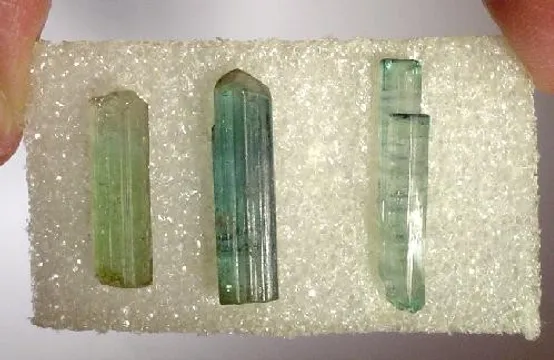
Elbaite is the Stewart mineral that most often carries collector excitement, especially in red, pink, green, teal-blue, and multicolored crystals from clay-bearing pocket zones and lepidolite-rich pegmatite. Classic Stewart elbaite occurs as striated trigonal prisms, stout crystals, sprays, broken pocket singles, and crystals partly embedded in lepidolite, albite, cleavelandite, quartz, montmorillonite, and occasionally beryl or spodumene. The locality is especially associated with reddish-pink elbaite and with rarer blue-capped or complexly zoned crystals; the best pieces show bright color, glassy luster, intact terminations or convincing restoration where pocket breakage is expected, and a matrix that identifies the mine rather than a loose crystal that could be merely “Pala.”
“Tourmaline” on a Stewart label may refer to elbaite, rubellite, indicolite-zoned elbaite, verdelite, schorl, or mixed tourmaline material, and the distinction matters because the mine produced both black schorl in pegmatite zones and colored lithium tourmaline in gem-bearing pockets. In the Stewart pegmatite, tourmaline appears as embedded rubellite prisms in massive lepidolite, small colorful crystals in clay or mica-rich pocket material, darker schorl-rich masses in structural zones, and bicolored crystals associated with quartz, albite, cleavelandite, and lepidolite. Superior Stewart tourmaline is not simply large; it is well-colored, well-zoned, plausibly attributed to a Stewart pocket or old lepidolite body, and preferably accompanied by the purple mica or pale feldspar matrix that gives the locality its distinctive face.
Lepidolite is the mineral that made Stewart a mine before it became a collector locality: the deposit was once the most important domestic source of lepidolite, and its two principal ore bodies yielded gray, bluish-gray, deep-purple, reddish, and pinkish lithium mica in great volume. Specimen-quality lepidolite ranges from dense, massive ornamental material to scaly or crystalline aggregates framing rubellite sprays, albite blades, quartz, and morganite; the northern ore body is especially important to collectors because much of it contained albite and abundant prismatic rubellite, while the southern body was often purer, coarser, and more reddish. The best lepidolite specimens are those that retain strong purple or lilac color, clean contrast with tourmaline or albite, and enough structure to avoid looking like anonymous lithium-mica ore.
Rubellite from Stewart is the classic red-to-pink expression of the mine: opaque to gemmy prisms, sprays, and broken pocket crystals occurring in purple lepidolite, clay-bearing pockets, quartz, cleavelandite, albite, and occasionally with beryl. The old lepidolite ore bodies produced abundant prismatic rubellite in places, and modern Stewart collecting lore centers on bright pink crystals from reopened or rediscovered workings rather than on the darker, ironier tourmalines that earlier high-graders sometimes recovered. Good Stewart rubellite has saturated pink to red color, visible crystal form rather than mere pink streaks in mica, and a matrix that has not been overtrimmed away; the finest pieces balance strong color with the unmistakable lavender-to-purple lepidolite setting.
Quartz at the Stewart is more than a colorless accessory: it is one of the main framework minerals of the pegmatite and a common pocket associate of elbaite, lepidolite, albite, cleavelandite, and morganite. In the Pala pocket environment, quartz may appear as subhedral to euhedral crystals, smoky quartz, matrix crystals partly coated or included by clay minerals, and crystals that served as anchors for tourmaline or beryl; in nearby and related Pala accounts, quartz crystals with montmorillonite-rich coatings or inclusions are a recurring feature of clay-pocket material. Fine Stewart quartz specimens are valued when they are not isolated “quartz from Pala” curiosities but part of a meaningful association—tourmaline on quartz, quartz with purple lepidolite, or quartz acting as matrix for morganite or colored elbaite.
Cleavelandite, the platy albite variety so familiar from lithium pegmatites, is one of the key aesthetic partners for Stewart tourmaline and lepidolite. It occurs as white to pale, bladed or sheaflike feldspar in the albite-rich and pocket-bearing parts of the pegmatite, commonly with elbaite, rubellite, quartz, lepidolite, morganite, and clay alteration minerals. The best Stewart cleavelandite pieces are not judged by cleavelandite alone but by how the blades present and protect the colored minerals: a spray of albite framing rubellite, a snowy bladed base under a zoned elbaite, or a clean feldspar contrast against lilac mica will outrank a dull feldspar mass with only minor color.
Albite is widespread in the Stewart pegmatite as a rock-forming, replacement, and pocket-associated feldspar, and its significance lies in its role in the mine’s mineralized central zones. The lepidolite bodies grade in places into quartz-albite pegmatite with lepidolite stringers, lenses, and stockworks, while pocket pegmatite in the district is dominated by quartz, albite, feldspar, muscovite, lepidolite, and tourmaline. Stewart albite specimens range from massive to cleavelanditic habits, and the collector-grade examples are those with crisp white or pale crystals associated with rubellite, elbaite, lepidolite, quartz, or morganite rather than ordinary feldspar broken from the dike.
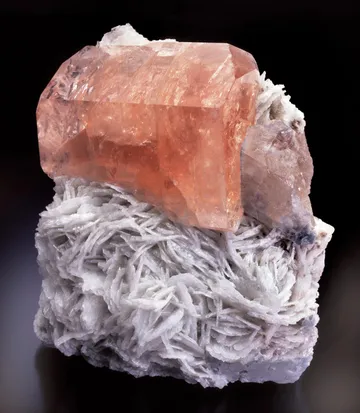
Morganite from Stewart is one of the locality’s desirable accessory gems, occurring as pale pink to salmon-pink beryl crystals and fragments in the same lithium-rich pocket environment that produced elbaite, lepidolite, albite, cleavelandite, and quartz. Modern Stewart material has yielded morganite both as specimen crystals and gem material, and collector examples are often judged by color intensity, crystal form, association with purple lepidolite or tourmaline, and absence of unattractive bruising or heavy clay alteration. The best pieces are recognizable Pala pegmatite associations rather than anonymous pink beryl: morganite with lepidolite, morganite with elbaite, or morganite sitting against pale albite and quartz carries far more locality character.
Spodumene at the Stewart belongs to the lithium-rich core and pocket-pegmatite story rather than to the great spodumene fame of the Pala Chief. In the Pala district, gem spodumene occurs within cores where it escaped hydrothermal alteration, and the Stewart dike includes spodumene-bearing material along with lepidolite, albite, tourmaline, quartz, and primary phosphate minerals. Stewart spodumene specimens are scarcer on the market than lepidolite-tourmaline combinations; the better examples show recognizable crystal form or gemmy remnants, credible Stewart provenance, and association with lepidolite, albite, quartz, elbaite, or kunzite-variety material rather than indistinct pale altered lithium silicate.
Beryl from Stewart is documented in white, pink, and golden varieties, with morganite the most collected named variety from the mine and goshenite and heliodor-type material also reported in the broader Stewart mineral list. It occurs as a pocket and central-zone mineral associated with lepidolite, albite, cleavelandite, quartz, and tourmaline, reflecting the same beryllium-bearing late-stage environment that made the Pala district famous for gem minerals. Collectors should favor Stewart beryl with visible crystal faces, pleasing pink or golden color where present, and a strong pegmatite association; matrix morganite or beryl with lepidolite and elbaite is much more desirable than a loose worn crystal fragment without documentation.
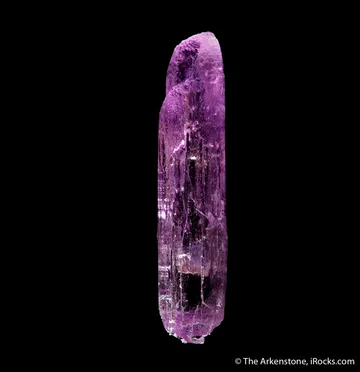
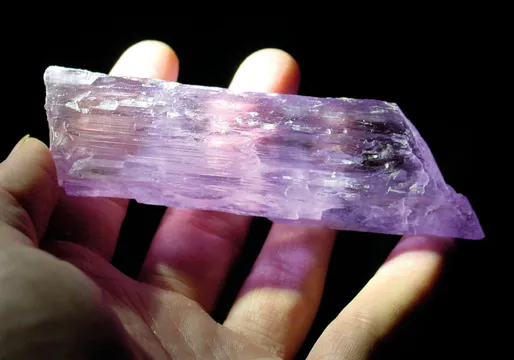
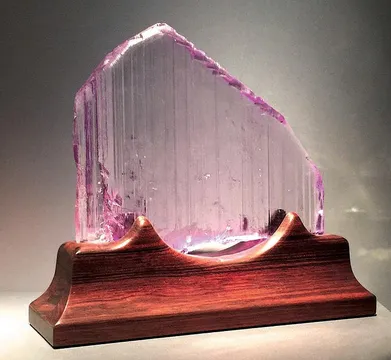
Kunzite from Stewart is a scarce but important part of the mine’s lithium-gem assemblage, reported from the reopened modern gem-mining era and listed from the Stewart locality alongside spodumene. It is best understood as a spodumene variety from lithium-rich pocket or core material, usually more delicate in color than the tourmaline and far less common as a robust matrix specimen. Good Stewart kunzite requires careful provenance and condition: pale pink to lilac color, transparency, and crystal form matter, but so do protection from light exposure, documentation tying the piece to Stewart rather than simply “Pala,” and associations with lepidolite, albite, quartz, or elbaite when matrix specimens occur.
Lithiophilite at Stewart is a mineralogical collector’s prize rather than a showy gem species, because it is central to the mine’s celebrated phosphate alteration suite. It occurs in or near lithium-rich pegmatite cores and is commonly rimmed or replaced by a sequence of secondary manganese- and iron-phosphate minerals, including hureaulite, sicklerite-like material, purpurite, strengite, stewartite, and jahnsite-group phases. The most desirable Stewart lithiophilite specimens preserve readable primary phosphate masses or crystals with colorful alteration rims—tan to flesh-colored lithiophilite, reddish-brown to purple alteration, yellow stewartite, blue strengite, or associated hureaulite—because such pieces record the chemical evolution of the pegmatite more vividly than massive altered phosphate alone.
Beyond the headline gem minerals, the Stewart Mine is one of the more important phosphate localities in the California pegmatites. Stewartite is a type-locality mineral from the mine, named for the Stewart occurrence, and jahnsite-(MnMnMn) is also tied to the Stewart as a type-locality species through later work on the jahnsite-whiteite complex. The locality list further includes bermanite, hureaulite, phosphosiderite, purpurite, strengite, triphylite, triplite, wardite, and discredited or reinterpreted historical phosphate material such as salmonsite and sicklerite-like alteration products. Other documented species include amblygonite, apatite, columbite-(Mn), tantalite-(Mn), microlite-group minerals, stibiotantalite, bismuth minerals, schorl, spessartine, microcline, orthoclase, muscovite, cookeite, kaolinite, montmorillonite, and rare secondary copper-bismuth-phosphate associations. For advanced collectors, Stewart’s rare phosphates are as scientifically compelling as its rubellite is beautiful.
Stewart material is usually bought for locality character: rubellite in purple lepidolite, bicolored elbaite with albite or cleavelandite, morganite with lepidolite, and rare phosphates with clear provenance. The most common authenticity problem is not a sophisticated fake but vague or careless labeling. “Pala,” “Stewart Lithia,” “Tourmaline Queen Mountain,” “Tourmaline Queen,” and “Stewart” are sometimes used loosely in older collections and dealer stock, and the difference matters. A Stewart label should ideally name the Stewart Mine or Stewart Lithia Mine specifically; for important pieces, older Pala International, Bill Larson, Ed Swoboda, Gems of Pala, museum, or well-documented collection history adds real value.
Repairs are not automatically disqualifying for Stewart and Pala tourmalines. Pocket elbaite from these pegmatites was commonly broken by natural pocket rupture, movement, clay alteration, and mining, and important specimens may have been repaired from matching fragments. What matters is disclosure, quality, and whether restoration improves a genuine specimen rather than creating a misleading composite. Inspect terminations, contact zones, color breaks, and matrix attachment points under magnification and with strong side lighting. A small, disclosed repair on a fine bicolored crystal may be acceptable; an undisclosed reconstructed termination, glued-in crystal, or mismatched tourmaline placed on lepidolite is a different matter.
Condition issues are predictable. Lepidolite is soft and can be bruised, crumbly, or abraded, especially on old ore pieces. Cleavelandite blades chip easily. Morganite and kunzite may show cleavage, conchoidal breakage, or edge wear. Tourmaline is harder but commonly broken at terminations or along contacts with matrix. Clay-pocket specimens may retain montmorillonite or kaolinite-rich coatings, which can be part of their history but may also conceal bruising or repairs. Avoid aggressive washing of friable mica-rich material, and be cautious with ultrasonic cleaning around repaired tourmaline, soft lepidolite, clay seams, and bladed feldspar.
Kunzite requires special handling because its color can be light-sensitive; keep Stewart kunzite out of prolonged direct sunlight and intense display lighting. Pink tourmaline is generally stable, but faceted Stewart material should still be evaluated with normal gemological caution: inclusions, fractures, and color zoning are common, and treatment disclosure should be requested for cut stones. For specimen collectors, the more important question is often whether the piece is a natural pocket or ore-body specimen, a trimmed mining fragment, a repaired classic, or a modern gem-bag find.
Market availability varies sharply by class. Massive lepidolite with embedded rubellite remains obtainable, though the better old classic pieces with strong color and attractive sprays are much less common than casual listings suggest. Loose small tourmalines, lepidolite chunks, and screened Stewart material appear periodically. Fine bicolored elbaite, strong rubellite on purple lepidolite, morganite associations, and documented Swoboda/Larson-era specimens are much scarcer and command a premium. Stewartite, jahnsite-(MnMnMn), lithiophilite alteration suites, and other rare phosphates are specialist material; when well-identified and well-labeled, they belong in systematic pegmatite collections as much as in Pala suites.
Ed Swoboda’s Stewart story begins with a price that sounds small only in hindsight. During a period when his jewelry business was solvent enough to allow some risk, he bought the Stewart Lithia Mine for the “firm and frightening price” of five thousand dollars, paid over three years. At the time the Stewart was regarded by many as an exhausted mica mine. High-graders had found tourmaline underground, but much of it was secondary fracture material, dark or iron-rich enough to discourage anyone looking for first-rate gem specimens. Swoboda’s interest sharpened when he heard a story from a high-grader who had recovered a pocket of bright pink crystals from a lower, dangerous, actively caving part of the mine.
The clue that changed the mine was the old west adit. Swoboda had heard, from Pala Reservation families, local night collectors, and old reports, that an exploratory tunnel had once been driven westward in the pegmatite in search of another lepidolite ore body, then cut off by a cave-in during active mining. Terrance Szenics and Roger Bostard were put to work on the bare slope of Pala Mountain with an antique compressor, worn drilling equipment, and a camp that was primitive even by small-mine standards. After 19 feet of discouraging tunnel through tough quartz-feldspar rock, the work seemed futile. Heavy cold rain only deepened the misery. Swoboda pulled the men away briefly to Baja California, then sent them back to the Stewart.
At 26 feet in from the surface, a blast sounded different—muffled rather than ordinary. Before the nitrous gases had cleared, Szenics went in to examine the face and found, below him and stretching in both directions, a tunnel with mine rail: the old west adit. To the east it was blocked by the known cave-in. To the west it ran more than 150 feet from the break-in; around a bend stood an ore car still on track, loaded to the brim with violet lepidolite. Hand tools lay nearby. On top of the loose lithium mica sat creamy montmorillonite masses holding nodules and sections of clear bright pink faceting elbaite. Szenics made a record descent to the public telephone in front of the Pala Store, and Swoboda made his own fast trip from Los Angeles. Within weeks they had extended the workings down-dip from the end of the old adit, cutting short crosscuts into the soft core zone and recovering roughly 200 pounds of pink tourmaline from that area alone.
One Stewart specimen from Swoboda’s work captures the mine’s replacement chemistry in a single object. It consisted of a bright pink elbaite, five-eighths of an inch by 2 3/4 inches, attached to a terminated quartz crystal about 2 1/4 by 4 inches. The upper half of the elbaite was transparent and bright-faced. The lower half had been altered outward to lepidolite, leaving a slender quarter-inch core of elbaite surrounded by mica replacement. That is the Stewart in miniature: not just a pretty pink tourmaline locality, but a place where lithium-rich fluids, quartz growth, tourmaline, and mica replacement are visibly entangled.
The most famous Stewart “last blast” came just as Pala Properties was preparing to move its main effort uphill to the Tourmaline Queen. By then the Stewart had been worked with mild success since 1968, but economics were forcing a move. Swoboda had arranged for a bulldozer to repair the road, build a working pad, and move the compressor. The bulldozer was delayed for a week. With nothing better to do, foreman John McLean put one final blast into the Stewart between two adits where a rich lepidolite zone was exposed. When the fumes cleared, a tourmaline crystal measuring 10 by 4 inches lay in the rubble. McLean thanked the mine spirits. José Montes first thought it was quartz; when he saw the red, he jumped and celebrated. After three and a half years, the Stewart had produced what Bill Larson later called its “crowning glory”—the largest and finest tourmaline then known from the mine.
Rolf Luetcke’s collecting story is a different kind of Stewart tale: no grand pocket, no museum crystal, just the practical hunger of a working collector in the 1970s who needed inexpensive material for mineral sets. He had gone to Southern California looking for massive lepidolite, guided by a pre-internet copy of Minerals of California. At the local shop, he was shown flats of fine pink elbaite crystals—exactly the wrong thing for someone selling mineral sets for three dollars each. He asked for access to the mine dumps and was refused. Walking away, he saw a roughly hundred-pound boulder on the ground and pointed out that it was the kind of low-grade material he needed. It too was for sale by the pound, at a price useless for his purpose.
Disappointed, Luetcke stopped at a small store and gas station on the Pala Indian Reservation. The man behind the counter noticed his expression. Luetcke pointed toward the Stewart dumps visible on the hill and explained that he had been denied permission to collect. The man smiled and told him, “I think I am going to make your day!” According to the story, the mine was owned by people in Pala, but the surrounding land and dumps lay on reservation land. For three dollars, the storekeeper sold him a permit to drive to the dumps and collect what he wanted. He even drew a map and told Luetcke to pick oranges from the Sunkist-leased grove where branches hung over the road.
The oranges became part of the memory. Luetcke filled a couple of bags from branches overhanging the dirt road and later wrote that they were the best oranges he had ever eaten. The road led to the Stewart dumps on a steep hillside below the mine. He parked about 50 yards away, partly protected by a single manzanita bush, and climbed to the dump. He wanted lepidolite boulders, and he found one. But as he worked it loose, the boulder took off down the steep slope, dodging every obstacle and heading straight for his vehicle. The manzanita stopped it. A wrist-thick branch caught the rock before it could hit the truck. Luetcke later reflected that a hundred different paths were possible, but the boulder had run “straight and true” toward the car; only the toughness of the manzanita saved him.
The near-disaster gave him exactly what he had come for. The boulder had landed near the vehicle, easy to load, and it supplied lepidolite for his mineral collections for years. He found no large elbaite crystal—the miners had been too thorough—but he did recover smaller pieces with tiny tourmalines in several colors, ideal under the microscope. The story became one of his most memorable collecting trips not because of a great specimen, but because it captures another side of Stewart collecting: access negotiated in a local store, a three-dollar permit, oranges from a roadside grove, a runaway lithium-mica boulder, and a miner’s dump whose “dregs” were exactly what a working mineral dealer needed.