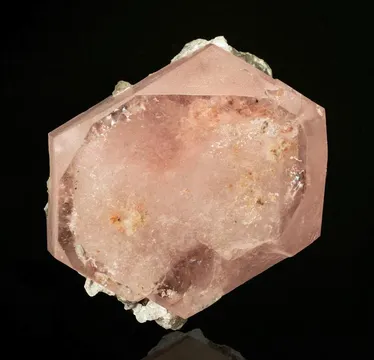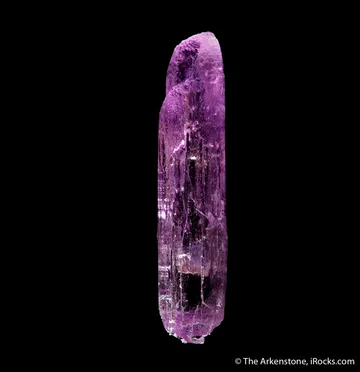
White Queen Mine, USA - premier Pala pegmatite locality famed for albite, cleavelandite, tourmaline, and peach-pink morganite; historic, collectible specimens.
Key facts
The White Queen Mine is one of the signature gem-pegmatite localities of southern California: a small but consequential working on the upper west slope of Hiriart Mountain, east of Pala in San Diego County. Its reputation rests on an unusually collector-friendly combination of history, mineralogy, and specimen style. Geologically it is a rare-element, lithium-bearing granitic pegmatite emplaced in the dark gabbroic country rock of the Peninsular Ranges batholith. For collectors, that translates into the classic Pala vocabulary: albite and cleavelandite, quartz, lepidolite, K-feldspar, pocket clays, tourmaline, phosphates, and above all peach to salmon-pink beryl variety morganite.
White Queen is not merely another Pala name on a label. It is a mine whose story touches the early recognition of kunzite, the mid-century rebirth of San Diego County gem mining, and the production of some of North America’s most admired morganite specimens. The best White Queen pieces have a look that is hard to mistake once learned: squat to tabular hexagonal morganite crystals, commonly pale pink to peach but occasionally richly saturated, set on snowy bladed cleavelandite and quartz; or large quartz crystals with milky, tan, rose, and salmon-colored montmorillonite locked inside or coating surfaces, sometimes cut and polished to reveal plume-like interiors. Good examples have old California gravity—bright enough to compete aesthetically with later finds from Brazil and Afghanistan, yet unmistakably tied to the dry hills above Pala.
Regional View
Country View
The mine’s famous period of specimen production was largely the Dawson era. Norman E. Dawson acquired the claim in the late 1940s, but the high, difficult position on Hiriart Mountain limited early work until a road was pushed up the mountain around 1959. That road changed the locality from a historic claim into a serious specimen producer. Subsequent underground work met pocket zones yielding morganite, quartz, montmorillonite, cleavelandite, amblygonite, lithium phosphates, and uncommon tourmalines including material of interest in the elbaite–foitite series.

Photo: Rob Lavinsky, iRocks.com, via Wikimedia Commons

Search for specimens: View all specimens from White Queen Mine, USA
The White Queen Mine lies on Hiriart Mountain in the Pala Mining District of northwestern San Diego County, California. The working is part of the Pala lithium-pegmatite field, where tabular rare-element pegmatite dikes cut gabbroic rocks of the Peninsular Ranges batholith. The district’s productive gem dikes are typically zoned: graphic granite toward the hanging-wall side, aplite and line rock toward the footwall, and a central pay streak where lithium minerals, albite, quartz, feldspar, pocket clays, and gem crystals concentrate. White Queen fits this pattern as an asymmetrically zoned, fractionated pegmatite dike several meters thick and hundreds of meters long, with pockets developed near the central bladed-albite and lepidolite-rich zones.
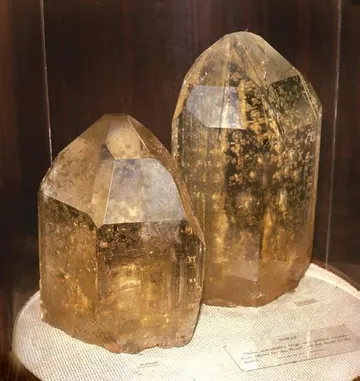
The important specimen bodies at White Queen were pockets rather than continuous ore shoots. These cavities and clay-filled seams yielded quartz crystals, bladed albite/cleavelandite, K-feldspar, mica, beryl, tourmaline, phosphates, and abundant pocket clays. In the most collectible material, the mine’s mineralization has an unmistakably late-stage, hydrothermal character: etched beryl, clay-lined quartz, cookeite or montmorillonite on feldspar, and quartz crystals with suspended pink and tan clay inclusions. The montmorillonite-bearing quartz is so characteristic that older California collectors often recognize it at a glance, especially when the crystals have been partially polished to reveal the included rose-colored clay clouds.
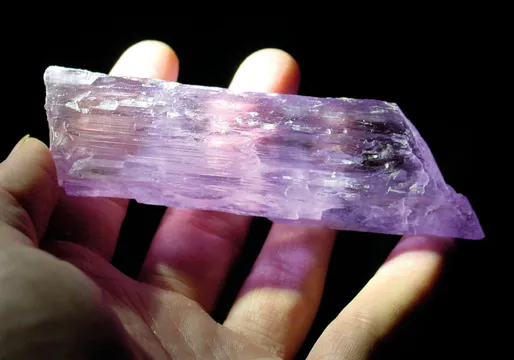
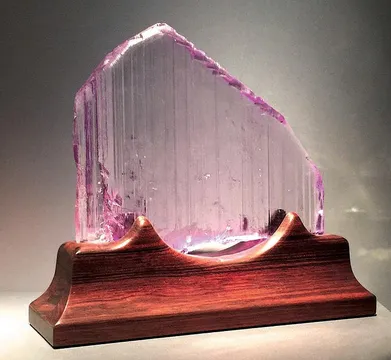
Frederick M. Sickler located the White Queen claim in 1901 after earlier prospecting on the unnamed mountain east of Pala. Early work exposed lepidolite and gem pockets, and George F. Kunz described salmon-pink lithium beryls from the mine in the first decade of the twentieth century. The mine is also interwoven with the complicated origin story of kunzite: early lilac spodumene from the Hiriart Mountain claims, including material attributed to White Queen and nearby related workings, reached Kunz at Tiffany & Co. in 1902–1903 and became part of the debate over the first discovery and naming of the gem variety.
Commercially and specimen-wise, the mine’s great second life began with Norman E. Dawson. George Ashley purchased Hiriart Mountain claims from Sickler in 1947 and sold White Queen to Dawson in 1948. Dawson’s early work was modest because of the mine’s mountaintop position, but around 1959 a roughly 1.25-mile access road was built from lower claims up to the White Queen. Road building encountered lepidolite and led to open-cut work that produced quartz pockets and some morganite. Later, with the help of Kenneth and Robert Dawson and Roger Helsel, Dawson began a higher working roughly 150 feet above the open cut; that work produced a pocket with more than 100 pounds of dark blue tourmaline.
By 1963, a small exploratory drift had been advanced about 25 feet along the pegmatite using pneumatic tools and hand mucking. The mineral mix became increasingly encouraging: lepidolite, albite, orthoclase, amblygonite, and quartz. Then came the material that built the mine’s distinctive specimen identity—large quantities of tan and pink montmorillonite-coated or included quartz, often called lithia quartz in old descriptions. As the pocket zone was pursued deeper, the clay began yielding morganite crystals, and White Queen shifted from promising pegmatite to major American morganite locality.
A lower adit driven in 1966 intersected the pocket zone at depth and produced large cathedral-style quartz crystals, some reported up to about 600 pounds, together with exceptional peach-pink beryl. Among the best-known products of that period were morganites on cookeite-encrusted cleavelandite and gem rough suitable for important cut stones. A near-flawless 178-carat faceted morganite cut by Spencer Barnhart went to the Smithsonian Institution, along with a large matrix morganite specimen about 8 x 11 x 5 inches, with the largest beryl crystal reported at roughly 4 inches across by 6 inches long.
The mine continued to yield material intermittently. A 1973 pocket reportedly produced about 6000 kg of quartz crystals and about 30 kg of morganite. Between 1974 and 1989, smaller morganite crystals on cleavelandite matrix were recovered from old workings. In 1990, Robert and Kenneth Dawson and partners drove a new lower adit to intersect the known pocket system at depth. Soon after reaching the pegmatite in September, they encountered a large pocket that produced around 200 peach to salmon-colored morganite specimens, many in the 2–3 inch diameter range and about 1.5 inches thick; these are often regarded as the finest morganites produced by the mine.
Collecting access today should be treated as closed. In the early 1990s the claim was investigated in relation to Pala tribal land matters, and in 1992 the White Queen claim was declared invalid from the beginning. The land is now managed for the benefit of the Pala Band of Mission Indians by the Bureau of Indian Affairs. Modern White Queen specimens therefore come from old mine production, Dawson-family material, historic California collections, dealer recycling, and museum or private collection deaccessions—not from casual field collecting.
White Queen morganite is the locality’s defining collector mineral: typically squat to tabular hexagonal beryl crystals in pale rose, peach, salmon, and occasionally richer grapefruit-pink tones, with glassy prism faces, frosted or satiny terminations, and frequent etching from late-stage pocket fluids. The best pieces are matrix specimens on bladed cleavelandite, albite, quartz, lepidolite, or cookeite-coated feldspar rather than loose crystals, and they show enough internal transparency to glow under gentle backlighting without losing the distinctly Californian pastel character. Sizes range from thumbnails and miniatures to small-cabinet crystals, with documented White Queen crystals and specimens reaching several inches across; the 1990 pocket produced roughly 200 peach to salmon crystals commonly around 2–3 inches in diameter, while earlier Dawson pockets furnished both cabinet specimens and large gem rough, including the celebrated 178-carat faceted stone acquired by the Smithsonian.
At White Queen, “beryl” is inseparable from the mine’s salmon-pink lithium pegmatite pockets, but the broader species occurs as gem and semi-gem hexagonal crystals in the central pocket zone, associated with albite, cleavelandite, quartz, K-feldspar, mica, lepidolite, montmorillonite, and local tourmaline. Early reports emphasized salmon-pink beryls, and later Dawson work showed that the mine could produce exceptional peach-colored crystals of high gem quality, as well as paler crystals whose appeal lies in sharp form, clean terminations, and classic matrix. Ordinary White Queen beryl is often pale, contacted, or partly etched; superior examples combine recognizable hexagonal morphology, real translucency, pleasing pink to peach color, intact edges, and an undisturbed pocket matrix that places the crystal unmistakably in the Pala tradition.
Quartz from White Queen is famous less for ordinary rock-crystal brilliance than for its strange partnership with montmorillonite: large clear, smoky, milky, etched, and cathedral-style crystals penetrated or coated by tan to pink clay, some so included that cutting and polishing reveal internal curtains, sprays, floors, and walls of rose-colored material. The mine produced quartz in very large quantity, including the 1973 pocket with about 6000 kg of crystals and earlier Dawson pocket material that entered major California collections; reported large “cathedral” pieces reached hundreds of pounds. For collectors, the finest White Queen quartz specimens have sharp sculptural form, visible terminations or double terminations, attractive smoky-to-clear contrast, and well-distributed pink montmorillonite inclusions visible through natural windows or disclosed polished faces.
White Queen montmorillonite is a pocket clay, not a display species in the usual freestanding-crystal sense, and its collector value comes from the way it colors and textures the mine’s quartz and feldspar assemblages. In the Dawson workings it occurred as tan, pale pink, and stronger rose clay coatings and inclusions in quartz, with additional pocket clays including cookeite and iron-stained kaolinite reported from the same systems. Fine examples show montmorillonite sealed within quartz as plume-like, wall-like, or feathery inclusions rather than merely smeared on broken surfaces; ordinary examples can be chalky, opaque, friable, or unattractive unless the quartz is transparent enough to reveal the internal clay architecture.
Cleavelandite at White Queen is the bladed albite variety that forms the white, sparkling, platey matrix for many of the mine’s most desirable morganites. It appears as thin lamellae, rosettes, fans, and drusy bladed aggregates in pocket assemblages with quartz, beryl, lepidolite, cookeite, montmorillonite, and K-feldspar. Its role is often architectural: a fine morganite crystal perched on snowy cleavelandite has far more visual and locality value than the same beryl broken free of matrix. Top pieces preserve bright, separate albite blades and clean contrast with peach-pink beryl; lesser pieces show crushed, clay-soaked, chalky, or overtrimmed feldspar where the morganite has lost its original pocket context.
Albite is a major White Queen pegmatite mineral, occurring both as ordinary feldspar in the pegmatite fabric and as the collector-familiar bladed cleavelandite of the pocket zones. In the White Queen system, albite is part of the central pocket assemblage with quartz, K-feldspar, muscovite, beryl, tourmaline, and lithium minerals, and it commonly records the late-stage open-space growth that allowed morganite and quartz specimens to form. Good albite specimens from the locality are judged less as single-species feldspar pieces than as matrix: clean white blades, rosettes, or sparkling aggregates that carry beryl, quartz, or rare tourmaline make the strongest specimens, whereas massive feldspar without pocket texture is mainly of locality interest.
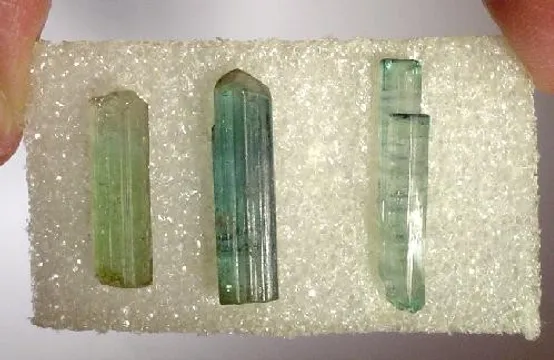
Other documented White Queen minerals broaden the locality beyond its morganite-and-quartz fame. The pegmatite has produced lepidolite, muscovite, microcline, orthoclase, spodumene variety kunzite, schorl, elbaite, foitite, spessartine, almandine, amblygonite, montebrasite-series material, lithiophilite, apatite/fluorapatite, columbite-(Mn), and additional uncommon secondary or accessory species including beyerite, clinobisvanite, namibite, and todorokite. Foitite is especially important historically and mineralogically: the tourmaline species was originally described from “southern California” material, and later nomenclature sources and pegmatite studies identify the White Queen Mine as the probable source of that type material. White Queen tourmaline is not the spectacular candy-colored elbaite of the Tourmaline Queen or Himalaya mines, but zoned elbaite–foitite crystals, dark blue to bluish-black material, and rare matrix associations make it highly significant to specialists.
The first authenticity issue with White Queen material is locality discipline. San Diego County produced morganite, kunzite, tourmaline, cleavelandite, and quartz from a cluster of famous mines—White Queen, Pala Chief, Tourmaline Queen, Stewart, Katerina, Elizabeth R., Oceanview, and others—and old labels are sometimes shortened simply to “Pala.” A true White Queen morganite should ideally have a specific White Queen label, Dawson provenance, old Pala International or California collection history, or a credible dealer chain. Without that, pale pink beryl on albite from the broader Pala district can be difficult to assign confidently.
White Queen morganite also has a visual authentication problem because the best crystals can resemble younger production from Brazil, Afghanistan, or Pakistan, especially when richly colored and etched. Conversely, ordinary White Queen pieces can be so pale that photographs exaggerate their color. Serious buyers should look for natural crystal form, matrix style, old labels, and unforced lighting; backlit photographs are useful for showing transparency but should not be mistaken for normal display color. A specimen that appears neon pink in every image deserves caution unless the provenance is exceptionally strong.
No large, well-documented industry of White Queen fakes is known, but there are predictable hazards. Detached morganite crystals may be reattached to albite or quartz matrix; polished or sawn quartz with montmorillonite inclusions may be sold without adequate disclosure; and pale beryl from another Pala mine may be promoted as White Queen because the name is more marketable. Repairs are not automatically disqualifying—pocket specimens from pegmatites are often repaired—but repairs, polishing, trimming, and restoration should be disclosed clearly.
Condition issues are typical for pocket pegmatites. Morganite edges chip easily despite beryl’s hardness, especially along etched rims and thin tabular corners. Terminations may be frosted naturally, contacted against clay or feldspar, or bruised during extraction, so examine with magnification before assuming every dull area is damage. Cleavelandite matrices are fragile and can shed blades if handled by the feldspar. Montmorillonite and associated clays are soft; exposed clay should not be washed aggressively, oiled, or cleaned ultrasonically. Quartz pieces with polished windows are durable, but their value depends on honest disclosure of the polishing and on whether the internal pink clay pattern is attractive.
Color handling deserves special mention. Published gemological observations of White Queen morganite show that a brownish component in some cut stones can disappear after about a week of sunlight, changing the apparent shade of pink. For display specimens, that means strong light can matter: do not assume the color you see under one lamp is permanent or representative, and avoid baking fine pieces in direct sun simply to intensify or “improve” their look. Morganite from this mine is generally inert to ultraviolet in reported gemological observations, so fluorescence is not a useful buying feature.
Market availability is sporadic but real. White Queen specimens appear in old collections, California suites, auction offerings, and dealer inventories, but high-end matrix morganites are scarce and increasingly provenance-driven. Included quartz is more available than top morganite, though large, aesthetic, well-polished or naturally windowed pieces with strong pink montmorillonite still command attention. The most desirable purchases combine beauty, mine-specific character, and documented history: Dawson-era labels, Alice or Herb and Mary Walters quartz provenance, Bill Larson/Pala International history, or publication in recognized mineral references can materially affect value.
The White Queen story begins with a miner’s uncertainty. Fred Sickler and his brother Allan had hunted mineral specimens on the mountain east of Pala before the great gem rush, finding quartz crystals, lepidolite, pink and blue tourmaline, and a small lilac mineral about three inches long. It was pretty enough to remember but puzzling enough to remain unnamed. When word spread that two sheep herders had located a claim on the mountain, Fred returned to the spot, and on June 8, 1901, staked what became the White Queen. The surrounding names—Hiriart, Peiletch, Sickler, Salmons—would soon become entangled in one of the most durable priority arguments in American gem history.
The unidentified lilac crystals were the problem. Fred showed them around San Diego and Los Angeles; no one could tell him what they were. In December 1902, specimens reached George F. Kunz at Tiffany & Co. in New York, where they were recognized as spodumene. The new lilac gem variety would soon be named kunzite in Kunz’s honor, but the question of who first discovered it became a thorny matter. Sickler later protested that Frank Salmons of the Pala Chief mine was being called the discoverer and insisted that his own paper trail proved otherwise. In one memorable complaint, Sickler wrote that he had brought the stone before local lapidists and experts “a year before the Pala Chief yielded any Kunzite,” and that Salmons and his associate were advertising that they had “the only Kunzite deposit in the world.” For a small mountain claim above Pala, the White Queen had stepped directly into the world of Tiffany, scientific naming, and mining-boom rivalry.
The Dawson chapter has a different rhythm: road work, compressors, hand mucking, and stubbornness. Norman Dawson bought the claim in 1948, but the mine sat high enough on the mountain that serious work required a road. Around 1959, a road was built from the Fargo area at the base, across the El Molino, and up to White Queen—about 1.25 miles of mountain access that took nearly a year to complete. That practical improvement opened the mine’s modern collecting life. Road work exposed lepidolite, an open pit followed, quartz pockets appeared, and then morganite began to emerge from the same pegmatite system that earlier workers had only tested.
The 1960s workings read like classic small-scale California gem mining. Dawson, assisted by Kenneth and Robert Dawson and son-in-law Roger Helsel, began a new location about 150 feet above the open cut. Soon after breaking surface they found a pocket containing more than 100 pounds of dark blue tourmaline. By 1963, the mine had a small drift driven about 25 feet along the pegmatite. The work was not glamorous: a pneumatic hammer, hand pails, and the slow accumulation of clues—more lepidolite, more albite, orthoclase, amblygonite, quartz. Then the pocket changed character and began yielding ton after ton of large tan and pink montmorillonite-coated quartz crystals. As the work moved deeper, the clay began to give up morganite.
The 1966 lower adit produced the sort of finds that make a mine’s reputation permanent. Large cathedral-style quartz crystals came out, some reported up to 600 pounds, and with them were exceptional peach-colored beryl crystals. The finest morganite matrix pieces, on cookeite-encrusted cleavelandite, were described in terms normally reserved for national classics. One cut stone from this production—a near-flawless 178-carat orangey-pink morganite faceted by Spencer Barnhart—went to the Smithsonian Institution. Alongside it went a matrix specimen about 8 x 11 x 5 inches, with the largest beryl measuring roughly 4 inches across by 6 inches long. For a mine worked with modest equipment by a family-scale operation, the result was extraordinary.
The last great pocket came after many people would have assumed the mine’s best days were gone. In 1990, Robert and Kenneth Dawson and partners drove a new adit below the old openings, hoping to hit the same pocket system at depth. In September, not long after reaching the pegmatite, they found a large pocket and recovered around 200 morganite specimens. The crystals were peach to salmon colored, commonly 2–3 inches in diameter and about 1.5 inches thick. Many collectors regard that pocket as the finest the White Queen ever produced—late proof of the old Pala miner’s rule that exhausted ground is often only ground that has not yet been understood.